Supply · 供给
| English | 中文 | Pinyin · 拼音 |
|---|---|---|
| supply/səˈplaɪ/ | 供给 | gōng jǐ |
| law of supply/lɔː ɒv səˈplaɪ/ | 供给定律 | gōng jǐ dìng lǜ |
| quantity supplied/ˈkwɒntɪti səˈplaɪd/ | 供给量 | gōng jǐ liàng |
| technology/tekˈnɒlədʒi/ | 技术 | jì shù |
| subsidy/ˈsʌbsɪdi/ | 补贴 | bǔ tiē |
| costs of production/kɒsts ɒv prəˈdʌkʃn/ | 生产成本 | shēng chǎn chéng běn |
Why high prices bring more sellers
- When the price of a crop soars, farmers plant more of it next season. High prices pull supply 供给 out of producers.
- That's the law of supply 供给定律 — the mirror image of demand, and the other half of every market.
为什么高价带来更多卖家
- 当一种作物的价格飙升时,农民下个季节种更多它。高价把供给从生产者那里拉出来。
- 那是供给定律(law of supply)——需求的镜像,和每个市场的另一半。
The supply curve slopes upward because, as price rises, firms: · 供给曲线向上倾斜,因为当价格上升时,企业:
Higher prices reward production, so quantity supplied rises — an upward curve. · 更高的价格奖励生产,所以供给量上升——一条向上的曲线。
The law of supply
- Supply is the quantity producers are willing and able to sell at each price.
- The law of supply: as price rises, quantity supplied 供给量 rises — so the supply curve slopes upward (higher prices reward more production).
Higher price → more supplied (move along S₁); lower costs or better technology 技术 shift supply right to S₂.
供给定律
- 供给(supply)是生产者在每个价格愿意且能够卖出的数量。
- 供给定律:当价格上升,供给量上升——所以供给曲线向上倾斜(更高的价格奖励更多的生产)。
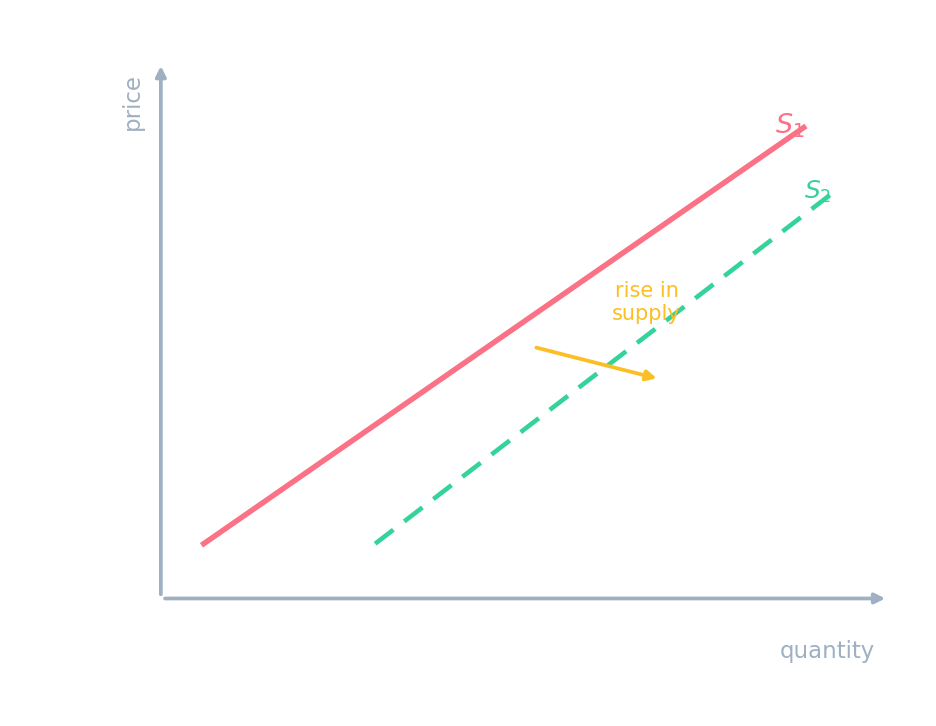
更高的价格 → 更多被供给(沿 S₁ 移动);更低的成本或更好的技术把供给右移到 S₂。
Demand & supply · 需求与供给
Supply · 供给 slopes up — a higher price, more is produced. · 供给向上倾斜——价格更高,生产的更多。
Movement vs shift
- A change in the good's own price → movement along the supply curve.
- A change in costs, technology, taxes/subsidies → a shift of the whole curve.
The supply curve slopes up; costs, technology, tax and subsidy 补贴 shift it
移动对移位
- 商品自己价格的变化 → 沿供给曲线的移动。
- 成本、技术、税/补贴的变化 → 整条曲线的一个移位。

供给曲线向上倾斜;成本、技术、税和补贴移位它
Which causes the supply curve to shift right (an increase in supply)? · 哪个使供给曲线右移(供给的增加)?
Lower costs raise supply at every price (shift right); own-price is a movement along; tax shifts left. · 更低的成本在每个价格提高供给(右移);自己价格是沿曲线移动;税左移。
A government subsidy shifts the supply curve to the right. · 一个政府补贴把供给曲线右移。
A subsidy lowers effective costs, so firms supply more at each price. · 一个补贴降低有效成本,所以企业在每个价格供给更多。
Match each change to its effect on supply. · 把每个变化与它对供给的影响配对。
Lower costs and better tech raise supply; a tax raises costs and lowers it. · 更低的成本和更好的技术提高供给;一项税提高成本并降低它。
A per-unit ______ raises firms' costs and shifts the supply curve left. · 一项单位______提高企业的成本并把供给曲线左移。
A tax adds to cost, reducing supply at every price. · 一项税增加成本,在每个价格减少供给。
What shifts supply
- Costs of production 生产成本 (cheaper inputs → supply rises),
- Technology (better tech → supply rises),
- Taxes (raise costs → supply falls) and subsidies (lower costs → supply rises),
- Number of firms and weather (for farm goods).
A subsidy shifts supply right. A per-unit subsidy lowers each firm's effective cost, so they supply more at every price — the whole curve moves right.
什么移位供给
- 生产成本(更便宜的投入 → 供给上升),
- 技术(更好的技术 → 供给上升),
- 税(提高成本 → 供给下降)和补贴(降低成本 → 供给上升),
- 企业数量和天气(对农产品)。
一个补贴把供给右移。 一个单位补贴降低每个企业的有效成本,所以它们在每个价格供给更多——整条曲线右移。
You've got it
- law of supply: price up → quantity supplied up (upward curve)
- own-price change = movement along; costs/technology/tax = shift
- supply shifts with costs, technology, taxes, subsidies, number of firms
你掌握了
- 供给定律:价格上升 → 供给量上升(向上的曲线)
- 自己价格的变化 = 沿曲线移动;成本/技术/税 = 移位
- 供给随成本、技术、税、补贴、企业数量移位