| English | 释义 | 拼音 |
|---|---|---|
| wants/wɒnts/ | 欲望 | yù wàng |
| scarcity/ˈskeəsɪti/ | 稀缺性 | xī quē xìng |
| resources/rɪˈzɔːsɪz/ | 资源 | zī yuán |
| finite/ˈfaɪnaɪt/ | 有限的 | yǒu xiàn de |
| opportunity cost/ɒpəˈtjuːnɪti kɒst/ | 机会成本 | jī huì chéng běn |
| next best alternative/nekst best ɔːlˈtɜːnətɪv/ | 次优选择 | cì yōu xuǎn zé |
| consumers/kənˈsuːməz/ | 消费者 | xiāo fèi zhě |
| production possibility curve/prəˈdʌkʃn ˌpɒsəˈbɪlɪti kɜːv/ | 生产可能性曲线 | shēng chǎn kě néng xìng qū xiàn |
One Saturday, two choices
- A student is offered a paid shift worth £18 on Saturday, at the same time as a football match with friends. She can only do one. Whatever she picks, she gives something up.
- Countries face the same problem on a huge scale. There will never be enough land, workers, machines or time to satisfy every want 欲望. This is scarcity 稀缺性, the starting point of all economics: it forces every person, firm and government to choose.
What is scarcity?
难度 1/5 · 今日首次完成可获 100 金币及少量额外奖励
Scarcity affects every society, rich or poor.
The basic economic problem
- Resources 资源 (land, labour, capital and enterprise) are finite 有限的, but human wants are unlimited. So every society must decide:
- What to produce (more hospitals or more roads?), how to produce it (with many workers or with machines?), and for whom (who receives the output: those who can pay, or those who need it?).
Match each decision to the basic economic question it answers.
难度 2/5 · 今日首次完成可获 140 金币及少量额外奖励
What, how and for whom.
Opportunity cost
- Because resources are scarce, using them for one thing means giving up another. Opportunity cost 机会成本 is the value of the next best alternative 次优选择 given up when a choice is made.
- It applies to consumers 消费者 (a new phone or a holiday), firms (a new machine or a bigger shop) and governments (a new hospital or a new school). The student who chooses the match has an opportunity cost of the £18 shift.
Worked example. A government can spend ¥10 billion on either a high-speed rail line or 50 new hospitals; its next-best use would be the hospitals. If it builds the railway, the opportunity cost is the 50 hospitals, not the money: the ¥10 billion is only the way the resources are measured.
A student can work a Saturday shift for £18 or go to a football match, and chooses the match. What is the opportunity cost of the match, in pounds?
难度 2/5 · 今日首次完成可获 140 金币及少量额外奖励
The next best alternative given up is the £18 shift.
A student's options are a film, a nap and a walk, ranked in that order. She chooses to study instead. What is her opportunity cost?
难度 1/5 · 今日首次完成可获 100 金币及少量额外奖励
Only the next best alternative counts.
Showing choice on a PPC
- A production possibility curve 生产可能性曲线 (PPC) shows the maximum combinations of two goods an economy can produce with all its resources fully and efficiently used.
- A point on the curve is efficient; a point inside means unemployed or wasted resources; a point beyond cannot be reached with current resources. Moving along the curve to make more of one good means giving up some of the other: that is the opportunity cost.
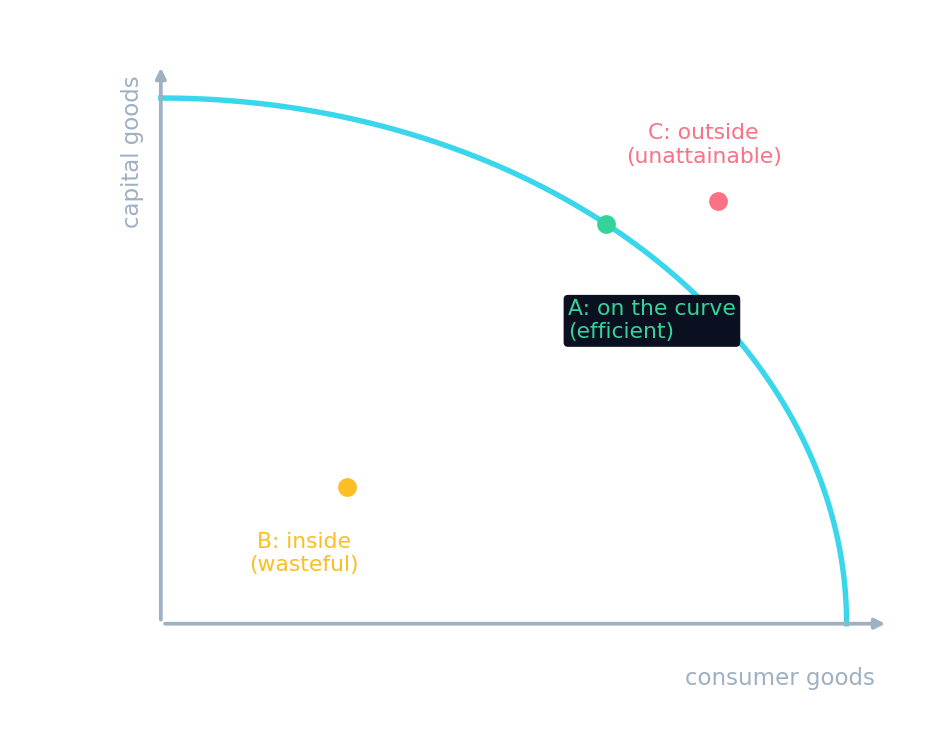
生产可能性边界
Producing more of one good means giving up some of the other — that trade-off is the opportunity cost, shown by the slope of the frontier.
Match each point to its meaning on a PPC.
难度 2/5 · 今日首次完成可获 140 金币及少量额外奖励
The curve shows the maximum possible output.
Worked exam answer
Explain the meaning of opportunity cost, using an example of a government decision. [4]
Opportunity cost is the value of the next best alternative given up when a choice is made. Because resources are scarce, a government that uses its budget and workers to build a new airport cannot use the same resources for its next-best option, for example a new university. The university that is not built is the opportunity cost of the airport.
- Why it scores: an accurate definition (AO1), a link to scarcity, and an example that names the single alternative given up (AO2).
Opportunity cost is the next best option, not all the options you did not choose. If a student skips a film to study, and the other choices were a film, a nap and a walk, the opportunity cost is only the most-valued one.
Scarcity means finite resources and unlimited wants, so every society must decide what, how and for whom to produce. Opportunity cost is the value of the next best alternative given up. A PPC shows the maximum output combinations: on the curve is efficient, inside is wasteful, beyond is unattainable, and moving along it has an opportunity cost.
Exam practice. A city council has land that it could use for a new park or a new car park. It builds the park. (a) Identify the opportunity cost. [1] (b) Explain why choices like this must be made. [3]
Scarcity forces choice; choice has an opportunity cost.