| English | 释义 | 拼音 |
|---|---|---|
| ammonia/æˈməʊnɪə/ | 氨 | ān |
| lone pair/ləʊn peə/ | 孤对电子 | gū duì diàn zi |
| ammonium ion/æˈməʊnɪəm ˈaɪɒn/ | 铵离子 | ǎn lí zi |
| triple bond/ˈtrɪpl bɒnd/ | 三键 | sān jiàn |
| non-polar/nɒn ˈpəʊlə/ | 非极性 | fēi jí xìng |
| coordinate bond/kəʊˈɔːdɪnət bɒnd/ | 配位键 | pèi wèi jiàn |
From the air to fertiliser
- Every breath you take is 78% nitrogen, yet it passes through your body unchanged. Making it react took a Nobel Prize: the Haber process turns it into ammonia 氨 for fertiliser.
- This lesson: why N₂ is so unreactive, and why ammonia is a base.
Why nitrogen is unreactive
- The N≡N triple bond 三键 has a bond energy of 945 kJ/mol, about four times the Cl–Cl bond (242). Reactions must break it first, so $E_A$ is very high.
- The molecule is non-polar 非极性: both atoms are the same, so there is no partial charge to attract other reactants.
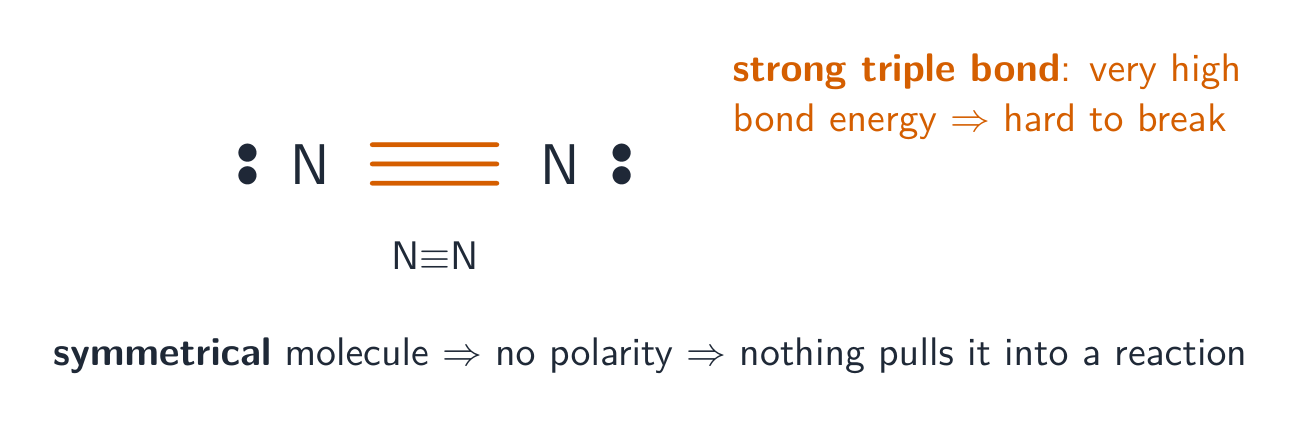
Nitrogen is unreactive: a strong triple bond and no polarity
Nitrogen gas is unreactive because it has:
难度 1/5 · 今日首次完成可获 100 金币及少量额外奖励
The N≡N triple bond is very strong, and the symmetrical molecule is non-polar — both make it unreactive.
Nitrogen is unreactive partly because the N₂ molecule is non-polar.
难度 1/5 · 今日首次完成可获 100 金币及少量额外奖励
Nothing attracts electrophiles or nucleophiles to it, and the triple bond is very strong.
When nitrogen does react
| Where | Conditions | Product |
|---|---|---|
| lightning | very high temperature | NO, then NO₂ |
| car engines | about 1000 °C in the cylinder | NO (1202) |
| Haber process | iron catalyst, 450 °C, 200 atm | NH₃ |
- Each needs a lot of energy or a catalyst to break the triple bond.
Why does nitrogen react with oxygen in a lightning bolt but not in the air around us?
难度 1/5 · 今日首次完成可获 100 金币及少量额外奖励
The activation energy is very high because the triple bond must break. Only very high temperatures supply it.
Ammonia and the ammonium ion 铵离子
- Ammonia is a base: the lone pair 孤对电子 on nitrogen accepts a proton, $\text{NH}_3+\text{H}^+\rightarrow\text{NH}_4^+$. The new bond is a coordinate bond 配位键 (both electrons from N).
- NH₃ is pyramidal (107°, three bond pairs and one lone pair). NH₄⁺ is tetrahedral (109.5°): all four N–H bonds are identical once formed.
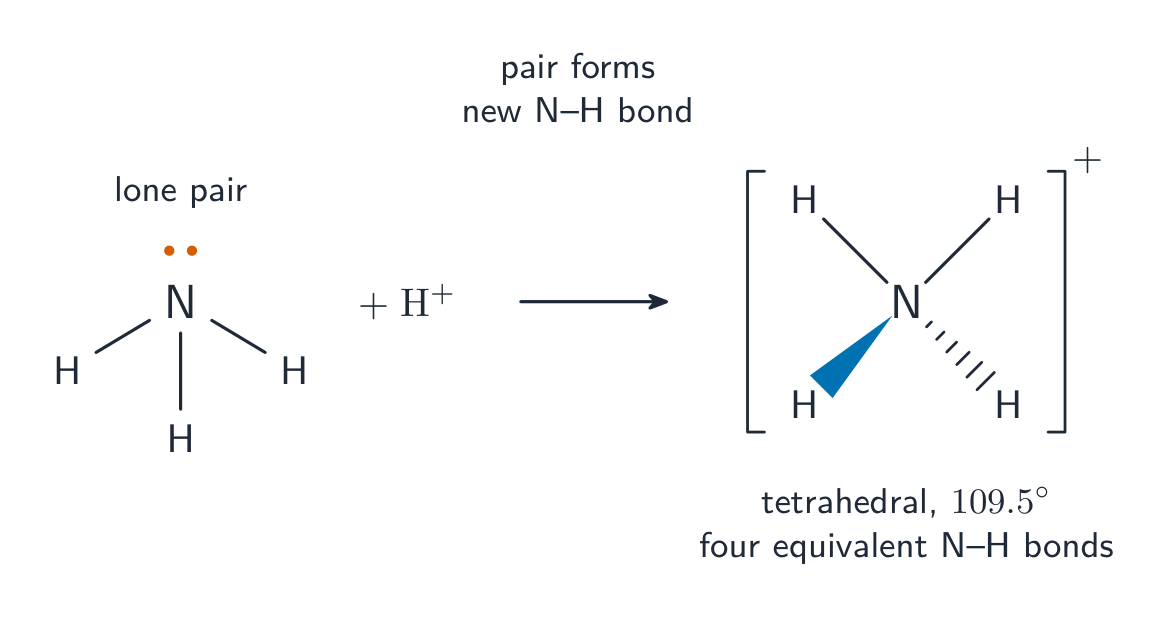
Ammonia's lone pair accepts a proton, forming the ammonium ion by a coordinate bond
The shape of ammonia
Ammonia has three bonding pairs and one lone pair — the lone pair pushes the bonds down into a pyramidal shape (about 107°).
Ammonia acts as a base because:
难度 1/5 · 今日首次完成可获 100 金币及少量额外奖励
A Brønsted–Lowry base accepts a proton; ammonia's nitrogen lone pair does exactly that.
The bond formed when NH₃ accepts H⁺ is a coordinate bond because:
难度 1/5 · 今日首次完成可获 100 金币及少量额外奖励
Nitrogen supplies both electrons of the new N–H bond, making it a coordinate (dative) bond.
Ammonia (NH₃) acts as a base because it can accept a ______.
难度 1/5 · 今日首次完成可获 100 金币及少量额外奖励
NH₃ + H⁺ → NH₄⁺.
What is the shape of the ammonium ion, NH₄⁺?
难度 1/5 · 今日首次完成可获 100 金币及少量额外奖励
Four bonding pairs and no lone pairs around nitrogen.
What is the H–N–H bond angle in an ammonia molecule, NH₃, in degrees?
难度 2/5 · 今日首次完成可获 140 金币及少量额外奖励
Four electron pairs would give 109.5°, but the lone pair repels the bond pairs more, closing the angle to 107°.
Testing for an ammonium salt
- Warm the salt with NaOH(aq): $\text{NH}_4^+ + \text{OH}^- \rightarrow \text{NH}_3 + \text{H}_2\text{O}$.
- Ammonia gas has a sharp smell and turns damp red litmus blue.
The test for an ammonium salt is to warm it with NaOH and look for:
难度 1/5 · 今日首次完成可获 100 金币及少量额外奖励
A base displaces ammonia from the salt; the ammonia smells sharp and turns damp red litmus blue.
Match each nitrogen/ammonia fact.
难度 2/5 · 今日首次完成可获 140 金币及少量额外奖励
Each item links the term to its correct meaning.
A student has a white solid that could be NaCl or NH₄Cl. Describe a test and give the equation and observations for a positive result.
- Warm a small sample with aqueous NaOH and hold damp red litmus at the mouth of the tube. With NH₄Cl: $\text{NH}_4\text{Cl} + \text{NaOH} \rightarrow \text{NaCl} + \text{NH}_3 + \text{H}_2\text{O}$.
- Ammonia gas turns the litmus blue, with a sharp smell. NaCl gives no gas. The litmus must be damp, because ammonia must dissolve to form $\text{OH}^-$ ions: $\text{NH}_3 + \text{H}_2\text{O} \rightleftharpoons \text{NH}_4^{+} + \text{OH}^{-}$.
- "Strong triple bond" alone is half the answer. Add that the molecule is non-polar.
- Once formed, the coordinate N–H bond in NH₄⁺ is identical to the other three.
- NH₃ is pyramidal, not trigonal planar: the lone pair repels more than a bond pair.
You've got it
- N₂ is unreactive: very strong triple bond (945 kJ/mol) and a non-polar molecule.
- Ammonia is a base: its lone pair accepts H⁺ → NH₄⁺ (coordinate bond; pyramidal → tetrahedral).
- Test for NH₄⁺: warm with NaOH → NH₃ turns damp red litmus blue.