Original teaching practice. Read one pattern, cover its model and try the questions before checking the separate answer section. Examples adapted from Chinese Grammar Wiki (AllSet Learning, CC BY-NC-SA) retain the course-reference provenance.
Verb + (degree marker)得 + to invert倒 + Adj (a pointed note)
Easy for you to say
- Your flatmate says moving all the furniture will be easy, but he has no plans to help.
- you你variant of 说说(degree marker)得to invert倒easy容易,who谁to come来to move (i.e. relocate…搬(and …? / softener)呢? — "That's easy for you to say — who's going to do the lifting?"
Verb + (degree marker)得 + to invert倒 + Adj
- V (degree marker)得to invert倒 + Adj comments on how someone does or says something, with a pointed contrast: the claim is fine, but reality is different.
- Typical: variant of 说说(degree marker)得to invert倒light轻松, want / think / miss想(degree marker)得to invert倒beautiful美, variant of 说说(degree marker)得倒好to listen to听.
you你think想得(how nice)倒nicely美。

Irony, and sincere surprise
- Ironic: he / him他want / think / miss想(degree marker)得to invert倒beautiful美,to think (i.e. to take it…以为not不variant of 复习复习also也can / be able to能to check考full marks满分。 — "Dream on — he thinks he can get full marks without revising."
- Sincere: this这child孩子画得to invert倒correct不错。 — "This child actually draws rather well." to invert倒 marks that it is better than expected.
this这child孩子draws画得actually倒quite well不错。
to invert倒 sits after (degree marker)得
- Order: verb + (degree marker)得 + to invert倒 + adjective: variant of 说说(degree marker)得to invert倒easy容易, not variant of 说说to invert倒(degree marker)得easy容易.
- Not every to invert倒 sentence is sarcastic; tone and context decide whether it is a jab or a pleasant surprise.
Versus a plain (degree marker)得 complement
- you你variant of 说说(degree marker)得degree / adjective linker很easy容易 just describes the manner.
- you你variant of 说说(degree marker)得to invert倒easy容易 implies "but it isn't really": the contrast with reality is the point.
you你say说得(how)倒easily轻松。
Recap
- V (degree marker)得to invert倒 + Adj = it sounds / looks … (but reality differs), or "actually rather …".
- Order V + (degree marker)得 + to invert倒 + Adj; tone decides irony or sincere surprise.
Practise this pattern step by step.
degree / adjective linker很to be / is是 + Adj (a formal “very”)
A formal report
- A news report describes how residents feel about the new park.
- resident居民(plural)们to / towards / correct对new新park (for public recreation)公园degree / adjective linker很to be / is是satisfied满意。 — "Residents are very satisfied with the new park."
degree / adjective linker很to be / is是 + Adj / feeling verb
- degree / adjective linker很to be / is是 = "very, quite", a more formal or literary degree / adjective linker很: degree / adjective linker很to be / is是happy高兴, degree / adjective linker很to be / is是satisfied满意, degree / adjective linker很to be / is是anxious担心.
- It goes before two-syllable adjectives or feeling verbs.
hearing听到this这个news消息,he他was very很是pleased高兴。

Writing and storytelling
- old man or woman老人一个人住,child孩子(plural)们degree / adjective linker很to be / is是anxious担心。 — "The old man lives alone, and his children are very worried."
- It gives a measured, slightly old-fashioned tone suited to narratives and reports.
the children孩子们are very很是worried担心。
Two-syllable words, written tone
- degree / adjective linker很to be / is是 prefers two-syllable predicates: degree / adjective linker很to be / is是satisfied满意, not degree / adjective linker很to be / is是good好.
- In conversation, plain degree / adjective linker很 or very非常 sounds more natural.
degree / adjective linker很to be / is是 versus to be / is是 for emphasis
- degree / adjective linker很to be / is是 = very (degree). Do not confuse it with to be / is是 for emphasis: he / him他to be / is是degree / adjective linker很busy忙 — "He really is busy (I admit)."
- Here degree / adjective linker很to be / is是 is one unit before the adjective.
he他(really)是very很busy忙。
Recap
- degree / adjective linker很to be / is是 + two-syllable Adj / feeling verb = very (formal, literary).
- Spoken Chinese prefers degree / adjective linker很 / very非常.
Practise this pattern step by step.
fully足足 + Amount (a full / as much as)
A whole three hours
- The queue for the new museum exhibition was much longer than you expected.
- we / us我们fully足足a row排(completed / change)了三个hour小时(modifier / structural particle)的squadron队。 — "We queued for a full three hours."
fully足足 + amount = a full, fully
- fully足足 + number + measure word stresses that the amount is large, at least that much: fully足足三个hour小时, fully足足十公斤.
- It goes before the verb or directly before the amount.
this这个suitcase箱子a full足足has有twenty二十kilos公斤。

Emphasising size, time or weight
- he / him他fully足足than / compared to比I / me我high高(completed / change)了一个头。 — "He's a full head taller than me."
- this这顿饭fully足足flower花(completed / change)了五百块。 — "This meal cost a whole 500 yuan."
this这顿meal饭a full足足cost花了five hundred五百yuan块。
Large amounts only
- fully足足 stresses a large amount; for "only" a small amount use only then / not until才 / only只: only then / not until才五分钟.
- It needs a number: fully足足三天, not just fully足足degree / adjective linker很(long) time久.
fully足足 versus whole整整
- whole整整 also means "a whole, exactly": whole整整一天 — "a whole day". It stresses completeness.
- fully足足 stresses that the amount is large, even more than expected.
he他a whole整整day一天didn't没eat吃anything东西。
Recap
- fully足足 + amount = a full / as much as (a large amount, stressed).
- Small amounts use only then / not until才 / only只; whole整整 = a whole, exactly.
Practise this pattern step by step.
repeatedly一再 + Verb (again and again)
Told him again and again
- Your brother kept forgetting his keys even though everyone reminded him.
- mama妈妈repeatedly一再to remind提醒he / him他,he / him他or / still还是to forget忘(completed / change)了。 — "Mum reminded him again and again, but he still forgot."
repeatedly一再 + verb = repeatedly, time and again
- repeatedly一再 means an action was repeated several times, often with insistence: 一再强调, repeatedly一再to request要求, repeatedly一再to postpone推迟.
- It goes before the verb.
the teacher老师repeatedly一再stressed强调safety安全。

Delays and insistence
- meeting会议repeatedly一再to postpone推迟。 — "The meeting was postponed again and again."
- he / him他一再表示(express) thanks感谢。 — "He thanked us repeatedly."
the meeting会议repeatedly一再postponed推迟。
Past repetitions, formal tone
- repeatedly一再 mostly reports actions already repeated; for advice about the future, over and over again再三 often fits better: to ask请you你over and over again再三to think over考虑.
- It sounds formal; in chat, good好several times几次 is more natural: I / me我with / and跟he / him他variant of 说说(completed / change)了good好several times几次.
repeatedly一再 versus over and over again再三 and repeatedly屡次
- over and over again再三 = again and again, often for thinking or asking: over and over again再三to think over考虑, over and over again再三to request请求.
- repeatedly屡次 is more written: "on many occasions": repeatedly屡次to win an award获奖.
he他again and again再三considered考虑。
Recap
- repeatedly一再 + verb = repeatedly, time and again (often insistent, formal).
- over and over again再三 for thinking / asking; repeatedly屡次 written; good好several times几次 in chat.
Practise this pattern step by step.
each and every凡是 … all / both都 (all / any without exception)
No exceptions
- The school rules are read out on the first day.
- each and every凡是to arrive late迟到(modifier / structural particle)的student学生,all / both都want / will / need要to write写to explain说明。 — "Every student who is late, without exception, must write an explanation."
each and every凡是 + category,all / both都 …
- each and every凡是 X,all / both都 … = "all X, any X without exception": every member of the category is included.
- all / both都 is needed in the second part: each and every凡是…all / both都….
all凡是who have been to去过there那里的people人,all都say说it's good好。

Rules and generalisations
- each and every凡是he / him他to answer答应(modifier / structural particle)的matter事,all / both都can / will会to accomplish做到。 — "Whatever he promises, he always does."
- each and every凡是to have / there is有question问题(modifier / structural particle)的,请举手。 — "Anyone with questions, please raise your hand."
whatever凡是he他promises答应的things事,all都will会be done做到。
each and every凡是 needs all / both都
- Do not drop all / both都: each and every凡是student学生all / both都want / will / need要to participate参加, not each and every凡是student学生want / will / need要to participate参加.
- each and every凡是 introduces a category, usually with (modifier / structural particle)的: each and every凡是…(modifier / structural particle)的person人 / each and every凡是…(modifier / structural particle)的matter事.
each and every凡是 versus all所有 and each每
- all所有(modifier / structural particle)的student学生all / both都… = all the students.
- each and every凡是…all / both都… stresses "any, without exception", often for rules and strong generalisations.
all所有的students学生all都came来了。
Recap
- each and every凡是 + category ((modifier / structural particle)的…),all / both都 … = all / any … without exception.
- Needs all / both都; used for rules and firm generalisations.
Practise this pattern step by step.
always (previously)向来 (always / all along)
Always punctual
- Your colleague has never been late in ten years.
- he / him他always (previously)向来degree / adjective linker很on time准时,today今天not / haven't没to come来,to be certain肯定to be occupied with sth有事。 — "He's always been punctual; if he hasn't come today, something must be up."
always (previously)向来 + verb / adj = always, all along
- always (previously)向来 describes a long-standing habit or character, from the past until now: always (previously)向来degree / adjective linker很to economize节约, always (previously)向来not不to drink (alcohol)喝酒.
- It goes after the subject, before the predicate.
she她always向来not不drink喝alcohol酒。

Character and habits
- 这家inn店always (previously)向来to use以to serve服务good好well-known for sth出名。 — "This shop has always been known for its good service."
- I / me我always (previously)向来not不to be convinced (that sth…相信this kind of这种to advertise广告。 — "I've never believed adverts like this."
this这家shop店has always向来for以service服务good好been famous出名。
Long-term only
- always (previously)向来 describes long-standing patterns, not one recent stretch: for "all morning", use all along一直.
- It sounds formal; in speech always (previously)一向 or always从来 (with negatives) are common.
always (previously)向来 versus all along一直 and always从来
- all along一直 = continuously over a period: today今天all along一直to rain下雨.
- always从来 mostly with not不 / not / haven't没: never从来不to arrive late迟到. always (previously)向来 works with positive and negative predicates.
today今天all day一直raining下雨。
Recap
- always (previously)向来 + predicate = always, all along (long-standing character or habit).
- all along一直 = continuously over a stretch; always从来 mostly with negatives.
Practise this pattern step by step.
really果然 (sure enough / as expected)
Just as the forecast said
- The weather app warned of afternoon storms. At three o'clock, thunder rolls in.
- weather forecast天气预报variant of 说说afternoon下午有雨,really果然to rain下雨(completed / change)了。 — "The forecast said it would rain this afternoon, and sure enough, it did."
really果然 + result = sure enough, as expected
- really果然 confirms that something happened as predicted or expected.
- It goes after the subject (or at the start of the clause): he / him他really果然to come来(completed / change)了 / really果然,他来(completed / change)了.
he他said说would会come来,sure enough果然came来了。

Predictions and reputations
- everyone大家all / both都variant of 说说这家(modifier / structural particle)的vegetable菜to be fond of eating好吃,really果然lit. name is not in vain…名不虚传。 — "Everyone said the food here was good, and it really lives up to its name."
- I / me我then / just就to know知道他会to arrive late迟到,he / him他really果然to arrive late迟到(completed / change)了。 — "I knew he'd be late, and sure enough he was."
I我just就knew知道he他would会be late迟到,he他sure enough果然was late迟到了。
Needs an earlier expectation
- really果然 only makes sense after a prediction, warning or reputation; without one, it sounds odd.
- For a surprise (against expectation), use unexpectedly竟然 / unexpectedly居然, the opposite of really果然.
really果然 versus unexpectedly竟然
- really果然 = just as expected: he / him他really果然to pass a university…考上(completed / change)了.
- unexpectedly竟然 = unexpectedly: he / him他unexpectedly竟然没考上 — "Surprisingly, he didn't get in."
he他unexpectedly竟然didn't没get in考上。
Recap
- really果然 = sure enough, as expected (after a prediction or reputation).
- Opposite: unexpectedly竟然 / unexpectedly居然 (unexpectedly).
Practise this pattern step by step.
it seems似乎 (it seems / as if)
Something seems off
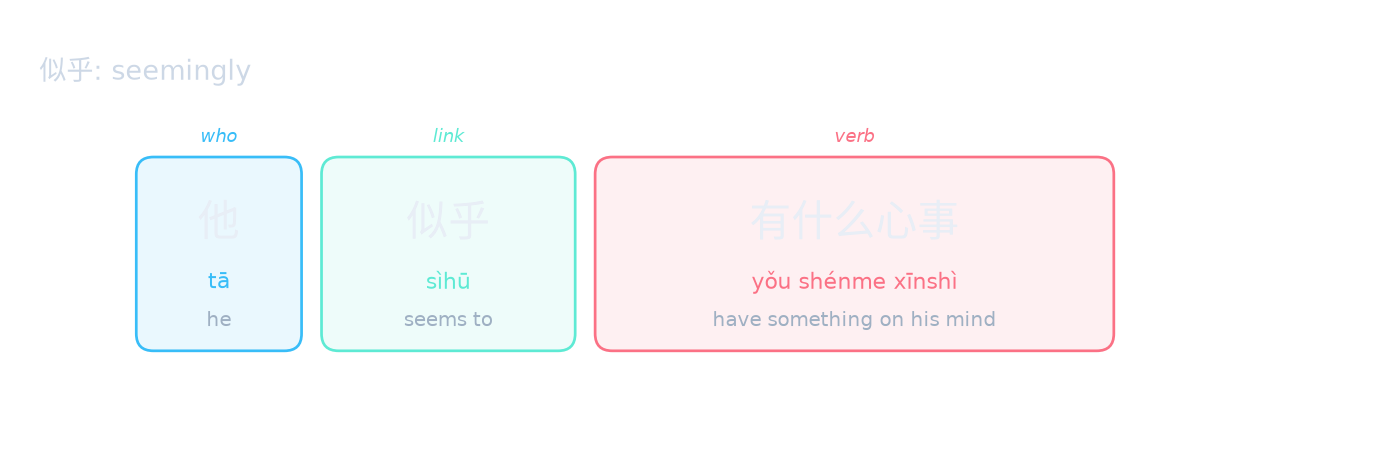
- Your usually cheerful colleague is quiet in the meeting and avoids eye contact.
- he / him他it seems似乎to have / there is有what什么a load on one's mind心事。 — "He seems to have something on his mind."
it seems似乎 + guess = it seems, apparently
- it seems似乎 gives a tentative impression or guess, a more formal as if好像: it seems似乎not不太高兴, it seems似乎clear明白(completed / change)了.
- It goes after the subject or at the start of the clause.
she她seems似乎not very不太happy高兴。
Writing and careful speech
- question问题it seems似乎than / compared to比we / us我们want / think / miss想(modifier / structural particle)的more更complicated复杂。 — "The problem seems more complicated than we thought."
- it seems似乎…same一样 = as if: he / him他it seems似乎what什么all / both都to know知道same一样.
the problem问题seems似乎than比we我们thought想的more更complicated复杂。
Tentative, so not with definitely一定
- it seems似乎 is soft; do not pair it with definitely一定 / to be certain肯定: he / him他it seems似乎illness病(completed / change)了, not he / him他it seems似乎to be certain肯定illness病(completed / change)了.
- It sounds formal; in conversation as if好像 is more common.
it seems似乎 versus as if好像 and apparently看来
- as if好像 = it seems (spoken): he / him他as if好像to walk走(completed / change)了.
- apparently看来 draws a conclusion from evidence: he / him他not / haven't没to come来,apparently看来to be / is是illness病(completed / change)了.
he他seems to好像have left走了。
Recap
- it seems似乎 = it seems / apparently (formal, tentative); it seems似乎…same一样 = as if.
- Spoken as if好像; conclusion from evidence apparently看来; not with definitely一定.
Practise this pattern step by step.
(indicates that sth turns…偏偏 (of all things / just had to)
Of all days
- You planned the class picnic for weeks. It has been sunny all month — until today.
- we / us我们with great difficulty好不容易to fix定(completed / change)了picnic野餐(modifier / structural particle)的day日子,(indicates that sth turns…偏偏that day那天to rain下雨。 — "We finally fixed a date for the picnic, and of all days, it rained."
(indicates that sth turns…偏偏 = of all things, just had to
- (indicates that sth turns…偏偏 marks that something happened against what was wanted or expected, often annoyingly: (indicates that sth turns…偏偏that day那天to rain下雨.
- It can also mean "insist on (doing the opposite)": to let / make让he / him他don't别to go去,he / him他(indicates that sth turns…偏偏want / will / need要to go去.
told让him他not to别go去,he他insisted偏偏on要going去。

Bad luck and stubbornness
- Bad luck: I / me我urgent急(ongoing -ing)着to go out出门,key钥匙(indicates that sth turns…偏偏to try to find找not to arrive不到(completed / change)了。 — "I was in a hurry, and of course I couldn't find my keys."
- Stubbornness: everyone大家all / both都to advise劝he / him他,he / him他(indicates that sth turns…偏偏not不to listen to听。 — "Everyone tried to persuade him, but he just wouldn't listen."
I我in a hurry急着to go out出门,the keys钥匙of all times偏偏couldn't find找不到了。
It needs a contrast
- (indicates that sth turns…偏偏 only works when the event goes against a wish or advice; for a neutral fact, leave it out.
- As an adverb it follows the subject: he / him他(indicates that sth turns…偏偏not不to listen to听. Before to be / is是 + noun it means "of all people / things": (indicates that sth turns…偏偏to be / is是he / him他.
(indicates that sth turns…偏偏 versus unexpectedly竟然
- unexpectedly竟然 = surprisingly (any surprise).
- (indicates that sth turns…偏偏 = contrary to what was wanted — frustrating timing or stubborn behaviour.
he他surprisingly竟然came来了。
Recap
- (indicates that sth turns…偏偏 = of all things / just had to (against a wish), or stubbornly insist on the opposite.
- Needs a contrast; unexpectedly竟然 = any surprise.
Practise this pattern step by step.
again / then再 + Adj + also也 (however …, still …)
However busy
- Your mother works long hours but never misses family dinner on Sundays.
- to work工作again / then再busy忙,she / her她also也can / will会to return home回家to have a meal吃饭。 — "However busy work gets, she still comes home for dinner."
again / then再 + Adj,also也 … = however …, still …
- again / then再 + Adj,(Subject) also也 + result = no matter how Adj it is, the result stays the same.
- again / then再 here means "even more, however much"; also也 is needed in the second part.
the weather天气however再cold冷,he他still也goes去running跑步。

Determination and limits
- 再贵I / me我also也want / will / need要to buy买。 — "However expensive it is, I'm going to buy it."
- you你again / then再explanation解释also也useless没用,he / him他improbable不会to be convinced (that sth…相信(modifier / structural particle)的。 — "However much you explain, it won't help; he won't believe it."
you你however much再explain解释still也no use没用。
also也 is required
- Do not drop also也: again / then再busy忙also也to come来, not again / then再busy忙to come来.
- again / then再 + Adj here is a condition, not "again": again / then再cold冷 = however cold.
Versus no matter what or how无论many多 / not to be concerned不管many多
- no matter what or how无论多忙,she / her她all / both都can / will会to return home回家 = the same idea, more explicit.
- again / then再busy忙also也… is shorter, very common in speech.
no matter无论how多busy忙,she她still都will会come home回家。
Recap
- again / then再 + Adj / Verb,also也 + result = however …, still ….
- also也 is required; no matter what or how无论many多…all / both都… is the longer form.
Practise this pattern step by step.
same一律 (uniformly / without exception)
Same price for everyone
- At the museum entrance, a sign explains the ticket policy.
- ticket (for theater, cinema…门票same一律二十元。 — "Tickets are twenty yuan, without exception."
same一律 + verb / predicate = uniformly, without exception
- same一律 applies a rule to everyone or everything in the same way: same一律free (of charge)免费, same一律not不to retreat退.
- It is formal and common on signs, rules and notices.
this shop's本店goods商品all一律20% off八折。

Rules and policies
- student学生same一律to wear穿school uniform校服。 — "All students must wear school uniform."
- to be overdue过期(modifier / structural particle)的ticket票same一律not valid无效。 — "Expired tickets are invalid without exception."
students学生all一律wear穿school uniform校服。
Rules, not descriptions
- same一律 states a rule or uniform treatment; for "all" in a description, use all / both都: student学生all / both都to come来(completed / change)了.
- It goes before the verb, after the group: student学生same一律…, not same一律student学生….
same一律 versus all / both都 and whole全部
- all / both都 = all (neutral).
- same一律 = all, by rule, no exceptions: (of a restaurant) to…外卖same一律to put放doorway门口 — "All deliveries go at the door."
deliveries外卖all一律go放at the door门口。
Recap
- Group + same一律 + predicate = uniformly, by rule, no exceptions (formal).
- Plain "all" in descriptions = all / both都.
Practise this pattern step by step.
only无非 (nothing but / merely)
Just the usual excuses
- Your manager has heard your colleague's reasons for being late many times before.
- he / him他variant of 说说(modifier / structural particle)的only无非to be / is是traffic jam堵车、to rain下雨these这些reason理由。 — "What he says is nothing but the usual excuses — traffic, rain."
only无非 (to be / is是) + content = nothing but, merely
- only无非 says something is no more than the ordinary items mentioned: only无非to be / is是, only无非want / think / miss想.
- It often has a dismissive tone: "it's just …".
he他merely无非is是wants想more多earn赚a bit点儿money钱。

Summing up the obvious
- everyone大家to discuss讨论(modifier / structural particle)的only无非to be / is是两个question问题:(concept of) time时间and / with和coin钱。 — "What everyone discussed boiled down to two issues: time and money."
- he / him他so much这么to make做,only无非to be / is是want / think / miss想to give rise to引起to take note of注意。 — "He's doing it merely to attract attention."
he他like this这么does it做,merely无非is是wanting想attract引起attention注意。
Ordinary, limited content
- What follows only无非 should be ordinary or limited; it is not for surprising facts.
- It often comes with to be / is是 or want / think / miss想 / want / will / need要: only无非to be / is是…, only无非want / think / miss想….
only无非 versus merely只是 and but不过
- merely只是 / but不过 = only, just (neutral).
- only无非 = nothing more than, often summarising and slightly dismissive.
this这is only只是a一个small小problem问题。
Recap
- only无非 (to be / is是 / want / think / miss想) + ordinary content = nothing but, merely (often dismissive).
- Neutral "only" = merely只是 / but不过.
Practise this pattern step by step.
always (previously)一向 (all along / consistently)
Consistently careful
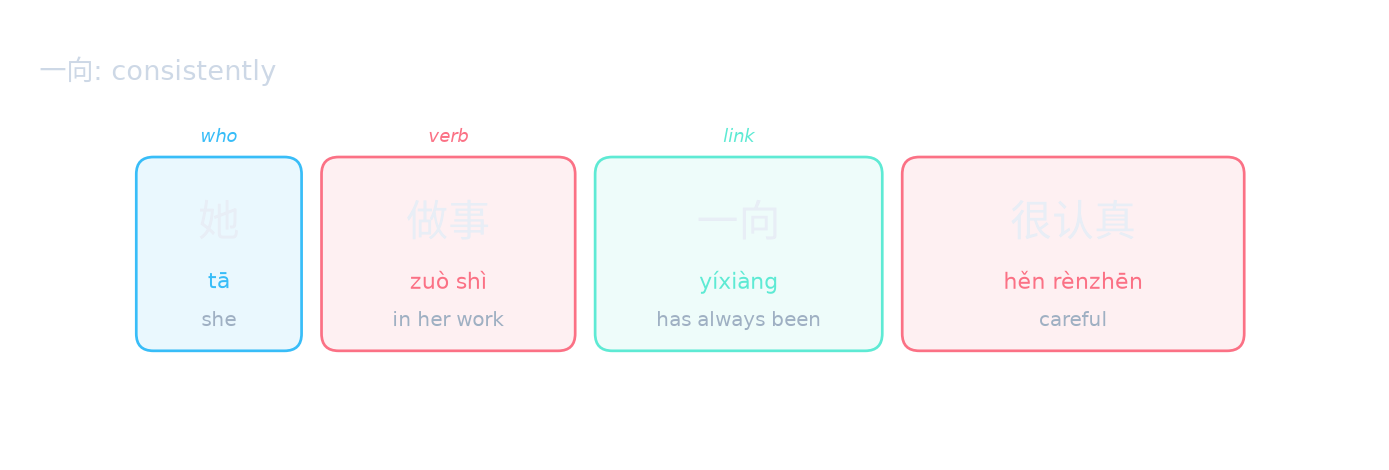
- Your colleague has always double-checked every document, ever since she joined.
- she / her她to work做事always (previously)一向degree / adjective linker很conscientious认真。 — "She has always been very conscientious in her work."
always (previously)一向 + predicate = all along, consistently
- always (previously)一向 describes a consistent habit or character from the past until now: always (previously)一向degree / adjective linker很on time准时, always (previously)一向不爱to speak说话.
- It goes after the subject, before the predicate.
he他always一向not不like爱to talk说话。
Habits and reputations
- 这家company公司always (previously)一向to attach importance to sth重视quality质量。 — "This company has always valued quality."
- I / me我always (previously)一向to feel / think觉得he / him他to be / is是(measure word)个good person好人。 — "I've always thought he was a good person."
this这家company公司always一向values重视quality质量。
Habit, not a single stretch
- always (previously)一向 describes long-term character; for one continuous stretch use all along一直: he / him他all along一直at / in在to wait for等.
- It is not "towards": that is towards向 alone (向前走).
always (previously)一向 versus always (previously)向来 and all along一直
- always (previously)一向 and always (previously)向来 are close synonyms; always (previously)向来 is a little more formal.
- all along一直 = continuously, or all along with a specific stretch: (literary) to rain雨all along一直down下.
the rain雨continuously一直falls下。
Recap
- always (previously)一向 + predicate = always, consistently (character or habit).
- Synonym always (previously)向来; one continuous stretch = all along一直.
Practise this pattern step by step.
when the moment comes到时候 (when the time comes)
We'll decide then
- Your friend asks what you'll do if the flight is cancelled next month.
- when the moment comes到时候to say again再说(suggestion)吧。 — "Let's deal with it when the time comes."
when the moment comes到时候 = when the time comes, then
- when the moment comes到时候 refers to a future moment already mentioned or understood: the trip, the exam, the meeting.
- It usually starts its clause: when the moment comes到时候I / me我to / for / give给you你to make a telephone call打电话.
when the time comes到时候I我to给you你will call打电话。

Plans and warnings
- you你now现在not不variant of 复习复习,when the moment comes到时候then / just就there's not enough time (to…来不及(completed / change)了。 — "If you don't revise now, it'll be too late when the time comes."
- next week下周to hold a meeting开会,when the moment comes到时候everyone大家all / both都want / will / need要to make a speech发言。 — "We have a meeting next week; everyone will have to speak then."
you你now现在don't不revise复习,when the time comes到时候then就too late来不及了。
Future only
- when the moment comes到时候 points to a future moment; for a past "at that time", use that那time时候 / at once当时.
- The moment must be clear from context; when the moment comes到时候 alone with no plan sounds vague.
when the moment comes到时候 versus at once当时
- at once当时 = at that time (past): at once当时I / me我still / also还很小.
- when the moment comes到时候 = then (future): when the moment comes到时候you你then / just就to know知道(completed / change)了 — "You'll know when the time comes."
at that time当时I我still还very很young小。
Recap
- when the moment comes到时候 = when the time comes (a known future moment); when the moment comes到时候to say again再说 = deal with it then.
- Past = at once当时 / that那time时候.
Practise this pattern step by step.
there is no need何必 (why bother / no need)
No need to go to the trouble
- Your friend is about to take a taxi across town to return a cheap pen you lent him.
- there is no need何必specialist专门to run跑一趟?next time下次to meet见面again / then再to / for / give给I / me我就行了。 — "Why bother making a special trip? Just give it back next time we meet."
there is no need何必 + verb ((and …? / softener)呢)? = why bother, there's no need to
- there is no need何必 asks a rhetorical question meaning "there's no need to …": there is no need何必to get angry生气(and …? / softener)呢?
- It gently advises against something unnecessary.
why bother何必over为this这little点儿matter小事getting angry生气呢?

Advice and comfort
- you你there is no need何必so much这么polite客气? — "No need to be so polite."
- since既然he / him他not不to like喜欢,you你again又there is no need何必to do with difficulty勉强he / him他? — "Since he doesn't like it, why force him?"
since既然he他doesn't不like it喜欢,you你(then)又why何必force勉强him他?
A rhetorical question, not a real one
- there is no need何必 does not ask for a reason; it means "you don't need to". The answer is built in.
- (and …? / softener)呢 often ends the question: there is no need何必(and …? / softener)呢? — "Why bother?"
there is no need何必 versus need not不必
- need not不必 states it plainly: you你need not不必anxious担心 — "You needn't worry."
- there is no need何必 says the same as a rhetorical question, softer and more persuasive.
you你needn't不必worry担心。
Recap
- there is no need何必 + verb ((and …? / softener)呢)? = why bother / there's no need to (rhetorical advice).
- Plain statement = need not不必.
Practise this pattern step by step.
Practice without the models
Verb + (degree marker)得 + to invert倒 + Adj (a pointed note)
0101.1 Retort: “That's easy for you to say!” you你variant of 说说(degree marker)得…………easy容易!
0101.2 Which order is correct?
- A. you你(degree marker)得variant of 说说to invert倒light轻松。
- B. you你variant of 说说(degree marker)得to invert倒light轻松。
- C. you你to invert倒variant of 说说(degree marker)得light轻松(degree marker)得。
- D. you你variant of 说说to invert倒(degree marker)得light轻松。
0101.3 this这child孩子画得to invert倒correct不错 can be sincere praise.
True or false? Explain or repair the statement.
0101.4 Build: “Dream on – he thinks he can pass without revising.”
Arrange all chunks: he / him他want / think / miss想(degree marker)得 / 倒美 / also也can / be able to能to pass through通过。 / ,to think (i.e. to take it…以为not不variant of 复习复习
0101.5 Your flatmate says moving all the furniture will be easy, but he has no plans to help. Close the examples. Say a Mandarin response, then write it in Chinese. Explain briefly in English what the lesson’s pattern adds. Compare with the model, then change one detail and try again.
Write or say your own response before reading the key.
degree / adjective linker很to be / is是 + Adj (a formal “very”)
0102.1 Complete (formal): “The audience was very moved.” spectators观众…………to move (sb)感动。
0102.2 Which is the least natural?
- A. he / him他degree / adjective linker很to be / is是satisfied满意。
- B. everyone大家degree / adjective linker很to be / is是anxious担心。
- C. she / her她degree / adjective linker很to be / is是happy高兴。
- D. weather天气degree / adjective linker很to be / is是good好。
0102.3 Build: “His children are very worried.”
Arrange all chunks: degree / adjective linker很to be / is是 / anxious担心。 / child孩子(plural)们
0102.4 degree / adjective linker很to be / is是 sounds more formal than degree / adjective linker很.
True or false? Explain or repair the statement.
0102.5 A news report describes how residents feel about the new park. Close the examples. Say a Mandarin response, then write it in Chinese. Explain briefly in English what the lesson’s pattern adds. Compare with the model, then change one detail and try again.
Write or say your own response before reading the key.
fully足足 + Amount (a full / as much as)
0103.1 Complete: “We waited a full two hours.” we / us我们…………to wait for等(completed / change)了两个hour小时。
0103.2 “It only took five minutes.” Which fits?
- A. fully足足only then / not until才五分钟。
- B. 五分钟fully足足。
- C. fully足足五分钟。
- D. only then / not until才五分钟。
0103.3 Build: “This meal cost a whole 500 yuan.”
Arrange all chunks: fully足足 / 五百块。 / flower花(completed / change)了 / this这顿饭
0103.4 whole整整一天 stresses a whole, complete day.
True or false? Explain or repair the statement.
0103.5 The queue for the new museum exhibition was much longer than you expected. Close the examples. Say a Mandarin response, then write it in Chinese. Explain briefly in English what the lesson’s pattern adds. Compare with the model, then change one detail and try again.
Write or say your own response before reading the key.
repeatedly一再 + Verb (again and again)
0104.1 Complete: “The doctor repeatedly told him to rest.” doctor医生…………to warn repeatedly叮嘱he / him他many多rest休息。
0104.2 Which sounds most natural in casual chat? “I told him several times.”
- A. I / me我with / and跟he / him他variant of 说说(completed / change)了good好several times几次。
- B. I / me我over and over again再三he / him他to tell告诉。
- C. I / me我repeatedly屡次to tell告诉he / him他。
- D. I / me我repeatedly一再to tell告诉he / him他。
0104.3 Build: “The meeting was postponed again and again.”
Arrange all chunks: repeatedly一再 / to postpone推迟。 / meeting会议
0104.4 repeatedly一再 often carries a sense of insistence.
True or false? Explain or repair the statement.
0104.5 Your brother kept forgetting his keys even though everyone reminded him. Close the examples. Say a Mandarin response, then write it in Chinese. Explain briefly in English what the lesson’s pattern adds. Compare with the model, then change one detail and try again.
Write or say your own response before reading the key.
each and every凡是 … all / both都 (all / any without exception)
0105.1 Complete: “Everyone who has been there says it's good.” each and every凡是去过there那里(modifier / structural particle)的person人,…………to come to an agreement说好。
0105.2 Which sentence is complete?
- A. student学生each and every凡是all / both都want / will / need要to participate参加。
- B. each and every凡是student学生all / both都want / will / need要to participate参加。
- C. all / both都each and every凡是student学生want / will / need要to participate参加。
- D. each and every凡是student学生want / will / need要to participate参加。
0105.3 Build: “Whatever he promises, he does.”
Arrange all chunks: all / both都can / will会 / to accomplish做到。 / each and every凡是he / him他to answer答应(modifier / structural particle)的matter事 / ,
0105.4 each and every凡是 stresses “without exception”.
True or false? Explain or repair the statement.
0105.5 The school rules are read out on the first day. Close the examples. Say a Mandarin response, then write it in Chinese. Explain briefly in English what the lesson’s pattern adds. Compare with the model, then change one detail and try again.
Write or say your own response before reading the key.
always (previously)向来 (always / all along)
0106.1 Complete: “He has always been very frugal.” he / him他…………degree / adjective linker很to economize节约。
0106.2 “It's been raining all day.” Which fits?
- A. today今天always (previously)向来不下雨。
- B. today今天always从来to rain下雨。
- C. today今天always (previously)向来to rain下雨。
- D. today今天all along一直to rain下雨。
0106.3 Build: “I've never believed adverts like this.”
Arrange all chunks: this kind of这种to advertise广告。 / always (previously)向来 / not不to be convinced (that sth…相信 / I / me我
0106.4 always (previously)向来 can be used with both positive and negative predicates.
True or false? Explain or repair the statement.
0106.5 Your colleague has never been late in ten years. Close the examples. Say a Mandarin response, then write it in Chinese. Explain briefly in English what the lesson’s pattern adds. Compare with the model, then change one detail and try again.
Write or say your own response before reading the key.
really果然 (sure enough / as expected)
0107.1 Complete: “He said he'd come, and sure enough he did.” he / him他variant of 说说can / will会to come来,…………to come来(completed / change)了。
0107.2 “Everyone expected him to win, but surprisingly he lost.” Which word fits? everyone大家all / both都to think (i.e. to take it…以为他会to beat赢,he / him他____to lose输(completed / change)了。
- A. of course当然
- B. unexpectedly竟然
- C. really果然
- D. suddenly突然
0107.3 Build: “I knew he'd be late, and sure enough he was.”
Arrange all chunks: to arrive late迟到(completed / change)了。 / , / I / me我then / just就to know知道他会to arrive late迟到 / he / him他really果然
0107.4 really果然 needs an earlier prediction or expectation.
True or false? Explain or repair the statement.
0107.5 The weather app warned of afternoon storms. At three o'clock, thunder rolls in. Close the examples. Say a Mandarin response, then write it in Chinese. Explain briefly in English what the lesson’s pattern adds. Compare with the model, then change one detail and try again.
Write or say your own response before reading the key.
it seems似乎 (it seems / as if)
0108.1 Complete (formal): “The plan seems to have problems.” this这个plan计划…………to have / there is有question问题。
0108.2 Which is unnatural?
- A. he / him他as if好像illness病(completed / change)了。
- B. he / him他it seems似乎to be certain肯定illness病(completed / change)了。
- C. apparently看来他病(completed / change)了。
- D. he / him他it seems似乎illness病(completed / change)了。
0108.3 Build: “The problem seems more complicated than we thought.”
Arrange all chunks: question问题it seems似乎 / complicated复杂。 / than / compared to比we / us我们want / think / miss想(modifier / structural particle)的 / more更
0108.4 as if好像 is more common than it seems似乎 in conversation.
True or false? Explain or repair the statement.
0108.5 Your usually cheerful colleague is quiet in the meeting and avoids eye contact. Close the examples. Say a Mandarin response, then write it in Chinese. Explain briefly in English what the lesson’s pattern adds. Compare with the model, then change one detail and try again.
Write or say your own response before reading the key.
(indicates that sth turns…偏偏 (of all things / just had to)
0109.1 Complete: “Everyone told him not to, but he insisted on going.” everyone大家to let / make让he / him他don't别to go去,he / him他…………want / will / need要to go去。
0109.2 Which sentence fits (indicates that sth turns…偏偏 best?
- A. weather天气degree / adjective linker很good好,(indicates that sth turns…偏偏we / us我们to go去to climb a mountain爬山(completed / change)了。
- B. (indicates that sth turns…偏偏today今天Monday星期一。
- C. we / us我们plan计划to go去coast海边,(indicates that sth turns…偏偏that day那天to rain下雨(completed / change)了。
- D. he / him他(indicates that sth turns…偏偏to be / is是一个student学生。
0109.3 Build: “Everyone persuaded him, but he just wouldn't listen.”
Arrange all chunks: , / he / him他(indicates that sth turns…偏偏 / everyone大家all / both都to advise劝he / him他 / not不to listen to听。
0109.4 (indicates that sth turns…偏偏 is used for any kind of surprise.
True or false? Explain or repair the statement.
0109.5 You planned the class picnic for weeks. It has been sunny all month – until today. Close the examples. Say a Mandarin response, then write it in Chinese. Explain briefly in English what the lesson’s pattern adds. Compare with the model, then change one detail and try again.
Write or say your own response before reading the key.
again / then再 + Adj + also也 (however …, still …)
0110.1 Complete: “However tired I am, I'll finish it.” 再累,I / me我…………want / will / need要to make做to finish完。
0110.2 What does 再贵I / me我also也want / will / need要to buy买 mean?
- A. If it's more expensive, I won't buy it.
- B. However expensive it is, I'll buy it.
- C. I'll buy it again.
- D. It's expensive again, so I'll buy it.
0110.3 Build: “However much you explain, it's no use.”
Arrange all chunks: also也 / useless没用。 / you你again / then再explanation解释
0110.4 no matter what or how无论多忙…all / both都… expresses the same idea as again / then再busy忙…also也….
True or false? Explain or repair the statement.
0110.5 Your mother works long hours but never misses family dinner on Sundays. Close the examples. Say a Mandarin response, then write it in Chinese. Explain briefly in English what the lesson’s pattern adds. Compare with the model, then change one detail and try again.
Write or say your own response before reading the key.
same一律 (uniformly / without exception)
0111.1 Complete (notice): “All goods are 20% off.” 本店commodity商品…………八折。
0111.2 “All my classmates came to the party.” Which fits best?
- A. to study at the same school同学(plural)们same一律to come来(completed / change)了。
- B. same一律to study at the same school同学(plural)们to come来(completed / change)了。
- C. to study at the same school同学(plural)们all / both都to come来(completed / change)了。
- D. to study at the same school同学(plural)们to come来(completed / change)了same一律。
0111.3 Build: “All students must wear school uniform.”
Arrange all chunks: school uniform校服。 / to wear穿 / student学生 / same一律
0111.4 same一律 is common on signs and in rules.
True or false? Explain or repair the statement.
0111.5 At the museum entrance, a sign explains the ticket policy. Close the examples. Say a Mandarin response, then write it in Chinese. Explain briefly in English what the lesson’s pattern adds. Compare with the model, then change one detail and try again.
Write or say your own response before reading the key.
only无非 (nothing but / merely)
0112.1 Complete: “He merely wants to earn more money.” he / him他…………to be / is是want / think / miss想many多to cheat赚erhua variant of 点点儿coin钱。
0112.2 What tone does only无非 often add?
- A. Dismissive summarising
- B. Politeness
- C. Surprise
- D. Admiration
0112.3 Build: “He's doing it merely to attract attention.”
Arrange all chunks: to give rise to引起to take note of注意。 / he / him他so much这么to make做 / only无非to be / is是want / think / miss想 / ,
0112.4 merely只是 is more neutral than only无非.
True or false? Explain or repair the statement.
0112.5 Your manager has heard your colleague's reasons for being late many times before. Close the examples. Say a Mandarin response, then write it in Chinese. Explain briefly in English what the lesson’s pattern adds. Compare with the model, then change one detail and try again.
Write or say your own response before reading the key.
always (previously)一向 (all along / consistently)
0113.1 Complete: “He has always been very punctual.” he / him他…………degree / adjective linker很on time准时。
0113.2 “He has been waiting the whole time.” Which fits?
- A. he / him他always (previously)一向at / in在to wait for等。
- B. he / him他always (previously)一向to wait for等(completed / change)了。
- C. he / him他always (previously)向来at / in在to wait for等(ongoing -ing)着。
- D. he / him他all along一直at / in在to wait for等。
0113.3 Build: “This company has always valued quality.”
Arrange all chunks: quality质量。 / always (previously)一向 / 这家company公司 / to attach importance to sth重视
0113.4 always (previously)一向 and always (previously)向来 are close synonyms.
True or false? Explain or repair the statement.
0113.5 Your colleague has always double-checked every document, ever since she joined. Close the examples. Say a Mandarin response, then write it in Chinese. Explain briefly in English what the lesson’s pattern adds. Compare with the model, then change one detail and try again.
Write or say your own response before reading the key.
when the moment comes到时候 (when the time comes)
0114.1 Complete: “Let's deal with it when the time comes.” …………to say again再说(suggestion)吧。
0114.2 “At that time I was still very young.” Which fits? ____I / me我still / also还很小。
- A. in the future将来
- B. when the moment comes到时候
- C. at once当时
- D. after以后
0114.3 Build: “If you don't revise now, it'll be too late then.”
Arrange all chunks: , / you你now现在not不variant of 复习复习 / then / just就there's not enough time (to…来不及(completed / change)了。 / when the moment comes到时候
0114.4 when the moment comes到时候 refers to the future.
True or false? Explain or repair the statement.
0114.5 Your friend asks what you'll do if the flight is cancelled next month. Close the examples. Say a Mandarin response, then write it in Chinese. Explain briefly in English what the lesson’s pattern adds. Compare with the model, then change one detail and try again.
Write or say your own response before reading the key.
there is no need何必 (why bother / no need)
0115.1 Complete: “Why get angry over such a small thing?” …………for为这点儿trifle小事to get angry生气(and …? / softener)呢?
0115.2 What does there is no need何必(and …? / softener)呢? mean?
- A. There's no need for that.
- B. Where is it?
- C. What do you need?
- D. Why did you do it?
0115.3 Build: “Since he doesn't like it, why force him?”
Arrange all chunks: since既然he / him他not不to like喜欢 / to do with difficulty勉强he / him他? / , / you你again又there is no need何必
0115.4 you你need not不必anxious担心 states plainly what you你there is no need何必anxious担心(and …? / softener)呢 suggests.
True or false? Explain or repair the statement.
0115.5 Your friend is about to take a taxi across town to return a cheap pen you lent him. Close the examples. Say a Mandarin response, then write it in Chinese. Explain briefly in English what the lesson’s pattern adds. Compare with the model, then change one detail and try again.
Write or say your own response before reading the key.
Answers and explanations
Verb + (degree marker)得 + to invert倒 + Adj (a pointed note)
0101.1 to invert倒
V (degree marker)得to invert倒 + Adj = pointed contrast.
0101.2 B. you你variant of 说说(degree marker)得to invert倒light轻松。
The pattern is verb + (degree marker)得 + to invert倒 + adjective: you你variant of 说说(degree marker)得to invert倒light轻松 (“You make it sound easy”, implying it is not). to invert倒 sits inside the complement, after (degree marker)得 and before the adjective, and (degree marker)得 appears only once.
0101.3 True.
to invert倒 can mark that something is better than expected.
0101.4 he / him他want / think / miss想(degree marker)得to invert倒beautiful美,to think (i.e. to take it…以为not不variant of 复习复习also也can / be able to能to pass through通过。
want / think / miss想(degree marker)得to invert倒beautiful美 = dream on.
0101.5 One possible response: you你variant of 说说(degree marker)得to invert倒easy容易,who谁to come来to move (i.e. relocate…搬(and …? / softener)呢?
Check meaning and form:
- My response conveys a message that fits the opening situation.
- I can explain the meaning of the pattern, rather than only naming it.
- Order: verb + (degree marker)得 + to invert倒 + adjective: variant of 说说(degree marker)得to invert倒easy容易, not variant of 说说to invert倒(degree marker)得easy容易.
- Not every to invert倒 sentence is sarcastic; tone and context decide whether it is a jab or a pleasant surprise.
- I tried a second response with a name, time, place, or description changed.
This is supported productive practice. Compare meaning and structure; your answer need not copy the model. A partner or teacher must hear the spoken response to comment on pronunciation.
degree / adjective linker很to be / is是 + Adj (a formal “very”)
0102.1 degree / adjective linker很to be / is是
degree / adjective linker很to be / is是 + two-syllable feeling word.
0102.2 D. weather天气degree / adjective linker很to be / is是good好。
degree / adjective linker很to be / is是 prefers two-syllable predicates.
0102.3 child孩子(plural)们degree / adjective linker很to be / is是anxious担心。
Subject + degree / adjective linker很to be / is是 + feeling.
0102.4 True.
It suits writing and narration.
0102.5 One possible response: resident居民(plural)们to / towards / correct对new新park (for public recreation)公园degree / adjective linker很to be / is是satisfied满意。
Check meaning and form:
- My response conveys a message that fits the opening situation.
- I can explain the meaning of the pattern, rather than only naming it.
- degree / adjective linker很to be / is是 prefers two-syllable predicates: degree / adjective linker很to be / is是satisfied满意, not degree / adjective linker很to be / is是good好.
- In conversation, plain degree / adjective linker很 or very非常 sounds more natural.
- I tried a second response with a name, time, place, or description changed.
This is supported productive practice. Compare meaning and structure; your answer need not copy the model. A partner or teacher must hear the spoken response to comment on pronunciation.
fully足足 + Amount (a full / as much as)
0103.1 fully足足
fully足足 stresses a large amount.
0103.2 D. only then / not until才五分钟。
only then / not until才 marks an amount as small (“only five minutes”). fully足足 does the opposite: it stresses that an amount is large (fully足足to wait for等(completed / change)了两个hour小时), so it cannot combine with only then / not until才 here.
0103.3 this这顿饭fully足足flower花(completed / change)了五百块。
fully足足 + verb + amount.
0103.4 True.
True. whole整整 stresses a full, complete amount (whole整整一天 “a whole day”, whole整整十年 “ten full years”), often with the feeling that it is a lot.
0103.5 One possible response: we / us我们fully足足a row排(completed / change)了三个hour小时(modifier / structural particle)的squadron队。
Check meaning and form:
- My response conveys a message that fits the opening situation.
- I can explain the meaning of the pattern, rather than only naming it.
- fully足足 stresses a large amount; for "only" a small amount use only then / not until才 / only只: only then / not until才五分钟.
- It needs a number: fully足足三天, not just fully足足degree / adjective linker很(long) time久.
- I tried a second response with a name, time, place, or description changed.
This is supported productive practice. Compare meaning and structure; your answer need not copy the model. A partner or teacher must hear the spoken response to comment on pronunciation.
repeatedly一再 + Verb (again and again)
0104.1 repeatedly一再
repeatedly一再 + verb = repeatedly.
0104.2 A. I / me我with / and跟he / him他variant of 说说(completed / change)了good好several times几次。
good好several times几次 is the casual choice.
0104.3 meeting会议repeatedly一再to postpone推迟。
Subject + repeatedly一再 + verb.
0104.4 True.
True. repeatedly一再 means “again and again” and usually carries insistence or emphasis: he / him他一再强调safe安全 “He stressed safety repeatedly.” It often goes with verbs like to emphasize (a statement)强调, to request要求, to express / indicate表示.
0104.5 One possible response: mama妈妈repeatedly一再to remind提醒he / him他,he / him他or / still还是to forget忘(completed / change)了。
Check meaning and form:
- My response conveys a message that fits the opening situation.
- I can explain the meaning of the pattern, rather than only naming it.
- repeatedly一再 mostly reports actions already repeated; for advice about the future, over and over again再三 often fits better: to ask请you你over and over again再三to think over考虑.
- It sounds formal; in chat, good好several times几次 is more natural: I / me我with / and跟he / him他variant of 说说(completed / change)了good好several times几次.
- I tried a second response with a name, time, place, or description changed.
This is supported productive practice. Compare meaning and structure; your answer need not copy the model. A partner or teacher must hear the spoken response to comment on pronunciation.
each and every凡是 … all / both都 (all / any without exception)
0105.1 all / both都
each and every凡是…all / both都….
0105.2 B. each and every凡是student学生all / both都want / will / need要to participate参加。
each and every凡是 introduces a whole category and needs all / both都 before the verb: each and every凡是student学生all / both都want / will / need要to participate参加 “All students, without exception, must attend.” Without all / both都 the sentence is incomplete, and each and every凡是 must come first.
0105.3 each and every凡是he / him他to answer答应(modifier / structural particle)的matter事,all / both都can / will会to accomplish做到。
each and every凡是…(modifier / structural particle)的matter事,all / both都….
0105.4 True.
True. each and every凡是 means “every … without exception” and is stronger than all所有. It is usually followed by all / both都 in the main clause.
0105.5 One possible response: each and every凡是to arrive late迟到(modifier / structural particle)的student学生,all / both都want / will / need要to write写to explain说明。
Check meaning and form:
- My response conveys a message that fits the opening situation.
- I can explain the meaning of the pattern, rather than only naming it.
- Do not drop all / both都: each and every凡是student学生all / both都want / will / need要to participate参加, not each and every凡是student学生want / will / need要to participate参加.
- each and every凡是 introduces a category, usually with (modifier / structural particle)的: each and every凡是…(modifier / structural particle)的person人 / each and every凡是…(modifier / structural particle)的matter事.
- I tried a second response with a name, time, place, or description changed.
This is supported productive practice. Compare meaning and structure; your answer need not copy the model. A partner or teacher must hear the spoken response to comment on pronunciation.
always (previously)向来 (always / all along)
0106.1 always (previously)向来
always (previously)向来 = always (long-standing).
0106.2 D. today今天all along一直to rain下雨。
One stretch of time takes all along一直.
0106.3 I / me我always (previously)向来not不to be convinced (that sth…相信this kind of这种to advertise广告。
Subject + always (previously)向来 + not不 + verb.
0106.4 True.
True. always (previously)向来 (“always, all along”) describes a long-standing habit and works with positive and negative predicates: he / him他always (previously)向来degree / adjective linker很on time准时 / he / him他always (previously)向来not不to drink (alcohol)喝酒.
0106.5 One possible response: he / him他always (previously)向来degree / adjective linker很on time准时,today今天not / haven't没to come来,to be certain肯定to be occupied with sth有事。
Check meaning and form:
- My response conveys a message that fits the opening situation.
- I can explain the meaning of the pattern, rather than only naming it.
- always (previously)向来 describes long-standing patterns, not one recent stretch: for "all morning", use all along一直.
- It sounds formal; in speech always (previously)一向 or always从来 (with negatives) are common.
- I tried a second response with a name, time, place, or description changed.
This is supported productive practice. Compare meaning and structure; your answer need not copy the model. A partner or teacher must hear the spoken response to comment on pronunciation.
really果然 (sure enough / as expected)
0107.1 really果然
really果然 confirms an expectation.
0107.2 B. unexpectedly竟然
Against expectation = unexpectedly竟然.
0107.3 I / me我then / just就to know知道他会to arrive late迟到,he / him他really果然to arrive late迟到(completed / change)了。
Prediction, then really果然 + result.
0107.4 True.
It confirms what was expected.
0107.5 One possible response: weather forecast天气预报variant of 说说afternoon下午有雨,really果然to rain下雨(completed / change)了。
Check meaning and form:
- My response conveys a message that fits the opening situation.
- I can explain the meaning of the pattern, rather than only naming it.
- really果然 only makes sense after a prediction, warning or reputation; without one, it sounds odd.
- For a surprise (against expectation), use unexpectedly竟然 / unexpectedly居然, the opposite of really果然.
- I tried a second response with a name, time, place, or description changed.
This is supported productive practice. Compare meaning and structure; your answer need not copy the model. A partner or teacher must hear the spoken response to comment on pronunciation.
it seems似乎 (it seems / as if)
0108.1 it seems似乎
it seems似乎 gives a tentative impression.
0108.2 B. he / him他it seems似乎to be certain肯定illness病(completed / change)了。
Tentative it seems似乎 does not combine with to be certain肯定.
0108.3 question问题it seems似乎than / compared to比we / us我们want / think / miss想(modifier / structural particle)的more更complicated复杂。
Subject + it seems似乎 + comparison.
0108.4 True.
True. Both mean “seem”, but it seems似乎 is more formal and written. In everyday speech as if好像 is far more common: he / him他as if好像not不太高兴.
0108.5 One possible response: he / him他it seems似乎to have / there is有what什么a load on one's mind心事。
Check meaning and form:
- My response conveys a message that fits the opening situation.
- I can explain the meaning of the pattern, rather than only naming it.
- it seems似乎 is soft; do not pair it with definitely一定 / to be certain肯定: he / him他it seems似乎illness病(completed / change)了, not he / him他it seems似乎to be certain肯定illness病(completed / change)了.
- It sounds formal; in conversation as if好像 is more common.
- I tried a second response with a name, time, place, or description changed.
This is supported productive practice. Compare meaning and structure; your answer need not copy the model. A partner or teacher must hear the spoken response to comment on pronunciation.
(indicates that sth turns…偏偏 (of all things / just had to)
0109.1 (indicates that sth turns…偏偏
(indicates that sth turns…偏偏 = stubbornly does the opposite.
0109.2 C. we / us我们plan计划to go去coast海边,(indicates that sth turns…偏偏that day那天to rain下雨(completed / change)了。
(indicates that sth turns…偏偏 needs an event against a wish.
0109.3 everyone大家all / both都to advise劝he / him他,he / him他(indicates that sth turns…偏偏not不to listen to听。
Subject + (indicates that sth turns…偏偏 + negative.
0109.4 False.
It stresses going against a wish; unexpectedly竟然 covers any surprise.
0109.5 One possible response: we / us我们with great difficulty好不容易to fix定(completed / change)了picnic野餐(modifier / structural particle)的day日子,(indicates that sth turns…偏偏that day那天to rain下雨。
Check meaning and form:
- My response conveys a message that fits the opening situation.
- I can explain the meaning of the pattern, rather than only naming it.
- (indicates that sth turns…偏偏 only works when the event goes against a wish or advice; for a neutral fact, leave it out.
- As an adverb it follows the subject: he / him他(indicates that sth turns…偏偏not不to listen to听. Before to be / is是 + noun it means "of all people / things": (indicates that sth turns…偏偏to be / is是he / him他.
- I tried a second response with a name, time, place, or description changed.
This is supported productive practice. Compare meaning and structure; your answer need not copy the model. A partner or teacher must hear the spoken response to comment on pronunciation.
again / then再 + Adj + also也 (however …, still …)
0110.1 also也
again / then再 + Adj,also也….
0110.2 B. However expensive it is, I'll buy it.
again / then再 + adjective + also也 means “no matter how …”: 再贵I / me我also也want / will / need要to buy买 “However expensive it is, I'll still buy it.” Here again / then再 does not mean “again”.
0110.3 you你again / then再explanation解释also也useless没用。
again / then再 + verb,also也 + result.
0110.4 True.
again / then再…also也… is the shorter form.
0110.5 One possible response: to work工作again / then再busy忙,she / her她also也can / will会to return home回家to have a meal吃饭。
Check meaning and form:
- My response conveys a message that fits the opening situation.
- I can explain the meaning of the pattern, rather than only naming it.
- Do not drop also也: again / then再busy忙also也to come来, not again / then再busy忙to come来.
- again / then再 + Adj here is a condition, not "again": again / then再cold冷 = however cold.
- I tried a second response with a name, time, place, or description changed.
This is supported productive practice. Compare meaning and structure; your answer need not copy the model. A partner or teacher must hear the spoken response to comment on pronunciation.
same一律 (uniformly / without exception)
0111.1 same一律
same一律 applies a rule uniformly.
0111.2 C. to study at the same school同学(plural)们all / both都to come来(completed / change)了。
A description takes all / both都; same一律 states a rule.
0111.3 student学生same一律to wear穿school uniform校服。
Group + same一律 + verb.
0111.4 True.
It is formal and rule-like.
0111.5 One possible response: ticket (for theater, cinema…门票same一律二十元。
Check meaning and form:
- My response conveys a message that fits the opening situation.
- I can explain the meaning of the pattern, rather than only naming it.
- same一律 states a rule or uniform treatment; for "all" in a description, use all / both都: student学生all / both都to come来(completed / change)了.
- It goes before the verb, after the group: student学生same一律…, not same一律student学生….
- I tried a second response with a name, time, place, or description changed.
This is supported productive practice. Compare meaning and structure; your answer need not copy the model. A partner or teacher must hear the spoken response to comment on pronunciation.
only无非 (nothing but / merely)
0112.1 only无非
only无非to be / is是 = nothing but.
0112.2 A. Dismissive summarising
It reduces something to the ordinary.
0112.3 he / him他so much这么to make做,only无非to be / is是want / think / miss想to give rise to引起to take note of注意。
Action,only无非to be / is是want / think / miss想 + purpose.
0112.4 True.
only无非 often sounds dismissive.
0112.5 One possible response: he / him他variant of 说说(modifier / structural particle)的only无非to be / is是traffic jam堵车、to rain下雨these这些reason理由。
Check meaning and form:
- My response conveys a message that fits the opening situation.
- I can explain the meaning of the pattern, rather than only naming it.
- What follows only无非 should be ordinary or limited; it is not for surprising facts.
- It often comes with to be / is是 or want / think / miss想 / want / will / need要: only无非to be / is是…, only无非want / think / miss想….
- I tried a second response with a name, time, place, or description changed.
This is supported productive practice. Compare meaning and structure; your answer need not copy the model. A partner or teacher must hear the spoken response to comment on pronunciation.
always (previously)一向 (all along / consistently)
0113.1 always (previously)一向
always (previously)一向 = consistently.
0113.2 D. he / him他all along一直at / in在to wait for等。
A single stretch takes all along一直.
0113.3 这家company公司always (previously)一向to attach importance to sth重视quality质量。
Subject + always (previously)一向 + verb.
0113.4 True.
always (previously)向来 is a little more formal.
0113.5 One possible response: she / her她to work做事always (previously)一向degree / adjective linker很conscientious认真。
Check meaning and form:
- My response conveys a message that fits the opening situation.
- I can explain the meaning of the pattern, rather than only naming it.
- always (previously)一向 describes long-term character; for one continuous stretch use all along一直: he / him他all along一直at / in在to wait for等.
- It is not "towards": that is towards向 alone (向前走).
- I tried a second response with a name, time, place, or description changed.
This is supported productive practice. Compare meaning and structure; your answer need not copy the model. A partner or teacher must hear the spoken response to comment on pronunciation.
when the moment comes到时候 (when the time comes)
0114.1 when the moment comes到时候
when the moment comes到时候to say again再说 = deal with it then.
0114.2 C. at once当时
at once当时 refers to a particular moment in the past (“at that time”). when the moment comes到时候 looks forward to a future moment (“when the time comes”), and after以后 / in the future将来 also point to the future.
0114.3 you你now现在not不variant of 复习复习,when the moment comes到时候then / just就there's not enough time (to…来不及(completed / change)了。
Condition, then when the moment comes到时候 + consequence.
0114.4 True.
It points to a future moment already known.
0114.5 One possible response: when the moment comes到时候to say again再说(suggestion)吧。
Check meaning and form:
- My response conveys a message that fits the opening situation.
- I can explain the meaning of the pattern, rather than only naming it.
- when the moment comes到时候 points to a future moment; for a past "at that time", use that那time时候 / at once当时.
- The moment must be clear from context; when the moment comes到时候 alone with no plan sounds vague.
- I tried a second response with a name, time, place, or description changed.
This is supported productive practice. Compare meaning and structure; your answer need not copy the model. A partner or teacher must hear the spoken response to comment on pronunciation.
there is no need何必 (why bother / no need)
0115.1 there is no need何必
there is no need何必 = why bother (rhetorical).
0115.2 A. There's no need for that.
It is rhetorical advice, not a request for a reason.
0115.3 since既然he / him他not不to like喜欢,you你again又there is no need何必to do with difficulty勉强he / him他?
Reason, then there is no need何必 + verb.
0115.4 True.
need not不必 is the plain statement.
0115.5 One possible response: there is no need何必specialist专门to run跑一趟?next time下次to meet见面again / then再to / for / give给I / me我就行了。
Check meaning and form:
- My response conveys a message that fits the opening situation.
- I can explain the meaning of the pattern, rather than only naming it.
- there is no need何必 does not ask for a reason; it means "you don't need to". The answer is built in.
- (and …? / softener)呢 often ends the question: there is no need何必(and …? / softener)呢? – "Why bother?"
- I tried a second response with a name, time, place, or description changed.
This is supported productive practice. Compare meaning and structure; your answer need not copy the model. A partner or teacher must hear the spoken response to comment on pronunciation.