Skip to content
Subjects · ⁨科目⁩

English Grammar · B2 · ⁨英语语法 · B2⁩

  • 1 Narrative tenses · ⁨叙事时态⁩
    1.1

    一般过去时与过去进行时

    English

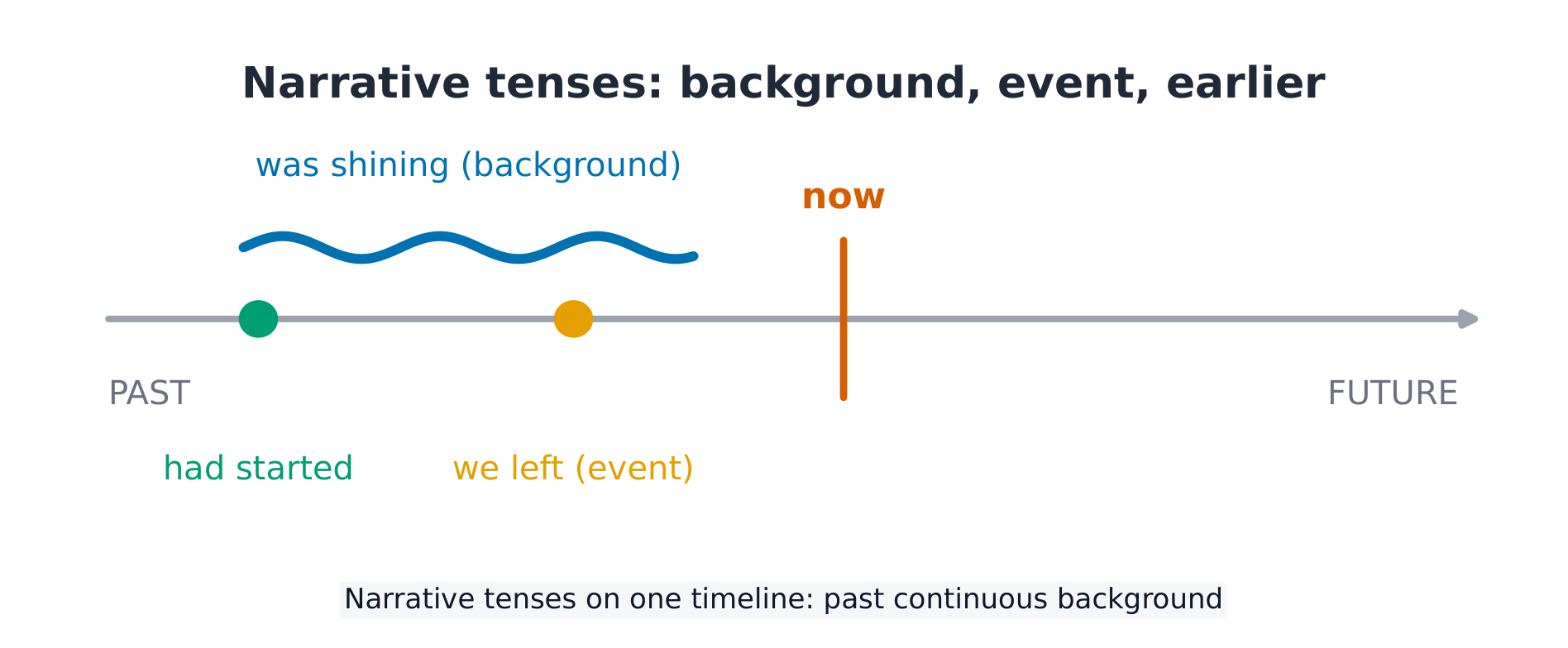
    When telling stories, English uses a set of narrative tenses in combination. The most basic two are:

    • Simple Past: The main actions that advance the plot (one after another).
    • Past Continuous: Setting the background, describing what was happening at that time.

    (冠词)The 太阳sun (过去进行)was 照耀shining 当...时when 我们we 出发left.

    We set off while the sun was shining brightly. (Background + main action)

    她She (过去进行)was 做饭cooking 当...时when (冠词)the 电话phone 响了rang.

    Her phone rang while she was cooking.

    Note A long background action uses the past continuous (was cooking); a short action interrupting it uses the simple past (rang).

    中文
    叙事时态:背景、事件、更早

    讲故事时,英语用一组叙事时态 (narrative tenses) 配合使用。最基础的两个是:

    • 一般过去时:推进情节的主要动作(一件接一件)。
    • 过去进行时:设置背景,描述当时正在进行的事。

    (冠词)The 太阳sun (过去进行)was 照耀shining 当...时when 我们we 出发left.

    我们出发时,阳光正灿烂。(背景 + 主要动作)

    她She (过去进行)was 做饭cooking 当...时when (冠词)the 电话phone 响了rang.

    她做饭时电话响了。

    注意 长的背景动作用过去进行时(was cooking);打断它的短动作用一般过去时(rang)。

    1.2

    过去完成时表更早的过去

    English

    To indicate an action that occurred before another past action, use the past perfect (had + past participle).

    当...时When 我们we 到达arrived (冠词), the 电影film (过去完成)had 已经already 开始started.

    By the time we arrived, the film had already started. (Started first, arrived later)

    Combination in Narrative:

    • Earliest → Past Perfect (had started).
    • Later → Simple Past (arrived).
    • Background → Past Continuous (was raining).

    Note These three tenses combined clearly convey the timeline of a story.

    中文

    当需要表示一个动作发生在另一个过去动作之前,用过去完成时 (had + 过去分词)。

    当...时When 我们we 到达arrived (冠词), the 电影film (过去完成)had 已经already 开始started.

    我们到时,电影已经开始了。(先开始,后到)

    叙事中的配合:

    • 最早 → 过去完成时(had started)。
    • 之后 → 一般过去时(arrived)。
    • 背景 → 过去进行时(was raining。

    注意 这三种时态一起,能把一个故事的时间层次讲清楚。

    1.3

    过去完成进行时

    English

    The past perfect continuous (had been + V-ing) emphasizes an action that continued up until a specific point in the past.

    她She (过去)was 累tired 因为because 她she (过去完成)had (进行)been 工作working 一整天all day.

    She was tired because she had been working all day.

    Difference from Past Perfect:

    • Past Perfect Continuous: Emphasizes the continuous process / duration (had been working — kept doing it).
    • Past Perfect: Emphasizes completion / result (had finished — got it done).

    Note Stative verbs (know, be) do not take the continuous form: use had known, not ~~had been knowing~~.

    Common Errors

    • ❌ ~~When the phone rang, she cooked dinner.~~ (Meaning: "was cooking") → ✓ …she was cooking dinner. — Using simple past implies she started cooking after the phone rang.
    • ❌ ~~While I walked home, I was meeting a friend.~~ → ✓ While I was walking home, I met a friend. — Long background actions use continuous tense; short actions use simple past. Do not reverse this.
    • ❌ ~~She had finished the report, then she had sent it.~~ → ✓ She finished the report, then sent it. — When narrating in chronological order, simple past is sufficient; past perfect is only used to look back at an earlier event.
    • ❌ ~~It was the first time I saw snow.~~ → ✓ It was the first time I had seen snow. — "First time" in past narration requires past perfect.
    中文

    过去完成进行时 (had been + V-ing) 强调在某个过去时间点之前一直持续的动作。

    她She (过去)was 累tired 因为because 她she (过去完成)had (进行)been 工作working 一整天all day.

    她很累,因为她一整天都在工作。

    与过去完成时的区别:

    • 过去完成进行时:强调持续的过程 / 时长(had been working — 一直在干)。
    • 过去完成时:强调完成 / 结果(had finished — 干完了)。

    注意 状态动词(know、be)不用进行时:用 had known,不用 ~~had been knowing~~。

    常见错误

    • ❌ ~~When the phone rang, she cooked dinner.~~(想说"正在做饭")→ ✓ …she was cooking dinner. — 用一般过去时,意思会变成"电话响了之后她才开始做饭"。
    • ❌ ~~While I walked home, I was meeting a friend.~~ → ✓ While I was walking home, I met a friend. — 长的背景动作用进行时,短动作用过去时,别颠倒。
    • ❌ ~~She had finished the report, then she had sent it.~~ → ✓ She finished the report, then sent it. — 按发生顺序叙述时,一般过去时就够了;过去完成时只在"倒回去补充更早的事"时用。
    • ❌ ~~It was the first time I saw snow.~~ → ✓ It was the first time I had seen snow. — 过去叙事里的"第一次"用过去完成时。
  • 2 Future continuous and perfect · ⁨将来进行时与将来完成时⁩
    2.1

    将来进行时 (will be + V-ing)

    English

    Future Continuous indicates an action that will be in progress at a specific moment in the future.

    Structure: will be + 动词-ing

    这个时候This time 明天tomorrow 我, I 将will (进行)be 飞flying 去to 巴黎Paris.

    At this time tomorrow, I will be flying to Paris.

    不要Don't 打电话call 在at 八点eight 我们; we 将will (进行)be 吃having 晚饭dinner.

    Don't call at eight; we'll be having dinner then.

    Note: It is also frequently used to politely ask about someone's plans: Will you be using the car tonight?

    中文
    将来进行时与将来完成时

    将来进行时 (future continuous) 表示在将来某个时刻正在进行的动作。

    结构: will be + 动词-ing

    这个时候This time 明天tomorrow 我, I 将will (进行)be 飞flying 去to 巴黎Paris.

    明天这个时候,我将在飞往巴黎的途中。

    不要Don't 打电话call 在at 八点eight 我们; we 将will (进行)be 吃having 晚饭dinner.

    八点别打电话,我们那时在吃晚饭。

    注意 也常用来礼貌地询问别人的安排:Will you be using the car tonight?(你今晚会用车吗?)

    2.2

    将来完成时 (will have + 过去分词)

    English

    Future Perfect indicates an action that will be completed before a specific moment in the future.

    Structure: will have + 过去分词, often used with by + future time.

    到...时By 明年next year 我, I 将will (完成)have 完成finished 我的my 学业studies.

    By next year, I will have graduated.

    他们They 将will (完成)have 离开left 在...之前by ...时候the time 你you 到达arrive.

    They will have left by the time you arrive.

    Note: Common collocation by + time point (e.g., by 2030, by then, by the time…), meaning "by that time."

    Common Errors

    • ❌ ~~By 2030, I will finish my degree.~~ → ✓ By 2030, I will have finished my degree. — "by + future time" is a strong signal for future perfect.
    • ❌ ~~This time tomorrow I will fly to Paris.~~ → ✓ …I will be flying to Paris. — "Action in progress at a future moment" uses will be + -ing; will fly merely states a decision.
    • ❌ ~~I will have finish it by Friday.~~ → ✓ I will have finished it. — Past participle follows will have.
    • ❌ ~~When you will arrive, I will have cooked dinner.~~ → ✓ When you arrive, I will have cooked dinner. — Time clauses still take simple present; no exceptions even with advanced main clauses.
    中文

    将来完成时 (future perfect) 表示在将来某个时刻之前已经完成的动作。

    结构: will have + 过去分词,常和 by + 将来时间 连用。

    到...时By 明年next year 我, I 将will (完成)have 完成finished 我的my 学业studies.

    到明年,我就会完成学业了。

    他们They 将will (完成)have 离开left 在...之前by ...时候the time 你you 到达arrive.

    你到的时候,他们已经走了。

    注意 常见搭配 by + 时间点(by 2030、by then、by the time …),表示"到那时为止"。

    常见错误

    • ❌ ~~By 2030, I will finish my degree.~~ → ✓ By 2030, I will have finished my degree. — by + 将来时间点是将来完成时的强信号。
    • ❌ ~~This time tomorrow I will fly to Paris.~~ → ✓ …I will be flying to Paris. — "将来某刻正在进行"用 will be + -ing;will fly 只是陈述决定。
    • ❌ ~~I will have finish it by Friday.~~ → ✓ I will have finished it. — will have 后面是过去分词。
    • ❌ ~~When you will arrive, I will have cooked dinner.~~ → ✓ When you arrive, I will have cooked dinner. — 时间从句照旧用一般现在时,再高级的主句也不例外。
  • 3 Third and mixed conditionals · ⁨第三与混合条件句⁩
    3.1

    第三条件句

    English

    Third Conditional discusses the past—an unreal assumption and its hypothetical result.

    Structure: If + 过去完成时, would have + 过去分词

    如果If 我I (过去完成)had 学习studied 我, I 会would (完成)have 通过passed.

    If I had studied, I would have passed. (But I didn't study, and I didn't pass)

    Note: It expresses a hypothesis contrary to past facts; often conveys regret or blame. Abbreviations: I'd have, would've.

    中文
    第三与混合条件句

    第三条件句 (third conditional) 谈论过去——一个没有发生的假设,以及它本会带来的结果。

    结构: If + 过去完成时, would have + 过去分词

    如果If 我I (过去完成)had 学习studied 我, I 会would (完成)have 通过passed.

    如果我当时学习了,就会通过了。(其实没学,也没通过)

    注意 它表示与过去事实相反的假设;常含遗憾或责备。缩写:I'd have、would've。

    3.2

    混合条件句

    English

    Mixed Conditional mixes different times. The most common type is: Past cause → Present result.

    Structure: If + 过去完成时, would + 动词原形

    如果If 我I (过去完成)had 存saved 钱money 我, I 会would (是)be 富有rich 现在now.

    If I had saved money, I would be rich now. (Past cause, present result)

    Note: Use would + base verb in the main clause (referring to present), not would have (which refers to the past).

    中文

    混合条件句 (mixed conditional) 把不同的时间混在一起。最常见的是:过去的原因 → 现在的结果。

    结构: If + 过去完成时, would + 动词原形

    如果If 我I (过去完成)had 存saved 钱money 我, I 会would (是)be 富有rich 现在now.

    如果我当初存了钱,现在就富有了。(过去的原因,现在的结果)

    注意 注意主句用 would + 动词原形(指现在),不是 would have(那指过去)。

    3.3

    条件句总览

    English

    Comparing all four conditionals together:

    • Zero Conditional: If + present, present. (Universal truths)
    • First Conditional: If + present, will + base verb. (Real future)
    • Second Conditional: If + past, would + base verb. (Unreal present)
    • Third Conditional: If + past perfect, would have + past participle. (Unreal past)

    如果If 我I 是were 你you 我, I 会would 道歉apologize.

    If I were you, I would apologize. (Second conditional)

    Note: Identify the tense of the if-clause: present / past / past perfect determines the conditional type.

    Common Errors

    • ❌ ~~If I would have known, I would have come.~~ → ✓ If I had known, I would have come. — Never use would in the if-clause; this is the most frequent error in spoken English (especially influenced by American TV dramas).
    • ❌ ~~If I had studied, I would pass the exam yesterday.~~ → ✓ …I would have passed the exam. — Past results require would have + past participle.
    • Mixed conditionals are not "random mixing": Only logical combinations like past cause → present result (If I had saved money, I would be rich now) work correctly.
    • Decoding abbreviations: I'd followed by have + past participle → I'd = I would; I'd followed directly by a past participle → I'd = I had. I'd have helped (would) vs. I'd finished (had).
    中文

    把四种条件句放在一起对比:

    • 零条件:If + 现在, 现在。(普遍真理)
    • 第一条件:If + 现在, will + 原形。(真实将来)
    • 第二条件:If + 过去, would + 原形。(现在不真实)
    • 第三条件:If + 过去完成, would have + 过去分词。(过去不真实)

    如果If 我I 是were 你you 我, I 会would 道歉apologize.

    我要是你,就会道歉。(第二条件句)

    注意 关键看 if 从句的时态:现在 / 过去 / 过去完成,决定了是哪一类条件句。

    常见错误

    • ❌ ~~If I would have known, I would have come.~~ → ✓ If I had known, I would have come. — if 从句里永远没有 would;这是口语里(尤其受美剧影响)最高频的错误。
    • ❌ ~~If I had studied, I would pass the exam yesterday.~~ → ✓ …I would have passed the exam. — 过去的结果要用 would have + 过去分词。
    • 混合条件句不是"随意混搭":只有过去的原因 → 现在的结果(If I had saved money, I would be rich now)这类才成立,前后要讲得通。
    • 解码缩写 I'd:后面跟 have + 过去分词 → I'd = I would;后面直接跟过去分词 → I'd = I had。I'd have helped(would)vs I'd finished(had)。
  • 4 wish and if only · ⁨wish 与 if only⁩
    4.1

    wish + 过去时(对现在的遗憾)

    English

    wish expresses a desire or regret. For dissatisfaction with the present, use past simple (subjunctive) after wish.

    Structure: wish + 一般过去时

    我I 但愿wish 我I 有had 更多more 时间time.

    I wish I had more time. (But I don't)

    她She 但愿wishes 她she 住lived 在by (冠词)the 海边sea.

    She wishes she lived by the sea. (But she doesn't)

    Note: Like the second conditional, the verb be is commonly were: I wish I were taller.

    中文
    wish / if only

    wish 用来表达愿望或遗憾。对现在情况不满意时,wish 后面用一般过去时(虚拟)。

    结构: wish + 一般过去时

    我I 但愿wish 我I 有had 更多more 时间time.

    但愿我有更多时间。(其实没有)

    她She 但愿wishes 她she 住lived 在by (冠词)the 海边sea.

    她希望自己住在海边。(其实没有)

    注意 和第二条件句一样,be 动词常用 were:I wish I were taller.(但愿我更高些。)

    4.2

    wish + 过去完成时 / would

    English

    Two advanced usages:

    • Regret about the past: wish + 过去完成时 (should have… but didn't).
    • Dissatisfaction with others' behavior / desire for change: wish + 主语 + would.

    我I 但愿wish 我I (过去完成)had 学习studied 更努力harder.

    I wish I had studied harder. (Regret about the past)

    我I 但愿wish 你you 会would 听listen.

    I wish you could listen. (Dissatisfaction with others' behavior)

    Note: if only functions like wish but with stronger emphasis: If only I had known!

    Common Errors

    • ❌ ~~I wish I have more time.~~ → ✓ I wish I had more time. — Tense must "step back" after wish.
    • ❌ ~~I wish I studied harder last year.~~ → ✓ I wish I had studied harder last year. — Regrets about the past require past perfect.
    • ❌ ~~I wish I would be taller.~~ → ✓ I wish I were taller. — wish + would applies only to dissatisfaction with others' behavior, never oneself.
    • ❌ ~~I wish you will pass the exam.~~ → ✓ I hope you pass the exam. — Wishes for real possibilities use hope; wish + clause expresses "unreality" (except fixed phrases like I wish you good luck).
    中文

    两种进阶用法:

    • 对过去的遗憾:wish + 过去完成时(本该……却没有)。
    • 对别人行为的不满 / 希望改变:wish + 主语 + would。

    我I 但愿wish 我I (过去完成)had 学习studied 更努力harder.

    但愿我当初更努力学习。(过去的遗憾)

    我I 但愿wish 你you 会would 听listen.

    我希望你能听一听。(对别人行为的不满)

    注意 if only 和 wish 用法相同,但语气更强:If only I had known!(我要是早知道就好了!)

    常见错误

    • ❌ ~~I wish I have more time.~~ → ✓ I wish I had more time. — wish 后面时态必须"后退一步"。
    • ❌ ~~I wish I studied harder last year.~~ → ✓ I wish I had studied harder last year. — 对过去的遗憾要退到过去完成时。
    • ❌ ~~I wish I would be taller.~~ → ✓ I wish I were taller. — wish + would 只能对别人的行为表达不满,不能用在自己身上。
    • ❌ ~~I wish you will pass the exam.~~ → ✓ I hope you pass the exam. — 真实可能发生的祝愿用 hope;wish + 从句表示"与事实相反"(固定祝福语 I wish you good luck 除外)。
  • 5 Advanced passive · ⁨高级被动语态⁩
    5.1

    各种时态的被动

    English

    The passive voice can be used in any tense—simply change the form of be, which is always followed by a past participle.

    Tense Passive Structure
    Present Simple am / is / are + past participle
    Past Simple was / were + past participle
    Present Perfect has / have been + past participle
    Future will be + past participle
    Modal can / must be + past participle

    (冠词)The 桥bridge (完成)has (被动)been 修理repaired.

    This bridge has already been repaired. (Present Perfect Passive)

    (冠词)The 工作work 将will (被动)be 完成done 很快soon.

    The work will soon be completed. (Future Passive)

    Note: Regardless of the tense, the core of the passive structure is always be (changing) + past participle (unchanged).

    中文
    各时态的被动

    被动语态 (the passive) 可以用在任何时态——只要改变 be 的形式,后面始终跟过去分词。

    时态 被动结构
    一般现在 am / is / are + 过去分词
    一般过去 was / were + 过去分词
    现在完成 has / have been + 过去分词
    将来 will be + 过去分词
    情态 can / must be + 过去分词

    (冠词)The 桥bridge (完成)has (被动)been 修理repaired.

    这座桥已经修好了。(现在完成被动)

    (冠词)The 工作work 将will (被动)be 完成done 很快soon.

    工作很快就会完成。(将来被动)

    注意 不论时态,被动的核心都是 be(变化)+ 过去分词(不变)。

    5.2

    被动转述 (it is said that…)

    English

    When reporting general opinions or rumors without specifying who said it, we often use the passive reporting structure:

    • It is said / believed / thought that + clause.
    • Subject + is said / believed to + infinitive / base verb.

    (形式主语)It (被动)is 说said (连词)that 他he 是is 非常very 富有rich.

    He is said to be very rich.

    他He (被动)is 说said (不定式)to 是be 非常very 富有rich.

    It is said that he is very rich. (Same meaning, subject moved forward)

    Note: Such structures are common in news and formal writing, allowing for objective reporting of unverified information.

    Common Errors

    • ❌ ~~The bridge has repaired.~~ → ✓ The bridge has been repaired. — In the perfect passive, been is easily omitted; without been, it means "the bridge repaired something else".
    • ❌ ~~The problem must be solve.~~ → ✓ The problem must be solved. — Modal passive = modal verb + be + past participle.
    • ❌ ~~He is said that he is rich.~~ → ✓ It is said that he is rich. / He is said to be rich. — The two "said" structures cannot be combined.
    • Additional: There is also a continuous passive — am / is / are being + past participle: The road is being repaired. (The road is currently being repaired.)
    中文

    当转述大家的看法 / 传闻、却不想指明是谁说时,常用被动转述结构:

    • It is said / believed / thought that + 句子。
    • 主语 + is said / believed to + 动词原形 / 不定式。

    (形式主语)It (被动)is 说said (连词)that 他he 是is 非常very 富有rich.

    据说他很有钱。

    他He (被动)is 说said (不定式)to 是be 非常very 富有rich.

    据说他很有钱。(同义,主语提前)

    注意 这类结构在新闻和正式写作里很常见,能客观地转述未经证实的信息。

    常见错误

    • ❌ ~~The bridge has repaired.~~ → ✓ The bridge has been repaired. — 完成时被动最容易丢 been;没有 been 就成了"桥修理了(别的东西)"。
    • ❌ ~~The problem must be solve.~~ → ✓ The problem must be solved. — 情态被动 = 情态动词 + be + 过去分词。
    • ❌ ~~He is said that he is rich.~~ → ✓ It is said that he is rich. / He is said to be rich. — 两种"据说"结构不能拼在一起。
    • 补充:进行时也有被动 — am / is / are being + 过去分词:The road is being repaired.(路正在被修。)
  • 6 Reported questions and commands · ⁨间接疑问句与命令⁩
    6.1

    间接疑问句

    English

    When reporting a question, the word order changes back to statement word order (subject + verb), and the question mark is removed.

    • Yes/No questions → introduced by if / whether.
    • Wh- questions → introduced by the original question word (what, where…).

    她She 问asked 哪里where 我I 住lived.

    She asked me where I lived. (Original: "Where do you live?")

    他He 问asked 是否if 我I (过去)was 忙busy.

    He asked me if I was busy. (Original: "Are you busy?")

    Note: In indirect questions, auxiliary verbs do / does / did are not used, and there is no inversion: ~~where did I live~~ ✗ → where I lived ✓.

    中文
    间接疑问句与命令

    转述问题时,语序要变回陈述句语序(主语 + 动词),并去掉问号。

    • Yes/No 问句 → 用 if / whether 引导。
    • 特殊疑问句 → 用原来的疑问词(what、where…)引导。

    她She 问asked 哪里where 我I 住lived.

    她问我住在哪里。(原话:"Where do you live?")

    他He 问asked 是否if 我I (过去)was 忙busy.

    他问我忙不忙。(原话:"Are you busy?")

    注意 间接疑问句里不用助动词 do / does / did,也不倒装:~~where did I live~~ ✗ → where I lived ✓。

    6.2

    间接命令与请求

    English

    When reporting a command, request, or suggestion, use tell / ask / advise + someone + (not) to + base verb.

    她She 叫told 我me (不定式)to 等wait.

    She told me to wait a moment. (Original: "Wait.")

    他He 请asked 我me 不要not to (是)be 迟到late.

    He asked me not to be late. (Original: "Please don't be late.")

    Note: Negative commands use not to: asked me not to go (asked me not to go).

    Common Errors

    • ❌ ~~He asked me am I busy.~~ → ✓ He asked me if I was busy. — You cannot simply insert the original sentence; it must become if + statement word order.
    • ❌ ~~She said me to wait.~~ → ✓ She told me to wait. — For reporting commands, use tell / ask / advise + person + to do; say cannot take this construction.
    • ❌ ~~He told me don't be late.~~ → ✓ He told me not to be late. — Negative commands become not to; don't cannot be inserted directly into reported speech.
    • ❌ ~~She suggested me to go home.~~ → ✓ She suggested that I (should) go home. / She suggested going home. — suggest cannot be followed by "person + to do".
    中文

    转述命令、请求或建议时,用 tell / ask / advise + 某人 + (not) to + 动词原形。

    她She 叫told 我me (不定式)to 等wait.

    她叫我等一下。(原话:"Wait.")

    他He 请asked 我me 不要not to (是)be 迟到late.

    他请我别迟到。(原话:"Please don't be late.")

    注意 否定命令用 not to:asked me not to go(请我别去)。

    常见错误

    • ❌ ~~He asked me am I busy.~~ → ✓ He asked me if I was busy. — 不能把原话直接塞进去,要变成 if + 陈述语序。
    • ❌ ~~She said me to wait.~~ → ✓ She told me to wait. — 转述命令用 tell / ask / advise + 人 + to do;say 不能这样接。
    • ❌ ~~He told me don't be late.~~ → ✓ He told me not to be late. — 否定命令变 not to,don't 不能原样搬进转述。
    • ❌ ~~She suggested me to go home.~~ → ✓ She suggested that I (should) go home. / She suggested going home. — suggest 后面不能接"人 + to do"。
  • 7 Past modals · ⁨过去情态动词⁩
    7.1

    must have / can't have(推测)

    English

    When speculating about the past, use modal verb + have + past participle. When you are certain:

    • must have + past participle: Must have been… (in the past).
    • can't have + past participle: Cannot have been… (in the past).

    他He 一定must (完成)have 忘记forgotten.

    He must have forgotten. (A definite positive speculation about the past)

    她She 不可能can't (完成)have 看见seen 我们us.

    She can't have seen us.

    Note: Negative speculation uses can't have, not mustn't have.

    中文
    过去情态动词:推测/遗憾/可能

    谈论对过去的推测时,用情态动词 + have + 过去分词。很确定时:

    • must have + 过去分词:一定(过去)是……。
    • can't have + 过去分词:不可能(过去)是……。

    他He 一定must (完成)have 忘记forgotten.

    他一定是忘了。(对过去很确定的肯定推测)

    她She 不可能can't (完成)have 看见seen 我们us.

    她不可能看见我们了。

    注意 否定推测用 can't have,不用 mustn't have。

    7.2

    should have(遗憾、批评)

    English

    should have + past participle indicates "should have done but didn’t

    我I 本该should (完成)have 学习studied 更努力harder.

    I should have studied harder. (Regret)

    你You 本不该shouldn't (完成)have 说said 那that.

    You shouldn't have said that. (Criticism)

    Note: It refers to something not done (or done) in the past that is now regretted.

    中文

    should have + 过去分词 表示"本该……却没做"——常含遗憾或批评。

    我I 本该should (完成)have 学习studied 更努力harder.

    我本该更努力学习的。(遗憾)

    你You 本不该shouldn't (完成)have 说said 那that.

    你本不该说那句话。(批评)

    注意 它说的是过去没做(或做了)、现在后悔的事。

    7.3

    could have / might have(可能)

    English

    could have / might have + past participle indicates something that was possible in the past (but not certain).

    他们They 可能might (完成)have 错过missed (冠词)the 火车train.

    They may have missed the train.

    (它)It 本可能could (完成)have 是been 更糟worse.

    Things could have been worse.

    Note: could have can also mean "could have done but didn't": I could have helped, but I didn't. (I could have helped, but I didn't.)

    Common Errors

    • ❌ ~~He must forgot.~~ → ✓ He must have forgotten. — Speculation about the past requires "modal + have + past participle"; there is no form like "must forgot".
    • ❌ ~~I should have went.~~ / Mishearing as oral speech ~~should of gone~~ → ✓ I should have gone. — After have comes the past participle; connected speech sounds like "of," but it must be written as "have."
    • ❌ ~~I could help you yesterday, but I was busy.~~ → ✓ I could have helped you yesterday… — "Could have done" expresses "could have but didn't"; could + base verb only expresses general ability in the past.
    • ❌ ~~You should had called.~~ → ✓ You should have called. — After a modal verb always comes the base form "have," never "had."
    中文

    could have / might have + 过去分词 表示过去**有可能(但不确定)**发生的事。

    他们They 可能might (完成)have 错过missed (冠词)the 火车train.

    他们可能错过了火车。

    (它)It 本可能could (完成)have 是been 更糟worse.

    情况本可能更糟的。

    注意 could have 也可表示"本来能做却没做":I could have helped, but I didn't.(我本可以帮忙,但没有。)

    常见错误

    • ❌ ~~He must forgot.~~ → ✓ He must have forgotten. — 对过去的推测必须是"情态 + have + 过去分词",没有 must forgot 这种形式。
    • ❌ ~~I should have went.~~ / 听音误写 ~~should of gone~~ → ✓ I should have gone. — have 后面是过去分词;口语连读听着像 of,写出来必须是 have。
    • ❌ ~~I could help you yesterday, but I was busy.~~ → ✓ I could have helped you yesterday… — "本可以却没做"用 could have done;could + 原形只表示过去的一般能力。
    • ❌ ~~You should had called.~~ → ✓ You should have called. — 情态动词后面永远是原形 have,不是 had。
  • 8 Relative clauses (defining and non-defining) · ⁨限制性与非限制性定语从句⁩
    8.1

    限制性 vs 非限制性

    English

    Relative clauses are divided into two types, distinguished by whether the information is essential:

    • Restrictive (defining): Provides essential information, identifying "which one," with no comma.
    • Non-restrictive (non-defining): Provides extra information; removing it does not affect identification, so it is set off by commas.

    (冠词)The 男人man (关系代词)who 打电话called 是is 我的my 老板boss.

    The man who called is my boss. (Restrictive: identifies which man)

    我的My 老板boss (关系代词), who 是is 非常very 友善kind 打电话, called 我me.

    My boss called me, and he is a very nice person. (Non-restrictive: supplementary information)

    Note: A comma signals a non-restrictive clause, indicating the information is an aside.

    中文
    限制性 vs 非限制性定语从句

    定语从句分两种,区别在于信息是否必不可少:

    • 限制性 (defining):提供必要信息,告诉你"是哪一个",不加逗号。
    • 非限制性 (non-defining):提供额外信息,去掉也不影响识别,用逗号隔开。

    (冠词)The 男人man (关系代词)who 打电话called 是is 我的my 老板boss.

    打电话来的那个男人是我老板。(限制性:指明是哪个男人)

    我的My 老板boss (关系代词), who 是is 非常very 友善kind 打电话, called 我me.

    我老板打电话给我,他人非常好。(非限制性:补充信息)

    注意 看到逗号就知道是非限制性,里面的信息是"顺便一提"。

    8.2

    逗号与 which

    English

    There are also differences in the choice of relative pronouns between the two types of clauses:

    • Restrictive: Use who / that for people, which / that for things; may be omitted when functioning as an object.
    • Non-restrictive: Use who for people, which for things; that cannot be used, and it cannot be omitted.

    这This 书book (关系代词), which 我I 读read 去年last year 是, is 优秀excellent.

    *I read this book last year, which was excellent. (Non-restrictive, use which)

    Note: that is never used in non-restrictive clauses: ~~My boss, that is kind, …~~ ✗ → My boss, who is kind, … ✓.

    Common Errors

    • ❌ ~~My mother who lives in Beijing is a teacher.~~ → ✓ My mother**, who** lives in Beijing**,** is a teacher. — Unique people or things (mother, Beijing, sun) can only take non-restrictive clauses; omitting commas implies "you have several mothers".
    • ❌ ~~He failed the exam, it made his parents angry.~~ → ✓ …the exam**, which** made his parents angry. — A comma cannot directly join two sentences; a comma plus which refers to the entire preceding situation.
    • ❌ ~~My boss, I met yesterday, is kind.~~ → ✓ My boss, who(m) I met yesterday, is kind. — The relative pronoun in a non-restrictive clause cannot be omitted.
    • Commas must appear in pairs: When a clause is inserted mid-sentence, it requires commas on both sides: My boss, who is kind, called me.
    中文

    两种从句在关系代词的选择上也有区别:

    • 限制性:人用 who / that,物用 which / that;作宾语时可省略。
    • 非限制性:人用 who,物用 which;不能用 that,不能省略。

    这This 书book (关系代词), which 我I 读read 去年last year 是, is 优秀excellent.

    这本书我去年读过,非常好。(非限制性,用 which)

    注意 非限制性从句里绝不用 that:~~My boss, that is kind, …~~ ✗ → My boss, who is kind, … ✓。

    常见错误

    • ❌ ~~My mother who lives in Beijing is a teacher.~~ → ✓ My mother**, who** lives in Beijing**,** is a teacher. — 独一无二的人 / 物(妈妈、北京、太阳)只能带非限制性从句;不加逗号等于暗示"你有好几个妈妈"。
    • ❌ ~~He failed the exam, it made his parents angry.~~ → ✓ …the exam**, which** made his parents angry. — 逗号不能直接连两个句子;逗号 + which 可以指代前面整件事。
    • ❌ ~~My boss, I met yesterday, is kind.~~ → ✓ My boss, who(m) I met yesterday, is kind. — 非限制性从句的关系代词不能省略。
    • 逗号要成对:从句插在句中时前后都要有:My boss, who is kind, called me.
  • 9 The causative · ⁨使役结构⁩
    9.1

    have something done

    English

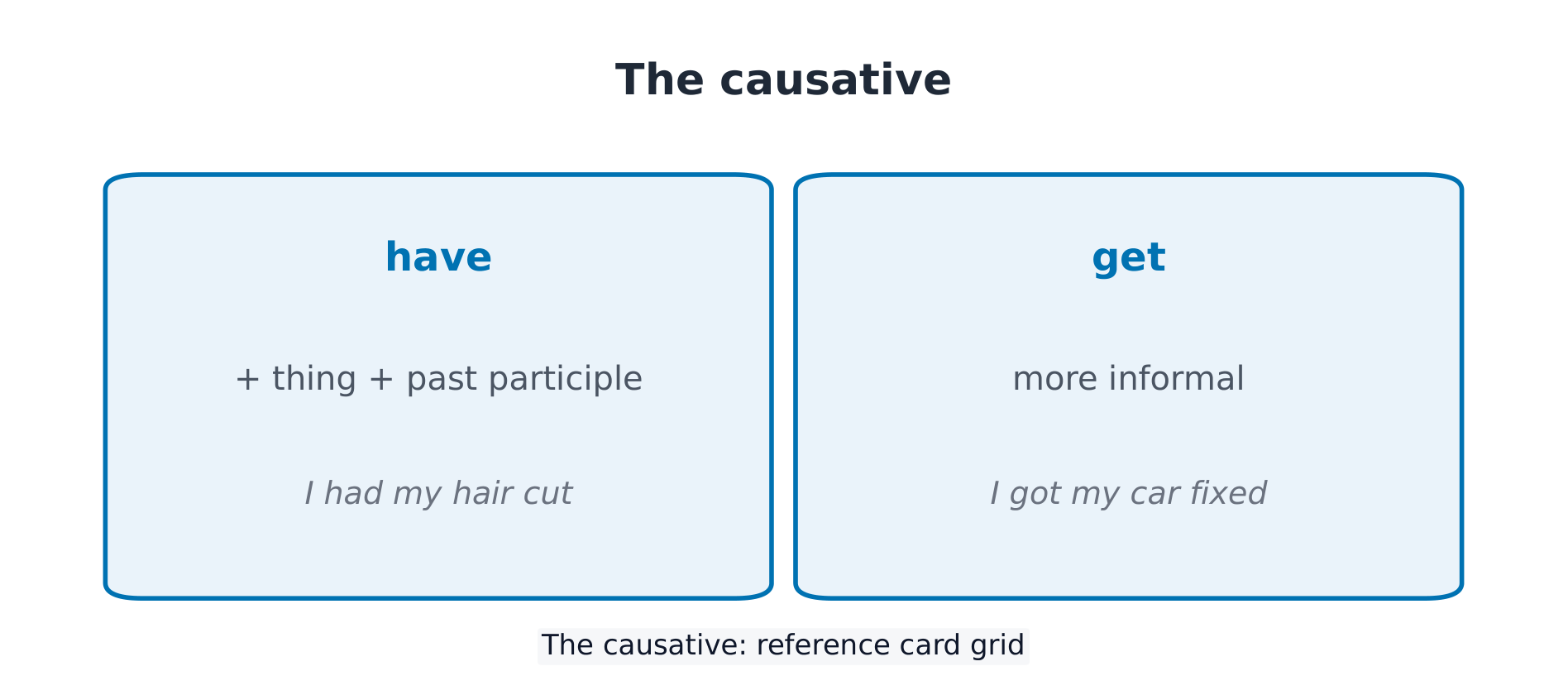
    The causative structure expresses having someone else do something for you, rather than doing it yourself.

    Structure: have + 宾语 + 过去分词

    我I (使役)had 我的my 头发hair 剪cut 昨天yesterday.

    I got my hair cut yesterday. (Not by myself)

    我们We (be)are (使役)having 我们的our 房子house 粉刷painted.

    We are getting the house painted. (By someone else)

    Note: Pay attention to word order: have + object + past participle. I had my car repaired. (I sent it to be fixed) differs from I repaired my car. (I did it myself).

    中文
    使役结构:have/get something done

    使役结构 (the causative) 表示"让别人替你做某事",而不是自己做。

    结构: have + 宾语 + 过去分词

    我I (使役)had 我的my 头发hair 剪cut 昨天yesterday.

    我昨天(请人)剪了头发。(不是自己剪的)

    我们We (be)are (使役)having 我们的our 房子house 粉刷painted.

    我们正在(请人)粉刷房子。

    注意 注意语序:have + 东西 + 过去分词。I had my car repaired.(我把车送去修了。)和 I repaired my car.(我自己修的)意思不同。

    9.2

    get something done

    English

    get + object + past participle functions similarly to have, but is more informal.

    我I 需要need to (使役)get 我的my 手机phone 修理fixed.

    *I need to get my phone repaired.

    她She (使役)got 她的her 照片photo 拍taken.

    She got a photo taken. (By someone else)

    Note: In causative structures, have and get are largely interchangeable; get carries a more casual, conversational tone.

    Common Errors

    • ❌ ~~I cut my hair yesterday.~~ (Actually at the salon) → ✓ I had my hair cut yesterday. — Using the active voice implies you cut it yourself with scissors.
    • ❌ Incorrect word order: ~~I had cut my hair~~ is the past perfect tense ("I had already cut it before then"), not causative; the causative form is have + object + past participle: I had my hair cut.
    • ❌ ~~I had my hair cutted.~~ → ✓ …cut. — The past participle in the causative structure must also be correct: cut–cut–cut remains unchanged.
    • To ask someone to do it: have + person + base form, get + person + to do: I'll have John fix it. / I'll get John to fix it.
    中文

    get + 宾语 + 过去分词 和 have 用法基本相同,但更口语化。

    我I 需要need to (使役)get 我的my 手机phone 修理fixed.

    我得把手机拿去修。

    她She (使役)got 她的her 照片photo 拍taken.

    她(请人)拍了张照片。

    注意 have 和 get 在使役结构里多数情况可互换;get 语气更随意、更口语。

    常见错误

    • ❌ ~~I cut my hair yesterday.~~(其实是理发店剪的)→ ✓ I had my hair cut yesterday. — 说成主动,意思就是你自己拿剪刀剪的。
    • ❌ 语序弄反:~~I had cut my hair~~ 是过去完成时("在那之前我已剪过"),不是使役;使役是 had + 宾语 + 过去分词:I had my hair cut。
    • ❌ ~~I had my hair cutted.~~ → ✓ …cut. — 使役里的过去分词也要用对:cut–cut–cut 不变形。
    • 请某个人做:have + 人 + 原形,get + 人 + to do:I'll have John fix it. / I'll get John to fix it.
  • 10 Contrast linkers · ⁨表示对比的连接词⁩
    10.1

    although, though, even though · ⁨although / though / even though⁩

    English

    These conjunctions express contrast / concession ("although...but..."). They are followed by a complete sentence (subject + verb).

    • although / though: Although. even though: Stronger tone, meaning "even if / despite the fact that".

    虽然Although (天气it)it (过去)was 下雨raining 我们, we 去went 外出out.

    *Although it was raining, we still went out.

    他He 通过passed 尽管, even though 他he 没有hadn't 学习studied.

    *Even though he didn't study, he still passed.

    Note: though can also appear at the end of a sentence to mean "however" (informal): It's expensive. I like it, though.

    中文
    对比连接词:although/despite/however

    这些连接词表示转折 / 让步("虽然……但是……")。它们后面跟一个完整的句子(主语 + 动词)。

    • although / though:虽然。even though:语气更强,"尽管"。

    虽然Although (天气it)it (过去)was 下雨raining 我们, we 去went 外出out.

    虽然在下雨,我们还是出门了。

    他He 通过passed 尽管, even though 他he 没有hadn't 学习studied.

    尽管他没学习,还是通过了。

    注意 though 还能放在句末,表示"不过"(口语):It's expensive. I like it, though.

    10.2

    despite, in spite of · ⁨despite / in spite of⁩

    English

    despite and in spite of have the same meaning as although, but they are followed by nouns / gerunds, not complete sentences.

    尽管Despite (冠词)the 雨rain 我们, we 去went 外出out.

    *Despite the rain, we still went out.

    尽管In spite of 是being 累tired 她, she 继续kept 工作working.

    *Despite being very tired, she continued working.

    Note: Key distinction: although + sentence; despite / in spite of + noun / -ing. ~~despite it was raining~~ ✗ → despite the rain ✓.

    中文

    despite 和 in spite of 意思和 although 一样,但后面跟名词 / 动名词,不跟完整句子。

    尽管Despite (冠词)the 雨rain 我们, we 去went 外出out.

    尽管下着雨,我们还是出门了。

    尽管In spite of 是being 累tired 她, she 继续kept 工作working.

    尽管很累,她还是继续工作。

    注意 关键区别:although + 句子;despite / in spite of + 名词 / -ing。~~despite it was raining~~ ✗ → despite the rain ✓。

    10.3

    however, nevertheless · ⁨however / nevertheless⁩

    English

    however and nevertheless are conjunctive adverbs that connect two sentences, usually placed at the beginning of a sentence followed by a comma.

    (它)It (过去)was 贵expensive 然而. However 我们, we 买bought 它it.

    *It was expensive. However, we still bought it.

    Note: However typically forms its own sentence separated by a comma; do not use it to directly join two clauses like but.

    Common Errors

    • ❌ ~~Although it was raining, but we went out.~~ → ✓ Keep only one: Although it was raining, we went out. / It was raining, but we went out. — Chinese "although...but..." appears in pairs, but English allows only one.
    • ❌ ~~Despite of the rain…~~ → ✓ despite the rain / in spite of the rain — despite never takes of; in spite always takes of; do not mix them.
    • ❌ ~~Even he studied hard, he failed.~~ → ✓ Even though he studied hard… — even alone is not a conjunction; use even though / even if.
    • ❌ ~~It was expensive, however we bought it.~~ → ✓ It was expensive. However, we bought it. (Or using a semicolon: …expensive**; however,** we…) — However cannot join two clauses with just a comma like but.
    中文

    however 和 nevertheless 是连接副词,连接两个句子,常放在句首并加逗号。

    (它)It (过去)was 贵expensive 然而. However 我们, we 买bought 它it.

    它很贵。然而,我们还是买了。

    注意 however 通常单独成句、用逗号隔开;别用它像 but 一样直接连接两个分句。

    常见错误

    • ❌ ~~Although it was raining, but we went out.~~ → ✓ 只留一个:Although it was raining, we went out. / It was raining, but we went out. — 中文"虽然……但是……"成对,英语只能选一边。
    • ❌ ~~Despite of the rain…~~ → ✓ despite the rain / in spite of the rain — despite 从不带 of;in spite 必须带 of;两个别杂交。
    • ❌ ~~Even he studied hard, he failed.~~ → ✓ Even though he studied hard… — even 单独不是连词,要用 even though / even if。
    • ❌ ~~It was expensive, however we bought it.~~ → ✓ It was expensive. However, we bought it.(或用分号:…expensive**; however,** we…)— however 不能像 but 一样用逗号连接两个分句。
  • 11 Articles (advanced) · ⁨冠词(进阶)⁩
    11.1

    泛指 vs 特指

    English

    At B2 level, the difficulty with articles lies in distinguishing generic reference from specific reference:

    • Generic reference (whole categories): Plural / uncountable nouns, no the.
    • Specific reference (particular ones): Use the.

    老虎Tigers 是are 危险dangerous.

    *Tigers are dangerous. (Refers to tigers in general, no the)

    (特指)The 老虎tigers 在at (冠词)the 动物园zoo 是are 困倦sleepy.

    *The tigers in the zoo are sleepy. (Specific, use the)

    Note: Abstract nouns are also used without the for generic reference: Love is important. (Love is important.) But the love of a mother uses the when referring specifically.

    中文
    选择冠词:a/an · the · 零冠词

    到了 B2,冠词的难点在于区分泛指和特指:

    • 泛指(整类事物):复数 / 不可数名词,不加 the。
    • 特指(具体的那些):加 the。

    老虎Tigers 是are 危险dangerous.

    老虎很危险。(泛指所有老虎,不加 the)

    (特指)The 老虎tigers 在at (冠词)the 动物园zoo 是are 困倦sleepy.

    动物园里的那些老虎很困。(特指,加 the)

    注意 抽象名词泛指时也不加 the:Love is important.(爱很重要。)但 the love of a mother(母爱)特指时加 the。

    11.2

    固定搭配

    English

    In many collocations, article usage is fixed and must be memorized as a whole:

    • No article: go to bed / school / work, by car / bus, at home, have breakfast.
    • Use the: in the morning, play the piano, the same, listen to the radio.

    我I 去go (介词)to 上班work 乘by 公交bus.

    *I go to work by bus. (Neither go to work nor by bus takes an article)

    Note: These collocations lack much logical reasoning; memorizing them as fixed phrases is most effective.

    Common Errors

    • ❌ ~~the China / the Japan~~ → ✓ China / Japan; but ✓ the US, the UK, the Netherlands, the Philippines — Only countries with plural forms or "organizational" names take the.
    • ❌ ~~Most of people agree.~~ → ✓ Most people agree. / Most of the people in this room agree. — most goes directly before a noun; most of must be followed by the / my / these etc.
    • Distinguish (British English): be in hospital (admitted as a patient) vs. go to the hospital (go to the building, e.g., to visit someone). The same applies to in prison / at school.
    • the + adjective refers to a class of people: The rich should help the poor.
    中文

    很多搭配里冠词的用法是固定的,要整体记:

    • 不加冠词:go to bed / school / work,by car / bus,at home,have breakfast。
    • 加 the:in the morning,play the piano,the same,listen to the radio。

    我I 去go (介词)to 上班work 乘by 公交bus.

    我坐公交车上班。(go to work、by bus 都不加冠词)

    注意 这些搭配没有太多道理,当作固定短语背下来最有效。

    常见错误

    • ❌ ~~the China / the Japan~~ → ✓ China / Japan;但 ✓ the US、the UK、the Netherlands、the Philippines — 复数形式或"组织式"国名才带 the。
    • ❌ ~~Most of people agree.~~ → ✓ Most people agree. / Most of the people in this room agree. — most 直接加名词;most of 后面必须有 the / my / these 等限定。
    • 区分(英式):be in hospital(住院,当病人)vs go to the hospital(去医院那栋楼,比如探望)。in prison / at school 同理。
    • the + 形容词指一类人:The rich should help the poor.(富人应该帮助穷人。)
  • 12 Emphasis · ⁨强调⁩
    12.1

    so 与 such 表强调

    English

    so and such are used to intensify meaning ('so...that' or 'such...that'), often followed by that to introduce a result.

    • so + adjective / adverb (+ that …).
    • such + (a/an) + adjective + noun (+ that …).

    (它)It (过去)was 如此so 冷cold 以至于that (冠词)the 湖lake 结冰froze.

    It is so cold that the lake has frozen over.

    (它)It (过去)was 如此such 一个a 好good 电影film 以至于that 我I 哭了cried.

    That movie was so good that I cried.

    Note: Follow so with an adjective (so cold); follow such with a noun phrase (such a good film).

    中文
    强调:so / such / do

    so 和 such 用来加强语气("如此……以至于……"),后面常接 that 引出结果。

    • so + 形容词 / 副词(+ that …)。
    • such + (a/an) + 形容词 + 名词(+ that …)。

    (它)It (过去)was 如此so 冷cold 以至于that (冠词)the 湖lake 结冰froze.

    天太冷了,湖都结冰了。

    (它)It (过去)was 如此such 一个a 好good 电影film 以至于that 我I 哭了cried.

    那电影太好了,我都哭了。

    注意 so 后面跟形容词(so cold);such 后面跟名词词组(such a good film)。

    12.2

    so do I, neither do I · ⁨so do I / neither do I⁩

    English

    To express "Me too" or "Me neither," English uses a short inverted structure where the auxiliary verb must match the previous sentence:

    • Affirmative agreement: So + auxiliary verb + subject (So do I / So am I / So can I).
    • Negative agreement: Neither + auxiliary verb + subject (Neither do I / Neither am I).

    "I like tea." — 也So (助动词)do 我I.

    "I like tea." — "Me too."

    "I can't swim." — 也不Neither (助动词)can 我I.

    "I can't swim." — "Neither can I."

    Note: The auxiliary verb must match the tense/verb of the previous sentence: if the previous sentence uses are → So are they; if it uses don't → Neither do I.

    Common Errors

    • ❌ "I love this song." — ~~So am I.~~ → ✓ So do I. — The agreeing auxiliary must match the previous sentence: main verbs → do / does / did; be → am / is; can → can.
    • ❌ "I don't like it." — ~~Me too.~~ → ✓ Me neither. / Neither do I. — Do not use too for negative agreements.
    • ❌ "I can't swim." — ~~So can't I.~~ → ✓ Neither can I. — Negative inversion begins with neither / nor, never so + negative.
    • To emphasize "really," avoid using very + verb: ❌ ~~I very like it.~~ → ✓ I do like it. / I really like it. — Placing the auxiliary do before the verb creates emphasis.
    中文

    表示"我也是 / 我也不是",英语用倒装的简短结构,助动词要和前句呼应:

    • 肯定附和:So + 助动词 + 主语(So do I / So am I / So can I)。
    • 否定附和:Neither + 助动词 + 主语(Neither do I / Neither am I)。

    "I like tea." — 也So (助动词)do 我I.

    "我喜欢茶。""我也是。"

    "I can't swim." — 也不Neither (助动词)can 我I.

    "我不会游泳。""我也不会。"

    注意 助动词要和前句时态 / 动词一致:前句 are → So are they;前句 don't → Neither do I。

    常见错误

    • ❌ "I love this song." — ~~So am I.~~ → ✓ So do I. — 附和的助动词要和前句呼应:实义动词 → do / does / did;be → am / is;can → can。
    • ❌ "I don't like it." — ~~Me too.~~ → ✓ Me neither. / Neither do I. — 否定句的附和不能用 too。
    • ❌ "I can't swim." — ~~So can't I.~~ → ✓ Neither can I. — 否定倒装用 neither / nor 开头,不说 so + 否定。
    • 强调"真的"别再用 very + 动词:❌ ~~I very like it.~~ → ✓ I do like it. / I really like it. — 助动词 do 放在动词前就是强调。

Log in or create account · ⁨登录或创建账户⁩

IGCSE, A-Level · ⁨IGCSE、A-Level⁩ & AP · ⁨与 AP⁩