Space physics
Gravity gathers dust into stars, stars fuse the elements, and the red-shift of distant galaxies tells us the whole universe is expanding from a beginning 14 thousand million years ago. OxfordAQA's final topic closes the course with stellar life cycles, orbits and the Big Bang evidence.
OxfordAQA International GCSE Physics 9203, topic 3.8 (Version 5.1). Statements marked (P) are Paper-2-only.
Life cycle of a star
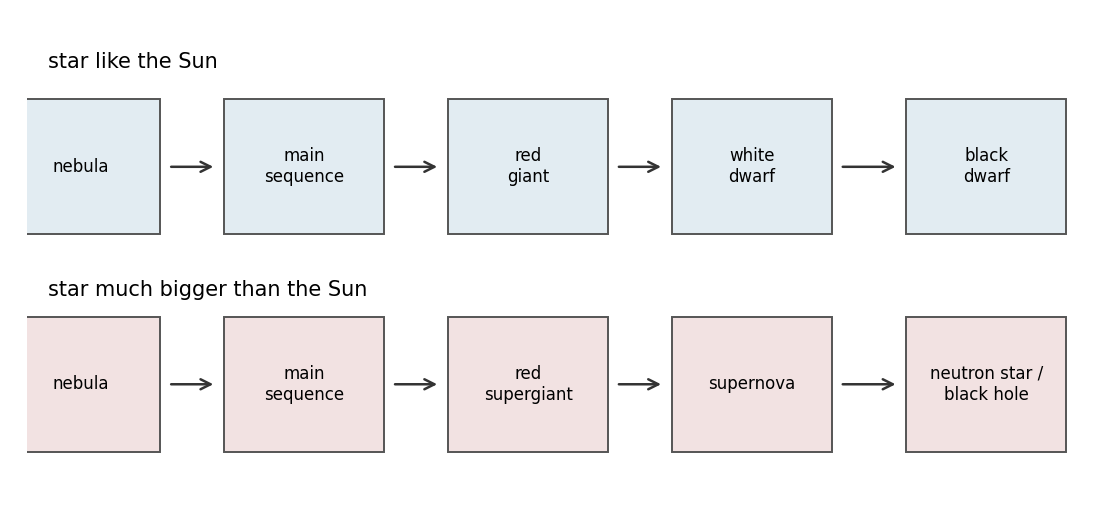
Stars form when gravity pulls dust and gas (mainly hydrogen and helium) together — smaller lumps become planets. In the long main sequence, hydrogen fuses to helium in the core and gravity balances the outward forces. The more massive a star, the hotter its core and the heavier the nuclei it can build by fusion.
When hydrogen runs out, mass decides the ending. A Sun-like star swells to a red giant, sheds its layers, and the exposed core cools from white dwarf to black dwarf. A massive star swells to a red supergiant, fuses ever-heavier elements (carbon, nitrogen, oxygen), then blasts apart as a supernova — scattering the elements (those heavier than iron are made in the explosion itself) — leaving a neutron star or black hole. Fusion in stars and supernovae made every naturally occurring element: the early universe held only hydrogen.
Solar system and orbital motion
The solar system: eight planets orbiting the Sun, plus moons, asteroids, dwarf planets and comets. The Milky Way is one of thousands of millions of galaxies, each with thousands of millions of stars. Artificial satellites orbit Earth in geostationary or low polar orbits.
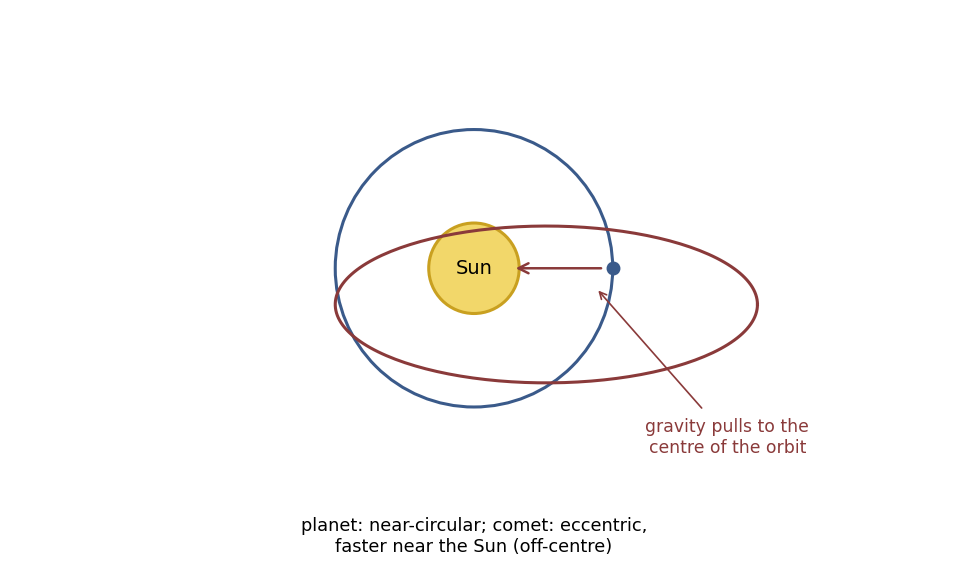
Gravity supplies the centripetal force: it acts towards the centre, changing the direction of motion (velocity) without changing speed. Greater separation means weaker gravity, so lower orbital speed: to stay at a particular radius, a satellite must move at the matching speed — change the speed and the orbit changes radius.
Red shift and the expanding universe (P)
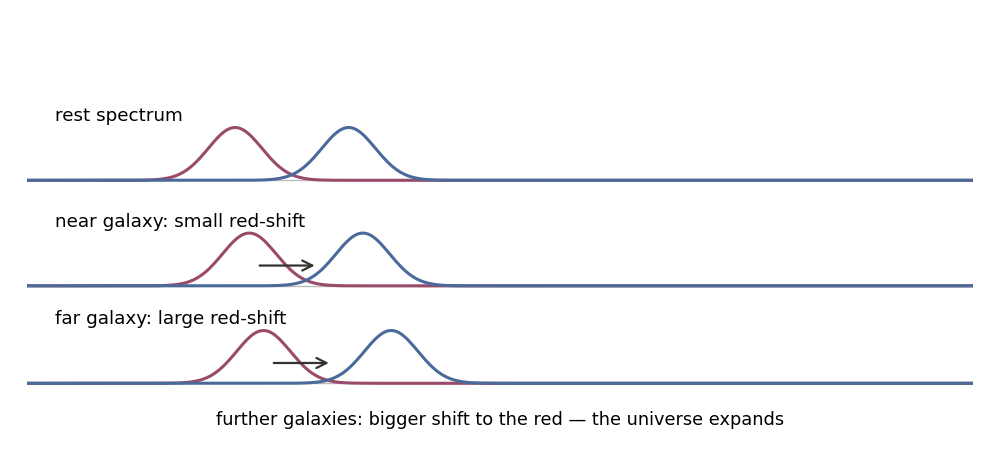
A moving wave source changes the observed wavelength (the Doppler effect): receding sources stretch waves — longer wavelength, lower frequency. The further a galaxy, the faster it recedes and the bigger the red-shift 红移 — space itself is expanding, pointing back to a very small beginning: the Big Bang 大爆炸. The cosmic microwave background 宇宙微波背景 — radiation filling the universe from shortly after that beginning — is the second pillar; the Big Bang theory is currently the only theory that explains it.
Check yourself
- What pulls dust and gas into stars?
- What happens in a main-sequence star's core?
- List the three stages a Sun-like star passes through after its main sequence.
- Which stars become supernovae?
- Where are elements heavier than iron made?
- Name the two artificial-satellite orbit types.
- Why does a satellite in a higher orbit move more slowly?
- (P) What happens to a wave's wavelength when its source recedes?
- (P) State the two pieces of evidence for the Big Bang.
- (P) What is the CMBR?
Answers: 1 gravitational attraction; 2 hydrogen nuclei fuse to helium, releasing energy, with gravity balanced; 3 red giant, white dwarf, black dwarf (three stages after the main sequence); 4 stars much more massive than the Sun; 5 in supernova explosions; 6 geostationary and low polar; 7 gravity weakens with separation, so the centripetal force — and the speed it demands — is smaller; 8 (P) it increases (red-shift), and the observed frequency falls; 9 (P) galaxy red-shift increasing with distance, and the cosmic microwave background; 10 (P) electromagnetic radiation filling the universe, left over from shortly after the Big Bang.