Electricity and magnetism
Electricity is charge on the move, guided by potential difference, resisted by every component — and every current makes a magnetic field. OxfordAQA's largest topic builds the circuit toolkit, the component behaviours, and the electromagnets that follow.
OxfordAQA International GCSE Physics 9203, topic 3.5 (Version 5.1). Statements marked (P) are Paper-2-only.
Electrical circuits
Metals conduct because they have free electrons; (P) an isolated charge imbalance is static electricity, discharged when a conducting route appears (lightning). Current is the rate of flow of charge:
Voltage drives charge round a circuit; potential difference across a component measures the energy transferred per unit charge (volts = joules per coulomb). Learn the standard symbols — switch, lamp, fuse, cell, battery, diode, resistor, variable resistor, thermistor, LDR, LED, ammeter and voltmeter.
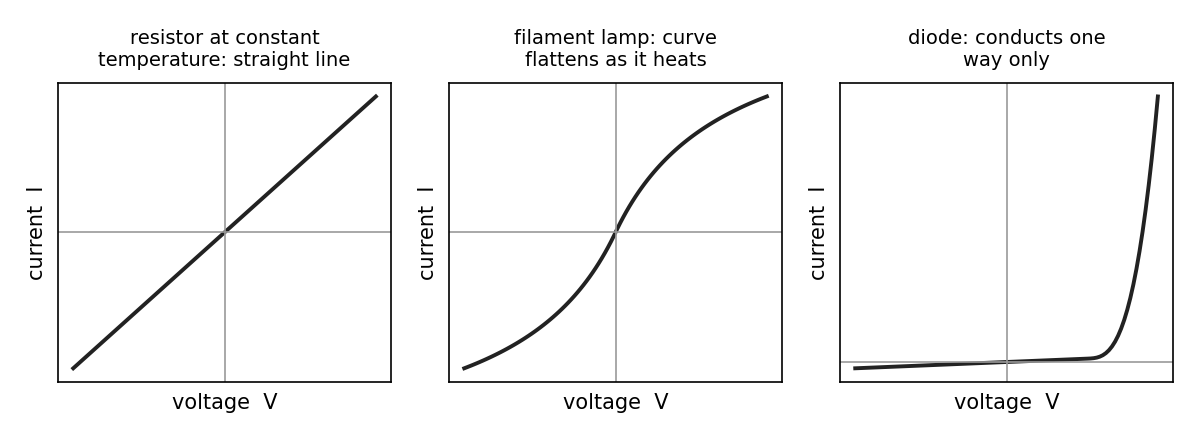
At constant temperature a resistor's V–I graph is a straight line (ohmic); a filament lamp curves as its ions vibrate more with temperature; a diode conducts forward only; (P) a thermistor's resistance falls as temperature rises (thermostats); an LDR's falls as light rises (automatic lighting); an LED emits light forward and saves energy versus filament and CFL lamps.
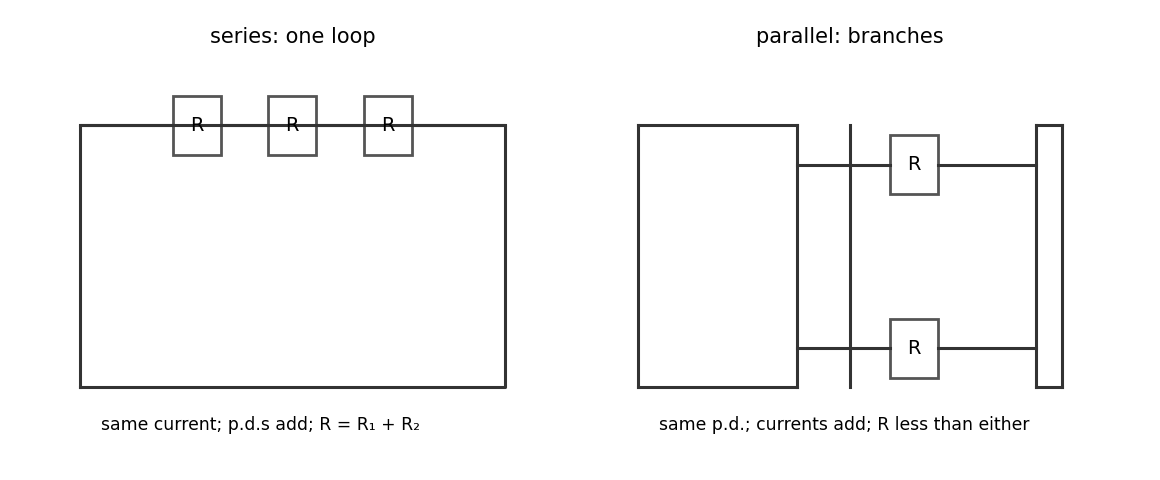
Series: same current, p.d.s shared, resistances add. Parallel: same p.d., currents split, combined resistance less than either. Charge colliding with the lattice heats every resistor.
Worked check. A 230 V lamp draws 0.25 A: $R = 230/0.25 = 920\ \Omega$. Two 4 Ω resistors in series across 12 V carry $I = 12/8 = 1.5$ A; in parallel, $R = 2\ \Omega$ and the supply gives $I = 12/2 = 6$ A.
Magnetism and electromagnetism
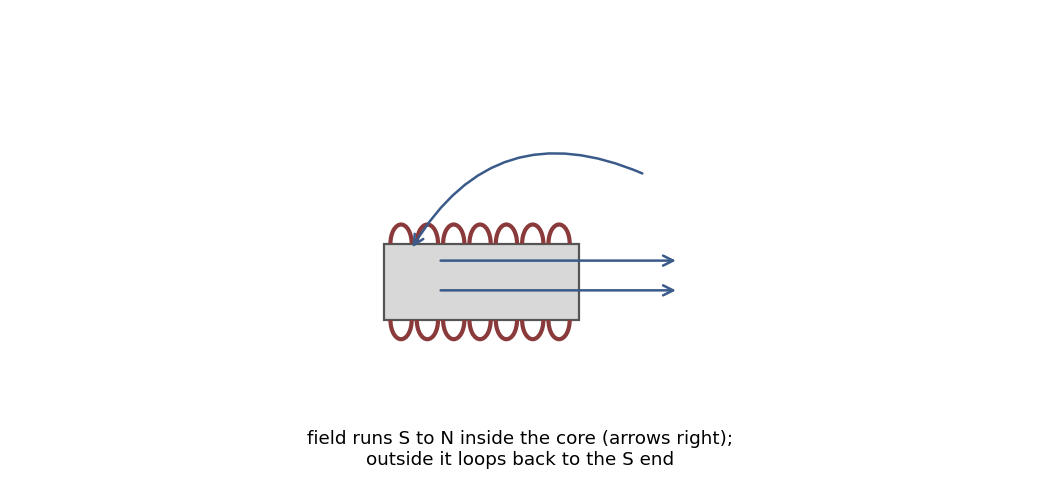
Poles: like repel, unlike attract — non-contact forces. Field lines run N to S outside a magnet; opposite poles facing give a uniform field between them. An induced magnet attracts while in the field and loses magnetism on removal; the Earth's field lets a plotting compass navigate.
A current-carrying wire has circular field lines around it (stronger current → stronger field; reverse current → reverse direction). A solenoid 螺线管 concentrates the field; with a soft-iron core it is an electromagnet 电磁铁 — switchable, adjustable, used in scrapyard cranes, relays and door locks. Required practical: the factors determining an electromagnet's strength.
Check yourself
- Why do metals conduct?
- State the relationship between current, charge and time with units.
- Calculate the charge flowing when 2 A passes for 30 s.
- State the V-I shape for a resistor at constant temperature and for a filament lamp.
- (P) What happens to a thermistor's resistance as temperature rises?
- State the current and p.d. rules for series and for parallel connections.
- Calculate R for a 12 V supply pushing 0.5 A.
- State the pole rule and the direction of field lines outside a magnet.
- What is an induced magnet?
- Name two ways to strengthen an electromagnet.
Answers: 1 they contain free electrons that drift when a p.d. is applied; 2 Q = It, charge in coulombs = current in amperes × time in seconds; 3 Q = 2 × 30 = 60 C; 4 straight line through the origin; S-curve flattening as current (and so temperature) rises; 5 (P) it falls — used in thermostats; 6 series — same current everywhere, p.d.s add; parallel — same p.d. across branches, currents add; 7 R = 12/0.5 = 24 Ω; 8 like poles repel, unlike attract; N to S outside the magnet; 9 a magnetic material that becomes a magnet only while placed in a field — attraction only, losing most magnetism on removal; 10 more turns on the coil; larger current (also a soft-iron core).