Energy: the accountant of physics
Nothing destroys energy — it is only moved between stores and partly dissipated into less useful forms. OxfordAQA's second topic builds the accounting: work and power, the three energy-store equations, conservation with Sankey diagrams, and the choices behind national energy resources.
OxfordAQA International GCSE Physics 9203, topic 3.2 (Version 5.1). Statements marked (P) are Paper-2-only.
Forces and energy
Work 功 is done when a force moves its point of application through a distance; work against friction transfers energy by heating (shuttle re-entry, meteorites, brakes). A stretched spring stores elastic potential energy $\frac{1}{2}ke^2$; a raised mass stores gravitational potential energy mgh; a moving mass carries kinetic energy ½mv² — doubling mass doubles it, doubling speed quadruples it (the road-safety link). Power 功率 is the rate of energy transfer.
Worked check. A 1500 kg car at 20 m/s brakes to rest: KE removed $= \frac{1}{2} \times 1500 \times 400 = 300\,000$ J — all transferred to heating the brakes. Lifting it 2 m at g = 10 N/kg stores $1500 \times 10 \times 2 = 30\,000$ J.
Energy transfers and dissipation
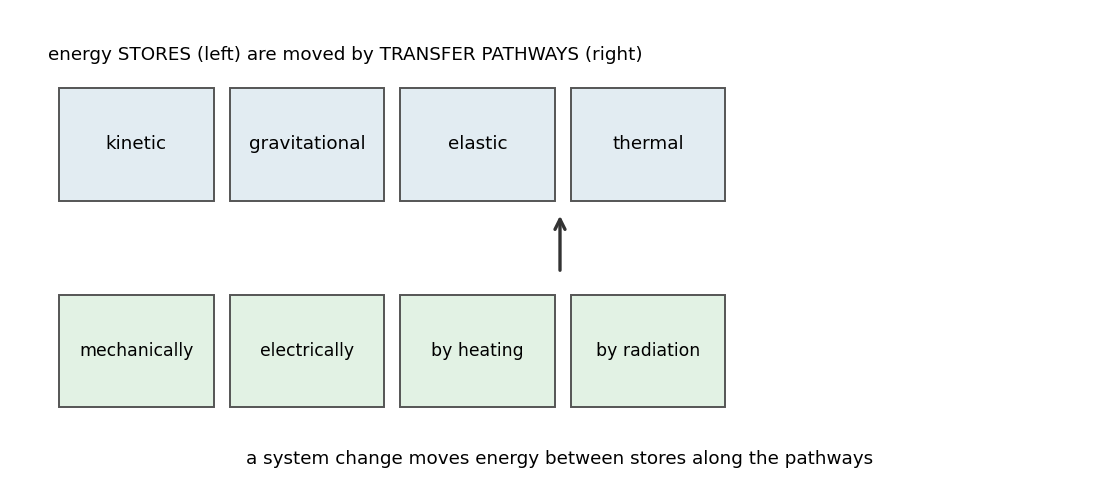
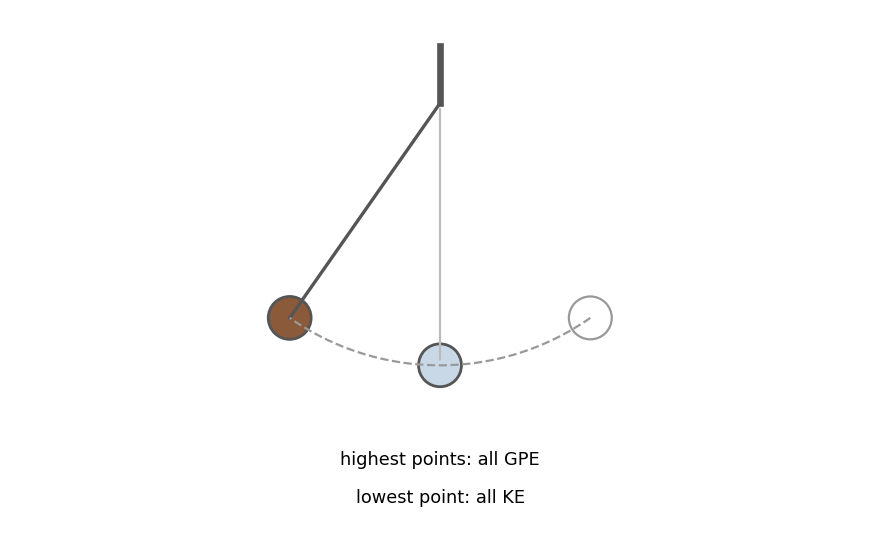
When a system changes, energy is transferred — usefully, stored, or dissipated 耗散 ("wasted") into less useful stores; it is never created or destroyed. Friction and air resistance dissipate energy by heating. (P) A pendulum swaps kinetic and gravitational potential energy each swing.
Sankey diagrams show the redistribution: arrows split in proportion to the energy flows (draw them to scale — width ∝ energy).
Worked check. A 60 W lamp gives 6 W of light: efficiency 效率 $= 6/60 \times 100 = 10\%$.
Energy resources
Fuels are chosen for ease of storage, energy content and safety; some transfer more of their energy usefully than others. National generation trades renewability against cost, reliability and the environmental cost of extraction, use and disposal.

Check yourself
- Calculate the work done by a 50 N force moving 4 m.
- Calculate the elastic energy in a spring (k = 200 N/m) stretched 0.15 m.
- A 2 kg book is lifted 3 m at g = 10 N/kg. Calculate the GPE gained.
- What happens to the kinetic energy of a car when it brakes?
- A motor transfers 800 J in 20 s. Calculate its power.
- State the efficiency equation in energy and power forms.
- A lamp gives out 12 J of light for every 100 J in. Calculate the efficiency.
- What does a Sankey diagram's arrow width show?
- Give one advantage and one drawback of wind power.
- What does "dissipated" mean?
Answers: 1 $W = 50 \times 4 = 200$ J; 2 $E_e = \frac{1}{2} \times 200 \times 0.0225 = 2.25$ J; 3 $E_p = 2 \times 10 \times 3 = 60$ J; 4 it is transferred to thermal energy of the brakes and surroundings by the friction force (the brakes heat up); 5 $P = 800/20 = 40$ W; 6 useful energy out ÷ total energy in (×100 %); equally useful power out ÷ total power in; 7 $12/100 \times 100 = 12\%$; 8 the energy flowing in that direction — width is proportional to energy; 9 renewable with no fuel or emissions; unreliable output with visual impact; 10 transferred to less useful stores (often waste heat), so it cannot readily do what we want.