Waves: carrying energy and information
Waves move energy from a source to a receiver without moving matter — light to an eye, sound to an ear, radio to a phone. This topic builds the wave model (frequency, wavelength, speed), then applies it across the electromagnetic spectrum, to sound and (P) ultrasound, reflection, refraction with total internal reflection, and (P) lenses and the eye.
OxfordAQA International GCSE Physics 9203, topic 3.3 (Version 5.1). Statements marked (P) are Paper-2-only.
General properties of waves
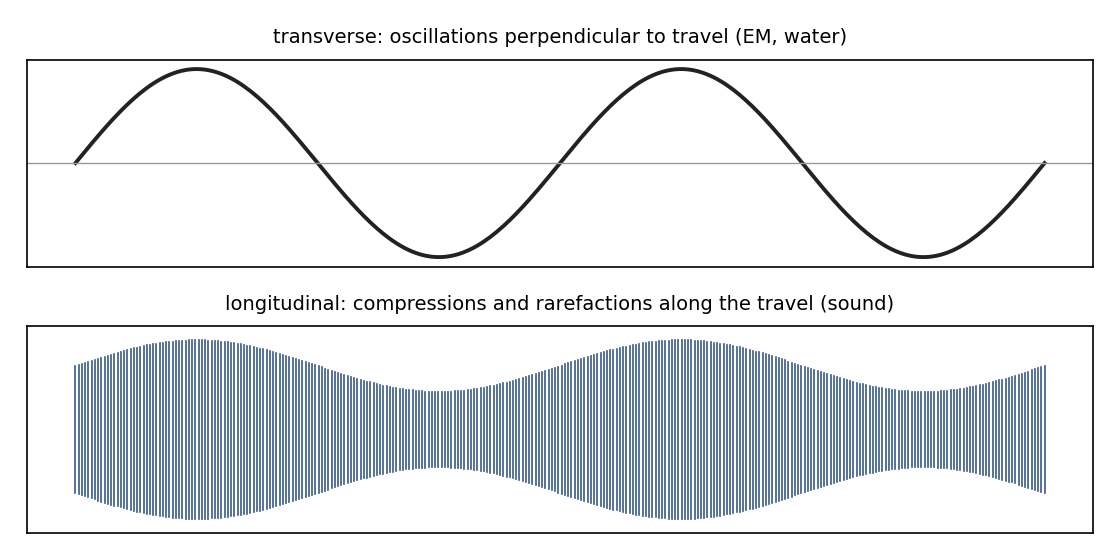
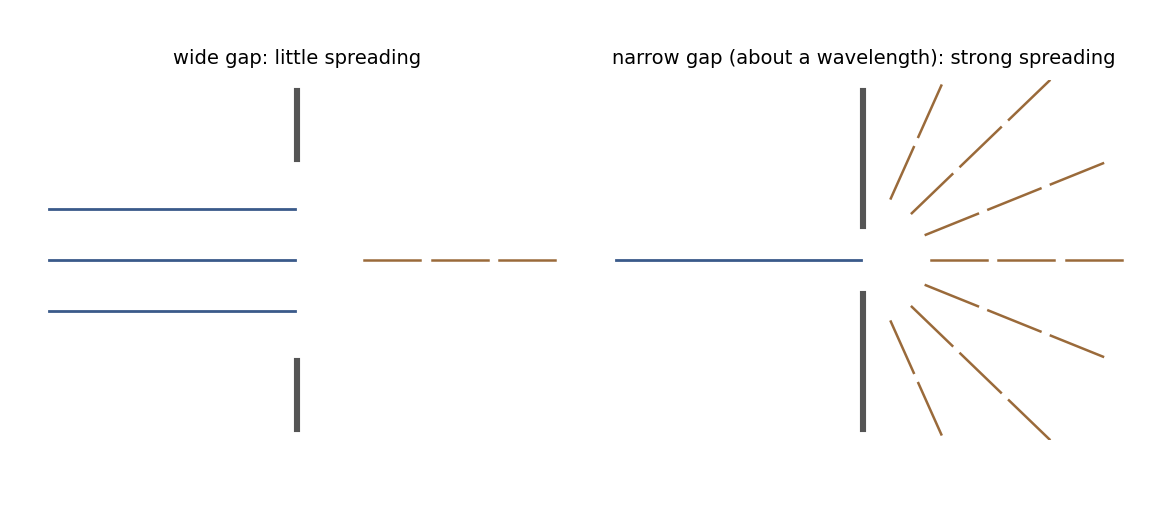
Transverse 横波: oscillations perpendicular to travel — electromagnetic and water waves. Longitudinal 纵波: oscillations parallel, as compressions and rarefactions — sound; mechanical waves may be either. At a boundary, waves are reflected, transmitted or absorbed; refraction 折射 comes from a change of velocity between media, and diffraction 衍射 spreads waves through a gap — strongly when the gap is comparable to the wavelength.
Amplitude, wavelength, frequency, period and wavefront define any wave, and:
Worked check. A water wave of frequency 2 Hz and wavelength 1.5 m travels at $2 \times 1.5 = 3$ m/s.
The electromagnetic spectrum
One continuous family, all transverse, all at the same speed in vacuum, ordered from radio (10⁴ m and beyond) down to gamma (10⁻¹⁵ m). Visible light is the narrow band our eyes detect — different wavelengths are different colours. Every object emits and absorbs infrared; (P) hotter objects radiate more and at higher frequencies (black-body radiation), dark matt surfaces absorb and emit best, light shiny ones reflect.
Uses: radio — TV and radio including Bluetooth; microwaves — phones, satellite TV; infrared — remotes, night vision, heating; visible — photography, fibre optics; UV — security marking; X-rays — medical imaging; gamma — sterilising instruments and food. Hazards: microwaves heat tissue; infrared burns; UV causes skin cancer and blindness; X-rays kill cells in high doses; gamma causes mutations — limit exposure time and distance, and shield.
X-rays: very short wavelength, high energy, ionising; they affect photographic film, are absorbed by metal and bone, and are transmitted by soft tissue — the basis of CT, fracture and dental imaging, and of cancer treatment (with careful monitoring of workers' doses).
Sound and ultrasound
Sound is longitudinal, vibrating a medium, heard between 20 Hz and 20 000 Hz; pitch follows frequency, loudness follows amplitude. Sound reflects (echoes) and diffracts. (P) Ultrasound 超声波 lies above 20 kHz: at a boundary between media it partially reflects, and the echo time locates the boundary:
Worked check. An ultrasound pulse returns from a fetus boundary after $6.0 \times 10^{-5}$ s (speed 1500 m/s in tissue): boundary depth $= 1500 \times 6.0\times10^{-5}/2 = 4.5$ cm — divide by two for the round trip. Uses: prenatal scanning, breaking kidney stones.
Reflection and refraction
Law of reflection: angle of incidence = angle of reflection, measured from the normal. A plane mirror gives a virtual, upright, laterally inverted image; construct ray diagrams with the normal drawn in. (P) Light entering a denser medium slows and bends towards the normal; into a less dense one, away; a prism disperses white light into a spectrum. Refractive index compares speeds:
Beyond the critical angle in the denser medium, light is totally internally reflected — how optical fibres carry visible light and infrared for medicine (endoscopes) and communications. Required practical: refraction of light by different substances.
Lenses and the eye (P)
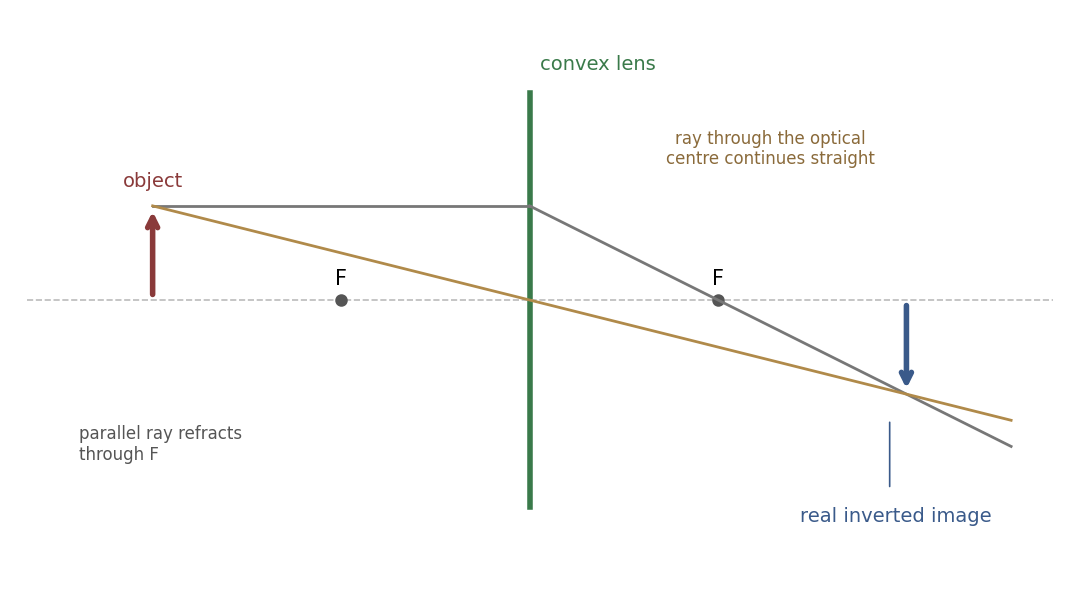
A convex (converging) lens brings parallel rays to the principal focus (focal length from the lens); a concave (diverging) lens spreads them as if from the focus. Images are described as larger/smaller, upright/inverted, real/virtual — ray diagrams on graph paper show them, and magnification = image height ÷ object height. A converging lens held close acts as a magnifying glass (virtual, upright, enlarged).
The eye: retina (detector), cornea (main refraction), variable-focus lens, pupil/iris (aperture), ciliary muscle and suspensory ligaments (change lens shape). Near point ≈ 25 cm; far point at infinity. Long sight (eyeball too short) is corrected with a convex lens; short sight (too long) with a concave lens; lasers can reshape the cornea in surgery. Against a camera: the eye focuses by changing lens shape, the camera by changing the lens–film distance; the retina plays the CCD's role.
Check yourself
- Give the oscillation directions of transverse and longitudinal waves, with one example of each.
- State v = fλ and calculate the speed of a 500 Hz wave of wavelength 0.68 m.
- When is diffraction strongest through a gap?
- Order the EM spectrum by increasing frequency.
- Which surfaces best absorb infrared?
- State the frequency range of human hearing.
- (P) An ultrasound echo returns in 0.0001 s from 15 cm deep. What is the speed?
- State the law of reflection and the nature of a plane-mirror image.
- (P) Glass has n = 1.5. Calculate the critical angle.
- (P) Which lens corrects short sight, and why?
Answers: 1 perpendicular — light; parallel, compressions — sound; 2 $v = 500 \times 0.68 = 340$ m/s; 3 gap ≈ one wavelength; 4 radio → microwave → IR → visible → UV → X-ray → gamma; 5 dark, matt; 6 20 Hz–20 kHz; 7 (P) $v = 0.3/10^{-4} = 3000$ m/s (round trip).
Answers continued: 8 i = r; virtual, upright, laterally inverted; 9 (P) $\sin c = 1/1.5$, $c \approx 41.8°$; 10 (P) a concave lens — it spreads light so the too-long eye focuses it on the retina.