| Candidates should be able to: | Notes and guidance |
|---|---|
| 1 Declare and use variables and constants | |
| 2 Understand and use basic data types | • Including: – integer – real – char – string – Boolean |
| 3 Understand and use input and output | |
| 4 (a) Understand and use the concept of sequence | |
| (b) Understand and use the concept of selection | • Including: – IF statements – CASE statements |
| (c) Understand and use the concept of iteration | • Including: – count-controlled loops – pre-condition loops – post-condition loops |
| (d) Understand and use the concepts of totalling and counting | |
| (e) Understand and use the concept of string handling | • Including: – length – substring – upper – lower • The first character of the string can be position zero or one |
| (f) Understand and use arithmetic, relational and logical operators | • Arithmetic, limited to: – + – – – / – * – ^ (raised to power of) – MOD – DIV • Relational, limited to: – = – < – <= – > – >= – <> (not equal to) • Logical, limited to: – AND – OR – NOT |
| 5 Understand and use nested statements | • Including nested selection and iteration • Candidates will not be required to write more than three levels of nested statements |
| 6 (a) Understand what is meant by procedures, functions and parameters (b) Define and use procedures and functions, with or without parameters (c) Understand and use local and global variables | • Procedures and functions may have up to three parameters |
| 7 Understand and use library routines | • Including: – MOD – DIV – ROUND – RANDOM |
| 8 Understand how to create a maintainable program | • Including appropriate use of: – meaningful identifiers – the commenting feature provided by the programming language – procedures and functions – relevant and appropriate commenting of syntax • Use meaningful identifiers for: – variables – constants – arrays – procedures and functions |
程序设计
IGCSE 计算机科学 · 第 8 主题
 13:16
13:16
Programming
Here is a short program. It reads five test marks and prints the total. The five marks are eight, nine, seven, six and ten, so the total should be forty. Watch…
英文讲解 · 内嵌中英文字幕
8.1
编程概念

大纲
来源:剑桥国际大纲
一个变量(variable)是一个有名字的存储,容纳一个在程序运行时能改变的值。一个常量(constant)是一个有名字的存储,它的值是固定的、不改变。

你应当在使用前声明(declare)它们(说它们的名称和类型):
DECLARE score : INTEGER
DECLARE name : STRING
CONSTANT Pi = 3.142

对一个从不改变的值(如 Pi)用一个常量,所以它在一处被设定,而且容易阅读。
探索
Variables and assignment
Step through the lines and watch each variable take its new value.
词汇表
训练
| 英文 | 中文 | 拼音 |
|---|---|---|
| variable/ˈveərɪəbl/ | 变量 | biàn liàng |
| constant/ˈkɒnstənt/ | 常量 | cháng liàng |
| declare/dɪˈkleə/ | 声明 | shēng míng |
| integer/ˈɪntɪdʒə/ | 整数 | zhěng shù |
| string/strɪŋ/ | 字符串 | zì fú chuàn |
8.1
数据类型

一个数据类型(data type)说明一个变量容纳什么种类的值。你必须知道五种基本类型。
| 类型 | 容纳 | 例子 |
|---|---|---|
| 整数(integer) | 一个整数 | 42、-7 |
| 实数(real) | 一个带小数点的数 | 3.14、-0.5 |
| 字符(char) | 一个单一字符 | 'A'、'?' |
| 字符串(string) | 一个字符序列 | "Hello" |
| 布尔值(Boolean) | 两个值之一 | TRUE 或 FALSE |
词汇表
训练
| 英文 | 中文 | 拼音 |
|---|---|---|
| data type/ˈdeɪtə taɪp/ | 数据类型 | shù jù lèi xíng |
| real/rɪəl/ | 实数 | shí shù |
| char/tʃɑː/ | 字符 | zì fú |
| Boolean/ˈbuːlɪən/ | 布尔值 | bù ěr zhí |
8.1
输入与输出
输入(input)从用户读一个值。输出(output)在屏幕上显示一个值。
OUTPUT "What is your name?"
INPUT name
OUTPUT "Hello ", name
词汇表
训练
| 英文 | 中文 | 拼音 |
|---|---|---|
| input/ˈɪnpʊt/ | 输入 | shū rù |
| output/ˈaʊtpʊt/ | 输出 | shū chū |
8.1
三种基本结构

每个程序从三个控制结构构建。
Sequence
顺序(sequence)意味着步骤一个接一个地运行,按顺序,从上到下。
INPUT length
INPUT width
area ← length * width
OUTPUT area
Selection
选择(selection)基于一个条件选择哪些步骤运行。用一个 IF 语句,或当有许多选择时用一个 CASE 语句。
IF score >= 50 THEN
    OUTPUT "Pass"
ELSE
    OUTPUT "Fail"
ENDIF
CASE OF grade
    'A' : OUTPUT "Excellent"
    'B' : OUTPUT "Good"
    OTHERWISE : OUTPUT "Keep trying"
ENDCASE
Iteration
迭代(iteration,一个循环(loop))重复步骤。有三种。
一个计数循环(count-controlled loop)重复一个固定的次数:
FOR i ← 1 TO 5
    OUTPUT "Hello"
NEXT i
一个前测循环(pre-condition loop)在每次重复之前检查条件,所以它可能运行零次:
WHILE answer <> "stop" DO
    INPUT answer
ENDWHILE
一个后测循环(post-condition loop)在每次重复之后检查条件,所以它总是运行至少一次:
REPEAT
    INPUT password
UNTIL password = "secret"

探索
How an IF … ELSE IF ladder decides
The conditions are tested top to bottom; the FIRST one that is true runs and the rest are skipped. Slide the score and watch which branch lights up.
探索
Selection
Change the value and watch which branch runs — selection in action.
词汇表
训练
| 英文 | 中文 | 拼音 |
|---|---|---|
| sequence/ˈsiːkwəns/ | 顺序 | shùn xù |
| selection/sɪˈlekʃn/ | 选择 | xuǎn zé |
| iteration/ˌɪtəˈreɪʃn/ | 迭代 | dié dài |
| loop/luːp/ | 循环 | xún huán |
| count-controlled loop/kaʊnt kənˈtrəʊld luːp/ | 计数循环 | jì shù xún huán |
| pre-condition loop/priː kənˈdɪʃn luːp/ | 前测循环 | qián cè xún huán |
| post-condition loop/pəʊst kənˈdɪʃn luːp/ | 后测循环 | hòu cè xún huán |
| length/leŋθ/ | 长度 | cháng dù |
8.1
求和与计数

- 求和(totalling)——不断把值加到一个运行中的总数:
total ← total + value。 - 计数(counting)——每次给一个计数器加 1:
count ← count + 1。
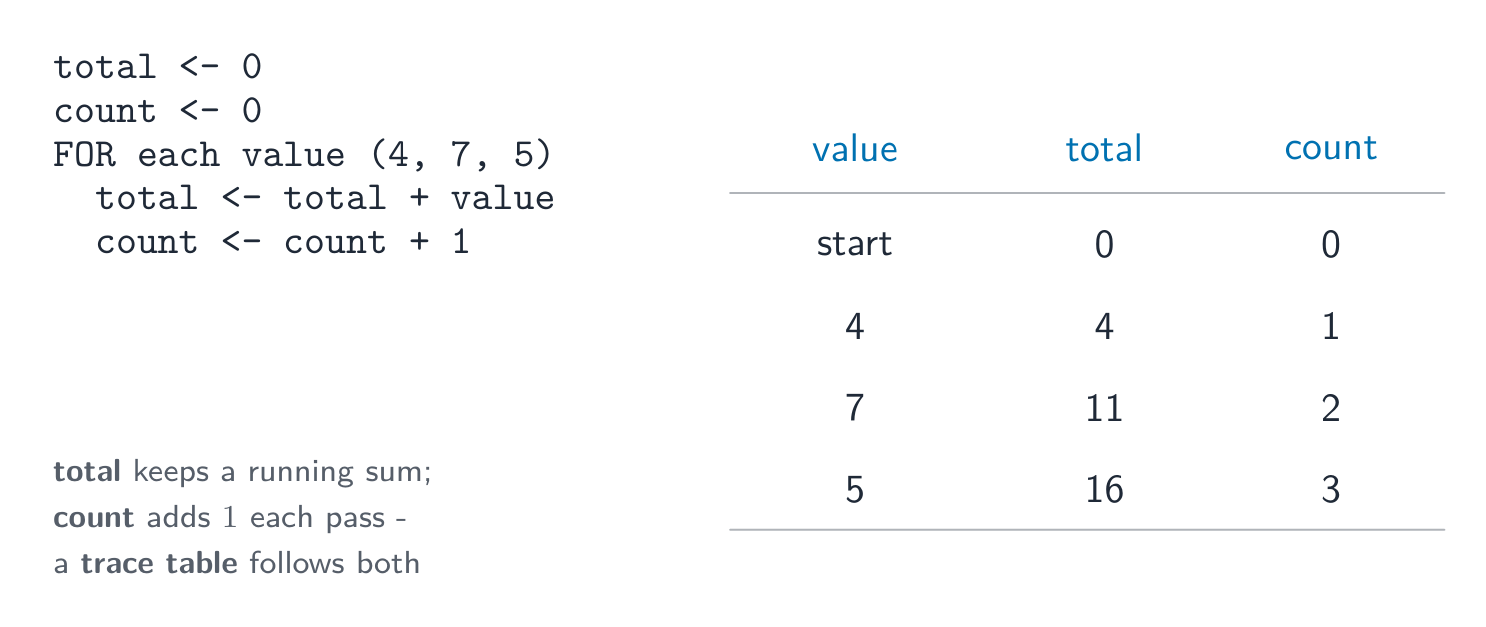
total ← 0
FOR i ← 1 TO 10
    INPUT mark
    total ← total + mark
NEXT i
OUTPUT total
例题。 一个程序要读入 5 个分数,然后输出总分和平均分。
total ← 0
FOR i ← 1 TO 5
    INPUT mark
    total ← total + mark
NEXT i
average ← total / 5
OUTPUT total, average
有两行是得分点。total ← 0 必须放在循环之前:放进循环里,总和每次都会被清零,程序最后只会输出最后一个分数。而 average ← total / 5 必须放在循环之后,因为在所有分数都加完之前,总和还不完整。先初始化,后计算 - 这个先后顺序才是题目真正考的东西。
词汇表
训练
| 英文 | 中文 | 拼音 |
|---|---|---|
| totalling/ˈtəʊtəlɪŋ/ | 求和 | qiú hé |
| counting/ˈkaʊntɪŋ/ | 计数 | jì shù |
8.1
运算符
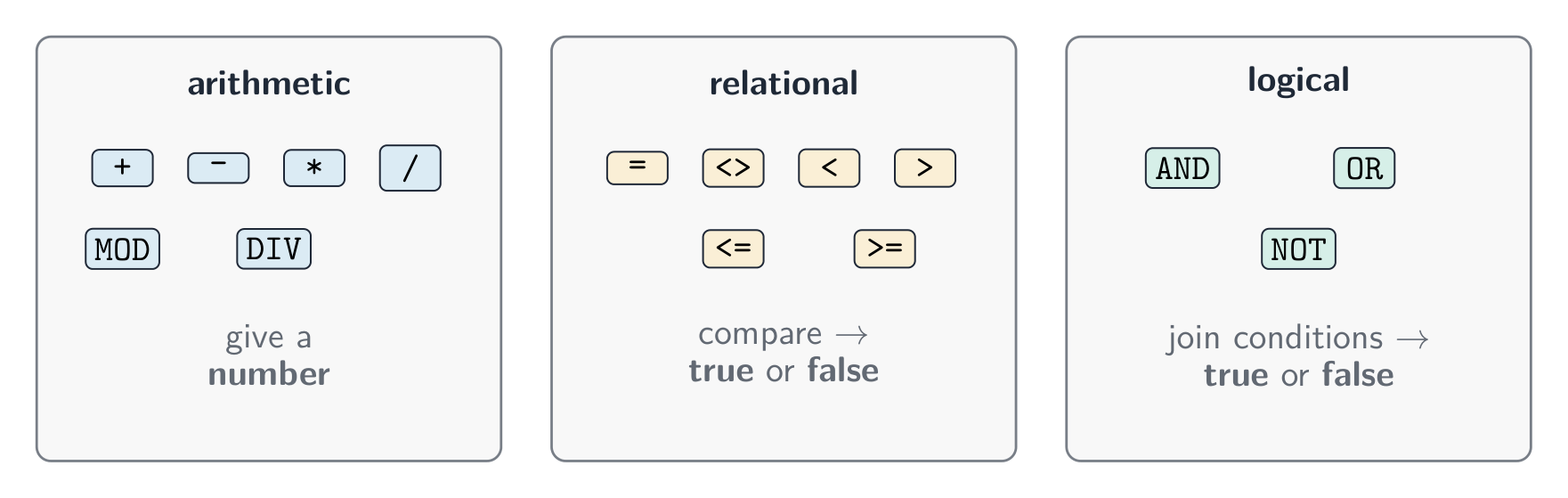
Arithmetic operators
| 运算符 | 意义 |
|---|---|
+ - * / |
加、减、乘、除 |
^ |
提升到……次幂 |
MOD |
除法后的余数(remainder) |
DIV |
一个除法的整数部分 |
例如,17 MOD 5 是 2,而 17 DIV 5 是 3。
Relational operators
这些比较两个值并给出一个布尔结果:=、<、<=、>、>=,以及 <>(不等于)。
Logical operators
这些连接条件:AND(两者都必须为真)、OR(至少一个必须为真)、NOT(反转真/假)。
IF age >= 13 AND age <= 19 THEN
    OUTPUT "Teenager"
ENDIF
词汇表
训练
| 英文 | 中文 | 拼音 |
|---|---|---|
| remainder/rɪˈmeɪndə/ | 余数 | yú shù |
8.1
字符串处理
一个字符串由字符构成。有用的操作:
- 长度(length)——字符串中字符的数目;
- 子串(substring)——从字符串取出的一个更小的部分;
- 大写(upper case)——把字母改成大写;
- 小写(lower case)——把字母改成小写。
name ← "Computer"
OUTPUT LENGTH(name)          // 8
OUTPUT SUBSTRING(name, 1, 4) // "Comp"
OUTPUT UCASE(name)           // "COMPUTER"
OUTPUT LCASE(name)           // "computer"
(第一个字符可能被数为位置 0 或位置 1,取决于语言。)
探索
Index and slice a string
Every character has a position (index). A slice takes the characters from the start index up to — but not including — the end index, just like SUBSTRING does.
词汇表
训练
| 英文 | 中文 | 拼音 |
|---|---|---|
| substring/ˈsʌbstrɪŋ/ | 子串 | zi chuàn |
| upper case/ˈʌpə keɪs/ | 大写 | dà xiě |
| lower case/ˈləʊə keɪs/ | 小写 | xiǎo xiě |
8.1
嵌套语句
一个嵌套语句(nested statement)是放在另一个里面的一个控制结构。你可以嵌套选择和迭代。
FOR i ← 1 TO 3
    IF i MOD 2 = 0 THEN
        OUTPUT i, " is even"
    ELSE
        OUTPUT i, " is odd"
    ENDIF
NEXT i
你不会必须写多于三层的嵌套。
词汇表
训练
| 英文 | 中文 | 拼音 |
|---|---|---|
| nested statement/ˈnestɪd ˈsteɪtmənt/ | 嵌套语句 | qiàn tào yǔ jù |
8.1
过程与函数
为了避免重复代码,你可以把一个程序分成有名字的块。
- 一个过程(procedure)是做一个任务的一个有名字的代码块。你用
CALL运行它。 - 一个函数(function)像一个过程,但它把一个值返回到它被调用的地方。
一个参数(parameter)是一个传入一个过程或函数的值(最多三个参数)。
PROCEDURE Greet(personName : STRING)
    OUTPUT "Hello ", personName
ENDPROCEDURE

CALL Greet("Sam")
FUNCTION Square(n : INTEGER) RETURNS INTEGER
    RETURN n * n
ENDFUNCTION

answer ← Square(5)   // answer is 25
Local and global variables
- 一个局部变量(local variable)在一个过程或函数里面声明。它只能在那里被使用。
- 一个全局变量(global variable)在主程序中声明。它能在任何地方被使用。
局部变量更安全,因为它们不能被程序另一部分错误地改变。
词汇表
训练
| 英文 | 中文 | 拼音 |
|---|---|---|
| procedure/prəˈsiːdʒə/ | 过程 | guò chéng |
| function/ˈfʌŋkʃn/ | 函数 | hán shù |
| parameter/pəˈræmɪtə/ | 参数 | cān shù |
| local variable/ˈləʊkl ˈveərɪəbl/ | 局部变量 | jú bù biàn liàng |
| global variable/ˈɡləʊbl ˈveərɪəbl/ | 全局变量 | quán jú biàn liàng |
8.1
库函数
一个库程序(library routine)是你能使用的一段现成的代码。你必须知道这些:
| 程序 | 它做什么 |
|---|---|
MOD |
给一个除法的余数 |
DIV |
给一个除法的整数部分 |
ROUND |
把一个实数舍入到若干小数位 |
RANDOM |
给一个随机数 |
词汇表
训练
| 英文 | 中文 | 拼音 |
|---|---|---|
| library routine/ˈlaɪbrəri ruːˈtiːn/ | 库程序 | kù chéng xù |
8.1
编写易于维护的程序
一个可维护的(maintainable)程序对其他人来说以后容易阅读和改变。要制作一个:
- 用有意义的标识符(meaningful identifiers)——变量、常量、数组、过程和函数的清晰名称(
totalScore,不是x); - 加注释(comments)以解释代码的各部分做什么;
- 用过程和函数把工作分成小块。
词汇表
训练
| 英文 | 中文 | 拼音 |
|---|---|---|
| maintainable/meɪnˈteɪnəbl/ | 可维护的 | kě wéi hù de |
| meaningful identifiers/ˈmiːnɪŋfl aɪˈdentɪfaɪəz/ | 有意义的标识符 | yǒu yì yì de biāo shí fú |
| comments/ˈkɒments/ | 注释 | zhù shì |
8.2
数组

大纲
| Candidates should be able to: | Notes and guidance |
|---|---|
| 1 Declare and use one-dimensional (1D) and two-dimensional (2D) arrays | |
| 2 Understand the use of arrays | • Including the use of variables as indexes in arrays |
| 3 Write values into, and read values from, an array using iteration | • The first index can be zero or one • Including nested iteration |
来源:剑桥国际大纲
一个数组(array)是一个单一变量,容纳同一类型的许多值,由一个索引(index,一个位置号)找到。
One-dimensional arrays
一个一维(1D)数组(one-dimensional array)像一个单一的列表。
DECLARE scores : ARRAY[1:5] OF INTEGER
scores[1] ← 90
scores[2] ← 75
OUTPUT scores[1]
你可以用一个循环填充或读取一个数组:
FOR i ← 1 TO 5
    INPUT scores[i]
NEXT i
Two-dimensional arrays
一个二维(2D)数组(two-dimensional array)像一个带行和列的表。它用两个索引。
DECLARE grid : ARRAY[1:3, 1:3] OF INTEGER
grid[1, 1] ← 5
grid[2, 3] ← 8

你用一个循环里面的一个循环(嵌套迭代)读一个 2D 数组。
探索
Arrays
Pick a position to read one element — how a list (array) is indexed.
词汇表
训练
| 英文 | 中文 | 拼音 |
|---|---|---|
| array/əˈreɪ/ | 数组 | shù zǔ |
| index/ˈɪndeks/ | 索引 | suǒ yǐn |
| one-dimensional (1D) array/wʌn daɪˈmenʃənl əˈreɪ/ | 一维数组 | yī wéi shù zǔ |
| two-dimensional (2D) array/tuː daɪˈmenʃənl əˈreɪ/ | 二维数组 | èr wéi shù zǔ |
8.3
文件处理
大纲
| Candidates should be able to: | Notes and guidance |
|---|---|
| 1 Understand the purpose of storing data in a file to be used by a program | |
| 2 Open, close and use a file for reading and writing | • Including: – read and write single items of data – read and write a line of text |
来源:剑桥国际大纲
一个程序可以把数据存储在一个文件(file)中,所以它在程序停止后被保留。你必须打开文件、使用它,然后关闭它。
OPENFILE "data.txt" FOR WRITE
WRITEFILE "data.txt", "Hello"
CLOSEFILE "data.txt"

OPENFILE "data.txt" FOR READ
READFILE "data.txt", line
CLOSEFILE "data.txt"
你可以读和写单个数据项或一整行文本。当你完成使用一个文件时总是关闭它。
词汇表
训练
| 英文 | 中文 | 拼音 |
|---|---|---|
| file/faɪl/ | 文件 | wén jiàn |
8.3
考试技巧
- 一个变量能在程序运行时改变;一个常量是固定的。学习五种数据类型:整数、实数、字符、字符串、布尔值。
- 每个程序从三个结构构建:顺序、选择(IF / CASE),和迭代(循环)。
- 一个 WHILE 循环在主体之前测试,所以它可能运行零次;一个 REPEAT … UNTIL 循环之后测试,所以它总是至少运行一次。
MOD给余数,而DIV给一个除法的整数部分:17 MOD 5是 2,17 DIV 5是 3。- 一个函数返回一个值;一个过程不返回。一个局部变量只在它的块里面工作;一个全局的在任何地方工作。
本主题的互动课程
逐步学习,并即时检测练习。