This handout teaches C.1 Simple harmonic motion in full, for the course first assessed in 2025. Sections marked AHL are for Higher Level only.
Prerequisites: displacement, velocity and acceleration from A.1; Newton's second law, Hooke's law and the forces on a pendulum from A.2; kinetic, gravitational and elastic potential energy from A.3; angular velocity $\omega$ and radians from circular motion in A.2. Use $g = 9.8\ \text{m s}^{-2}$.
11.2
振荡及简谐运动的条件
English
Why does a tall building sway at its own rhythm?
A tower model sways back and forth after a disturbance, with an approximately steady period for small movements. A child on a swing, a guitar string, a car bouncing on its springs and the atoms in a crystal all do the same: they move back and forth about a fixed point, with a steady rhythm. This unit builds one model, simple harmonic motion 简谐运动 (SHM), that can approximate small oscillations when its restoring-force conditions hold.
Oscillations
An oscillation 振动 is a repeated back-and-forth motion about a fixed position. The equilibrium position 平衡位置 is where the object would rest if it were not moving: the resultant force on it there is zero. When the object is pulled away from equilibrium, a force pulls it back. This force is called the restoring force 回复力.
Conditions for SHM
For one-dimensional motion, SHM requires:
the resultant restoring force (and so the acceleration) is proportional to the displacement from the equilibrium position;
the resultant restoring force always acts towards the equilibrium position, opposite to the displacement.
Acceleration always points back towards equilibrium, opposite to the displacement
A mass on a spring obeys both conditions, because Hooke's law gives $F = -kx$. A pendulum’s tangential motion obeys them closely when the angle is small. A ball bouncing on the floor does not perform SHM: while it is in the air its acceleration is $g$, the same at every height, not proportional to its distance from any point.
Two "show that it is SHM" set-ups: find the extra force when the system is displaced by $x$, and show it is proportional to $x$ and directed back
The two conditions can be written as one equation:
$$a = -\omega^2 x$$
where $a$ is the acceleration, $x$ is the displacement 位移 from equilibrium and $\omega$ is a constant called the angular frequency 角频率, in rad s⁻¹.
The acceleration is proportional to $x$: double the displacement and the acceleration doubles.
The minus sign means the acceleration is always in the opposite direction to the displacement. When the object is to the right of equilibrium ($x > 0$), it accelerates to the left ($a < 0$), and the other way round. The acceleration always points back towards equilibrium.
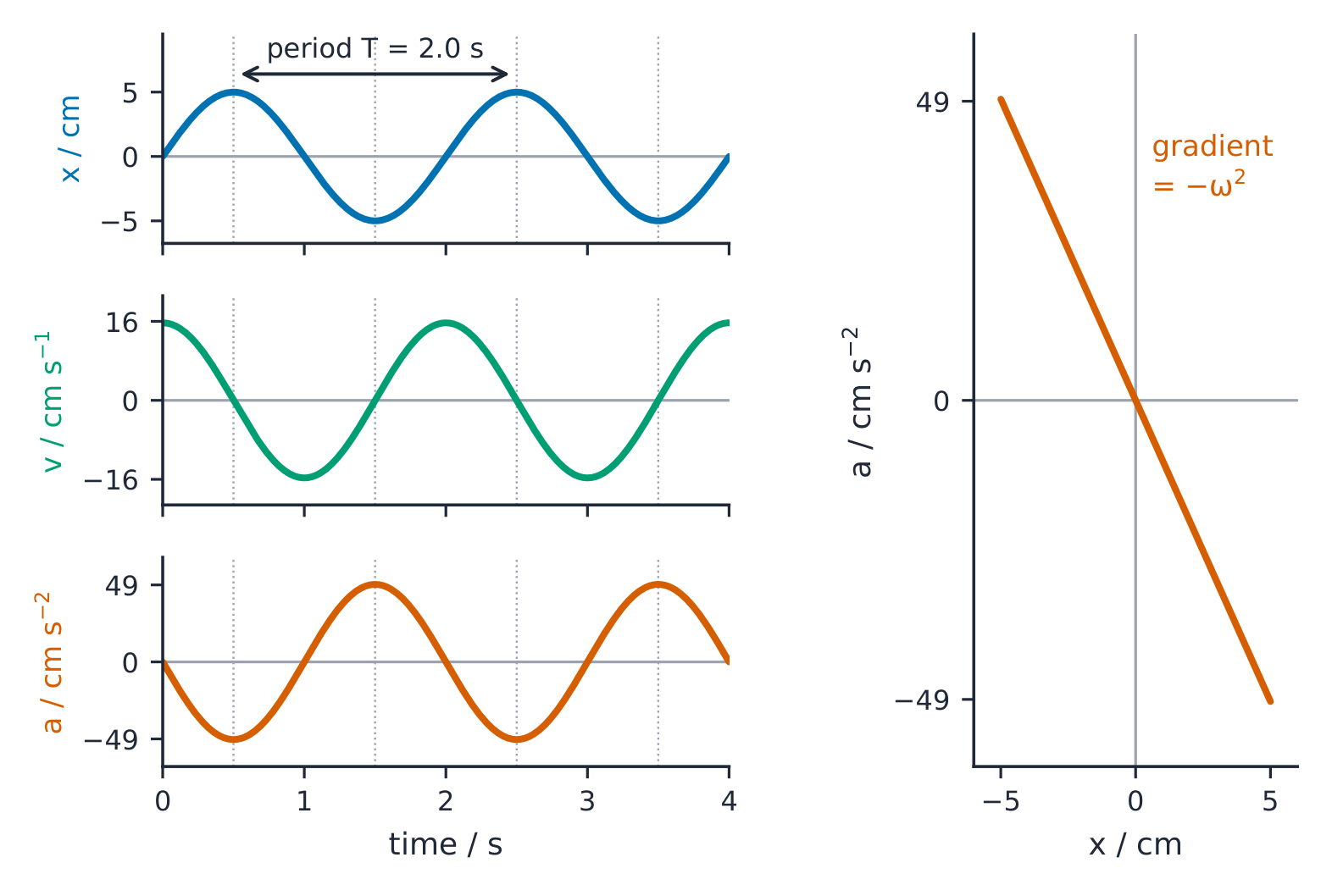
A graph of $a$ against $x$ is a straight line through the origin with gradient $-\omega^2$ (right-hand graph below). The acceleration magnitude is greatest at the ends and zero at equilibrium; the signed acceleration is positive at the negative extreme and negative at the positive extreme.
Worked example: an object oscillates with $\omega = 12.6\ \text{rad s}^{-1}$. When its displacement is $+0.020\ \text{m}$, $a = -12.6^2 \times 0.020 = -3.2\ \text{m s}^{-2}$, directed back towards equilibrium.
distance and direction from the equilibrium position
m
amplitude
$x_0$
the maximum displacement
m
period
$T$
the time for one complete oscillation
s
frequency
$f$
the number of oscillations per second
Hz
angular frequency
$\omega$
$2\pi$ times the frequency
rad s⁻¹
The amplitude 振幅$x_0$ is the largest displacement, measured from equilibrium (not from one end to the other). The period 周期$T$ and the frequency 频率$f$ are linked to $\omega$ by:
$$T = \frac{1}{f} = \frac{2\pi}{\omega}$$
One oscillation corresponds to $2\pi$ radians, just as one turn of a circle does. This is why the same $\omega$ appears in circular motion: the shadow of an object moving in a circle at constant speed moves with SHM.
The shadow of uniform circular motion is SHM: that is why $\omega$ appears in both
Worked example: a guitar string vibrates at 440 Hz. Its period is $T = 1/440 = 2.3 \times 10^{-3}\ \text{s}$ and its angular frequency is $\omega = 2\pi \times 440 = 2.8 \times 10^3\ \text{rad s}^{-1}$.
A plucked guitar string vibrates at its resonant frequencies.
SHM is isochronous 等时的: the period does not depend on the amplitude. A pendulum swinging through a small arc and one swinging through a larger (but still small) arc take the same time per swing. This is why pendulums were used to keep time in clocks.
Graphs of SHM
Displacement, velocity and acceleration over two periods, and the defining graph a = −ω²x
Read the graphs together, at the same time:
At the ends of the motion ($x = \pm x_0$) the object stops for an instant: velocity is zero and the acceleration magnitude is greatest, pointing back towards equilibrium.
At equilibrium ($x = 0$) the speed is greatest and the acceleration is zero.
The velocity graph is the gradient of the displacement graph; the acceleration graph is the gradient of the velocity graph.
The acceleration graph is the displacement graph turned upside down, because $a = -\omega^2x$.
Worked example: for the oscillation above, $T = 2.0\ \text{s}$, so $\omega = 2\pi/2.0 = 3.14\ \text{rad s}^{-1}$. The greatest acceleration magnitude is $\omega^2x_0 = 3.14^2 \times 5.0 = 49\ \text{cm s}^{-2}$, as the graph shows.
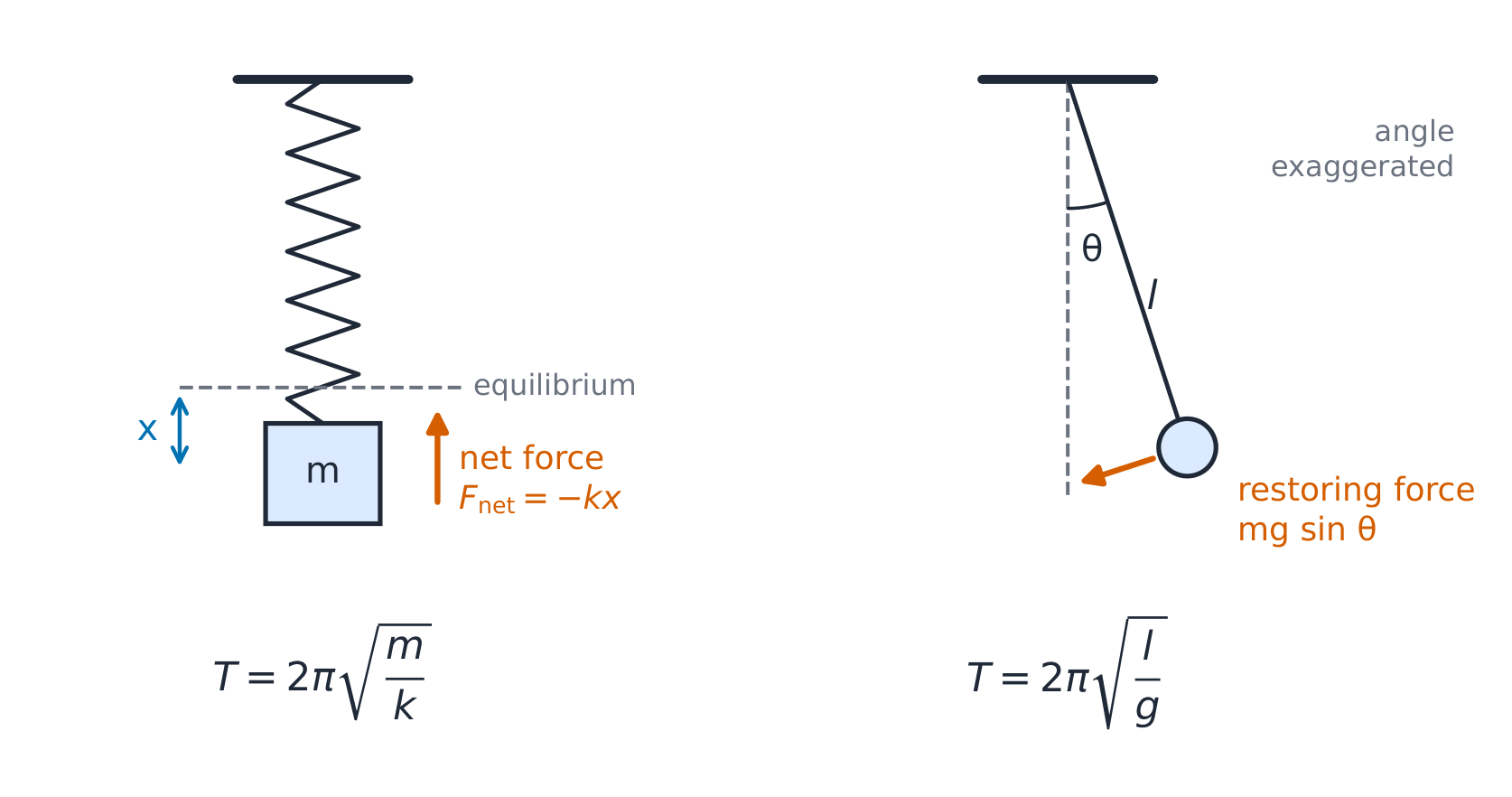
Take a constant mass $m$, an ideal linear spring of spring constant 劲度系数$k$, negligible spring mass and no driving or dissipative forces. Measure $x$ from equilibrium. The resultant restoring force is $F_{\rm net}=-kx$, so $ma=-kx$ and $a=-\frac{k}{m}x$. For a horizontal frictionless model this can be the spring force alone. For a vertical model include weight as well. Comparing with $a=-\omega^2x$ gives $\omega^2=k/m$, so:
$$T = 2\pi\sqrt{\frac{m}{k}}$$
The spring arrow is net force; the pendulum arrow is tangential weight. The drawn pendulum angle is exaggerated; its period formula uses the small-angle approximation.
A heavier mass oscillates more slowly: it has more inertia.
A stiffer spring (larger $k$) oscillates faster: the restoring force is larger.
The period does not depend on the amplitude, or on $g$. A vertical spring has the same period as a horizontal one, because gravity only moves the equilibrium position.
A 1200 kg car rests on springs with a combined spring constant of $6.0 \times 10^4\ \text{N m}^{-1}$. After a bump it bounces with $T = 2\pi\sqrt{\frac{1200}{6.0 \times 10^4}} = 0.89\ \text{s}$. Shock absorbers stop this oscillation quickly.
To double the period you must multiply the mass by 4, because $T \propto \sqrt{m}$.
A hanging spring is already stretched at equilibrium
Let $s$ be extension from natural length and take downward as positive. At equilibrium, $ks_{\rm eq}=mg$. A further downward displacement $x$ makes $s=s_{\rm eq}+x$, so
Measure x from equilibrium, not from natural length
$$F_{\rm net}=mg-k(s_{\rm eq}+x)=-kx.$$
The spring force itself is $-k(s_{\rm eq}+x)$, not $-kx$. Gravity shifts the equilibrium position; for this constant-$k$ model it does not change the period.
Worked model: $m=0.40$ kg, $k=40$ N/m and $g=9.8$ m/s². The equilibrium extension is $s_{\rm eq}=0.40(9.8)/40=0.098$ m. At $x=+0.025$ m below equilibrium, total extension is 0.123 m. The spring pulls upward with $40(0.123)=4.92$ N while weight is 3.92 N downward. Thus $F_{\rm net}=3.92-4.92=-1.00$ N and $a=-1.00/0.40=-2.5$ m/s², upward towards equilibrium. Substituting total extension into $-kx$ would incorrectly omit weight.
A simple pendulum 单摆 is a small, heavy bob on a light, inextensible string of length $l$. When the string makes an angle $\theta$ with the vertical, the component of the weight along the arc, $mg\sin\theta$, pulls the bob back towards equilibrium. For small angles (less than about 10°), $\sin\theta \approx \theta$ in radians and the arc displacement $x = l\theta$, so the acceleration is $a = -\frac{g}{l}x$. This is SHM with $\omega^2 = g/l$:
A pendulum clock keeps time using simple harmonic motion.
$$T = 2\pi\sqrt{\frac{l}{g}}$$
The period depends only on the length and on $g$, not on the mass of the bob or (for small angles) on the amplitude.
A longer pendulum swings more slowly: $T \propto \sqrt{l}$.
At large angles $\sin\theta$ is less than $\theta$, so the motion is no longer exactly SHM, and the period becomes a little longer.
Here $a$ is the tangential acceleration along the arc. At equilibrium that component is zero; the bob can still have radial acceleration towards the pivot.
Worked examples:
$l = 1.0\ \text{m}$: $T = 2\pi\sqrt{1.0/9.8} = 2.0\ \text{s}$. A pendulum of length 0.99 m has a half-period of about one second on its way across: a "seconds pendulum".
The same 1.0 m pendulum on the Moon ($g = 1.6\ \text{m s}^{-2}$) has $T = 2\pi\sqrt{1.0/1.6} = 5.0\ \text{s}$.
A pendulum is used to measure $g$: plot $T^2$ against $l$. The graph is a straight line through the origin with gradient $4\pi^2/g$. Time 10 or 20 oscillations and divide, to reduce the effect of reaction time.
In an ideal undriven oscillator with no dissipative forces, energy changes between kinetic energy and potential energy (elastic potential energy for a spring, gravitational potential energy for a pendulum). The total energy 总能量 of these mechanical stores stays constant. For the vertical spring, include both elastic and gravitational potential energy; the combined potential is least at equilibrium, although spring energy alone need not be.
Kinetic and potential energy swap twice in each period; their sum is constant
Follow a pendulum released from one end of its swing:
At the end ($x = x_0$): the bob is momentarily at rest, so its kinetic energy is zero and its potential energy is the greatest.
Moving towards equilibrium: potential energy changes to kinetic energy and the bob speeds up.
At equilibrium ($x = 0$): the speed is greatest, so kinetic energy is the greatest and potential energy is the least.
Moving away from equilibrium on the other side: kinetic energy changes back to potential energy, and the bob slows down to rest at $x = -x_0$.
Kinetic energy reaches its maximum twice in each period (once in each direction), so the energy graphs have half the period of the displacement graph. In a real oscillator friction and air resistance slowly transfer energy to the surroundings, the total energy falls and the amplitude decreases: this is called damping 阻尼. Periodic driving near a natural frequency can produce an enhanced response, or resonance; damping limits the response. Standing waves and resonance (C.4) develops the driven-motion model.
Kinetic and potential energy swap over a cycle while the total energy stays constant
Using the sine convention $x = x_0\sin(\omega t + \phi)$, the phase angle 相位角$\phi$ describes where an oscillation is in its cycle at $t = 0$. It is measured in radians: one complete cycle is $2\pi$ rad.
An oscillator that starts at equilibrium, moving in the positive direction, has $\phi = 0$.
One that starts at its positive amplitude, at rest, has $\phi = \pi/2$.
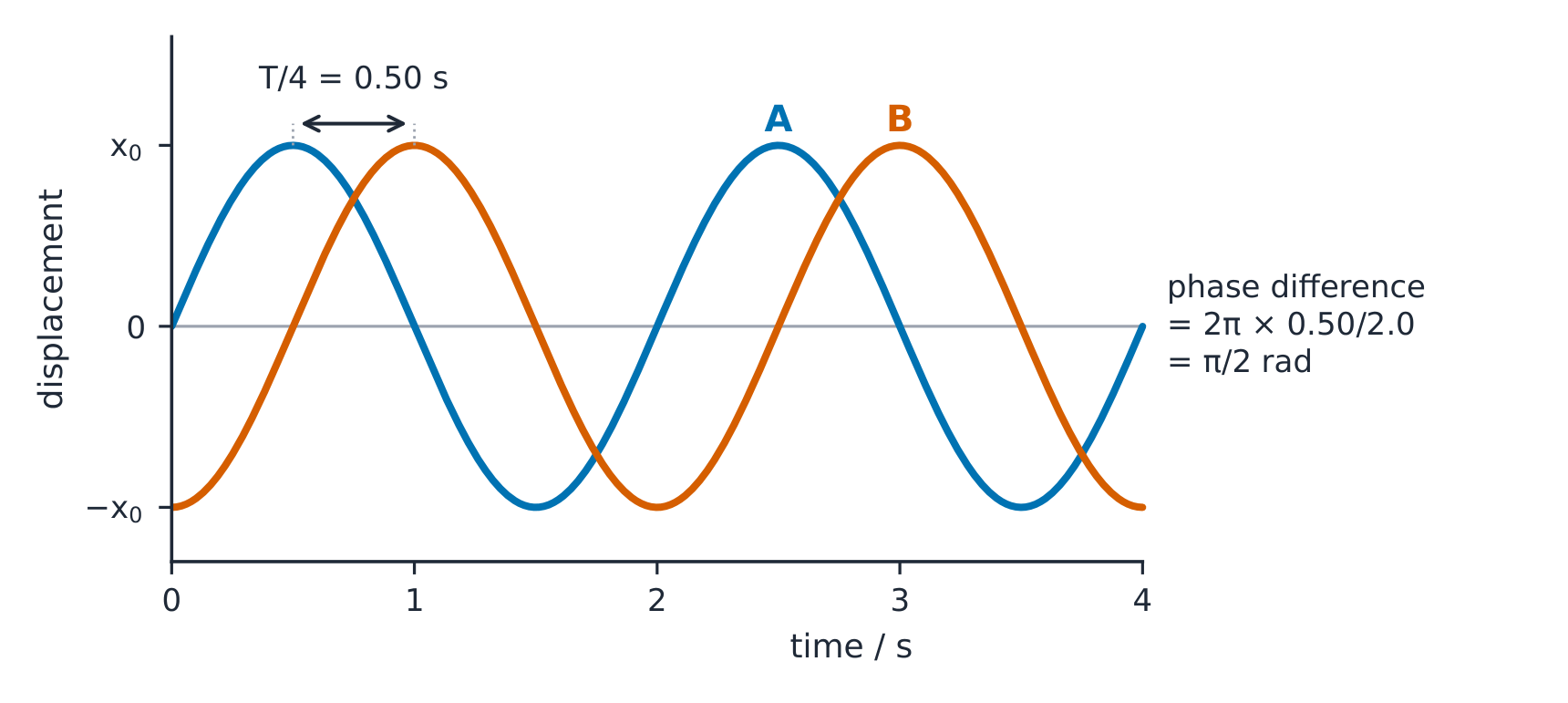
Two oscillators with the same period can be out of step. The phase difference 相位差 between them is
$$\Delta\phi = 2\pi\frac{\Delta t}{T}$$
where $\Delta t$ is the time by which one reaches a given point (for example, its maximum) after the other.
B lags behind A by a quarter period: a phase difference of π/2 rad
A phase difference of 0 (or $2\pi$) means the oscillators are in phase: they move together.
A phase difference of $\pi$ means they are in antiphase 反相: one is at $+x_0$ when the other is at $-x_0$.
Displacement and velocity in SHM are $\pi/2$ out of phase; displacement and acceleration are in antiphase.
$$x = x_0\sin(\omega t + \phi) \qquad v = \omega x_0\cos(\omega t + \phi)$$
Set your calculator to radians before using them. Starting at equilibrium ($\phi = 0$) gives $x = x_0\sin\omega t$; starting at the amplitude ($\phi = \pi/2$) gives $x = x_0\cos\omega t$.
The maximum speed is $v_{\max} = \omega x_0$, at equilibrium, and the maximum acceleration is $a_{\max} = \omega^2x_0$, at the ends.
Velocity at a given displacement
Eliminating $t$ gives the speed at any displacement:
$$v = \pm\omega\sqrt{x_0^2 - x^2}$$
The $\pm$ shows that at each position the object can be moving either way.
Velocity against displacement is an ellipse: $v = 0$ at the extremes and $v = \pm\omega x_{0}$ through equilibrium — read $x_{0}$ and $v_{0}$ from where it cuts the axes, then $\omega = v_{0}/x_{0}$
Worked example: a 0.40 kg mass on a spring of $k = 40\ \text{N m}^{-1}$ has $\omega = \sqrt{40/0.40} = 10\ \text{rad s}^{-1}$. It passes equilibrium in the positive direction at $t = 0$ with amplitude 0.050 m, so $\phi = 0$.
At $t = 0.10\ \text{s}$: $\omega t = 1.0\ \text{rad}$, $x = 0.050\sin(1.0) = 0.042\ \text{m}$ and $v = 10 \times 0.050 \times \cos(1.0) = 0.27\ \text{m s}^{-1}$.
Check with the other equation: $v = 10\sqrt{0.050^2 - 0.042^2} = 0.27\ \text{m s}^{-1}$.
Maximum speed: $\omega x_0 = 0.50\ \text{m s}^{-1}$; maximum acceleration: $\omega^2x_0 = 5.0\ \text{m s}^{-2}$.
Worked example: an oscillator of period 2.0 s starts at equilibrium moving in the positive direction. How long does it take to reach half its amplitude? $\tfrac{1}{2}x_0 = x_0\sin\omega t$, so $\omega t = \sin^{-1}(0.5) = \pi/6$ rad and $t = (\pi/6)/\pi = 0.17\ \text{s}$. This is $T/12$, not $T/8$: the object is fastest near equilibrium, so it covers the first half of the amplitude in less time than the second half.
11.10
AHL:能量方程式
English
For a mass $m$ in SHM, the total energy and the potential energy at displacement $x$ are:
so the kinetic energy is $E_k = E_T - E_p = \frac{1}{2}m\omega^2(x_0^2 - x^2)$, which agrees with $v = \pm\omega\sqrt{x_0^2 - x^2}$. The total energy is proportional to the square of the amplitude: double the amplitude and the energy is four times as great.
Energy against displacement for the 0.40 kg mass: the two parabolas always add to the total
Worked example, for the same mass ($m = 0.40\ \text{kg}$, $\omega = 10\ \text{rad s}^{-1}$, $x_0 = 0.050\ \text{m}$):
Speed there: $v = \sqrt{2 \times 0.032/0.40} = 0.40\ \text{m s}^{-1}$, the same as $10\sqrt{0.050^2 - 0.030^2}$.
For a horizontal spring, $m\omega^2 = k$ and $E_p = \frac{1}{2}kx^2$ is elastic potential energy measured from its unstretched equilibrium. For a vertical spring, $x$ is measured from its gravity-shifted equilibrium: this quadratic describes the combined elastic and gravitational potential energy relative to its minimum, not the spring energy alone.
11.11
练习
English
State the two conditions needed for an object to perform simple harmonic motion.
Explain the meaning of the minus sign in $a = -\omega^2x$.
An object moves with $a = -64x$, where $a$ is in m s⁻² and $x$ is in m. Find $\omega$, the period and the frequency.
A 0.50 kg mass hangs on a spring of spring constant 200 N m⁻¹. Find the period and frequency of its oscillations.
Find the length of a simple pendulum with a period of 1.0 s.
A mass on a spring has a period of 0.80 s. Find the period when (a) the mass is made four times as large, (b) the amplitude is doubled.
Describe the energy changes of a pendulum bob during one complete oscillation, starting from rest at one end of its swing.
For an object in SHM, state where in the motion (a) the speed is greatest, (b) the acceleration magnitude is greatest, (c) the acceleration is zero.
A student measures 20 oscillations of a pendulum of length 0.60 m in 31.0 s. Find $g$.
AHL An object oscillates with amplitude 0.080 m and $\omega = 5.0\ \text{rad s}^{-1}$. Find its maximum speed, its maximum acceleration and its speed when $x = 0.040\ \text{m}$.
AHL An oscillator of period 2.0 s passes through equilibrium in the positive direction at $t = 0$. Find the time at which it first reaches half its amplitude, and its displacement at $t = 0.25\ \text{s}$ if the amplitude is 6.0 cm.
AHL A 0.20 kg mass on a spring of $k = 80\ \text{N m}^{-1}$ oscillates with amplitude 0.050 m. Find the total energy, the maximum speed and the kinetic energy when $x = 0.030\ \text{m}$.
AHL Two pendulums have the same period of 2.0 s. B reaches its maximum displacement 0.25 s after A. Find the phase difference in radians.
An ideal vertical spring has stiffness 40 N/m and supports a 0.40 kg mass ($g=9.8$ m/s²). Find its equilibrium extension. At a point 0.025 m below equilibrium, find the total spring extension, spring force, resultant force and acceleration. Take downward as positive.
Answers.
The acceleration (restoring force) is proportional to the displacement from equilibrium, and it is always directed towards the equilibrium position.
The acceleration is always in the opposite direction to the displacement, so it always points back towards the equilibrium position.
(a) $T \propto \sqrt{m}$, so the period doubles to 1.6 s. (b) The period does not depend on amplitude: it stays 0.80 s.
At the end: all potential energy, zero kinetic energy. Towards equilibrium: potential changes to kinetic. At equilibrium: maximum kinetic, minimum potential. To the other end: kinetic changes back to potential, zero kinetic at the end. The same happens on the way back. Without friction the total stays constant.
(a) At the equilibrium position. (b) At the ends, where the displacement is greatest. (c) At the equilibrium position.
Equilibrium extension is $mg/k=0.098$ m. Total extension is $0.098+0.025=0.123$ m; spring force is $-40(0.123)=-4.92$ N. Including weight, $F_{\rm net}=3.92-4.92=-1.00$ N and $a=-1.00/0.40=-2.5$ m/s². Negative means upward. The check $-kx=-40(0.025)=-1.00$ N uses displacement from equilibrium, not extension from natural length.
11.12
考试技巧
English
To show that a motion is SHM, show that $a \propto -x$: proportional to the displacement and opposite in direction.
Measure amplitude from equilibrium, never from one end to the other.
The periods of a mass–spring system and a small-angle pendulum do not depend on the amplitude; a pendulum's period does not depend on its mass either.
Speed is greatest at equilibrium; acceleration magnitude is greatest at the ends.
AHL Set your calculator to radians for $x = x_0\sin(\omega t + \phi)$ and phase calculations.
AHL Energy is proportional to the amplitude squared: $E_T = \frac{1}{2}m\omega^2x_0^2$.