This handout teaches B.5 Current and circuits in full, for the course first assessed in 2025. There is no additional higher level content in B.5, so SL and HL students study the same material.
Prerequisites: work, energy and power from A.3; area of a circle; rearranging equations. The charge on an electron is $-1.60 \times 10^{-19}\ \text{C}$. Circuit symbols follow the IB data booklet. Meters are ideal unless stated, and only direct current (dc) circuits are required.
10.2
细胞与电动势来源
English
Why does a phone battery go flat?
A battery model stores 50 kJ, roughly enough in an ideal loss-free lift to raise a 50 kg mass by 100 m. As the phone runs, charge flows round its circuits and the stored chemical energy is transferred to light, sound and heating. When you use a phone hard, the battery even warms up: some energy is wasted inside the battery itself. This unit explains where the energy goes in a circuit and why every real source loses some of it.
Electromotive force
A source of electrical energy does work on the charges passing through it. Its electromotive force 电动势 (emf) $\varepsilon$ is the energy transferred to each coulomb of charge that passes through the source:
$$\varepsilon = \frac{W}{q}$$
in volts, $1\ \text{V} = 1\ \text{J C}^{-1}$. A 1.5 V cell gives 1.5 J to every coulomb that passes through it.
Chemical cells and solar cells
A chemical cell 化学电池 transfers chemical energy into electrical energy. Primary cells (such as alkaline cells) are used once; secondary cells (such as lithium-ion batteries) can be recharged. Advantages: portable and ready at any time. Disadvantages: limited energy store, they wear out, and they can contain toxic materials.
A solar cell 太阳能电池 transfers the energy of light into electrical energy. A single cell gives about 0.6 V, so cells are joined into panels. Advantages: no fuel and no emissions while running. Disadvantages: output depends on the light, so output needs illumination, and a large area is needed.
Solar cells use the photoelectric effect to turn light into electricity.
An electric current 电流 is a flow of charge carriers 载流子. In a metal they are free electrons; in an electrolyte they are ions. The current is the rate of flow of charge:
Charge carriers drifting inside a conductor: positive carriers drift with $I$, electrons against it
$$I = \frac{\Delta q}{\Delta t}$$
in amperes, $1\ \text{A} = 1\ \text{C s}^{-1}$. If 3.0 C passes a point in 1.5 s, $I = 2.0\ \text{A}$. That is $\frac{2.0}{1.60 \times 10^{-19}} = 1.25 \times 10^{19}$ electrons every second. By convention the current direction is the direction a positive charge would move: from the + terminal round the circuit to the − terminal, opposite to the electrons.
Conductors and insulators
A conductor 导体 has charge carriers that can move freely: metals have about $10^{28}$ free electrons per cubic metre. An insulator 绝缘体 has almost no mobile charge carriers, because its electrons are tightly bound to their atoms. Semiconductors such as silicon lie in between.
The standard circuit symbols you need to recognise and draw
Potential difference
The potential difference 电势差 (pd) $V$ between two points is the work done per unit charge in moving a positive charge between them:
$$V = \frac{W}{q}$$
If 12 J of energy is transferred as 2.0 C passes through a lamp, the pd across it is 6.0 V. Emf and pd have the same unit, but emf is energy given to charges by a source and pd is energy transferred from charges in a component. A voltmeter is connected in parallel with a component; an ammeter is connected in series.
Real fixed resistors — the coloured bands code the resistance in ohms
$$R = \frac{V}{I}$$
in ohms, $1\ \Omega = 1\ \text{V A}^{-1}$. Resistance arises because the moving electrons collide with the vibrating ions of the metal lattice. Each collision transfers energy to the lattice, which is why a resistor warms up.
Resistivity
The resistance of a wire depends on its material, length $L$ and cross-sectional area $A$. The resistivity 电阻率$\rho$ is a property of the material at specified physical conditions, including temperature:
$$\rho = \frac{RA}{L} \qquad \text{so} \qquad R = \frac{\rho L}{A}$$
in Ω m. Doubling the length doubles $R$; doubling the area halves $R$.
A wider conductor has less resistance — doubling $A$ halves $R$A longer conductor has more resistance — doubling $L$ doubles $R$
Worked example: a copper wire ($\rho = 1.7 \times 10^{-8}\ \Omega\ \text{m}$) is 2.0 m long with diameter 0.50 mm.
Ohm's law 欧姆定律: the current in a conductor is proportional to the potential difference across it, provided the temperature and other physical conditions stay constant. A component that obeys Ohm's law is ohmic 欧姆的: its $I$–$V$ graph is a straight line through the origin and its resistance is constant. A metal wire at constant temperature is ohmic.
For a non-ohmic component the resistance is $V/I$ at each point, not the gradient of the graph
In the lab: connect an ammeter in series with the component and a voltmeter in parallel across it. Use a variable low-voltage dc supply to change the pd in steps, recording both $V$ and $I$ at each setting. Reverse the supply polarity to measure negative values when the component permits it, and plot $I$ against $V$. Limit the current and switch off between readings to reduce unwanted heating; for an ohmic wire, keep its temperature constant.
Non-ohmic components and heating
A filament lamp 白炽灯 is non-ohmic 非欧姆的. As the current rises the filament heats up, its ions vibrate more strongly, electrons collide more often, and the resistance rises: the $I$–$V$ graph curves towards the $V$ axis. Always find resistance from $R = V/I$ at a point, never from the gradient.
$I$–$V$ characteristic of a filament lamp
Variable resistors
Some resistors are designed to change their resistance.
A thermistor 热敏电阻 (negative temperature coefficient): its resistance falls as its temperature rises, because more charge carriers are released. Used in thermostats and electronic thermometers.
A light-dependent resistor 光敏电阻 (LDR): its resistance falls as the light intensity rises. Used in automatic street lights.
A potentiometer 电位器: a resistor with a sliding contact. Used as a volume control or to give a variable output pd.
Resistance of an LDR decreases as light intensity increasesResistance of a thermistor falls as temperature rises
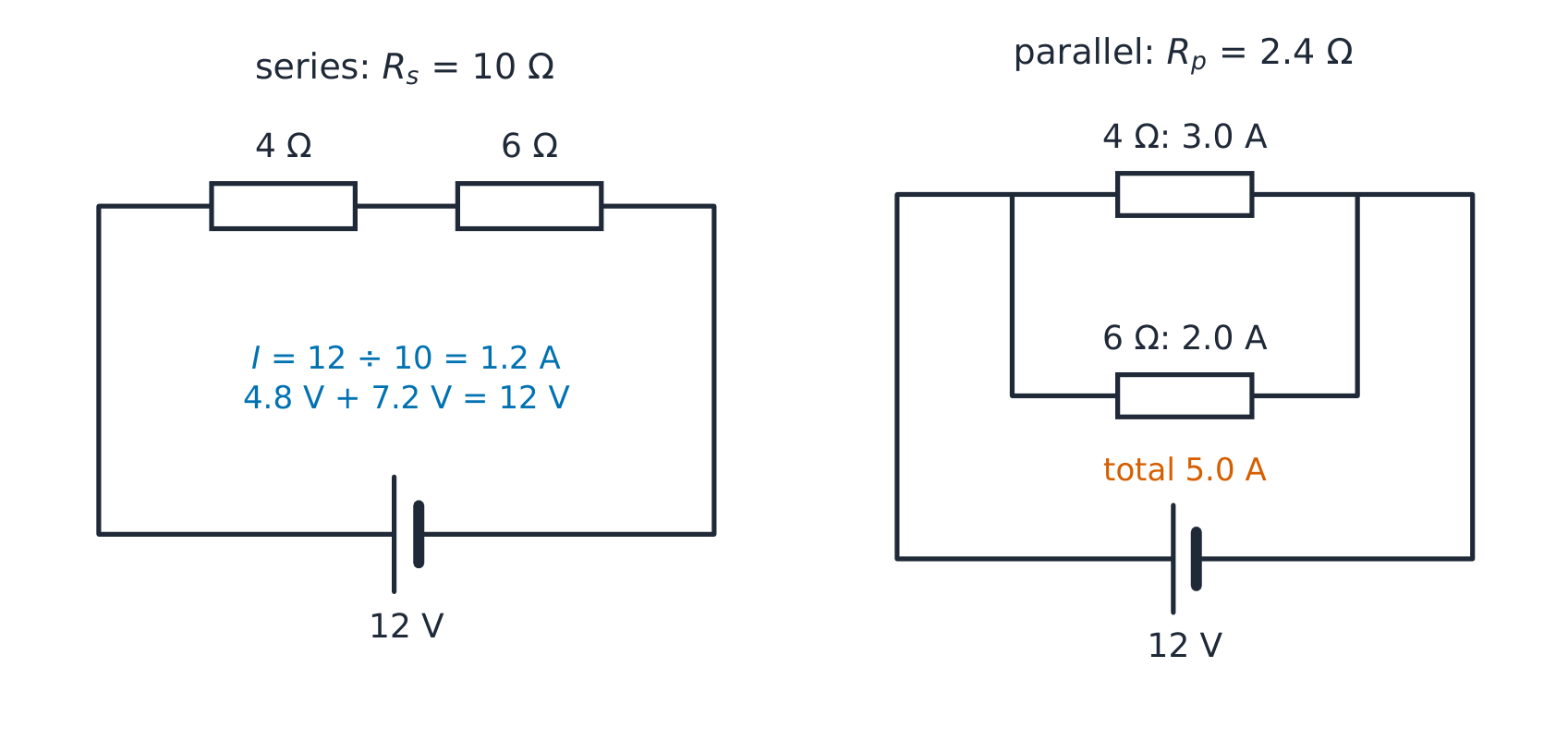
The current rule is conservation of charge: charge cannot pile up at a junction. The pd rule is conservation of energy: the energy given to each coulomb by the source is all transferred round any complete loop.
Current divides at a junction in a parallel circuit (3 A in equals 2 A plus 1 A)In series the pd is shared; in parallel the current is shared
Adding a resistor in series always increases the total resistance; adding one in parallel always decreases it, because it gives the charge another path. The total resistance of a parallel combination is smaller than the smallest resistor in it.
A combined circuit
Worked example: a 2.0 Ω resistor is in series with a parallel pair of 6.0 Ω and 3.0 Ω, across a 12 V supply.
Parallel pair: $\dfrac{1}{R_p} = \dfrac{1}{6.0} + \dfrac{1}{3.0}$, so $R_p = 2.0\ \Omega$. Total $R = 4.0\ \Omega$.
Current from the supply: $I = 12/4.0 = 3.0\ \text{A}$.
pd across the 2.0 Ω resistor $= 6.0\ \text{V}$, so 6.0 V across the pair.
Currents: $6.0/6.0 = 1.0\ \text{A}$ and $6.0/3.0 = 2.0\ \text{A}$, which add to 3.0 A.
10.8
内阻
English
Lost volts
Every real cell has an internal resistance 内阻$r$: the materials inside it resist the current. Some of the emf is used driving current through the cell itself, so the terminal potential difference 端电压$V$ across an external resistor $R$ is less than the emf:
$$\varepsilon = I(R + r) = V + Ir$$
$Ir$ is the energy per coulomb wasted inside the cell, the "lost volts". It warms the cell.
Worked example: a cell of emf 6.0 V and internal resistance 0.50 Ω drives current through a 2.5 Ω resistor.
Terminal pd $V = IR = 5.0\ \text{V}$; lost volts $Ir = 1.0\ \text{V}$.
Measuring emf and internal resistance
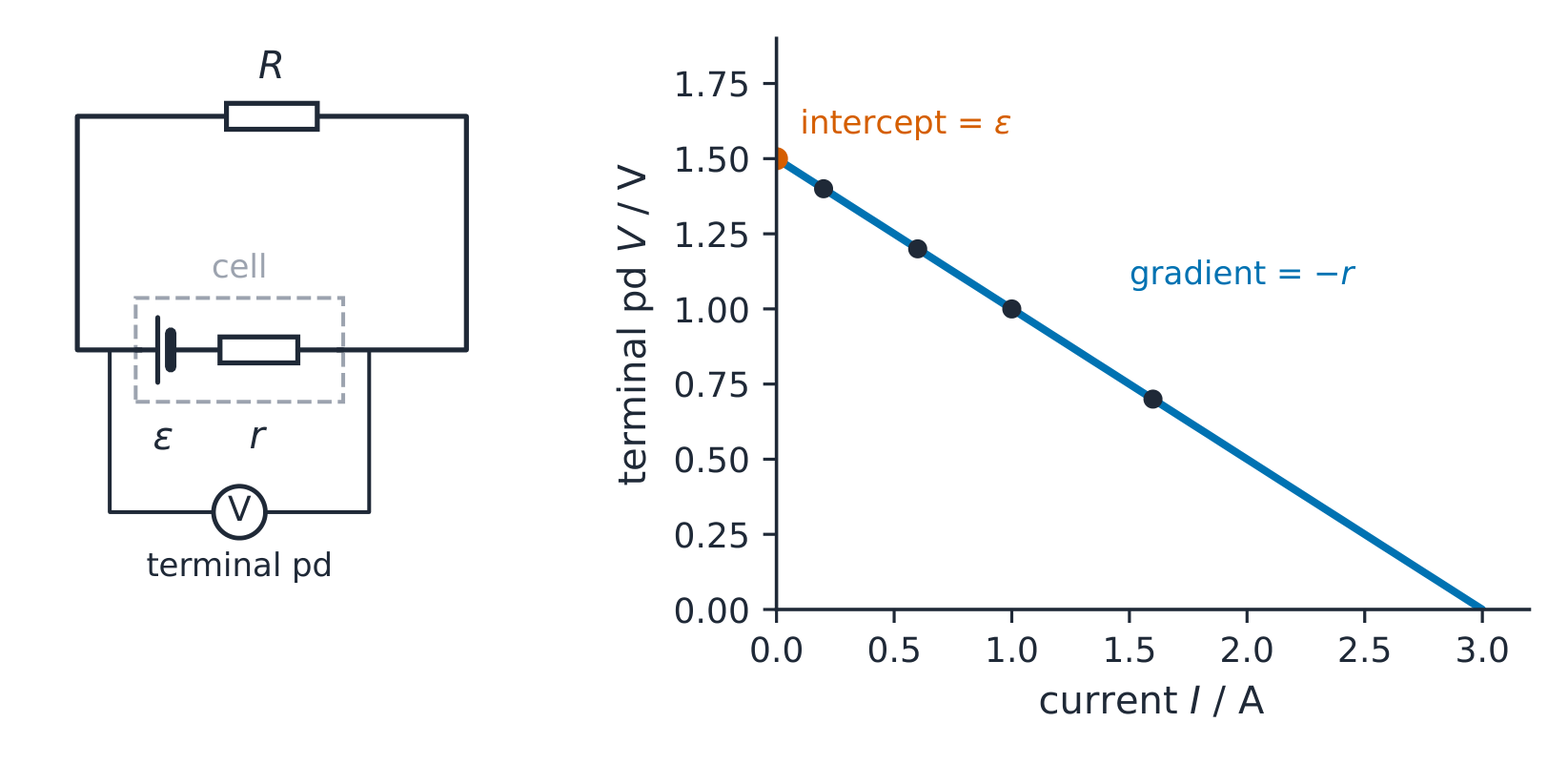
In the lab: connect the cell to a variable resistor with an ammeter in series and a voltmeter across the cell's terminals. Record $V$ and $I$ for several settings and plot $V$ against $I$. Since $V = \varepsilon - rI$, the graph is a straight line with intercept $\varepsilon$ and gradient $-r$.
A real circuit on a breadboard, being measured with a multimeterThe more current the cell supplies, the more of its emf is lost inside it
A car battery needs a very small internal resistance: with $\varepsilon = 12.6\ \text{V}$ and $r = 0.020\ \Omega$, a 150 A starter motor still receives $12.6 - 150 \times 0.020 = 9.6\ \text{V}$.
Terminal p.d. against current — the intercept is the e.m.f. and the gradient is minus the internal resistance
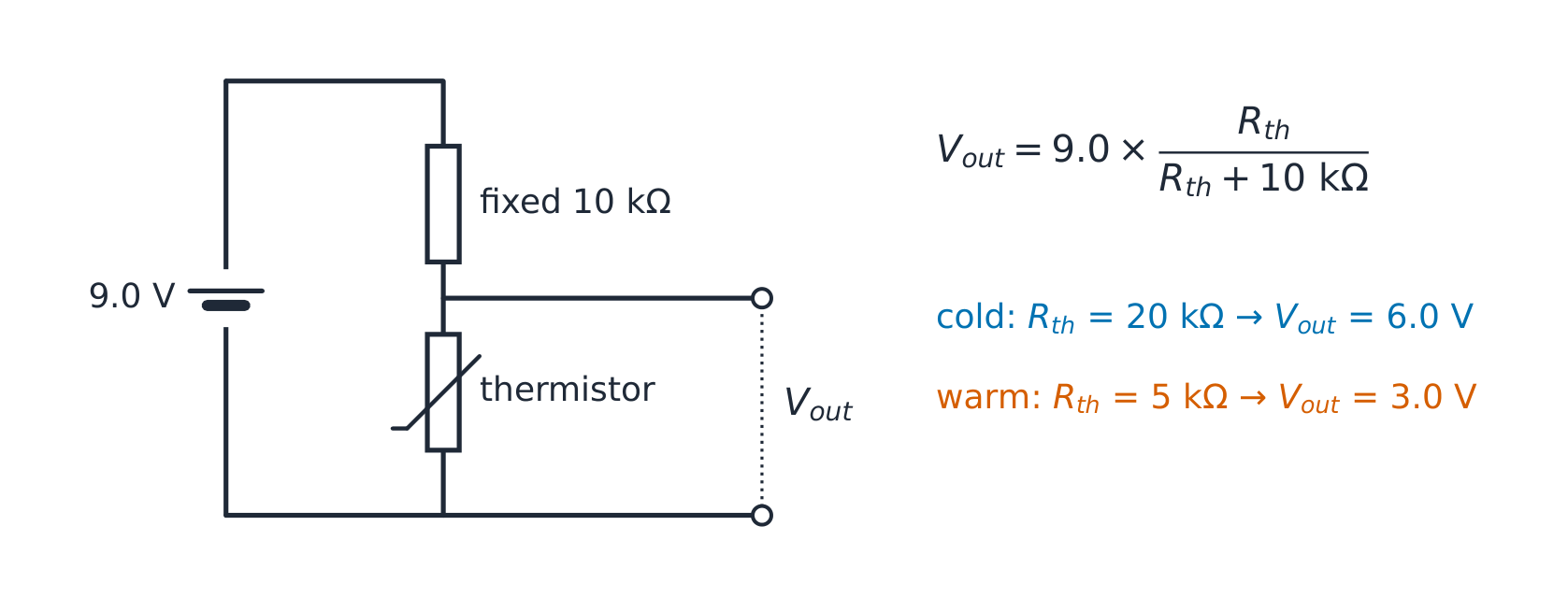
Two resistors in series across a supply share its pd in the ratio of their resistances. This potential divider 分压器 gives an output pd across one of them:
where $R_2$ is the resistor the output is taken across and the output draws negligible current. A load in parallel with $R_2$ changes its effective resistance, so recalculate the divider. With a thermistor or an LDR as $R_2$, the output changes with temperature or light: a sensor circuit.
As the thermistor warms its resistance falls, so it takes a smaller share of the 9.0 V
A charge of 240 C flows through a lamp in 2.0 minutes. Find the current and the number of electrons passing each second.
A 9.0 V battery transfers 54 J to the charge passing through it. Find the charge.
A wire of length 1.5 m and cross-sectional area $2.0 \times 10^{-7}\ \text{m}^2$ has resistance 0.13 Ω. Find the resistivity of its metal.
A wire is replaced by one of the same material, twice as long and with twice the diameter. Find the ratio of the new resistance to the old.
Sketch the $I$–$V$ graph of a filament lamp and explain its shape.
A filament lamp carries 0.25 A at 3.0 V. Find its resistance at this pd.
A 1000 W heater runs on 230 V. Find the current and the resistance of its element.
Resistors of 3.0 Ω and 6.0 Ω are connected (a) in series, (b) in parallel, to a 9.0 V supply of negligible internal resistance. Find the total resistance and the current from the supply in each case.
Three 12 Ω resistors are connected so that two are in parallel and the third is in series with the pair. Find the total resistance.
A cell of emf 1.5 V and internal resistance 0.40 Ω is connected to a 2.6 Ω resistor. Find the current, the terminal pd and the power wasted inside the cell.
A student's $V$–$I$ graph for a cell gives an intercept of 4.5 V and a gradient of −1.5 V A⁻¹. State the emf and internal resistance.
In the potential divider above, the thermistor's resistance is 10 kΩ. Find $V_{\text{out}}$.
Explain why the output of the potential divider above rises when the room cools.
Give one advantage and one disadvantage of solar cells compared with chemical cells.
$\rho = RA/L = 0.13 \times 2.0 \times 10^{-7} / 1.5 = 1.7 \times 10^{-8}\ \Omega\ \text{m}$ (consistent with the model copper value).
Length × 2 and area × 4, so $R$ × 2/4 = 0.5: the new resistance is half the old.
A curve through the origin that becomes less steep as $V$ rises (in both directions). The filament heats, its ions vibrate more, electrons collide more often and the resistance increases.
When the room cools the thermistor's resistance rises, so it takes a larger share of the supply pd and $V_{\text{out}}$ rises.
Advantage: no fuel or emissions, and there is no fuel consumption while operating; solar cells can still age and need replacement. Disadvantage: no output in the dark, and a large area is needed for useful power.
10.11
考试技巧
English
Emf is energy given to each coulomb by a source; pd is energy transferred from each coulomb in a component.
Find resistance from $R = V/I$ at a point; the gradient of an $I$–$V$ curve is not $1/R$ for a non-ohmic component.
Convert diameters to radii and mm² to m² before using $R = \rho L/A$.
For a combined circuit, reduce the parallel parts first, find the supply current, then work back through each part.
With internal resistance, the terminal pd falls as the current rises: $V = \varepsilon - Ir$.