This handout teaches Reactivity 3.4, Electron-pair sharing reactions, for the course first assessed in 2025. Sections marked AHL are for Higher Level only.
Prerequisites: covalent and coordination bonds and electronegativity from Structure 2.2, functional groups and classes of compounds from Structure 3.2, and homolytic fission and radicals from Reactivity 3.3.
22.2
亲核试剂与亲电试剂
English
Why does bromoethane react with alkali, but ethane does not?
Warm aqueous hydroxide can substitute Br in bromoethane to form ethanol; ethane shows little reaction under the same conditions. The polar C–Br bond provides a reacting centre. Here a whole electron pair moves, rather than splitting into single electrons as in homolysis.
Two kinds of reagent
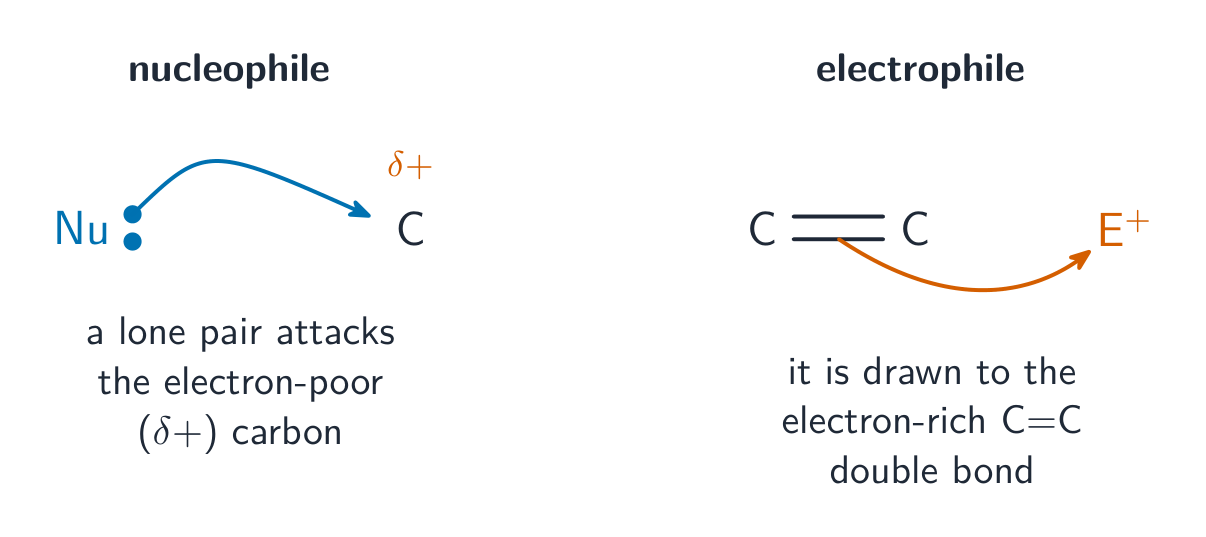
A nucleophile 亲核试剂 is a reactant that forms a new bond by giving both electrons of the bond. The common examples here donate a lone pair and are neutral or negative: $\text{OH}^-$, $\text{H}_2\text{O}$, $\text{NH}_3$, $\text{CN}^-$, $\text{Cl}^-$.
An electrophile 亲电试剂 is a reactant that forms a new bond by accepting both electrons of the bond. It has an electron-pair-accepting centre and can be charged or neutral: $\text{H}^+$, $\text{NO}_2^+$, $\text{Br}_2$ near a C=C bond, the H of HBr.
"Nucleophile" means "nucleus-loving": it is attracted to a positive centre. "Electrophile" means "electron-loving": it is attracted to a region of high electron density.
A nucleophile gives an electron pair; an electrophile takes one
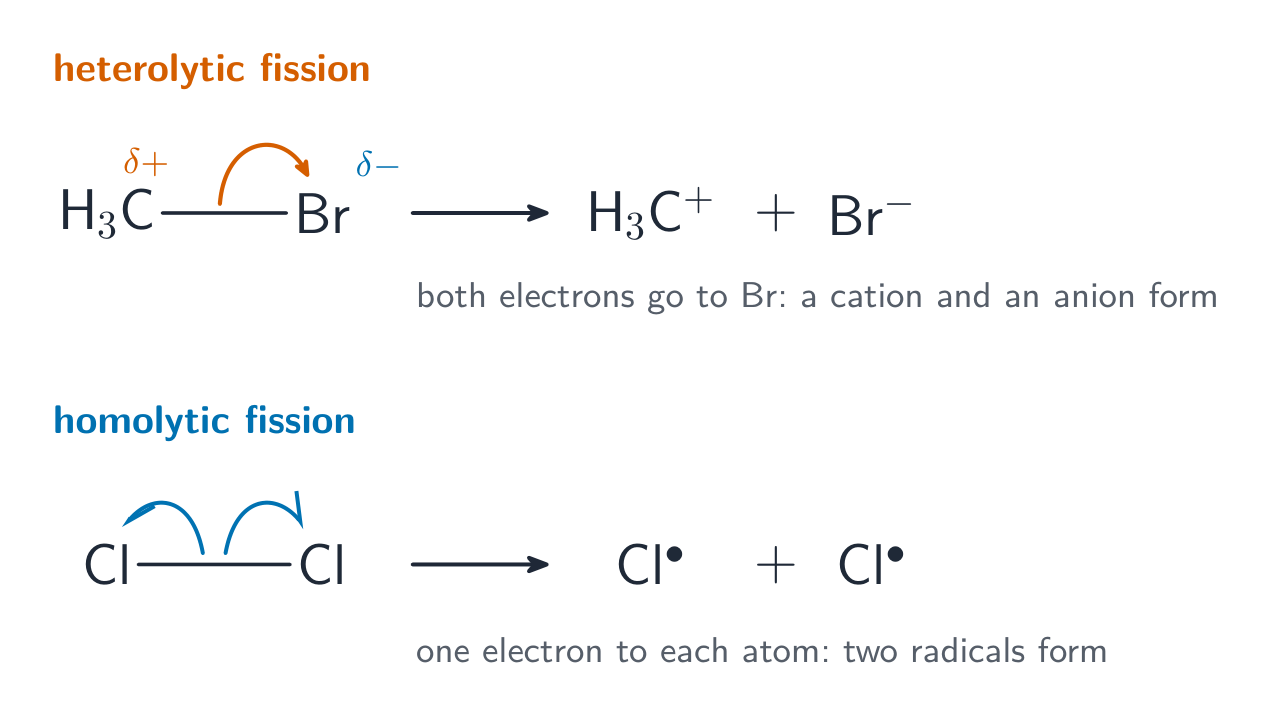
When a covalent bond breaks and both bonding electrons go to one atom, the break is heterolytic fission 异裂. The atom that takes the pair is usually the more electronegative one. For the neutral closed-shell molecules illustrated here, it gives a positive and a negative ion. It does not split the pair into two unpaired electrons.
A curly arrow moves an electron pair; a single-barbed arrow moves one electron
CH₃Br → CH₃⁺ + Br⁻ illustrates electron allocation, not proof that a free methyl carbocation readily forms in water. Primary substitution can form and break bonds together; detailed mechanisms are treated at Higher Level.
Drawing curly arrows
A curly arrow 弯箭头 (with a full, double-barbed head) shows the movement of an electron PAIR.
Arrows start at electrons
The tail starts at the donating electron pair: show the relevant lone pair or bond. A minus sign identifies charge, not the physical position of an electron pair.
The head points to where the pair goes: an atom (to form a new bond) or an atom that leaves with the pair.
Every curly arrow starts at electrons, not at a positive charge or a nucleus. Check the resulting bond count and formal charges as well as the arrow direction.
In a halogenoalkane 卤代烷, such as bromoethane, the halogen is more electronegative than carbon (Br 3.0, C 2.6). The C–Br bond is polar, so the carbon is $\delta+$. A nucleophile attacks this $\delta+$ carbon.
The reaction
In nucleophilic substitution 亲核取代, a nucleophile gives an electron pair to form a new bond as another bond breaks. The group that leaves with the old bonding pair is the leaving group 离去基团.
Here $\text{OH}^-$ is the nucleophile and $\text{Br}^-$ is the leaving group. Conditions: warm, with aqueous sodium hydroxide.
Two curly arrows describe the change:
From a lone pair on the O of $\text{OH}^-$ to the $\delta+$ carbon: the new C–O bond forms.
From the C–Br bond to Br: the bonding pair leaves with Br as $\text{Br}^-$.
Predict a product by tracing the reacting atom
Hydroxide donates at oxygen, replacing Br by OH without changing the carbon skeleton. Water can also donate at oxygen: an initially protonated organic product must lose H⁺ to give the neutral alcohol. Ammonia donates at nitrogen and can give an amine after proton transfer. Do not simply copy the whole nucleophile formula into a neutral product without checking its charge and bond count.
The nucleophile's donor atom replaces Br on the same carbon skeleton; water and ammonia products then lose H⁺.
One NH₃ supplies nitrogen to the organic product; another accepts a proton. The net equation conserves atoms and charge.
Worked common example. 0.0200 mol of 1-bromopropane reacts by substitution with excess aqueous hydroxide. The equation RBr + OH⁻ → ROH + Br⁻ gives a 1:1 mole ratio. The maximum propan-1-ol amount is therefore 0.0200 mol; actual isolated yield may be lower. A three-carbon substrate does not make three moles of alcohol per mole reacted.
The C=C double bond in an alkene has four electrons between two carbon atoms: a region of high electron density. Electrophiles are attracted to it. In electrophilic addition 亲电加成 the double bond opens and two new single bonds form, so one molecule adds across the C=C.
Orange bromine water: shaken with an alkene it decolourises, as bromine adds across the C=C double bond
Three additions to learn
Reagent
Conditions
Product from ethene
Br₂
room temperature, suitable medium
1,2-dibromoethane
HBr
usual ionic addition conditions
bromoethane
H₂O (steam)
H₃PO₄ catalyst, about 300 °C
ethanol
Electrophilic addition: the C=C opens and one atom or group adds to each carbon.
In a suitable comparison, cyclohexene rapidly decolourizes orange bromine water while cyclohexane shows no rapid change in the dark. Keep light, temperature and reagent amounts comparable. Decolourization is evidence consistent with unsaturation, not unique proof of an alkene: other reacting substances can consume bromine.
Catalytic addition of steam to ethene is one industrial route to ethanol; fermentation is another. The water reagent and the acid catalyst play different roles. A catalyst is regenerated overall, whereas one water molecule is incorporated per ethene molecule in the net equation.
Track the double bond, atoms and conditions
In addition the two carbon atoms remain joined: the C=C becomes C–C and each gains a new bond. For HBr, add H to one double-bond carbon and Br to the other; for hydration add H and OH, not a new oxygen atom with no hydrogens. But-2-ene + Br₂ gives CH₃CHBrCHBrCH₃, named 2,3-dibromobutane. Carbon numbering follows the product connectivity.
Two orientations; one major product
For unsymmetrical alkenes such as propene, two constitutional orientations can be drawn. Under the usual acid-catalysed hydration conditions propan-2-ol is the major product. Detailed carbocation mechanisms are Higher Level content.
Worked amount example. In a stated single-addition model, 0.0120 mol but-2-ene needs 0.0120 mol Br₂. With Br₂ molar mass 159.8 g/mol, mass = amount × molar mass = 0.0120 × 159.8 = 1.9176 g, or 1.92 g to three significant figures. This is a calculated requirement, not a recommended experimental dose.
Compare the two reaction patterns
Feature
Substitution
Addition
Organic starting point
a suitable C–leaving-group bond
C=C in an alkene
Change in skeleton
one group replaces another
two new bonds form across C=C
Example
bromoethane → ethanol
ethene → bromoethane
Specify reagent and conditions: HBr addition to ethene and aqueous OH⁻ substitution of bromoethane use different reacting bonds. Concentrated acids, bromine and halogenoalkanes require approved teacher-controlled procedures.
Functional groups, oxidation and polymerization
A functional group 官能团 is an atom or group of atoms responsible for characteristic reactions: an alcohol contains OH and a carboxylic acid contains COOH. Structural formulas must retain four bonds at each carbon.
Oxidation is another reaction pattern: CH₃CH₂OH + 2[O] → CH₃COOH + H₂O with excess acidified dichromate under reflux converts the alcohol group into a carboxylic acid group. It does not replace Br by OH or add a reagent across C=C.
In addition polymerization, $n\mathrm{CH_2{=}CH_2}\rightarrow[{-}\mathrm{CH_2{-}CH_2}{-}]_n$: many ethene molecules join as their C=C bonds become C–C links. Suitable initiator, temperature and pressure conditions are required. Each repeat unit retains both monomer carbons and no small molecule is lost. Trace bonds to distinguish substitution, addition, oxidation and polymerization before selecting reagents.
Every Brønsted–Lowry base is a Lewis base: to accept a proton, it donates an electron pair to $\text{H}^+$. But the Lewis definition also covers reactions with no proton at all.
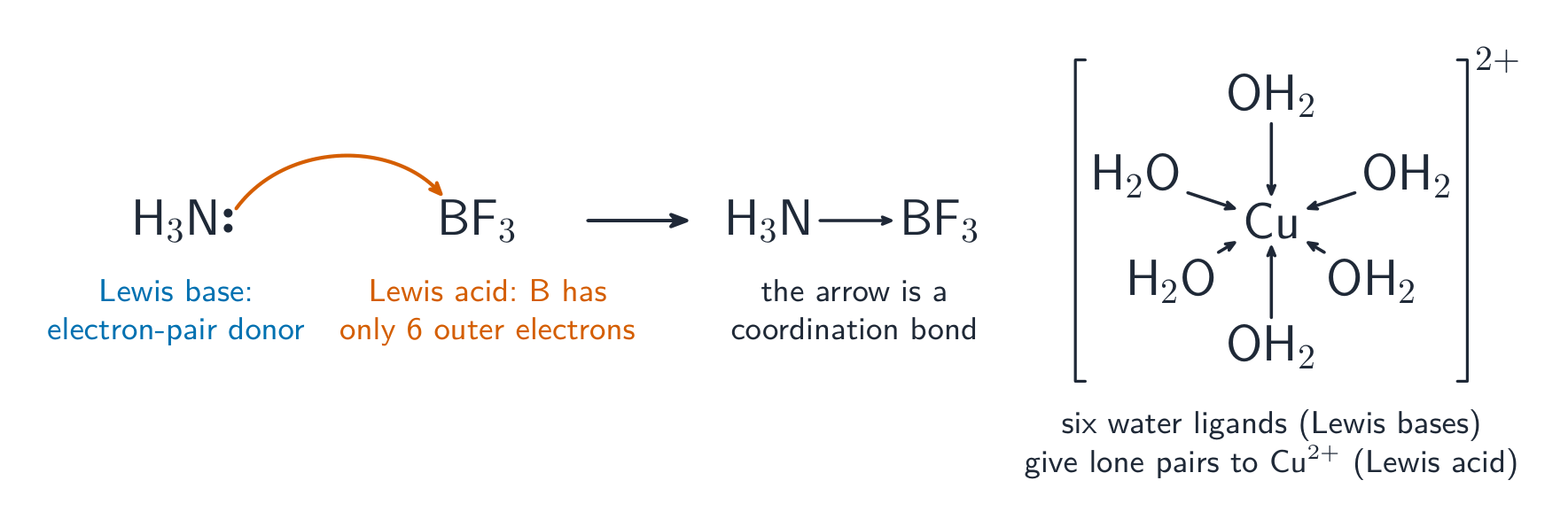
When a Lewis base reacts with a Lewis acid, the bond that forms is a coordination bond 配位键: both shared electrons come from the same atom.
Boron in $\text{BF}_3$ has only six outer electrons, so it can accept a pair.
A Lewis base gives a lone pair; a Lewis acid accepts it
Complex ions
Transition element ions are Lewis acids. Molecules or ions with a lone pair, called ligands 配体, form coordination bonds to the metal ion and give a complex ion 配离子:
Water, ammonia, $\text{Cl}^-$ and $\text{CN}^-$ are common ligands. The number of coordination bonds to the metal ion is its coordination number 配位数; it is 6 here.
Calculate complex-ion charge rather than ligand count alone
The complex charge is metal-ion charge plus the sum of ligand charges. Neutral H₂O and NH₃ contribute zero; each Cl⁻ or CN⁻ contributes −1. Thus [Cu(NH₃)₄]²⁺ has charge +2, while [Fe(CN)₆]⁴⁻ contains iron with $x+6(-1)=-4$, giving Fe(II). For [Co(NH₃)₅Cl]²⁺, $x-1=+2$, so cobalt is +3.
Complex shapes follow the coordination number: 2 is linear, 4 is tetrahedral or square planar, 6 is octahedral
Coordination number counts donor atoms bonded to the metal, not simply the complex charge. Six monodentate cyanide ligands give coordination number six. For a multidentate ligand, one ligand can provide several donor atoms. The donor origin of a coordination bond does not make it a separate class of weak bond after formation.
NH₃ + H⁺ → NH₄⁺ illustrates both definitions: NH₃ accepts a proton as a Brønsted–Lowry base and donates its lone pair as a Lewis base. BF₃ + NH₃ needs no proton, showing the wider Lewis scope. Draw the donor pair on N and the curly arrow to electron-deficient B; a coordination arrow in a product records donor origin, whereas the curly arrow records pair movement.
Linking the ideas
Nucleophiles are Lewis bases: they give an electron pair. Electrophiles are Lewis acids: they accept one. So all of this unit's mechanisms are Lewis acid–base reactions.
How the halogenoalkane reacts depends on how many carbon atoms are bonded to the carbon that carries the halogen.
Halogenoalkane
Example
Main mechanism
primary 伯: one alkyl group on the C–X carbon
bromoethane
S$_\text{N}$2
secondary: two alkyl groups
2-bromopropane
both
tertiary 叔: three alkyl groups
2-bromo-2-methylpropane
S$_\text{N}$1
S$_\text{N}$2: one step
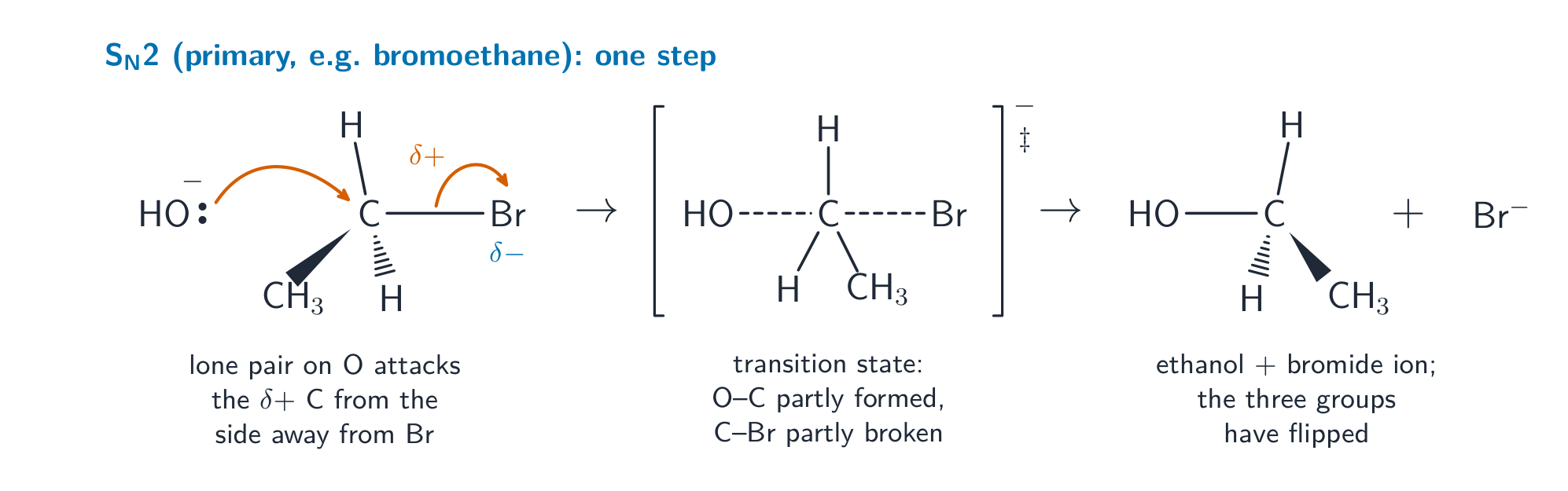
The incoming O pair and departing C–Br pair move in one concerted event.
S$_\text{N}$2 means substitution, nucleophilic, bimolecular. The nucleophile attacks the carbon from the side opposite the halogen while the C–X bond breaks, all in one step (see the bromoethane figure above).
In the transition state 过渡态 C–O is partly formed and C–Br partly broken; the system carries an overall negative charge in this OH⁻/neutral-halide example. Dotted bonds mean partial bonding, not exactly half a bond or an isolable intermediate.
Two particles are in the only step, so $\text{rate} = k[\text{RBr}][\text{OH}^-]$.
Backside attack gives inversion of configuration 构型翻转 at the reacting carbon: the three remaining groups turn over. S$_\text{N}$2 is stereospecific 立体专一的. A chiral starting halogenoalkane gives a product with inverted spatial arrangement; the alcohol is not the other enantiomer of the halogenoalkane, because their compositions differ. R/S labels also depend on priority assignments.
Primary halogenoalkanes react this way because the back of the carbon is open to attack.
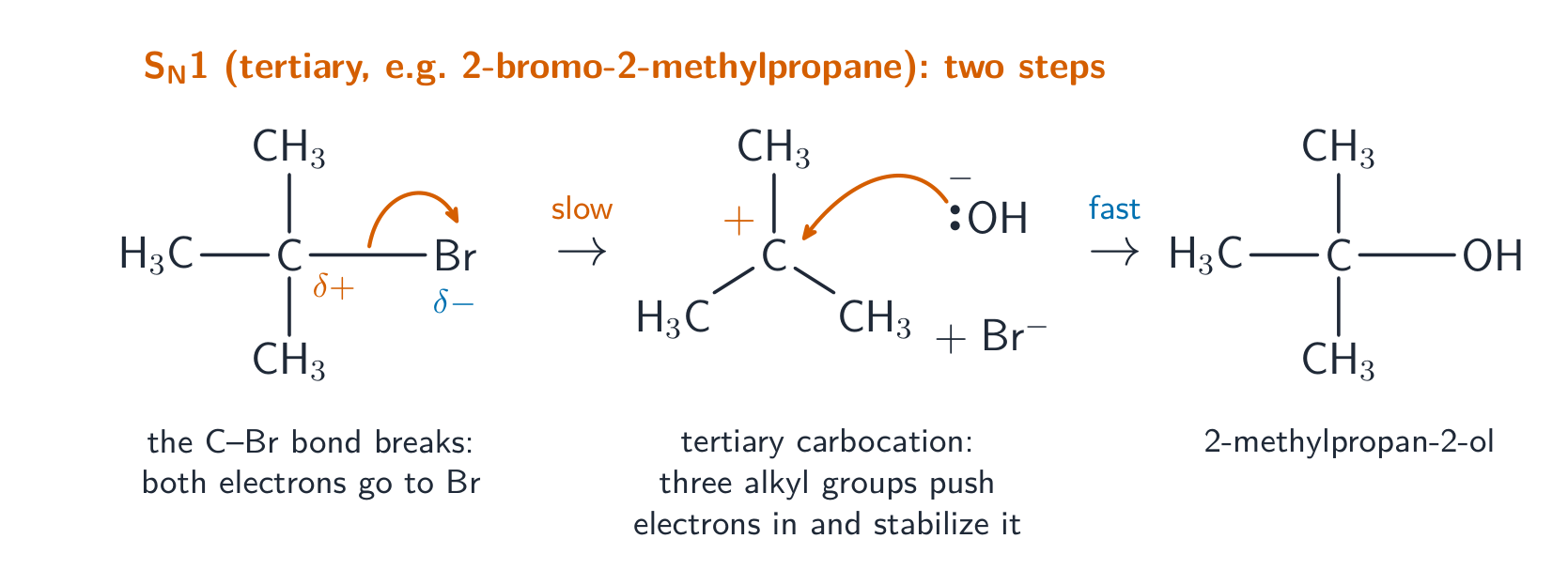
S$_\text{N}$1: two steps
S$_\text{N}$1 means substitution, nucleophilic, unimolecular.
The slow first step makes a carbocation; the nucleophile then attacks fast
Slow: the C–Br bond breaks heterolytically to give a carbocation 碳正离子 and $\text{Br}^-$.
Fast: the nucleophile attacks the positive carbon.
The slow first step is the rate-determining step 决速步骤. Only the halogenoalkane is in it, so $\text{rate} = k[\text{RBr}]$.
The carbocation centre is planar, so attack can occur from either face. If that centre becomes chiral in the product, both product enantiomers can form. This simple model allows racemization but does not guarantee an exactly 50:50 experimental ratio; ion pairing can affect access.
Tertiary halogenoalkanes react this way because three alkyl groups push electrons towards the positive carbon and make the carbocation stable enough to form. The bulky groups also block back attack.
Keep the comparison within its scope
The primary/tertiary distinction gives the syllabus mechanism models; secondary substrates can use either route. Real rates and competing pathways depend on the reaction conditions. Detailed solvent and mechanism effects on the leaving-group rate comparison are not assessed in this objective. Compare otherwise similar substrates under matched conditions rather than turning the mechanism table into an unconditional rate ranking.
Use rate data as a test of the model
For data, let [RBr] = 0.020 mol/dm³ and [OH⁻] = 0.100 mol/dm³ give rate $4.0\times10^{-5}$ mol/(dm³ s). Doubling either concentration separately doubles the rate. The observations support rate = k[RBr][OH⁻] over the tested range. Here $k=4.0\times10^{-5}/(0.020\times0.100)=0.020$ dm³/(mol s).
S$_\text{N}$2 is a single step through a charged transition state; S$_\text{N}$1 is a slow step to a carbocation, then a fast attack
For a separate S$_\text{N}$1 example, doubling [RBr] doubles the rate but doubling [OH⁻] leaves it unchanged under the stated conditions. This supports rate = k[RBr], not the absence of hydroxide from the overall reaction. Zero order in a species is a kinetic statement, not a claim that it is chemically irrelevant.
A one-step S$_\text{N}$2 profile has one transition-state peak. The two-step S$_\text{N}$1 model has two peaks and a carbocation intermediate in the valley between them. A transition state is not a bottleable intermediate. Neither overall stoichiometry nor substrate class alone proves an experimentally unique pathway.
The leaving group
The rate of substitution depends on the halogen. Iodoalkanes react fastest:
The weaker the C–X bond, the faster the halogenoalkane reacts — so iodoalkanes react fastest and chloroalkanes slowest
Bond
C–Cl
C–Br
C–I
Bond enthalpy / kJ mol⁻¹
324
285
228
Relative rate
slowest
fastest
For otherwise comparable halogenoalkanes under the stated substitution conditions, C–I is weaker than C–Br and C–Cl, so iodo compounds commonly react faster. Iodide is a better leaving group than chloride. The polarity order alone predicts the wrong trend. These mean homolytic bond enthalpies support a qualitative comparison; they are not numerical activation energies for heterolytic substitution.
inversion of configuration/ɪnˈvɜːʃn ɒv kənˌfɪɡjəˈreɪʃn/
构型翻转
gòu xíng fān zhuǎn
carbocation/ˌkɑːbəˈkeɪʃn/
碳正离子
tàn zhèng lí zi
rate-determining step/reɪt dɪˈtɜːmɪnɪŋ step/
决速步骤
jué sù bù zhòu
22.8
AHL:亲电加成机理
English
Bromine and ethene
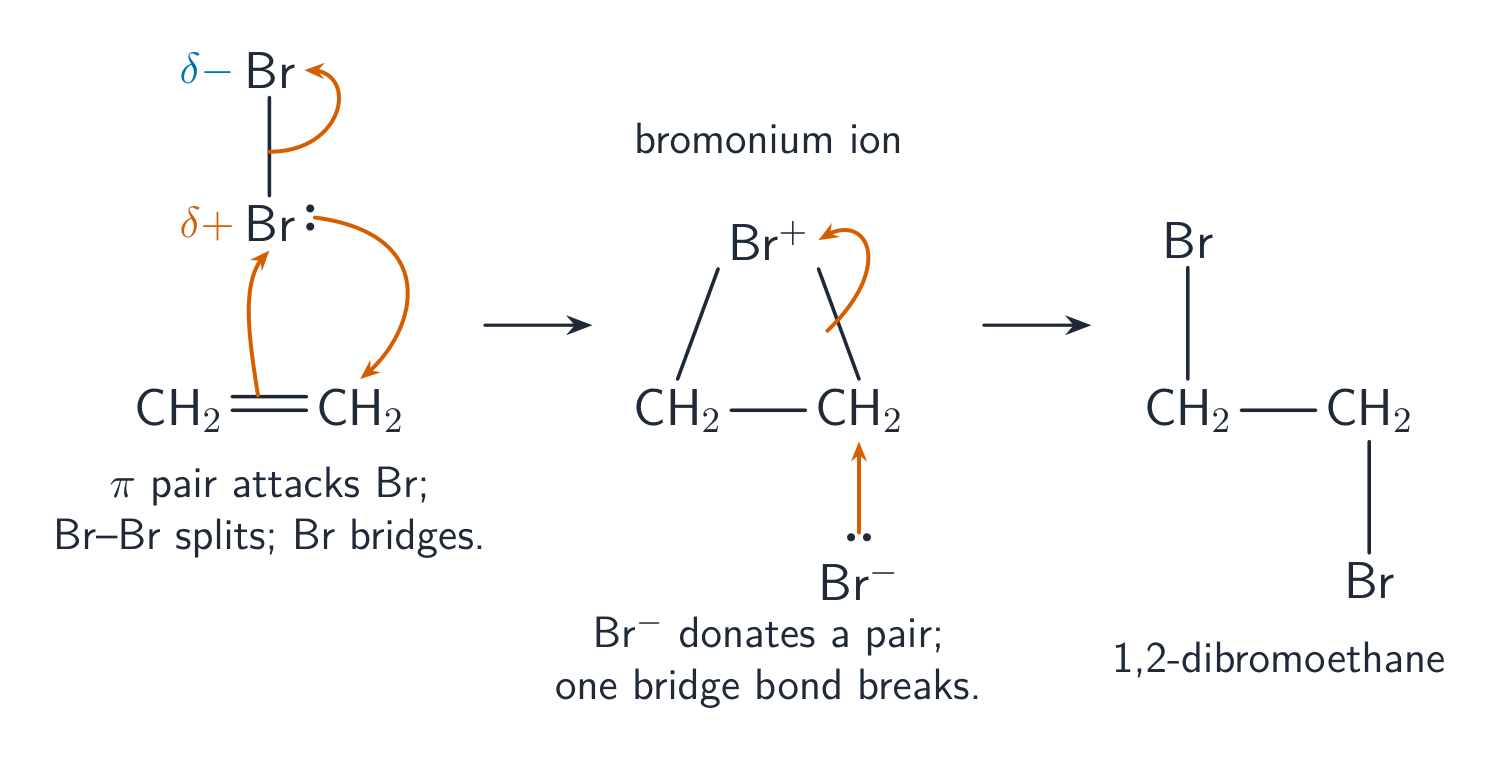
A $\text{Br}_2$ molecule is non-polar, but the electron-rich C=C bond repels the electrons in Br–Br as it gets close. This induces a dipole: the near Br becomes $\delta+$.
The bridged bromonium ion accounts for the usual bromine-addition pathway.
The π pair attacks the nearer Br, the Br–Br pair moves to the departing Br, and a lone pair on the nearer Br bonds to the other carbon. A positively charged bridged bromonium ion and Br⁻ form.
Br⁻ donates a lone pair to a carbon from the opposite side as the corresponding C–Br bridge bond breaks back towards Br. This gives 1,2-dibromoethane. A free open carbocation is an oversimplification of this bromination mechanism.
In aqueous bromine, water can compete as a nucleophile and bromohydrin products can form. The classroom decolourization observation alone does not identify every organic product; specify a Br₂ addition model when predicting the dibromide.
Hydrogen halides and acid-catalysed hydration
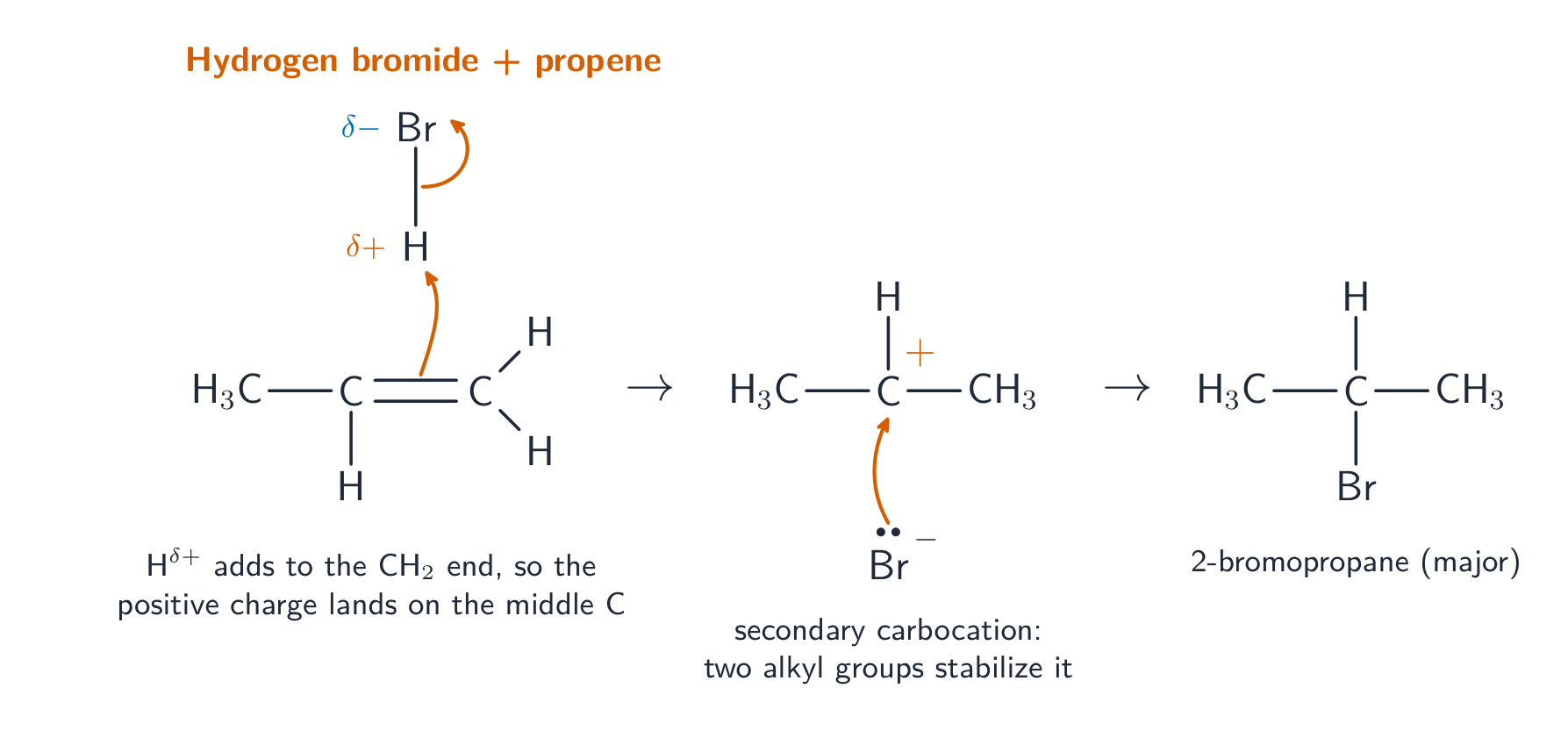
HBr is already polar. The π pair forms a bond to H, the H–Br pair goes to Br, then Br⁻ attacks the carbocation. For acid-catalysed hydration, π electrons first accept H⁺ to form a carbocation. Water then donates an O lone pair to the positive carbon, giving an oxonium ion. Loss of H⁺ gives an alcohol and regenerates the acid catalyst.
For ethene: CH₂=CH₂ + H⁺ → CH₃CH₂⁺; then + H₂O → CH₃CH₂OH₂⁺; loss of H⁺ gives CH₃CH₂OH. Check that the intermediate attached oxygen has three bonds and positive charge. Adding OH⁻ directly to a carbocation describes a different reagent situation from acid-catalysed hydration, where water is the available nucleophile.
HBr addition uses a carbocation model; bromination is distinguished above.
Unsymmetric alkenes: Markovnikov's rule
When HBr adds to propene, two products are possible: 1-bromopropane and 2-bromopropane. The major product is 2-bromopropane.
More alkyl groups on C⁺ make the carbocation more stable
The H adds to the end carbon so the positive charge is on the middle carbon. That is a secondary carbocation, which is more stable than the primary one.
Alkyl groups push electron density towards the positive carbon, which spreads out the charge. Stability: tertiary > secondary > primary.
Under the usual ionic addition conditions, the pathway through the more stable carbocation is favoured, so its product predominates. This is not a rule for every radical or rearranging addition reaction.
Markovnikov's rule 马氏规则 says this in short form: the H atom adds to the carbon of the C=C that already has more H atoms.
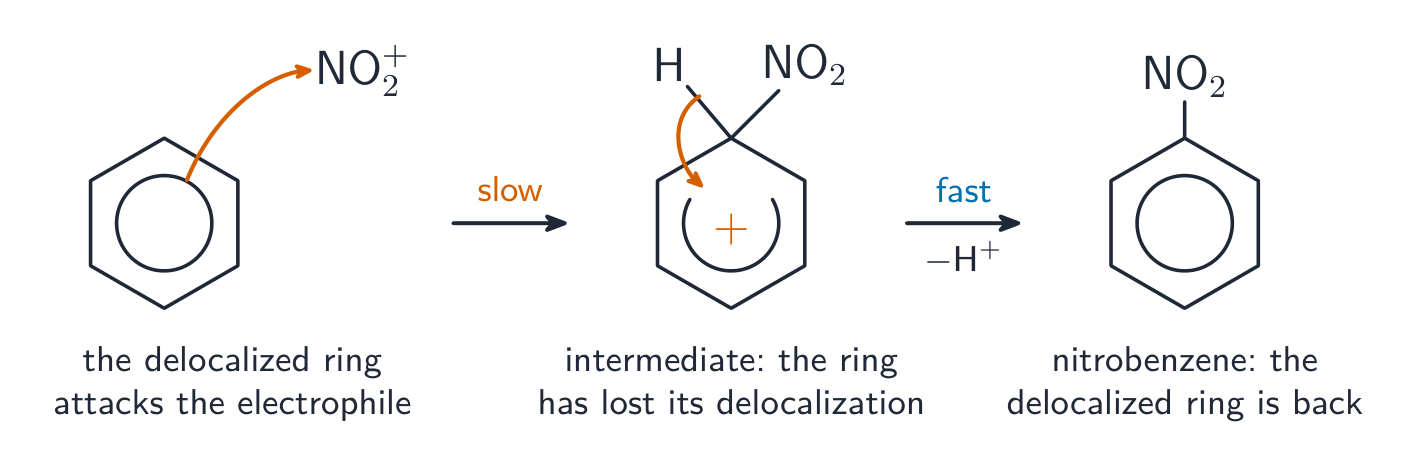
Benzene has six delocalized 离域的 π electrons above and below its plane. Electrophilic attack temporarily disrupts aromatic delocalization. Loss of H⁺ then restores it, giving electrophilic substitution 亲电取代. Addition would leave the final product without the original aromatic system; it is less favoured under the substitution conditions, not impossible under every possible condition.
Nitration as an example
The required mechanism can start with a supplied charged electrophile E⁺; formation of that electrophile is not assessed. Nitration illustrates the same ring attack and restoration of aromaticity.
As contextual chemistry, benzene can be warmed to about 50 °C with a mixture of concentrated nitric and sulfuric acids. The acids form the electrophile, the nitronium ion 硝鎓离子:
The ring attacks NO₂⁺, then loses H⁺ to get its delocalization back
A curly arrow from the delocalized ring to the N of $\text{NO}_2^+$. This is slow: the intermediate has lost its delocalization and carries a positive charge, shown by a broken ring (horseshoe) with + inside.
A curly arrow from the C–H bond into the ring. $\text{H}^+$ leaves and the delocalized ring is restored. $\text{HSO}_4^-$ takes the $\text{H}^+$, so $\text{H}_2\text{SO}_4$ is a catalyst.
Classify OH⁻, NH₃, H₂O, H⁺, NO₂⁺ and Br₂ approaching an alkene as electron-pair donors or acceptors. Explain why the sign of the charge alone is insufficient.
Contrast homolysis of Cl₂ with the formal heterolysis CH₃Br → CH₃⁺ + Br⁻. Give electron destinations and arrow types. Does the latter equation prove that a free methyl carbocation is an intermediate in ordinary substitution?
Write the overall equation for 1-bromopropane with warm aqueous OH⁻. Identify the nucleophile, attacked atom, leaving group and organic product.
Explain C–Br polarity and specify the start and end of both electron-pair arrows for replacing Br with OH. Explain why a curly arrow beginning at Cδ⁺ points the wrong way for nucleophilic attack.
Give structural formulas and names of the main organic products when propene reacts with (a) Br₂ in a stated dibromide-addition model, (b) HBr under usual ionic conditions, (c) acid-catalysed water. Describe the carbon–carbon bond change.
Compare cyclohexene and cyclohexane using bromine water in the dark. State the observation, two controlled conditions and one limitation of identifying an unknown from this test alone.
Use CH₃CH₂Br + 2NH₃ → CH₃CH₂NH₂ + NH₄⁺ + Br⁻ to explain the two ammonia roles. For water as nucleophile, explain why an initial product with oxygen bonded to two H atoms and the organic group must lose a proton to give an alcohol.
A substitution consumes 0.0200 mol 1-bromopropane with excess OH⁻. Find maximum propan-1-ol amount. If isolated yield is 68.0%, find actual amount. Does the carbon count change the 1:1 mole ratio?
In a single-addition model, find Br₂ amount and mass required for 0.0120 mol but-2-ene, using $M(\mathrm{Br_2})=159.8$ g/mol. Name the dibromide.
Plan the two-step route ethene → bromoethane → ethanol. Give reagents, suitable conditions and the reaction pattern of each step; write both net equations.
Repair these claims: (a) every nucleophile is negative; (b) a curly arrow can start at a positive charge; (c) steam is the catalyst for ethene hydration; (d) bromine decolourization proves the unknown is ethene.
AHL. (a) Explain BF₃ + NH₃ and H⁺ + NH₃ using Lewis roles and electron-pair arrows. Which also uses the Brønsted–Lowry definition? (b) Find metal oxidation states and coordination numbers for [Fe(CN)₆]⁴⁻ and [Co(NH₃)₅Cl]²⁺, assuming all ligands monodentate. (c) Explain why a coordination bond is not necessarily weaker than another covalent bond.
AHL. (a) Compare primary bromoethane S$_\text{N}$2 with tertiary 2-bromo-2-methylpropane S$_\text{N}$1: steps, arrows, rate expressions and energy-profile features. (b) Rates double when either [RBr] or [OH⁻] doubles separately. At 0.020 mol/dm³ RBr and 0.100 mol/dm³ OH⁻, rate is $4.0\times10^{-5}$ mol/(dm³ s). Deduce $k$ and predict the rate if both concentrations double. (c) Describe the spatial result of a stated S$_\text{N}$2 conversion of chiral 2-bromobutane to butan-2-ol; explain why calling it “the other enantiomer of the starting compound” is wrong. (d) Compare otherwise matched 1-iodobutane and 1-chlorobutane substitution rates.
AHL. (a) Describe electron-pair movements for Br₂ addition to ethene using a bridged intermediate. (b) Give all three stages of acid-catalysed ethene hydration, including the charged oxygen intermediate and catalyst regeneration. (c) Explain the major product of HBr + propene and distinguish the carbocation model from bromination. (d) Starting from a supplied electrophile E⁺, describe benzene substitution and restoration of aromaticity. Identify the role of each curved arrow; do not assume electrophile formation is required.
Worked answers
OH⁻, NH₃ and H₂O donate electron pairs: nucleophiles. H⁺, NO₂⁺ and the polarized Br₂ reactant accept pairs: electrophiles. Neutral molecules can fill either role depending on the available donating pair or accepting centre.
Cl₂ → 2Cl•: one electron to each Cl, shown with two fishhooks. CH₃Br → CH₃⁺ + Br⁻: the full C–Br pair goes to Br, shown with one full curly arrow. The latter is formal electron allocation, not evidence for a free methyl carbocation pathway.
CH₃CH₂CH₂Br + OH⁻ → CH₃CH₂CH₂OH + Br⁻. OH⁻ donates at O to the carbon bonded to Br; Br⁻ leaves; the alcohol is propan-1-ol.
Br attracts the bonding electrons more strongly than C, leaving Cδ⁺. Draw the O lone pair → attacked C, and C–Br bond pair → Br. Starting the first arrow at positive carbon would show electrons coming from the electron-poor site rather than from hydroxide.
(a) CH₃CHBrCH₂Br, 1,2-dibromopropane; (b) CH₃CHBrCH₃, 2-bromopropane; (c) CH₃CH(OH)CH₃, propan-2-ol, the major hydration product. Each addition replaces C=C by C–C and gives one new bond to each carbon. The carbon skeleton retains three atoms.
Cyclohexene rapidly decolourizes the orange reagent; cyclohexane has no rapid change in the dark. Match temperature, reagent amount and other conditions, keeping light exposure controlled. Other substances can consume bromine, so decolourization is not unique proof of an alkene or of ethene.
One NH₃ donates its N lone pair to form the organic C–N bond; another accepts H⁺, giving NH₄⁺. The net equation has eleven H atoms on each side and total charge zero. A water-derived intermediate R–OH₂⁺ has three O bonds and +1 charge; deprotonation gives R–OH without losing the oxygen-containing group.
The balanced substitution is 1:1, so maximum alcohol amount = 0.0200 mol. Actual amount = theoretical amount × fractional yield = $0.0200\times0.680=0.0136$ mol. Three carbon atoms stay together within each product molecule; they do not multiply the number of molecules produced.
The alkene/Br₂ ratio is 1:1, so $n(\mathrm{Br_2})=0.0120$ mol. Mass $m=nM=0.0120\times159.8=1.9176$ g, giving 1.92 g. The product is CH₃CHBrCHBrCH₃, 2,3-dibromobutane.
First, HBr adds to ethene under usual ionic addition conditions: CH₂=CH₂ + HBr → CH₃CH₂Br. Then warm aqueous OH⁻ substitutes Br: CH₃CH₂Br + OH⁻ → CH₃CH₂OH + Br⁻. Step one is electrophilic addition; step two nucleophilic substitution. Neither requires changing the two-carbon skeleton.
(a) NH₃ and H₂O are neutral nucleophiles. (b) Start at a donating pair or bond, not positive charge. (c) Water is the net reagent; acid is regenerated as catalyst. (d) The observation shows bromine consumption and is consistent with unsaturation; it does not uniquely identify ethene.
AHL. (a) NH₃ donates its N lone pair: arrow N pair → B in BF₃, or → H⁺. NH₃ is the Lewis base; BF₃/H⁺ the Lewis acid. H⁺ + NH₃ → NH₄⁺ also involves proton acceptance, so it is Brønsted–Lowry acid–base chemistry. BF₃ + NH₃ involves no proton transfer. (b) Fe: $x+6(-1)=-4$, so +2; coordination number six. Co: $x+5(0)-1=+2$, so +3; coordination number six. (c) Donor origin describes how the shared pair formed, not a separate universal bond-strength class.
AHL. (a) S$_\text{N}$2: O pair → C and C–Br pair → Br in one concerted step; rate = k[RBr][OH⁻], one transition-state peak and no carbocation intermediate. S$_\text{N}$1: slow C–Br pair → Br creates the carbocation, then fast O pair → C; rate = k[RBr] in the simple model, two peaks with an intermediate valley. A tertiary centre supports the carbocation and obstructs backside attack. (b) First order in each reactant, second order overall: $k=r/([\mathrm{RBr}][\mathrm{OH^-}])=0.020$ dm³/(mol s). Doubling both gives a factor four: $1.6\times10^{-4}$ mol/(dm³ s). (c) Backside attack inverts the arrangement at the reacting carbon. Butan-2-ol and 2-bromobutane differ in composition, so they cannot be enantiomers of each other; reassess R/S priorities rather than assuming the label always flips. (d) Matched iodobutane commonly reacts faster: C–I is weaker and I⁻ a better leaving group. Bond polarity alone is not the correct explanation.
AHL. (a) The π pair attacks Brδ⁺; Br–Br pair goes to the departing Br and a near-Br lone pair bonds to the other carbon, making a bromonium ion. Br⁻ then donates a pair to a carbon while its bridge C–Br pair returns to Br, opening the ring to give the dibromide. (b) π pair → H⁺ gives CH₃CH₂⁺; H₂O O pair → C gives CH₃CH₂OH₂⁺; base-assisted H⁺ loss returns the O–H pair to O, giving ethanol and regenerating acid. (c) Propene protonation favouring a secondary carbocation leads mainly to 2-bromopropane after Br⁻ attack. Bromination instead uses the bridged bromonium model. (d) A ring π pair → E⁺ creates a C–E bond and a positively charged non-aromatic intermediate. A C–H pair returns into the ring as a base removes H⁺; aromaticity is restored in C₆H₅E. Addition would not restore that original aromatic system.
22.11
考试技巧
English
Start a full curly arrow at an electron pair or bond, then check the new bonds and charges. A minus sign records charge; it does not locate a pair.
Identify the reacting carbon, donor atom and leaving group. Keep carbon skeletons and atom counts consistent; distinguish addition from substitution.
State reagents, conditions and evidence limits. Bromine consumption is consistent with unsaturation but does not uniquely identify an alkene; “colourless” describes colour, while “clear” describes transparency.
AHL. Distinguish a transition state from an intermediate. Use rate data, not overall coefficients, to test a rate expression; compare leaving groups under matched conditions.
AHL. Explain spatial inversion without calling different-composition reactant and product enantiomers. Hydration needs water attack and deprotonation; benzene substitution must restore aromaticity.