This handout teaches Structure 1.1, Introduction to the particulate nature of matter, for the course first assessed in 2025. All of it is SL and HL content.
Prerequisites: the idea that matter is made of particles, and reading a temperature–time graph. This is the first unit of the course; the rest of the course builds on it.
1.2
元素、化合物和混合物
English
Why is sea water not a pure substance?
A simplified salt-water sample contains water and dissolved salt. Heating can remove water as vapour while non-volatile salt remains; collecting the water requires condensation, not just watching vapour escape. Real sea water contains other substances, so the purity of a collected fraction depends on the method and possible contaminants. Sea water is a mixture: its components do not form a single new substance in a fixed formula, so a physical process can separate them. Water itself cannot be split by boiling; it needs a chemical reaction, such as electrolysis, to give hydrogen and oxygen.
Three kinds of matter
Elements and compounds are pure substances; a mixture is not
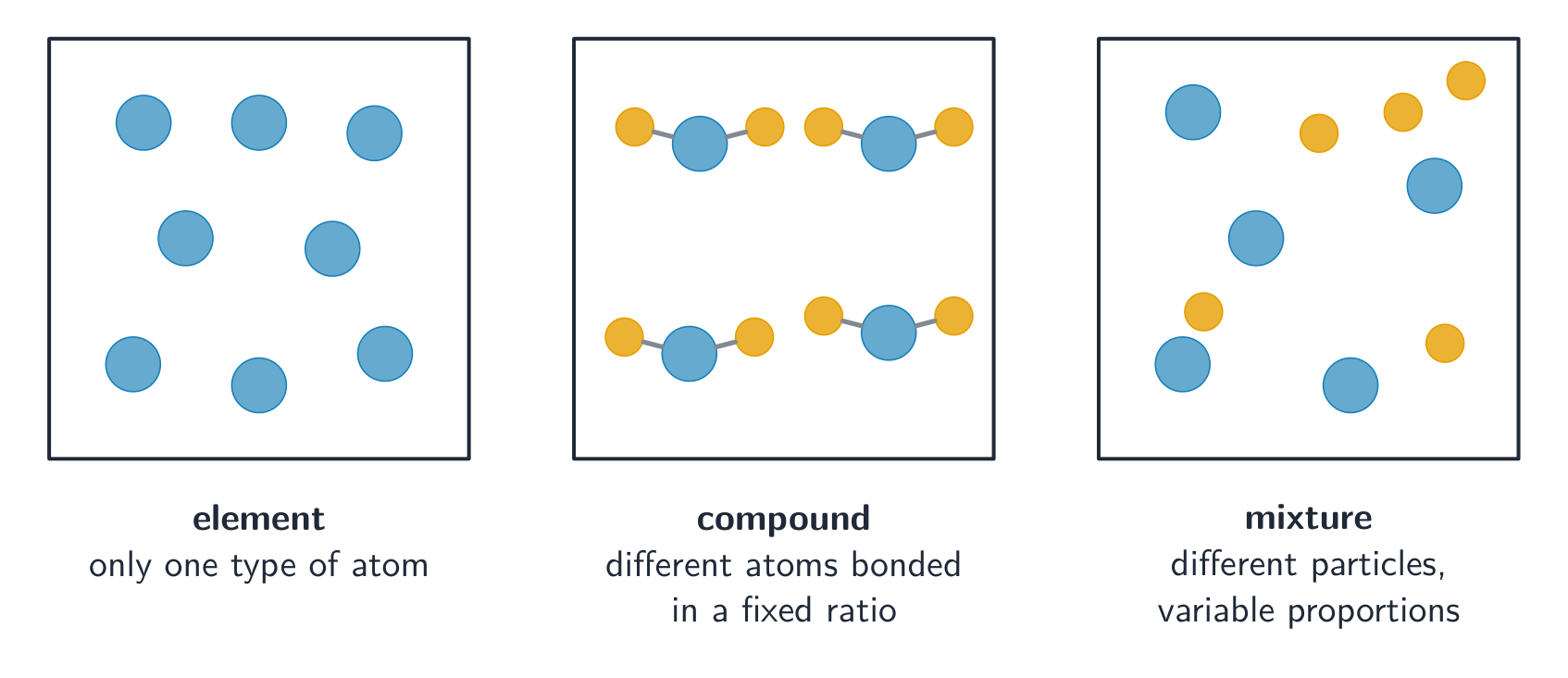
An element 元素 contains only one type of atom and cannot be chemically broken down into simpler substances, for example iron, Fe, or oxygen, O₂.
A compound 化合物 contains two or more elements chemically bonded in a fixed ratio, for example water, H₂O. Its properties differ from those of its elements: sodium and chlorine are dangerous, sodium chloride is table salt.
A mixture 混合物 contains more than one element or compound in variable proportions, rather than one new compound with a fixed composition. Components retain their chemical identities, although mixing and interactions can change bulk properties such as boiling point. Bonds within component molecules do not disappear.
Homogeneous and heterogeneous mixtures
A homogeneous 均匀的 mixture has the same composition throughout, and you cannot see the parts: a uniform salt solution, well-mixed air or a suitable single-phase brass sample. Some alloys contain more than one phase, so “alloy” alone does not guarantee a homogeneous sample.
A heterogeneous 不均匀的 mixture does not have a uniform composition, and the parts can often be seen: sand in water, oil and water, granite.
Mixtures are separated by physical methods that use a difference in physical properties: solubility, boiling point, or particle size.
On real chromatograms, each substance in the mixture rises a different distance, leaving a separate coloured spot
Mixture
Method
Property used
insoluble solid in a liquid (sand and water)
filtration 过滤
particle size
dissolved solid in a liquid (salt water), solid wanted
evaporation 蒸发 or crystallization 结晶
the solvent evaporates, the solute does not
dissolved solid in a liquid, liquid wanted
simple distillation 蒸馏
different boiling points
two miscible liquids (ethanol and water)
fractional distillation
different boiling points
an insoluble and a soluble solid (sand and salt in water)
dissolve the salt, filter off sand, then crystallize the salt
different solubility; dissolution involves solvation 溶剂化
coloured substances in a solution (inks, dyes)
paper chromatography (Structure 2.2)
attraction to two phases
Filtration
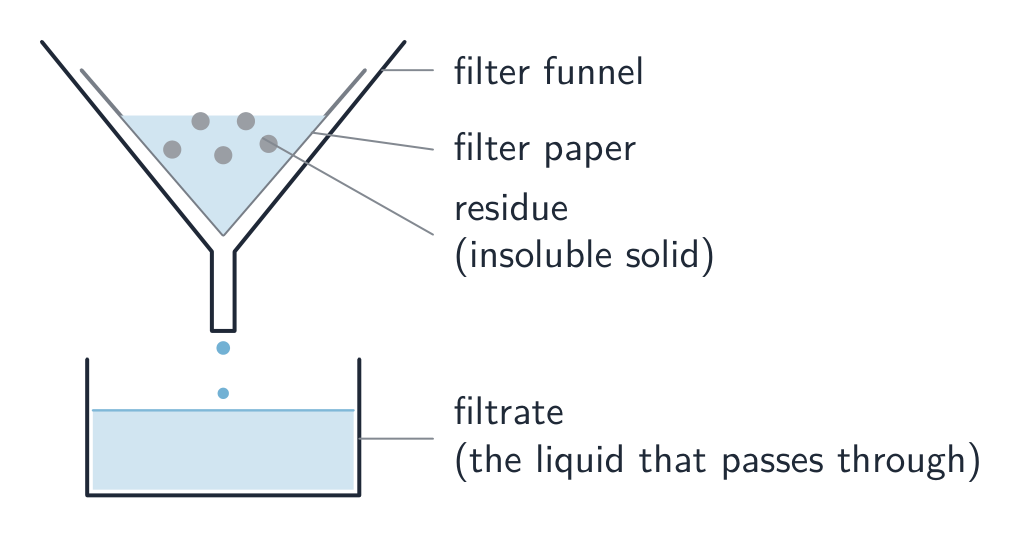
The solid that stays in the paper is the residue; the liquid that passes through is the filtrate
The filter paper has tiny holes. Dissolved particles and the solvent pass through; larger, undissolved particles do not.
Crystallization
To get crystals of a soluble solid, such as copper(II) sulfate, from its solution:
Making a soluble salt from an insoluble solid: react with excess, filter off the excess, evaporate, then crystallise
Heat the solution to evaporate some of the water until it is saturated 饱和的: a drop on a cold glass rod forms crystals.
Leave it to cool slowly. For a solute whose solubility decreases sufficiently on cooling, crystals can form. Choose a suitable solubility curve; not every solute has the same temperature dependence.
Filter off the crystals, wash them with a little cold water and dry them.
Evaporation to dryness can leave a solid residue, but may produce small crystals, trap impurities or decompose a heat-sensitive solid. Controlled crystallization and washing are chosen when purer crystals are wanted; neither guarantees complete recovery.
Distillation
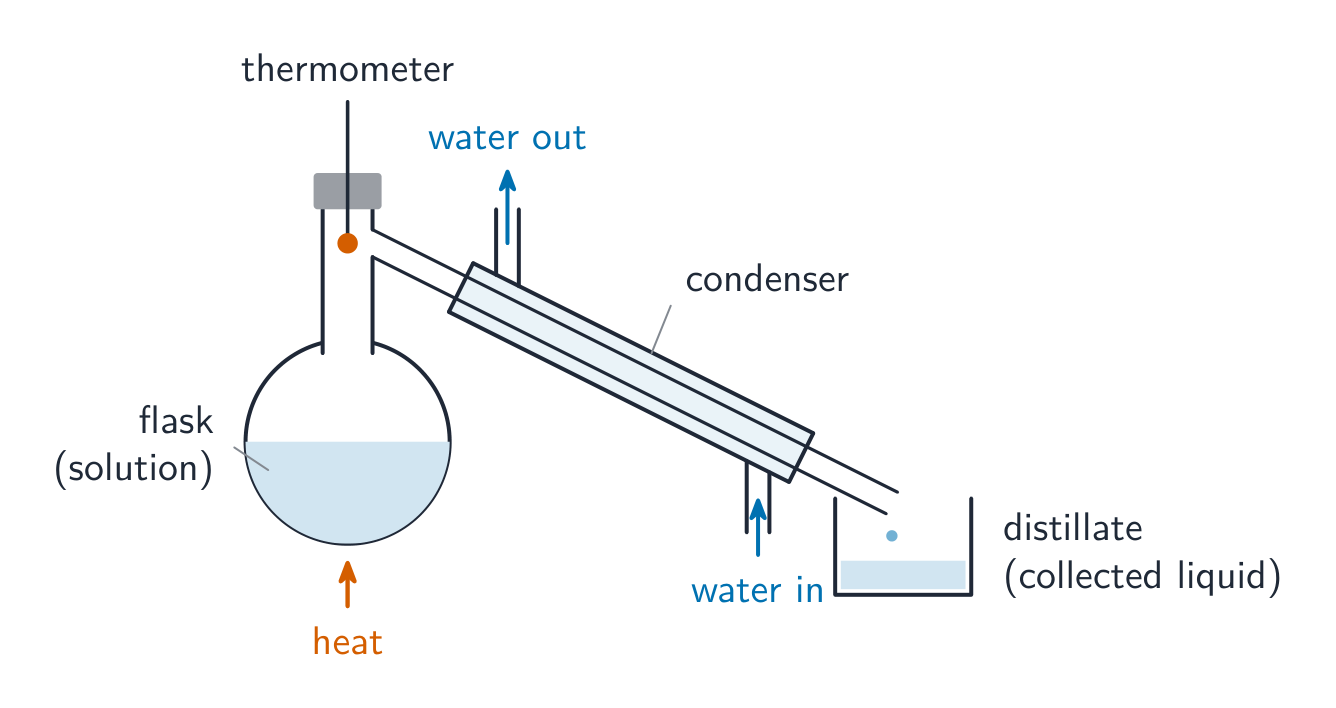
The liquid boils off, condenses in the cold condenser and collects as the distillate
For a solution containing a non-volatile solute, the vapour is mainly solvent; it condenses and is collected. For two volatile liquids, the vapour is commonly enriched in the more volatile component but need not be pure. They do not necessarily wait to boil one at a time.
Cold water enters the condenser at the bottom and leaves at the top, so the jacket stays full.
The thermometer bulb sits level with the side arm, so it reads the temperature of the vapour that is leaving.
A fractionating column provides repeated vaporization and condensation, improving separation of volatile components. Boiling points depend on pressure, and mixtures such as ethanol/water can limit the purity obtainable by ordinary distillation. Use approved apparatus, suitable heating, eye protection and an open vapour path; never heat a sealed improvised vessel or distil to dryness.
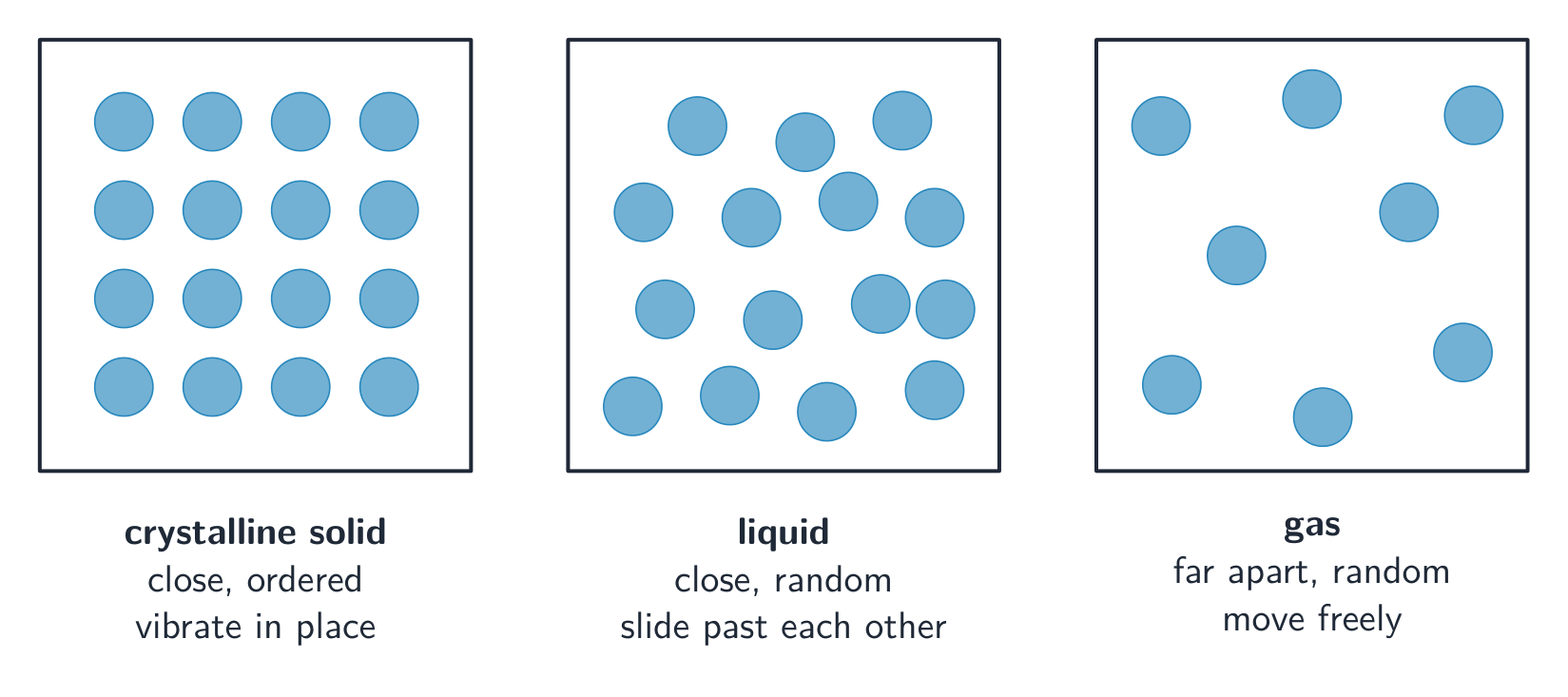
The kinetic molecular theory 分子动理论 says that all matter is made of particles that are always moving. How the particles are arranged and how they move decides the state.
Warmed solid iodine turns straight into a purple gas (sublimation)The state depends on how close the particles are and how freely they move
Solid
Liquid
Gas
Arrangement
close together; regular in a crystalline solid
close together, without long-range crystalline order
far apart in the simple gas model
Movement
vibrate about fixed positions
move past each other
move fast in all directions
Attractions and motion
constrain particles around positions
still important while particles rearrange
neglected in an ideal-gas model
Shape
fixed
takes the shape of the container
fills the container
Volume
fixed
fixed
fills the container
Compressible?
only slightly under ordinary conditions
only slightly
much more readily
Changes of state
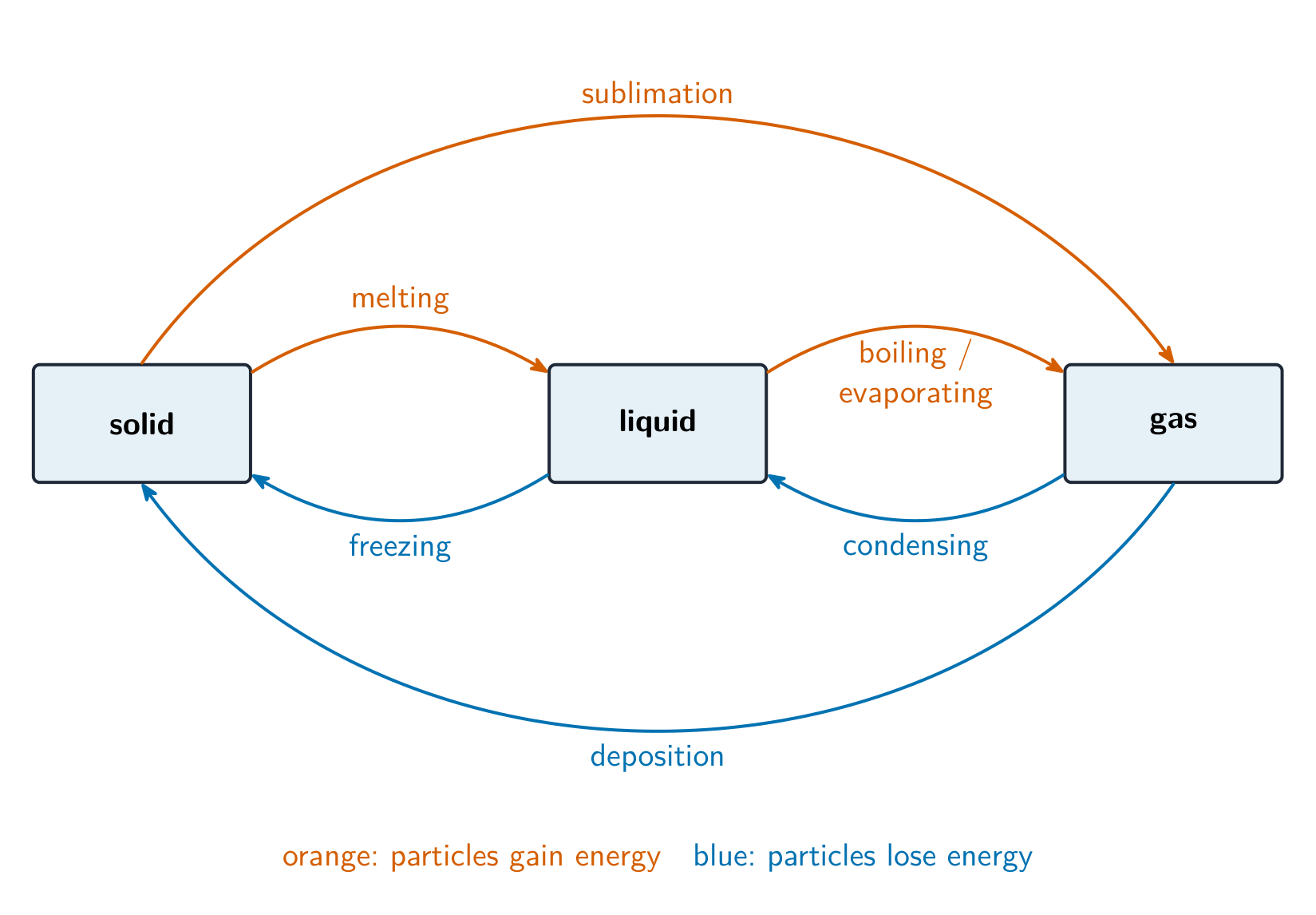
Orange changes need energy; blue changes release it
Melting, boiling or evaporating, and sublimation 升华 (solid straight to gas) are endothermic 吸热的: energy is taken in to overcome the forces between particles.
Freezing, condensing and deposition 凝华 (gas straight to solid) are exothermic 放热的: energy is released as forces form.
Dry ice (solid CO₂) and iodine sublime at atmospheric pressure. Frost forming on a cold window is deposition.
Evaporation and boiling are different. Evaporation occurs at a liquid surface over a range of temperatures: sufficiently energetic particles can escape. Boiling involves vapour bubbles throughout the liquid when conditions allow them to persist. A pure substance has a defined boiling temperature at a specified pressure; changing pressure changes that temperature. Melting and boiling water overcome intermolecular attractions rather than breaking each water molecule into hydrogen and oxygen. Some solids, such as glass, lack a regular crystalline arrangement: the simple ordered-particle drawing is a model, not every solid’s structure.
The heating curve
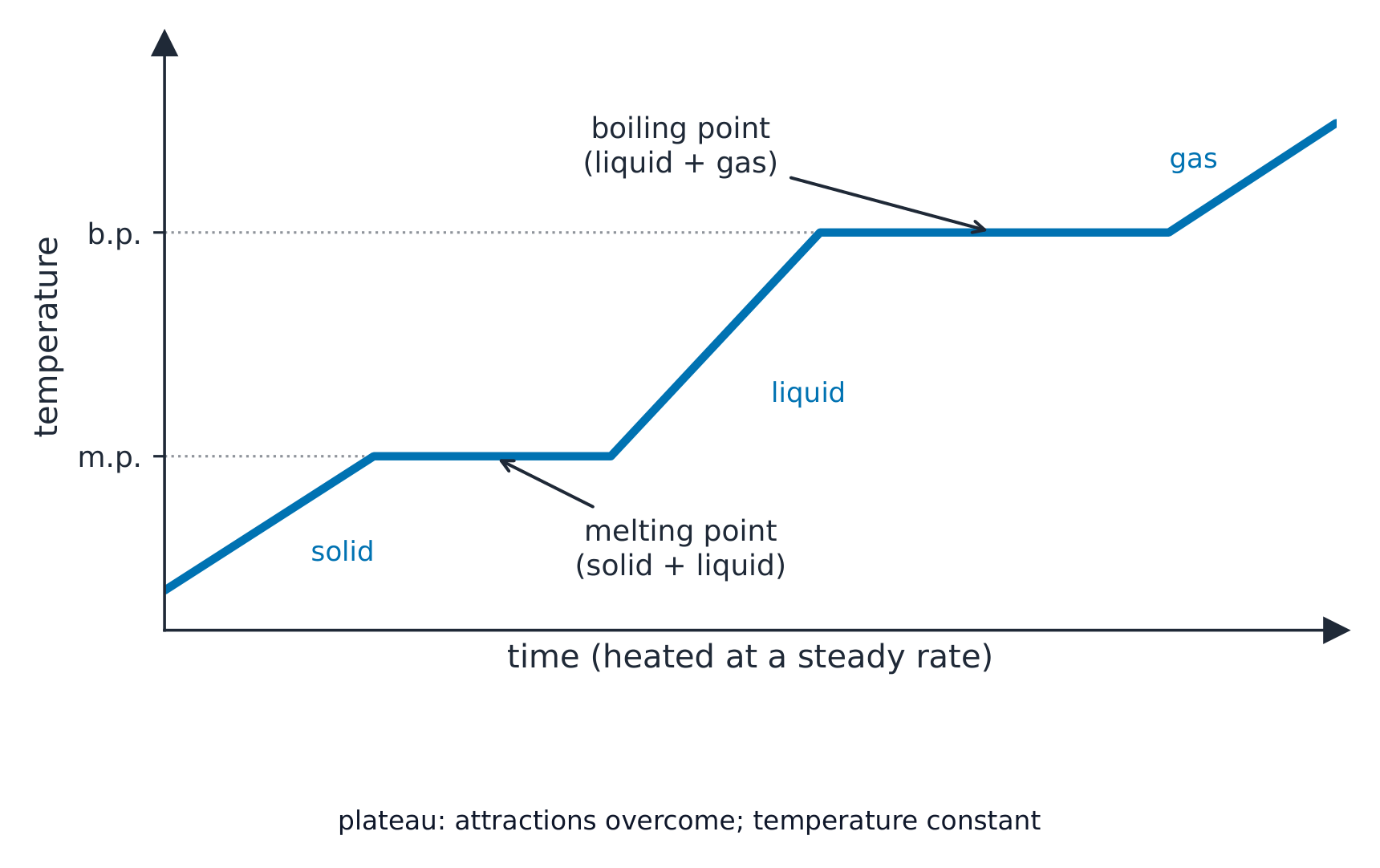
On each flat part the energy separates particles instead of making them move faster
On the sloping parts the energy increases the kinetic energy of the particles, so the temperature rises.
On the flat parts (the melting point and the boiling point) the energy is used to overcome the attractions between particles. The kinetic energy, and so the temperature, stays the same.
Plateau duration depends on sample mass, latent energy, heating power and heat losses.
For an appropriate pure crystalline substance at fixed pressure, a sharp melting point supports a purity 纯度 assessment. Many impurities depress/broaden melting, but a range alone is not conclusive: heating rate, instrument error or decomposition may also matter. Pure-substance phase plateaus assume suitable pressure and near-equilibrium conditions.
State symbols describe the sample
Use (s) for solid, (l) for liquid, (g) for gas and (aq) for dissolved in water. Aqueous does not mean a pure liquid. Water boiling is H₂O(l) → H₂O(g), a physical change with the same molecular identity. Sodium chloride dissolving can be represented NaCl(s) → Na⁺(aq) + Cl⁻(aq): the dissolved particles are ions, not lumps of solid salt small enough to see.
In the course’s kinetic model, temperature relates to average kinetic energy 平均动能 rather than the energy of every individual particle. For an ideal gas, mean translational kinetic energy is proportional to kelvin temperature: doubling T doubles that mean. A distribution of particle energies remains. Do not identify temperature with total internal energy in every material: phase changes also involve potential-energy changes.
At a higher temperature the curve flattens and spreads out, and the shaded fraction of particles above Ea grows much larger; a catalyst moves Ea to the left instead
The exact offset is 273.15 (NIST temperature conversion); use 273 for the whole-kelvin course estimates below, keeping one convention consistent.
0 K, absolute zero 绝对零度 (−273.15 °C), is the zero of the thermodynamic scale. The simple classical gas model approaches zero mean translational kinetic energy there; it does not describe all quantum motion in real matter.
For the ordinary thermal systems and classical model considered here, T is non-negative, and no degree sign: write 298 K, not 298 °K.
A temperature change of 1 K is the same as a change of 1 °C.
Worked example: converting temperatures
25 °C: $25 + 273 = 298$ K.
77 K (liquid nitrogen boils): $77 - 273 = -196$ °C.
Warming a gas from 27 °C to 327 °C, the temperature goes from 300 K to 600 K, so the average kinetic energy doubles. In degrees Celsius it looks like a twelve-fold rise, which is wrong.
Classify each as an element, a compound or a mixture: (a) carbon dioxide, (b) air, (c) copper, (d) sea water, (e) sodium chloride.
Classify each mixture as homogeneous or heterogeneous: (a) clear vinegar, (b) muddy water, (c) single-phase brass, (d) a fruit salad.
Describe how to get pure, dry crystals of copper(II) sulfate from a mixture of the solid with sand.
Explain why the thermometer bulb in a distillation is placed at the side arm, not in the liquid.
Explain how water can be collected from salty water by distillation.
Describe the arrangement and movement of particles in a liquid.
Explain why gases are easy to compress but liquids are not.
Name the change of state when (a) solid iodine turns to a purple vapour, (b) water vapour forms ice on a freezer wall.
Explain why the temperature stays constant while ice melts, although it is being heated.
A sample melts between 112 °C and 117 °C. The pure substance melts at 122 °C. What does this show?
Convert (a) −40 °C to K, (b) 373 K to °C.
A gas is heated from 200 K to 400 K. State how its average kinetic energy changes. Explain why heating from 20 °C to 40 °C does not double it.
Give state symbols for pure liquid water, water vapour, solid sodium chloride and sodium ions dissolved in water. Explain why (aq) and (l) are not synonyms.
An 12.0 g sand/salt mixture contains 7.50 g salt. After dissolving, filtration and crystallization, 6.60 g dry salt is recovered. Find the initial sand mass and percentage salt recovery. Give two reasons why incomplete recovery does not by itself establish a chemical reaction.
Add water and stir (copper sulfate dissolves, sand does not). Filter: sand stays as the residue. Heat the filtrate until saturated, cool so crystals form, filter them off, wash with a little cold water and dry.
The thermometer must measure the temperature of the vapour that is distilling over, which helps identify the collected fraction; temperature alone does not prove it is a pure single substance.
Heat the salty water: the water boils and its vapour passes into the condenser, cools and condenses, and drips into the beaker. The salt has a very high boiling point and stays in the flask.
Particles are close together in a random arrangement; they move and slide past each other.
Gas particles are far apart, with a lot of empty space between them; liquid particles are already close together.
(a) sublimation, (b) deposition.
The energy is used to overcome the forces between particles in the solid, not to increase their kinetic energy, so the temperature does not change until all the ice has melted.
The depressed and broadened range is consistent with impurity for an appropriate crystalline substance. Check heating rate, calibration and possible decomposition before treating it as conclusive proof.
It doubles, because kinetic energy is proportional to the temperature in K. 20 °C to 40 °C is 293 K to 313 K, an increase of only about 7%.
H₂O(l), H₂O(g), NaCl(s), Na⁺(aq). Aqueous means dissolved in water, whereas liquid states a physical state without implying a solvent. H₂O(l)→H₂O(g) keeps the molecular identity; boiling does not split water into its elements.
Initial sand 12.0−7.50 = 4.50 g. Salt recovery 6.60/7.50 × 100 = 88.0 %. Salt may remain dissolved in the mother liquor or be lost during transfer/washing. Check dryness and contamination too; less recovered mass alone does not demonstrate a new substance formed.
1.7
考试技巧
English
Distinguish variable-composition mixtures from fixed-composition compounds. Identify atoms, molecules or ions and use (s), (l), (g) and (aq) appropriately.
Name the property a separation uses: solubility, particle size or boiling point.
On a heating curve, say that energy overcomes the forces between particles; the kinetic energy and temperature stay constant.
Always convert to kelvin before comparing kinetic energies or using a gas law; write K without a degree sign.
Evaporation is a surface process; boiling involves persistent vapour bubbles. Specify pressure when discussing a boiling temperature and distinguish a fraction from proof of purity.