This handout teaches Reactivity 3.3, Electron sharing reactions, for the course first assessed in 2025. This topic is the same at Standard Level and Higher Level.
Prerequisites: covalent bonds and electronegativity from Structure 2.2, alkanes and structural formulas from Structure 3.2, and bond enthalpies from Reactivity 1.2. You will use bond enthalpy values from the data booklet.
21.2
自由基
English
Why does sunlight matter?
Free-radical substitution in three steps: initiation makes radicals, propagation carries the chain, and termination ends it
At room temperature, a methane/chlorine mixture can show little reaction in the dark. Suitable light can initiate a rapid chain reaction. Chloromethane is not the only possible organic product: further substitution can give $\text{CH}_2\text{Cl}_2$, $\text{CHCl}_3$ and $\text{CCl}_4$ as well. One kind of particle explains all of this: the radical.
What a radical is
A free radical 自由基, usually just called a radical, is a particle with an unpaired electron 未成对电子.
We show the unpaired electron with a single dot: $\text{Cl}{\bullet}$, $\text{Br}{\bullet}$, ${\bullet}\text{CH}_3$, ${\bullet}\text{OH}$.
A radical can be a single atom, such as $\text{Cl}{\bullet}$, or a group of atoms, such as the methyl radical ${\bullet}\text{CH}_3$.
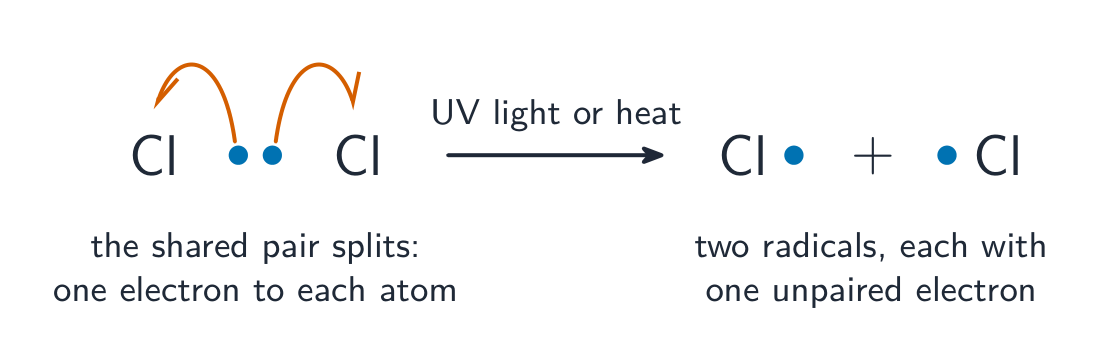
Homolytic fission gives one electron to each atom (two radicals); heterolytic fission gives both electrons to one atom (two ions)
The radicals in these mechanisms are reactive intermediates: they are formed and consumed during the reaction. A collision still needs a suitable pathway and enough energy. An unpaired electron does not mean that every collision reacts, or that every radical has the same lifetime.
Radical character and electrical charge answer different questions. Do not identify a radical from charge alone. $\text{Cl}{\bullet}$ has 17 electrons and no charge; the chloride ion $\text{Cl}^-$ has 18 electrons and a full outer shell, so it is not a radical.
A radical can also be an ion
Charge records an excess or shortage of electrons relative to the nuclei. A radical dot records an unpaired electron. A species can therefore have both a dot and a charge.
A dot means an unpaired electron; a charge means an electron excess or shortage
Example
Charge
Electron count and interpretation
$\text{Cl}{\bullet}$
0
17 electrons: an atomic radical
$\text{NO}{\bullet}$
0
$7+8=15$: a neutral molecular radical
$\text{CH}_4^{\bullet+}$
$+1$
$6+4-1=9$: a molecular radical cation
$\text{O}_2^{\bullet-}$
$-1$
$2(8)+1=17$: a molecular radical anion
These odd electron totals require at least one unpaired electron. For known closed-shell examples such as chloride or hydroxide, all electrons are paired. A charge alone cannot tell you which situation applies. The molecular-ion example connects this unit to electron-impact mass spectrometry; radical ions are not the neutral chain carriers in methane chlorination.
A covalent bond is a shared pair of electrons. When the bond breaks so that each atom keeps one electron of the pair, the break is called homolytic fission 均裂. For the closed-shell single-bond examples here, each fragment receives one electron and two radicals form.
In homolytic fission each atom takes one electron of the shared pair
A single-barbed arrow 单钩箭头 (also called a fishhook arrow) shows the movement of ONE electron. A normal double-barbed arrow shows a PAIR of electrons; you will use it in Reactivity 3.4.
Draw electron movement rather than particle movement
Start each fishhook at one electron in the shared bond and finish at the atom receiving that electron. Two fishhooks are needed for Cl–Cl homolysis: one electron goes to each Cl. The large straight reaction arrow only separates reactants and products; it does not replace the fishhooks. The reverse process combines two radicals: their two unpaired electrons make a shared pair and a covalent bond.
In a propagation step, one new bond forms as another breaks. Follow both atoms and the unpaired electron. A dot is not a negative charge, and an arrow starting from a bare positive nucleus does not show an electron source. Full electron-pair arrows belong to the next unit; do not replace a single-electron arrow with a double-headed one.
What supplies the energy?
Breaking a bond is endothermic, so homolytic fission needs energy from ultraviolet light 紫外线 or from heat. The halogens split most easily because their bonds are weak:
Bond
Bond enthalpy / kJ mol⁻¹
Br–Br
193
Cl–Cl
242
C–C
346
C–H
414
In the usual methane/chlorine photochemical reaction, light absorbed by chlorine produces Cl radicals. The lower Cl–Cl bond enthalpy helps explain this initiation route. Which bond light breaks also depends on absorption and wavelength; the weakest bond is not a universal rule for all photochemistry.
Alkanes such as methane do not react with acids, alkalis or most other polar reagents. There are two reasons:
Strong bonds. C–C (346 kJ mol⁻¹) and C–H (414 kJ mol⁻¹) need a lot of energy to break.
Almost no polarity. The electronegativities of C (2.6) and H (2.2) are close, so C–H bonds are almost non-polar 非极性的. Alkanes lack a strongly electron-rich or electron-poor functional-group centre for the usual ionic reactions.
Combustion and radical substitution are important alkane reactions. Cracking is another possible reaction under suitable conditions, so this is not a complete list.
Connect substitution to other organic reaction types
A functional group 官能团 is an atom or group of atoms responsible for characteristic reactions, such as the OH group in an alcohol. Identify the reacting bonds and keep four bonds at each carbon in a structural formula.
Name the reaction type at each step: oxidation, reduction, substitution, addition or elimination
Substitution replaces a group: CH₄ + Cl₂ → CH₃Cl + HCl under suitable UV light replaces C–H by C–Cl.
Addition opens a multiple bond: CH₂=CH₂ + H₂O → CH₃CH₂OH with steam and a phosphoric-acid catalyst adds H and OH across C=C.
Oxidation changes the alcohol group: CH₃CH₂OH + 2[O] → CH₃COOH + H₂O with excess acidified dichromate under reflux makes a carboxylic acid.
Addition polymerization joins many monomers: $n\mathrm{CH_2{=}CH_2}\rightarrow[{-}\mathrm{CH_2{-}CH_2}{-}]_n$ under suitable initiator, temperature and pressure conditions. C=C bonds become C–C links; no small molecule is lost.
A linked synthesis is ethene → ethanol → ethanoic acid: use steam/phosphoric acid first, then excess acidified dichromate under reflux. Each organic molecule retains two carbon atoms in both steps. Reagents and conditions belong to their own arrow; UV chlorination conditions cannot replace hydration or oxidation conditions.
The chain reaction
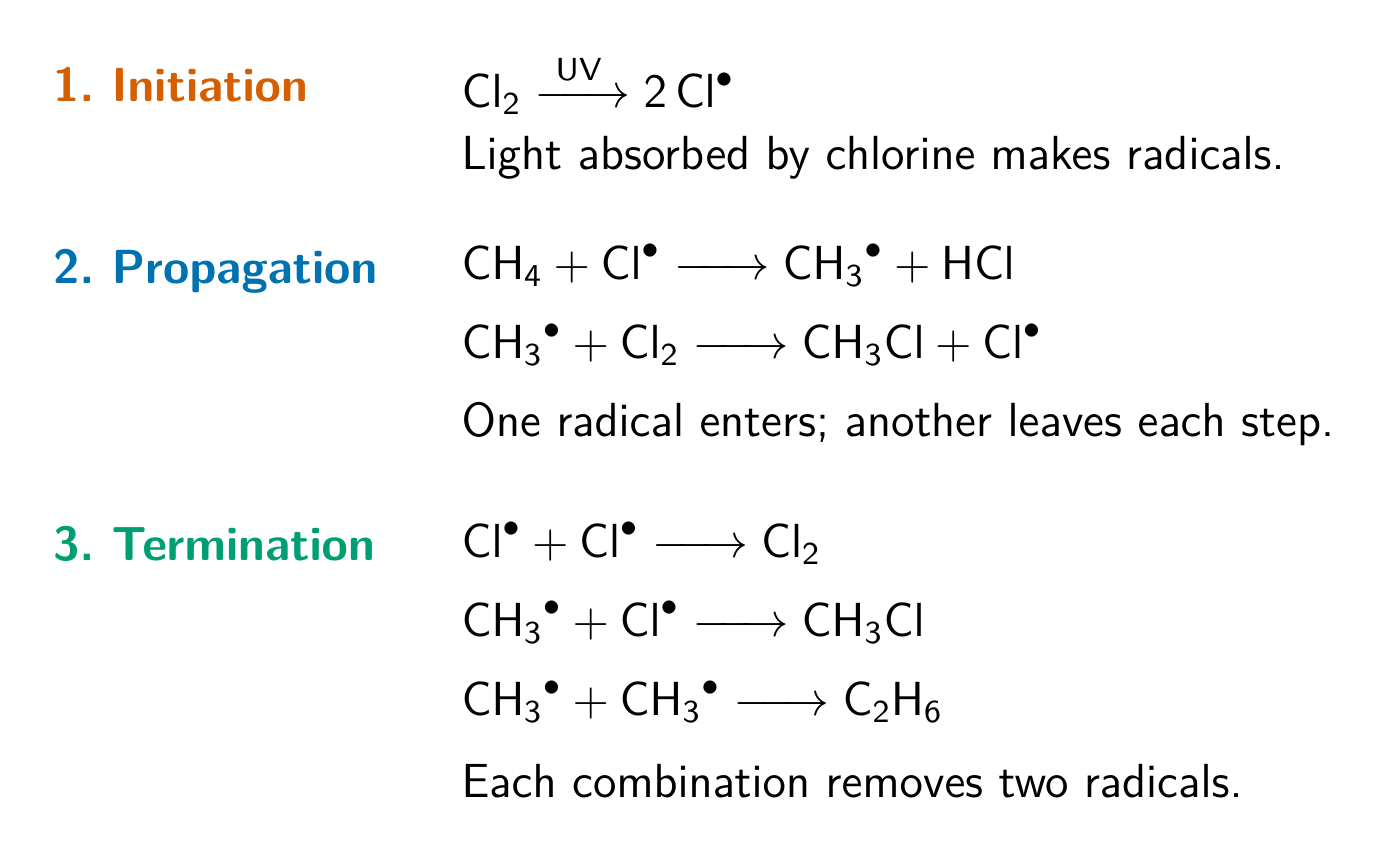
Methane and chlorine react in UV light by radical substitution 自由基取代: a chlorine atom takes the place of a hydrogen atom. It is a chain reaction 链反应 with three stages.
Initiation makes radicals, propagation passes them on, termination removes them
Initiation 引发: UV light splits chlorine molecules into radicals.
$$\text{Cl}_2 \rightarrow 2\text{Cl}{\bullet}$$
Propagation 链增长: each step uses one radical and makes another, so the chain keeps going.
In the first propagation step, chlorine abstracts hydrogen: H transfers directly from methane into HCl. A free hydrogen radical is not a product in this mechanism. The products of propagation are HCl and ${\bullet}\text{CH}_3$, never $\text{CH}_3\text{Cl}$ and ${\bullet}\text{H}$.
The same can happen again to give $\text{CHCl}_3$ and finally $\text{CCl}_4$. Termination also adds products such as ethane. Radical substitution commonly gives a product mixture 产物混合物. Which products are detectable depends on conditions and conversion. A useful organic product may need separation, for example by distillation when boiling points permit.
To get more of…
Use…
$\text{CH}_3\text{Cl}$
a large excess of methane, so $\text{Cl}{\bullet}$ usually meets $\text{CH}_4$
$\text{CCl}_4$
a large excess of chlorine
Evidence for the chain model
A low dark rate and a higher rate under suitable light support photochemical initiation. This observation alone does not establish every proposed intermediate.
A short burst of light causes a lot of reaction: each radical is passed on many times.
Ethane formation is consistent with methyl radicals combining. Together with light dependence and chain amplification, this supports the mechanism; a single product is not unique proof of every step.
What conditions can change
Excess methane increases the chance that a chlorine radical meets methane rather than a partly chlorinated molecule. It can improve the proportion of chloromethane without making all side reactions impossible. Limiting conversion can also reduce repeated substitution. Excess chlorine and longer reaction progress can favour more highly chlorinated products. These are qualitative controls, not a guarantee of a pure product or a fixed percentage.
For complete monochlorination only, one mole of alkane consumes one mole of chlorine and makes one mole of HCl. Further substitution uses more chlorine. If a sample consumes 0.060 mol Cl₂, you cannot report 0.060 mol chloromethane unless you know that every chlorine molecule was used in that single-substitution route.
In propane, a chlorine radical can remove a hydrogen atom from an end carbon or from the middle carbon, so two different monochloro products form: 1-chloropropane and 2-chloropropane.
Bromination follows the same type of chain mechanism. Under comparable conditions it is commonly slower and more selective than chlorination; do not infer exact product percentages from that statement.
Symmetry and amounts of products
The two end carbons of propane are equivalent. Removing H from either end gives the same constitutional product, 1-chloropropane; removing H from the middle gives 2-chloropropane. Do not count left and right drawings as different compounds. Similarly, butane gives two constitutional monochloro products, 1-chlorobutane and 2-chlorobutane. Optical isomers of the latter are not an extra substitution position.
Counting equivalent hydrogens in propane
There are six terminal H atoms and two middle H atoms in propane. If every H had equal reactivity, a deliberately simplified model would predict $6:2=3:1$ amounts of 1- to 2-chloropropane. Real sites need not have equal reactivity. With assumed per-H relative reactivities of 1 for terminal and 3 for middle H, the weighted amounts are $6(1):2(3)=1:1$. Neither model is a universal experimental ratio. Use supplied selectivity data; do not treat the number of H atoms as the whole explanation.
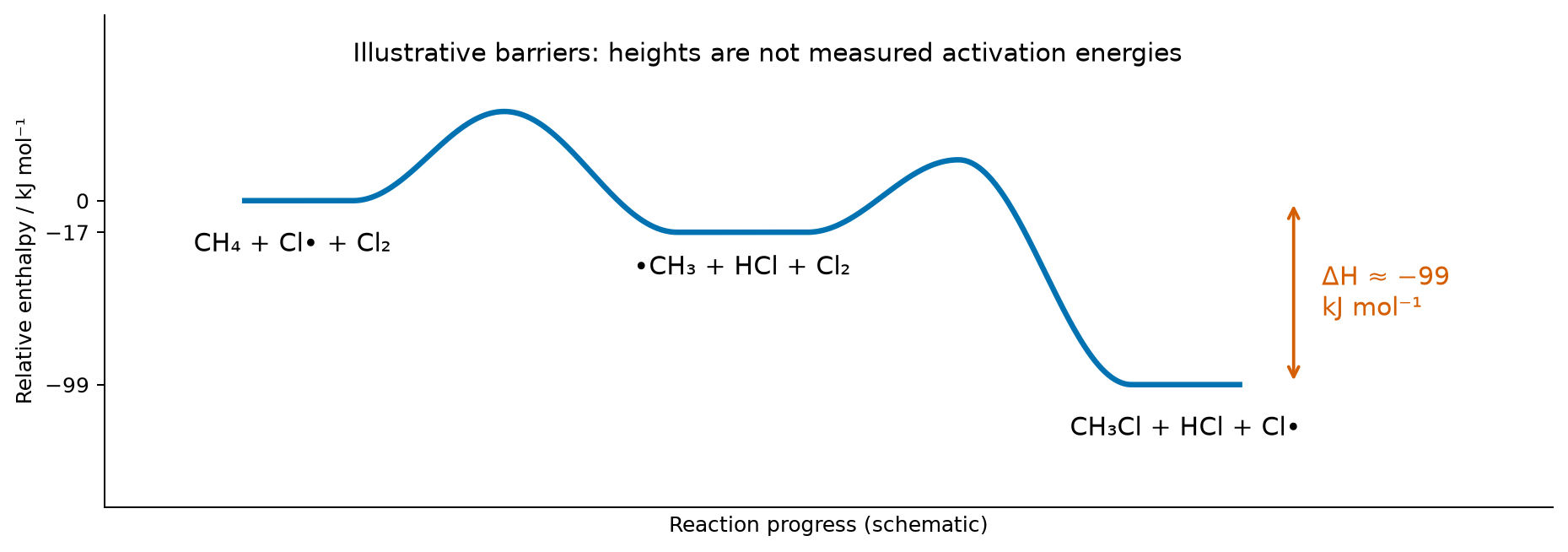
Use the supplied mean bond enthalpies to estimate the propagation energy changes. These values are approximate gas-phase averages; a negative enthalpy change is not a measured activation energy.
Both propagation steps are exothermic: −17 and −82 kJ mol⁻¹
Bond
C–H
Cl–Cl
H–Cl
C–Cl
H–Br
Bond enthalpy / kJ mol⁻¹
414
242
431
324
366
Worked example. Find $\Delta H$ for each propagation step of the chlorination of methane.
Add the two steps: $\Delta H = -99$ kJ mol⁻¹ for $\text{CH}_4 + \text{Cl}_2 \rightarrow \text{CH}_3\text{Cl} + \text{HCl}$.
Both estimated propagation changes are exothermic. The observed rate also depends on activation barriers, temperature, reactant concentrations and radical loss. Exothermic does not by itself mean fast.
For bromine the first estimate is $414 - 366 = +48$ kJ mol⁻¹. Hydrogen abstraction by bromine commonly has a higher barrier than by chlorine under comparable conditions. Its endothermicity helps interpret the difference, but enthalpy alone does not calculate a rate.
Kinetic stability is compatible with energy release
A fuel/oxygen mixture may release energy when it burns but remain little changed at room temperature because the initiation pathway has a large activation barrier. It is kinetically resistant under those conditions even though combustion products are thermodynamically favoured. Specify the proposed reaction: an alkane is not simply thermodynamically unstable relative to every possible chemical change.
Barriers; endpoint differences use the supplied mean bond enthalpies. The intermediate lies between two transition states.
UV supplies initiation energy; it is not a substance consumed once for every propagation cycle. Adding the propagation equations cancels both Cl• and •CH₃, leaving the net substitution equation. By contrast, adding initiation to every cycle incorrectly predicts that two new chlorine radicals are needed for each product molecule.
21.7
大气中的自由基
English
How CFCs destroy ozone
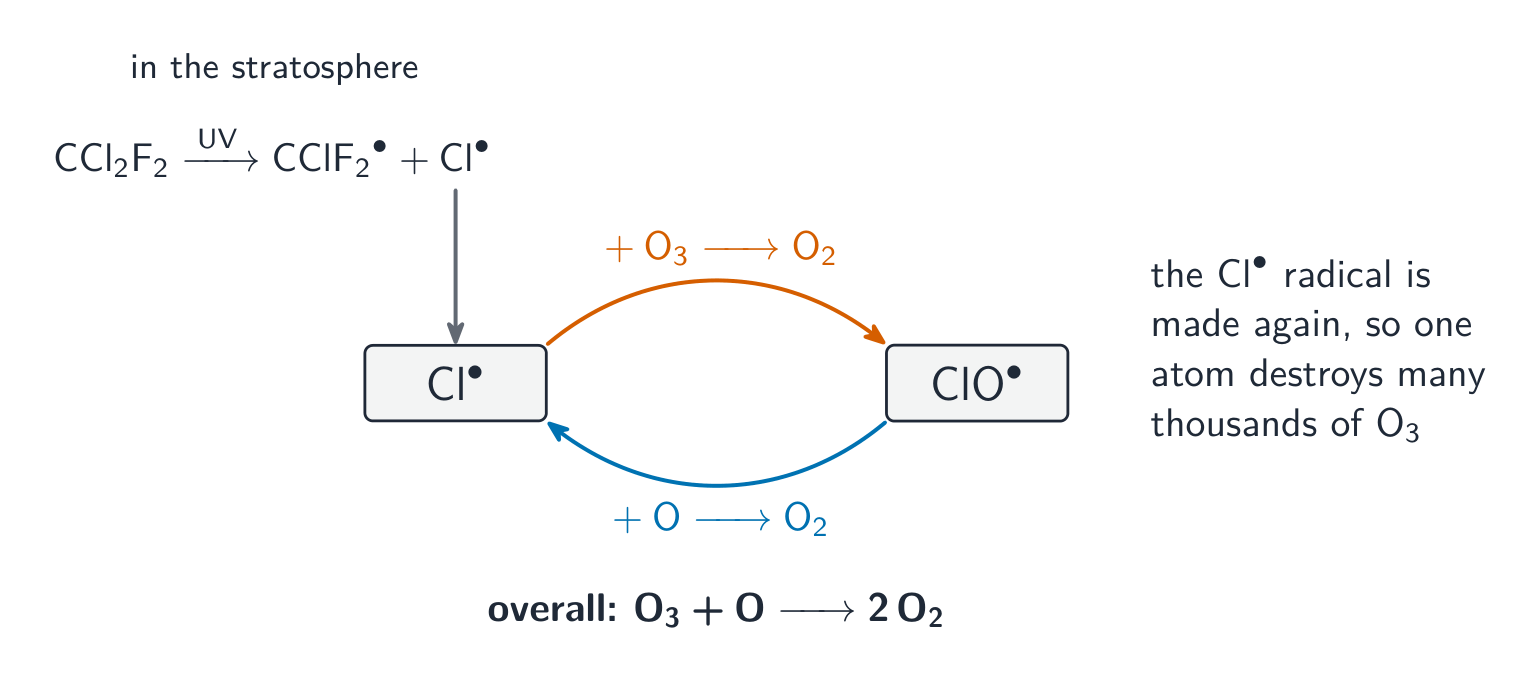
Chlorofluorocarbons 氯氟烃 (CFCs), such as $\text{CCl}_2\text{F}_2$, were used in fridges and spray cans. They are unreactive near the ground, so they drift up into the stratosphere 平流层. There, strong UV light breaks the C–Cl bond (324 kJ mol⁻¹), which is weaker than the C–F bond (492 kJ mol⁻¹):
Chlorofluorocarbons were once common aerosol propellants; in the stratosphere UV light splits off chlorine radicals that destroy ozone
The chlorine radical is made again at the end of each cycle
Overall: $\text{O}_3 + \text{O} \rightarrow 2\text{O}_2$. The chlorine radical is made again, so one Cl atom can destroy many thousands of ozone molecules before a termination step removes it. The Montreal Protocol, agreed in 1987, established controls leading to the phase-out of ozone-depleting substances including CFCs; it was not an instant worldwide removal of every CFC.
Limits of the simple ozone cycle
The written two-step model consumes one ozone molecule and one oxygen atom, not two ozone molecules. Cl• is regenerated and acts as a catalyst for the overall change; ClO• is an intermediate. Atomic oxygen is available through atmospheric photochemistry. The actual atmosphere has other coupled pathways and radical reservoirs; this simplified cycle does not represent every polar ozone-loss mechanism. The number of molecules destroyed by one chlorine atom is not a fixed constant: it depends on how long the chain survives before chlorine is removed into other species.
A chlorine atom from a CFC destroys ozone in a repeating cycle
Methane/chlorine and ozone chemistry are explanatory models here, not instructions for unsupervised experiments. Chlorine, UV exposure and potentially vigorous reactions require approved teacher-controlled demonstrations and the school risk assessment.
Which of these are radicals: $\text{Cl}^-$, $\text{Cl}{\bullet}$, ${\bullet}\text{CH}_3$, $\text{CH}_4$, ${\bullet}\text{OH}$, $\text{OH}^-$? Explain your choice.
Write an equation for the homolytic fission of bromine. State the condition needed.
Draw single-barbed arrows to show the homolytic fission of the C–Cl bond in $\text{CH}_3\text{Cl}$.
Give two reasons why alkanes are unreactive with acids and alkalis.
Ethane reacts with chlorine in UV light. Write equations for the initiation step, the two propagation steps and a termination step that forms butane.
State whether each step is initiation, propagation or termination: (a) ${\bullet}\text{CH}_3 + \text{Cl}{\bullet} \rightarrow \text{CH}_3\text{Cl}$ (b) $\text{CH}_3\text{Cl} + \text{Cl}{\bullet} \rightarrow {\bullet}\text{CH}_2\text{Cl} + \text{HCl}$ (c) $\text{Br}_2 \rightarrow 2\text{Br}{\bullet}$.
Explain why the reaction of methane with chlorine gives a mixture of products. Suggest how to make chloromethane the main product.
Use bond enthalpies (C–H 414, H–Br 366, Br–Br 193, C–Br 285 kJ mol⁻¹) to find $\Delta H$ for each propagation step in the bromination of methane, and for the overall reaction.
How many different monochloro products form when propane reacts with chlorine in UV light? Name them.
Explain, with equations, how one chlorine atom from a CFC can destroy many ozone molecules.
Given atomic numbers H 1, C 6, N 7 and O 8, calculate the electron totals in NO•, CH₄•⁺ and O₂•⁻. Explain why both radical and ion can describe one species.
State the two constitutional monochloro products of butane. For propane, use the relative per-H reactivities 1 (terminal) and 3 (middle) to calculate percentages of 1- and 2-chloropropane among monochloro products.
Model: 0.0020 mol Cl₂ initiates; each Cl• completes 40 propagation cycles. Find propagation CH₃Cl amount and explain amplification. Assume ample reactants, no side products.
Repair these claims: (a) a negative propagation enthalpy proves a zero activation energy; (b) a radical is always neutral; (c) the ozone cycle shown consumes two O₃ molecules; (d) every absorbed photon produces exactly one molecule of chloromethane.
Answers.
$\text{Cl}{\bullet}$, ${\bullet}\text{CH}_3$ and ${\bullet}\text{OH}$: each has an unpaired electron. $\text{Cl}^-$, $\text{OH}^-$ and $\text{CH}_4$ have all electrons paired.
$\text{Br}_2 \rightarrow 2\text{Br}{\bullet}$, in UV light (or heat).
One single-barbed arrow from the bond to C and one from the bond to Cl, giving ${\bullet}\text{CH}_3 + \text{Cl}{\bullet}$.
Strong C–C/C–H bonds and the lack of a strongly polar functional-group centre make the usual ionic reaction pathways difficult. This is kinetic resistance, not a claim that no reagent can ever react.
Chloromethane still has C–H bonds, so $\text{Cl}{\bullet}$ substitutes it further to $\text{CH}_2\text{Cl}_2$, $\text{CHCl}_3$ and $\text{CCl}_4$; termination adds ethane. Use a large excess of methane.
UV gives $\text{Cl}{\bullet}$ from the CFC; $\text{Cl}{\bullet} + \text{O}_3 \rightarrow \text{ClO}{\bullet} + \text{O}_2$; $\text{ClO}{\bullet} + \text{O} \rightarrow \text{Cl}{\bullet} + \text{O}_2$. The $\text{Cl}{\bullet}$ is made again, so the cycle repeats thousands of times until termination.
NO• has $7+8=15$ electrons; CH₄•⁺ has $6+4-1=9$; O₂•⁻ has $2(8)+1=17$. Each odd count requires an unpaired electron. The last two also have a net charge, so they are radical ions. A chloride ion is an ion without radical character.
The butane products are 1-chlorobutane and 2-chlorobutane. For the propane model, terminal sites contribute $6\times1=6$ and middle sites $2\times3=6$. Each therefore gives $6/(6+6)\times100=50\%$. Equal per-H reactivity would instead give 75% and 25%; neither assumption is universal.
Initiation: $2\times0.0020=0.0040$ mol Cl•. Propagation: $0.0040\times40=0.16$ mol CH₃Cl, consuming a further 0.16 mol Cl₂ and methane. Radical regeneration does not regenerate reactant molecules. Cycle count and absent side reactions are model assumptions.
(a) Enthalpy compares endpoints; activation energy measures a barrier. (b) Radicals may be neutral or charged. (c) Cancel Cl•/ClO• to obtain O₃ + O → 2O₂. (d) Initiation can support many cycles; radical loss and side reactions affect amplification.
21.9
考试技巧
English
Put the dot on the radical atom; distinguish an unpaired electron from charge. A fishhook moves one electron, a full curly arrow a pair.
First propagation gives HCl + •CH₃, not a free H•. Classify the whole equation: combination termination removes two radicals.
Explain mixtures through repeated substitution and radical combination. Count equivalent positions and use supplied site-reactivity data before predicting proportions.
Name the reaction and conditions: thermodynamic favourability does not establish speed, and bond-enthalpy differences do not give activation energies.