This handout covers D4.2: ecosystem stability, feedback, mesocosms, keystone species, resource harvesting, agricultural impacts, pollution and rewilding. Sections marked AHL are for Higher Level only.
Prerequisites: populations, food webs, energy flow and nutrient cycles. Named research and conservation examples are linked separately; none is an examination question or a record of a student investigation.
39.2
生态系统稳定性允许持续存在的系统内部不断发生变化
English
A forest can keep functioning while individual trees die, seedlings grow and animal numbers fluctuate. Stability means persistence of important ecosystem properties and processes over the timescale considered, not that every organism or population count remains unchanged. A stable concentration can coexist with substantial input and output.
Resistance is how little a system changes; resilience is how quickly it recovers
Resistance describes how little a system changes under disturbance; resilience describes its capacity to recover. A forest might resist a mild dry season yet recover slowly after severe fire. State what is being measured: species composition, productivity, canopy cover or nutrient retention need not recover at the same speed.
Fossils provide evidence over much longer periods than modern monitoring. Wing and colleagues' Cerrejón study described a Colombian rainforest flora about 58 million years old, including plant families important in modern Neotropical rainforest. This supports a very long history of rainforest organization.
39.3
能量供应、养分循环和多样性支持持久性
English
Most ecosystems need continuing light input because energy is transferred and eventually dissipated as heat. Nutrients can cycle between organisms and the non-living environment; energy is not recycled in the same way. Decomposers release mineral nutrients that producers can use again, while primary production supplies organic matter to food webs.
Nutrients cycle; energy flows through once and leaves as heat, so light must keep arriving.
Genetic diversity can leave a population with variants that respond differently to drought or disease. Species with partly overlapping functions can provide alternatives when one declines. Diversity can therefore support resilience. Function, interactions, environmental tolerance and the severity of change all matter.
Climatic variables must remain within limits compatible with the community's organisms and processes. Water supply, temperature and disturbance frequency affect survival, reproduction and decomposition. An ecosystem can tolerate ordinary fluctuations yet cross a threshold under a sufficiently large or sustained change.
The logistic model 逻辑斯蒂模型 describes population growth slowing as density-dependent limits increase. Its carrying capacity 环境容纳量 is the population supportable under specified conditions, not a universal fixed number or a guarantee against overshoot.
Trees take up soil water and release water vapour through transpiration. Evaporation and transpiration transfer water to the atmosphere and cool surfaces. Atmospheric moisture transport, condensation and rainfall connect forested regions; ocean-derived moisture also matters. Rainfall is not generated exclusively by the trees directly below a cloud.
Clearing forest destroys habitats and reduces biodiversity.
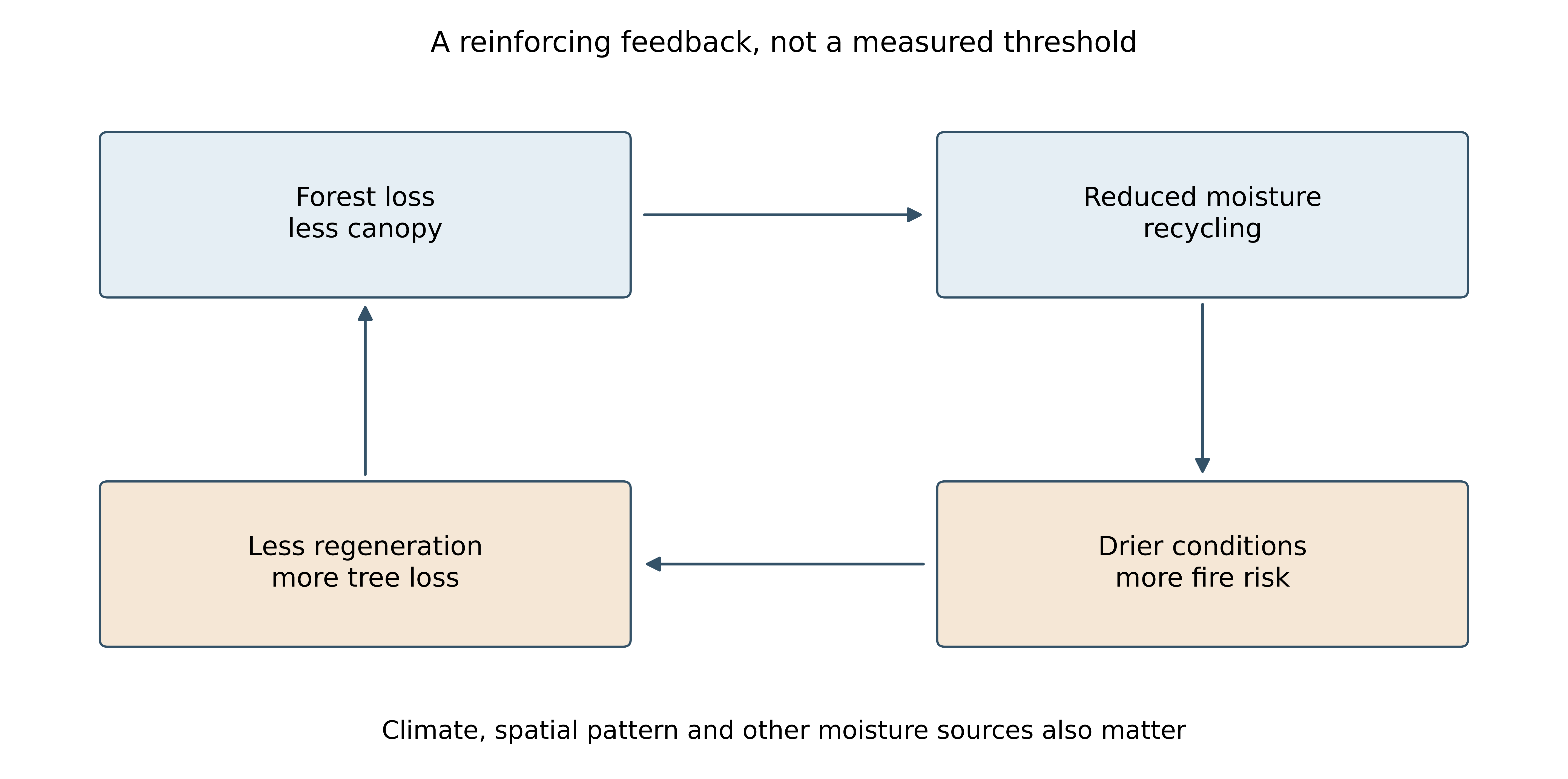
Removing a large forest area can reduce moisture recycling and alter surface heating and atmospheric circulation. Drier conditions can impair regeneration and favour fire, causing further forest loss. This reinforcing feedback can make a transition difficult to reverse. A tipping point is a threshold beyond which a relatively small additional pressure can produce a large persistent change in system state.
Arrows indicate proposed causal effects, not food-web energy transfer. The diagram gives no numerical tipping threshold.
The minimum forest area needed to sustain regional processes is uncertain and depends on spatial pattern, climate, drought and fire as well as total area. Avoid turning a proposed threshold into a universally measured cut-off or a prediction that every part of the Amazon changes simultaneously. Flores and colleagues discuss these interacting pressures and uncertainties.
In a region, original forest covers 12,000 square kilometres and later covers 9,000. Loss is 3,000 square kilometres; percentage loss is $3000/12000\times100=25\%$. A further loss to 8,400 is $600/9000\times100\approx6.67\%$ of the later starting area, but five percentage points of the original area. Always name the baseline.
39.5
中宇宙实验系统用于检验更大生态系统的模型
English
A mesocosm is a contained ecosystem model large enough to include interacting organisms and physical conditions. A sealed transparent vessel can exclude matter exchange while allowing light and heat transfer. It is closed to matter, not isolated from energy. Open tanks allow additional inputs and losses; the boundary must match the question.
An aquatic plant–microbial model can connect photosynthetic production, respiration and nutrient recycling. A teacher-approved investigation could compare light availability using replicated vessels with matched water volume, starting community, nutrients, temperature and headspace. Use independent vessels as treatment replicates, random allocation and repeated measurements that do not open the vessel or change the system unnecessarily. Do not seal fish or other animals into a vessel expected to become oxygen-depleted.
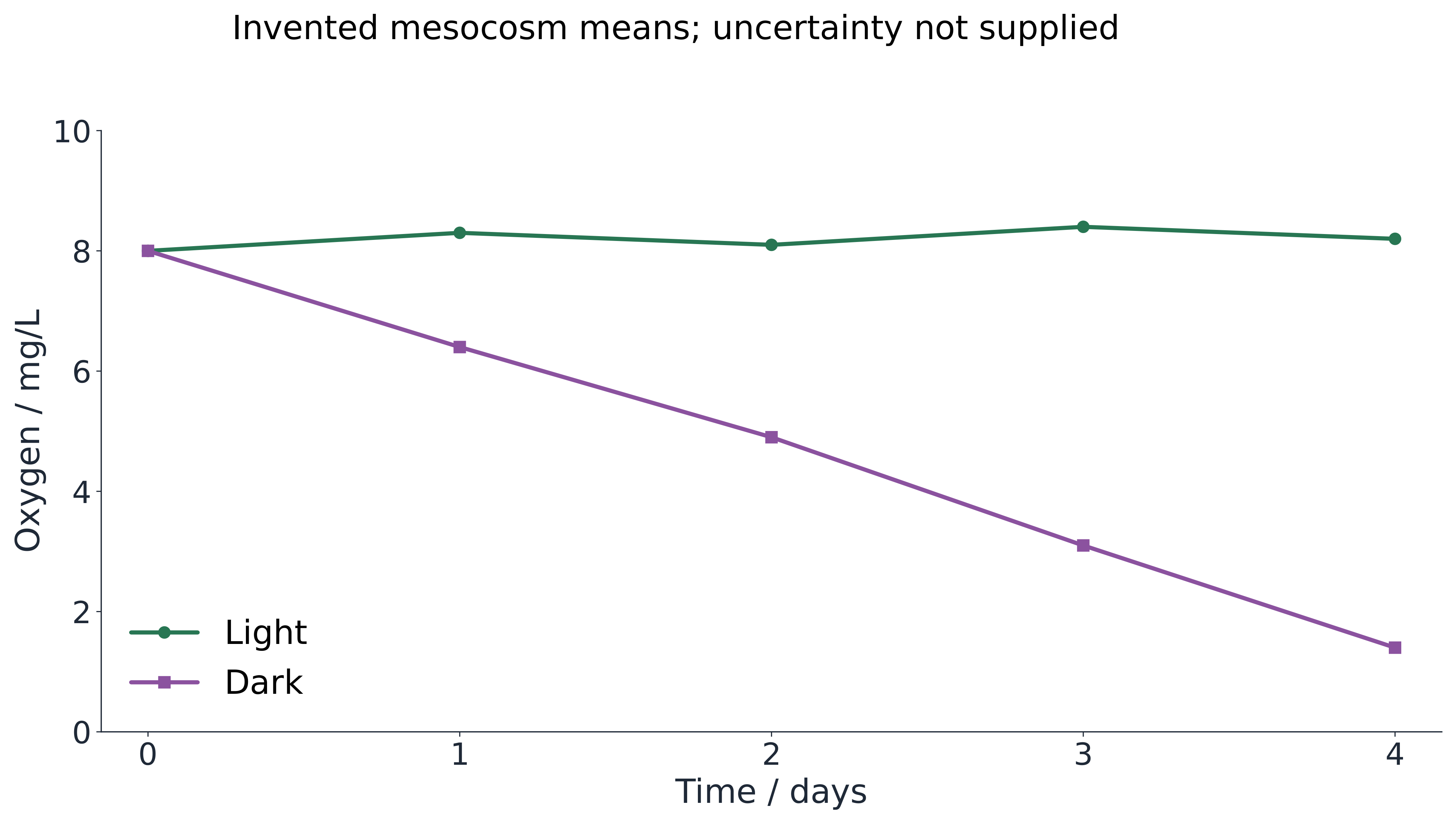
The records below describe mean dissolved-oxygen concentrations from separate light and dark treatments. They illustrate a prediction; no uncertainty estimate or significance result is supplied.
Stable oxygen does not imply absence of respiration. A falling concentration indicates a net balance, not a direct measurement of every production or consumption rate.
In light, oxygen production and consumption can approximately balance. In darkness, photosynthetic oxygen production stops while respiration can continue. A decline from 8.0 to 1.4 mg/L over four days is 6.6 mg/L, an average net fall of 1.65 mg/L per day. It does not identify which species consumed each molecule. A sensor drift or unequal starting biomass could also affect interpretation.
Aquatic and microbial models can be easier to maintain than terrestrial sealed systems. Small vessels have artificial boundaries, simplified food webs and limited buffering. Define maintenance, monitoring and welfare criteria before any real investigation; evaluate supplied data when these cannot be met.
39.6
关键物种的影响可能与其丰度不成比例
English
A keystone species strongly influences community structure relative to its abundance. It need not be the most numerous species or the largest producer. Removing it can alter indirect interactions as well as the organisms it consumes directly.
Sea otters as a keystone species: few in number, but they decide whether kelp forest or urchin barren results
For example, sea otters eat sea urchins in North Pacific nearshore systems. Reduced grazing pressure can permit kelp to persist, providing habitat for other organisms. Otter loss can therefore affect kelp indirectly through grazers. Other predators, urchin behaviour, storms and temperature also influence outcomes: the same simple cascade is not guaranteed at every coast. See the US Fish and Wildlife Service's account.
To evaluate a keystone hypothesis, compare replicated sites or appropriate before/after and control observations. Measure the proposed intermediate response, such as grazing, rather than only endpoint kelp cover. A correlation between otter abundance and kelp alone does not exclude a common environmental cause.
39.7
可持续收获需要更新、补充和预防原则
English
Sustainability 可持续性 means maintaining the capacity of a system or activity to continue over the relevant timescale without undermining that capacity. A renewable resource 可再生资源 can regenerate; it can still be depleted when removal exceeds replacement. Equal current input and harvest is a simple balance, while a precautionary harvest below uncertain replacement leaves a margin for recovery and error.
One-period model: $1000+80-100=980$ units; use exceeds regeneration by 20. A sustained-yield calculation also needs uncertainty and protection of other ecosystem functions.
For a stock balance, with all other gains and losses included in net replacement:
A fish biomass of 1,000 tonnes, annual net replacement 100 tonnes and harvest 150 tonnes loses 50 tonnes each year. If those rates remain constant, two years leave 900 tonnes. With replacement 120 and harvest 80 tonnes, annual gain is 40; three years from 900 leave 1,020 tonnes. These calculations are conditional models: real replacement depends on stock size, age structure, food, temperature and other mortality.
For a terrestrial example, people harvest seeds from Brazil nut trees, Bertholletia excelsa, in Amazonian forest. Surviving adults alone do not establish sustainable recruitment: removing too many seeds can reduce the next generation. Peres and colleagues' study of 23 populations associated persistent intensive harvesting with poor juvenile representation. Assess seedlings, juveniles, reproductive adults and harvest intensity over time, with comparable sampling and attention to other habitat differences.
For a marine example, Atlantic cod, Gadus morhua, assessment considers spawning biomass, recruitment, age/size structure, landings, discards and mortality. Research surveys help distinguish stock change from changes in fishing effort. See NOAA's stock-management account. A stable catch can conceal falling abundance if effort or technology increases; a falling catch can also reflect a protective quota. Do not treat every cod population as one identical stock.
Quadrat sampling can estimate plant density when positions are selected independently of abundance. For a mean of four juveniles per 0.25-square-metre quadrat, density is $4/0.25=16$ per square metre; a representative 100-square-metre area gives an estimate of 1,600. Patchiness, counting rules and uncertainty limit extrapolation. Use random coordinates or appropriately stratified sampling, not the most convenient patches.
探索
Renewable does not mean harvest can exceed regrowth
Reproduce 1,000 tonnes plus two years of 100 tonnes regrowth minus 150 tonnes harvest per year, leaving 900 tonnes. Compare the recovery example of 900 + 3 × (120 − 80) = 1,020 tonnes, equal flows, and the zero-stock boundary of this constant-flow model.
Crop removal exports nutrients that must be replaced or replenished. Fertilizers can support yield, but poorly timed or excessive applications can increase losses. Nitrogen fixation, organic inputs and mineral fertilizers have different effects and costs; none removes the need for a nutrient budget.
The Green Revolution raised yields, with environmental and social costs
Erosion physically removes soil, reducing rooting volume, organic matter and nutrient stores. Leaching carries dissolved substances downward with water; runoff carries material over the surface. Bare soil, slope, rainfall and cultivation influence these losses. Cover crops, suitable rotations, contour management and maintaining ground cover can reduce risks, depending on the site.
Pesticides can affect non-target organisms and select resistant populations; nutrient and pesticide pollution may affect receiving waters. Fertilizer manufacture, machinery, transport, land-use change and some soil processes contribute to agriculture's carbon footprint. Compare equal output and a stated boundary, rather than one farm's total emissions against another's emissions per kilogram of food. Sustainable assessment includes yield, soil condition, biodiversity, water and long-term input supply.
39.9
营养物富集会增加受纳水体的需氧量
English
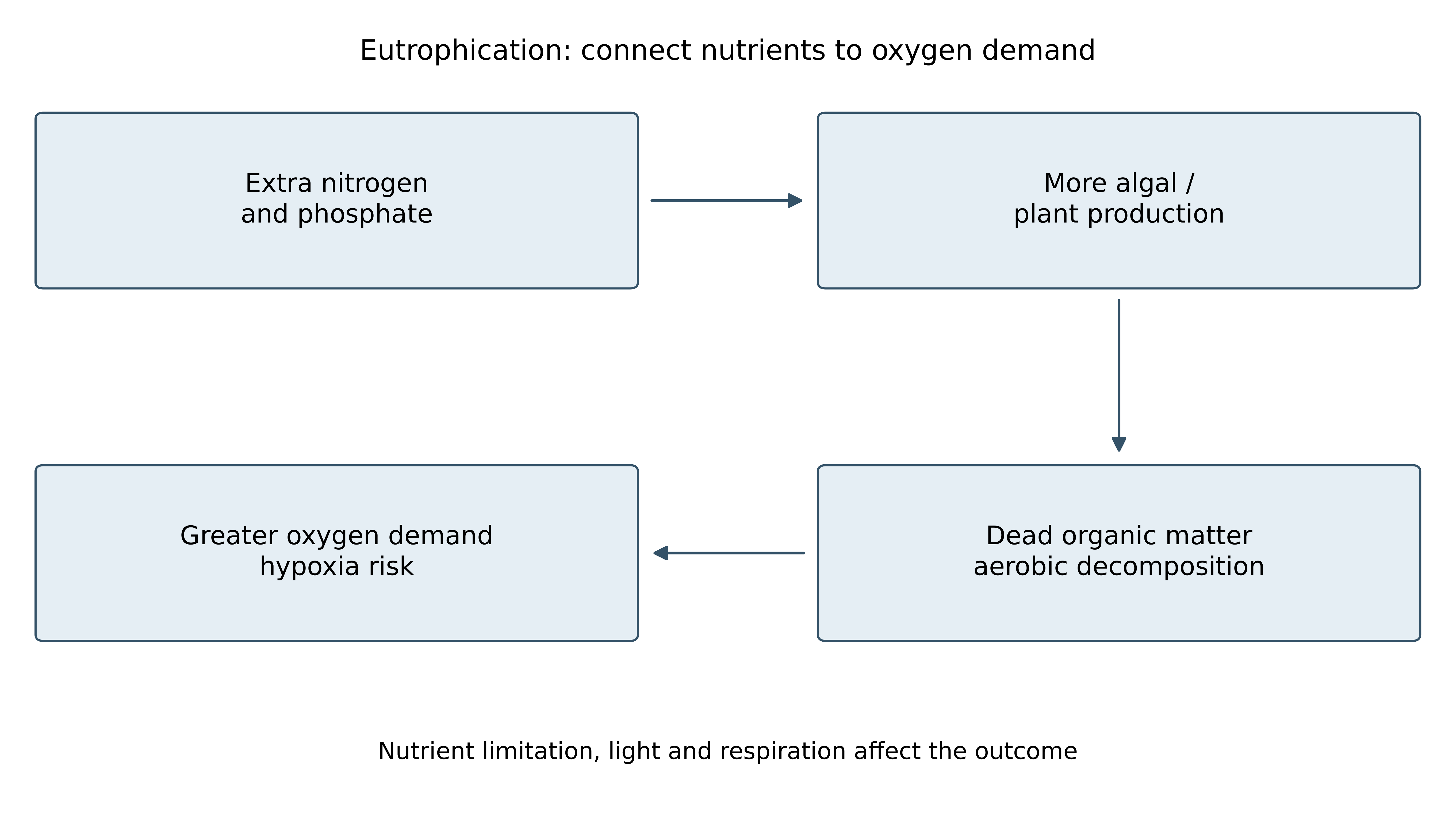
Nitrogen and phosphate fertilizers can reach lakes, rivers and coastal waters through leaching and runoff. Where a supplied nutrient limits growth, enrichment can increase algal or plant production. A dense bloom can shade submerged producers; living organisms respire, and dead organic material supports microbial decomposition.
Aerobic decomposers consume dissolved oxygen. Increased organic supply can therefore raise biochemical oxygen demand, reduce oxygen availability and harm oxygen-sensitive animals. Fish are not usually killed simply because fertilizer “poisons all the oxygen”, and photosynthesis during a bloom can temporarily raise daytime oxygen. Day/night changes and decomposition after bloom decline matter.
Enrichment, oxygen demand and dissolved-oxygen concentration are different quantities. Additional environmental factors can alter the final outcome.
A biochemical oxygen demand test measures oxygen consumed under specified incubation conditions. In a simplified undiluted five-day dark test at 20 degrees Celsius, dissolved oxygen falling from 8 to 3 mg/L gives BOD over that interval of 5 mg/L. Another matched sample falling from 8 to 6 gives 2 mg/L. These are concentration differences over the defined test, not automatically rates of 5 and 2 mg/L per day. Formal procedures may require dilution and seed corrections.
Control temperature, starting oxygen and test duration when comparing. Fertilizer reduction, buffer strips and wastewater treatment can reduce nutrient input, but a recovery may lag because stored nutrients and altered food webs remain. Measuring only water colour is insufficient to quantify oxygen stress.
39.10
持久性污染物可沿食物链逐级富集
English
Bioaccumulation is build-up within an organism from uptake exceeding elimination. Biomagnification is increasing concentration between trophic levels, often because a consumer eats many contaminated prey while eliminating the pollutant slowly. Compare concentration per equivalent tissue mass, not just total pollutant in differently sized animals.
Spraying a crop with pesticide: a persistent chemical that is not broken down can pass along food chains and build up in top consumers
DDT and its persistent breakdown products can move through food webs. DDE is particularly associated with eggshell thinning and reduced reproductive success in susceptible birds; effects are not identical in every species. For mercury, microbial conversion to methylmercury is important in aquatic systems. Methylmercury can accumulate and biomagnify, damaging nervous systems at sufficient exposure; not every chemical form of mercury behaves identically. See the USGS mercury account.
Trophic sample
Pollutant, mg/kg wet tissue
Producers
0.02
Primary consumers
0.10
Small fish
0.50
Predatory fish
2.00
Successive concentration ratios are 5, 5 and 4; overall ratio is $2.00/0.02=100$. This is a teaching dataset, not a universal tenfold rule or a real mercury survey. Trophic position, age, tissue type and exposure history must be comparable. The process does not create new pollutant atoms or make energy increase up the food chain.
39.11
大塑料和小塑料通过不同途径危害海洋生物
English
Discarded nets, lines and packaging can entangle animals, restrict movement or cause injury. Ingested plastic can obstruct or damage digestive pathways and interfere with feeding. Effects depend on item shape, size, organism and exposure, not just the total number of items recorded on a beach.
Most plastics are non-biodegradable, so waste plastic collects on beaches and in the oceans for hundreds of years
Microplastics are small particles, commonly defined as below 5 mm, including fragments and fibres. They can be ingested by small organisms and enter food webs. Many conventional plastics persist because biological breakdown is slow; fragmentation creates smaller particles rather than automatically mineralizing the polymer. Avoid treating every polymer as chemically identical or claiming that every detected particle causes a demonstrated population decline.
Clear scientific communication can distinguish observed entanglement or ingestion from uncertain long-term effects. Media images can influence perception and action, but a striking image is not an estimate of prevalence. Compare standardized litter surveys, organism observations and interventions such as preventing gear loss and reducing avoidable plastic releases.
39.12
再野化恢复生态过程,而不仅仅是引入具有吸引力的物种
English
Rewilding can restore ecological interactions by reintroducing appropriate apex predators or other keystone species, reconnecting habitats and reducing pressures that prevent natural regeneration. Connectivity supports dispersal and recolonization, but design must also consider disease, invasive species, neighbouring land use and human–wildlife conflict. Choosing a species needs evidence about its former role and present habitat.
Rewilding works through restored processes, not just added species
At Hinewai Reserve on Banks Peninsula, New Zealand, managers support native vegetation regeneration with relatively little interference while controlling selected damaging introduced organisms. Introduced gorse can act as a temporary nurse canopy for native seedlings. This is not a claim that every introduced species should remain everywhere or that restoration requires no management. The reserve's own description explains this context-dependent approach.
Set measurable goals, such as native recruitment, habitat connectivity, water quality or recovery of interactions. Use repeated monitoring and suitable comparisons to distinguish management effects from background change. Restoring a process may take decades, and a visitor's short observation cannot establish complete ecosystem recovery.
39.13
AHL:演替随环境条件和物种相互作用的变化而发生
English
Ecological succession is directional change in community composition over time after a new habitat forms or a disturbance changes conditions. Abiotic causes include new exposed substrate, altered water levels or fire effects. Biotic causes include colonization, litter production, shading, competition and modification of nutrient supply. Organisms both respond to and alter their environment.
Primary succession begins on newly available substrate with little or no developed soil, such as a recently exposed glacial surface. Secondary succession follows a disturbance where soil and biological legacies remain, often allowing faster recovery. A forest gap is not a newly created bare-rock surface merely because it has more light.
39.14
AHL:初生演替构建土壤、生产力和食物网复杂性
English
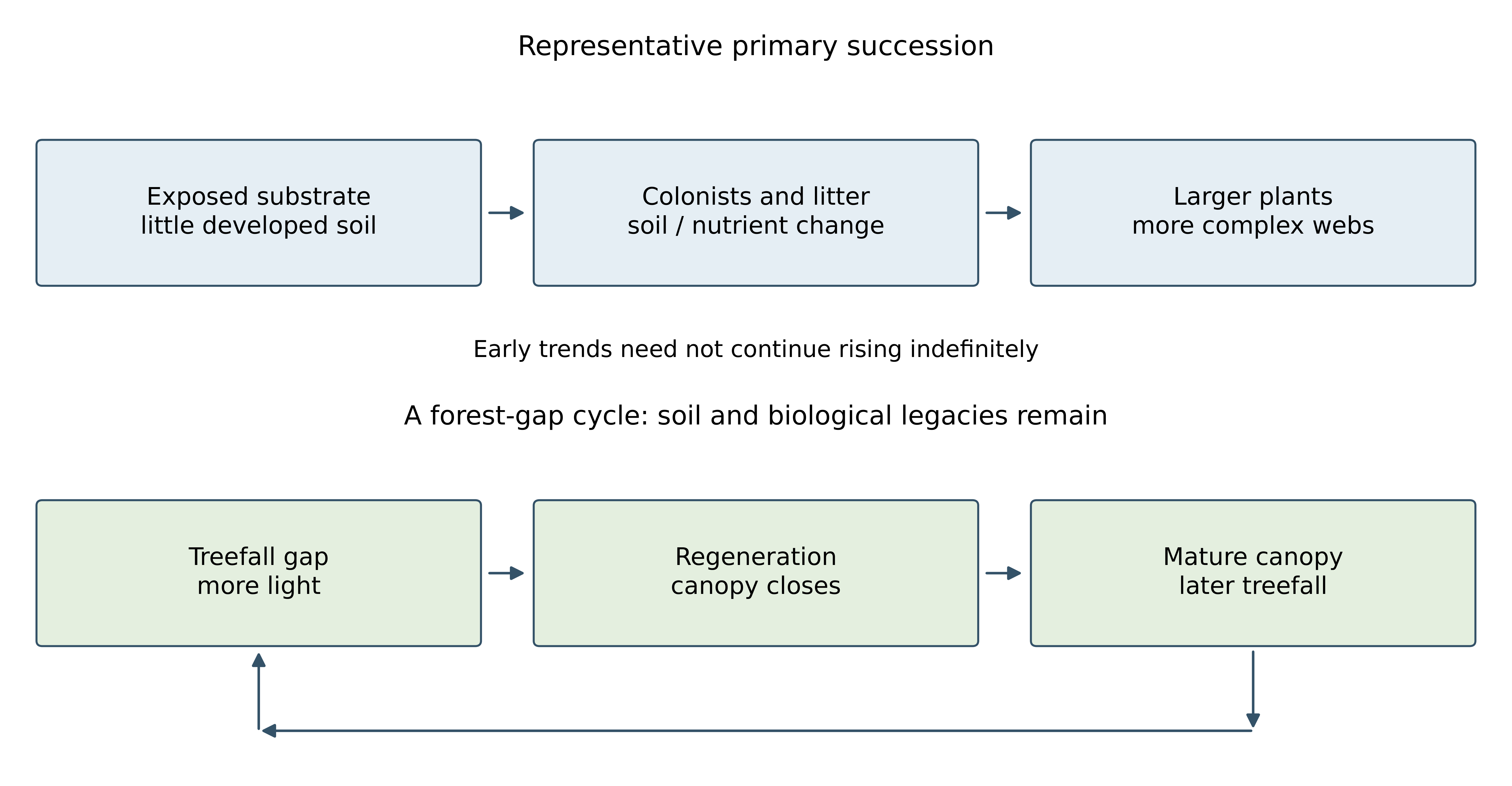
A representative glacial-retreat sequence begins with exposed mineral material and colonists tolerant of harsh conditions. Weathering and organic inputs help develop soil. Nitrogen-fixing associations, including alder with Frankia bacteria in suitable regions, can increase nitrogen supply. Larger plants can establish as rooting and nutrient conditions change, while litter and consumers support more complex food webs and cycling.
Plant size, primary production and diversity often rise during early development, but not every variable increases forever or monotonically. Shade can exclude early colonists; nutrient limitation and soil development alter later productivity. Ecosystem respiration also increases, so greater production does not mean all carbon remains stored.
Conceptual sequences show mechanisms and possible pathways, not a universal timetable or proof that every site converges on the same community.
At Glacier Bay, Alaska, Fastie's 1995 tree-ring reconstruction found multiple pathways related to landscape context and seed arrival. Different-aged sites need comparable starting conditions before they can represent stages of one history; repeated observations strengthen inference.
39.15
AHL:循环演替可维持群落的镶嵌分布格局
English
Treefall in a temperate beech forest opens a canopy gap. Increased light changes regeneration and ground vegetation; growing trees close the canopy and restore shade. Later treefall can repeat this community cycle, which is more than one tree's life history.
Patches at different stages form a mosaic within a persistent forest. Cycles have no fixed duration; severe disturbances can redirect their pathways.
39.16
AHL:环境条件和管理影响顶极群落
English
A climax community is a relatively persistent later-successional community under prevailing conditions, not a permanent species list. Climate, disturbances, dispersal and local conditions alter possible endpoints.
Arrested succession prevents an expected later community. Livestock grazing removes tree seedlings and can maintain openness where woodland could establish; not all natural grasslands are destined to become forest. Wetland drainage lowers the water table, altering oxygen, decomposition and establishment; continued drainage can prevent wetland recovery.
Reducing grazing or restoring hydrology can permit change, but seed sources, soils, remaining pressures and time constrain recovery. Name the mechanism maintaining or changing the community.
39.17
练习
English
Explain ecosystem stability, resistance and resilience using a forest example. What does the Cerrejón evidence support, and what does it not prove?
Connect energy input, nutrient recycling, genetic diversity and climatic tolerance with persistence. Why is logistic population growth alone insufficient evidence of ecosystem stability?
Explain Amazon forest–moisture feedback and threshold uncertainty. For 12,000 → 9,000 → 8,400 square kilometres, calculate successive percentage losses and total loss relative to original.
Design a replicated light-treatment mesocosm comparison: controls, boundary and response measure. Interpret the oxygen traces; calculate the dark treatment’s average daily net fall and state two limitations.
Explain an otter–urchin–kelp keystone effect. Why should an investigation measure the intermediate grazer response and include comparison sites?
Define sustainability and renewable resource. With initial stock 1,200 tonnes, annual net replacement 90 and harvest 130 tonnes, calculate annual change and stock after three years. Evaluate the constant-rate assumption.
Compare Brazil nut and cod assessments, including recruitment and sampling. Estimate juveniles from six per 0.50-square-metre quadrat across a representative 200-square-metre habitat.
Explain erosion, leaching, agrochemical pollution and carbon-footprint boundaries when evaluating agriculture. Give one management action and its mechanism.
Explain eutrophication through production, decomposition and oxygen demand. Matched five-day tests fall 9 → 4 and 9 → 7 mg/L: calculate BOD and distinguish interval results from daily rates.
Contrast bioaccumulation/biomagnification using DDT/DDE and methylmercury. Calculate successive and overall table ratios. Compare large/small plastic effects and an evidence limitation.
Explain three rewilding mechanisms. Use Hinewai to distinguish minimal interference from no management or removing every introduced plant.
AHL: Compare primary/secondary succession and abiotic/biotic causes. Explain soil, nitrogen, plant size, production, diversity and food-web changes after glacial retreat. Why may these trends stop or reverse?
AHL: Explain a forest-gap cycle and persistent patch mosaic. Why are different-aged Glacier Bay sites not automatically one universal sequence?
AHL: Define climax community and arrested succession. Explain livestock grazing and wetland drainage effects, and limits on recovery after removing pressure.
39.18
例题答案
English
Key properties persist despite turnover. Resistance limits disturbance effects; resilience supports recovery. Cerrejón fossils show rainforest organization and important families about 58 million years ago, not identical communities continuously occupying every site.
Energy input replaces dissipation; decomposition recycles nutrients. Genetic variants/overlapping functions support responses within environmental tolerances.
Forest loss can reduce moisture recycling, increase dryness/fire and impair regeneration, reinforcing loss. Climate and spatial pattern affect thresholds. Losses: $3000/12000=25\%$; $600/9000\approx6.67\%$; total $3600/12000=30\%$. The second loss is five percentage points of original area.
Randomly allocate independent vessels; match water, community, nutrients, headspace and temperature. Sealed matter boundaries still permit energy transfer. Light can balance oxygen production/consumption; dark net fall $=(8.0-1.4)/4=1.65$ mg/L per day. Separate rates are unknown; sensors/biomass may confound. No uncertainty test is supplied.
Otters consume urchins, reducing grazing and indirectly supporting kelp habitat. Grazer measurements test the intermediate mechanism; replicated controls address environmental changes affecting both endpoints.
Renewable means able to regenerate; sustainability preserves continuing capacity. Annual change $=90-130=-40$ tonnes; three years leave $1200-3(40)=1080$ tonnes. Replacement depends on abundance, age and environment; constant rates are assumptions.
Brazil nut assessment needs seedling/juvenile replacement, not just surviving adults; cod needs spawning biomass, recruitment and removals, with effort-independent surveys. Density $=6/0.50=12$ per square metre; estimate $12(200)=2400$. Representativeness, patchiness and counting rules constrain extrapolation.
Erosion removes soil; leaching exports dissolved material. Nutrients/pesticides affect non-target systems. Match output and boundaries for carbon comparisons. Ground cover reduces erosion; matching fertilizer to uptake can reduce nutrient loss.
Enrichment raises production where nutrients limit growth; shading/dead biomass support decomposition and oxygen demand, risking hypoxia. Matched five-day BOD: $9-4=5$ and $9-7=2$ mg/L. These are interval concentration differences, not daily rates; light and timing affect oxygen.
Accumulation is within organisms; magnification compares trophic concentrations. DDT/DDE can impair bird reproduction; methylmercury can accumulate with neurotoxic effects. Ratios 5, 5, 4; overall 100. Large items entangle/obstruct; small particles enter organisms/webs.
Restore interactions, reconnect habitat and reduce regeneration barriers. Hinewai selectively controls damaging introduced organisms while gorse can temporarily shelter native seedlings. Goals and repeated monitoring test recovery; minimal interference still involves management.
AHL: Primary starts with little/no developed soil; secondary retains soil/legacies. Substrate/water changes are abiotic; colonization, litter, shade and competition are biotic. Soil/nitrogen development can support larger plants, greater early production/diversity and richer webs/cycling. Later shade, competition and nutrient limits alter trends.
AHL: Treefall opens a gap; regeneration closes the canopy until another disturbance. Patches differ while forest persists. Glacier Bay sites differ in context/seed arrival; age differences alone do not establish comparable starting conditions or one universal pathway.
AHL: Climax means relative later persistence under stated conditions. Grazers remove seedlings; drainage alters wetland water, oxygen and establishment. Removing pressure permits change but seed sources, soils, other pressures and time constrain recovery.
39.19
考试技巧
English
Name the boundary, timescale and measured property. Separate energy flow, nutrient cycling, stock, catch and percentage baselines. Trace mechanisms and qualify causal claims.
AHL: Connect organisms with changed conditions. Distinguish a primary sequence, a patch cycle and management that arrests or redirects change.