This handout covers D4.1: natural selection, sources of variation, competition, abiotic pressures, fitness, heritability, sexual selection and experimental evidence. Sections marked AHL are for Higher Level only.
Prerequisites: genes and alleles, meiosis, reproduction and population ecology. Endler's published guppy results are identified separately; they are not measurements or examination questions.
38.2
自然选择将遗传差异与繁殖成功联系起来
English
Imagine a population whose roots vary in depth. During a drought, deeper-rooted plants may obtain more water and leave more viable offspring. If the relevant differences are inherited, later generations can contain more of the contributing alleles. The drought need not instruct each plant to make a useful new allele.
Banding varies between snails of one species: heritable differences that selection can act on
Natural selection 自然选择 is differential survival and reproduction associated with heritable differences in a particular environment. It can change a population over generations. It does not mean that an individual deliberately evolves, that every survivor reproduces, or that a population moves toward a universally perfect form.
Darwin supplied a mechanism for evolutionary change, rather than merely saying that species change. A theory is an explanatory framework supported and tested using evidence, not a guess awaiting promotion to a law. Replacing an influential explanatory framework is a paradigm shift. The selection explanation differed from an account based simply on use, disuse and inheritance of acquired improvements. Modern evolutionary understanding also includes mechanisms other than selection.
Selection operating over immense timescales has contributed to biodiversity through repeated adaptation and divergence. Its local outcome depends on conditions, inherited variation and reproductive success. A change in a measured average alone does not establish which mechanism produced it.
Variation 变异 means differences among individuals. Some variation reflects inherited DNA differences; some reflects environmental effects or interactions. Selection can discriminate between phenotypes, but an evolutionary response requires a heritable contribution to the relevant difference.
Crossing over swaps segments between homologous chromosomes
Mutation can introduce new alleles. It can occur before or during exposure to a selection pressure, but useful mutations are not produced because an organism needs them. “Random with respect to need” does not mean all base positions have equal mutation probability or that all mutations have equal effects.
Meiosis produces new allele combinations through crossing over and independent assortment of suitable loci. Random fertilization combines gametes. These processes reshuffle existing alleles; they do not explain the origin of every new allele. In a population with variation, selection affects which combinations contribute to later generations.
A deep-rooted plant could have an inherited tendency, could have grown in a favourable soil patch, or could show plastic growth under local conditions. Measure inheritance and environmental effects rather than assigning every visible difference to a new mutation.
Many organisms can produce more offspring than the environment can sustain to reproduction. A plant may produce hundreds of seeds, but only some find suitable space, water, mineral supply and light. Juveniles can compete for food or shelter; reproductive adults can compete for mates. Carrying capacity depends on resource supply and conditions, not a permanently fixed population number.
Natural selection: the best-adapted survive, reproduce and pass on their alleles
Intraspecific competition occurs between members of the same species, often with overlapping requirements. Competition need not involve fighting: neighbouring plants can reduce each other's access to light and water. If a heritable feature improves access and eventual reproductive success, its carriers can contribute more alleles to the next generation.
Overproduction alone is insufficient to establish selection. If mortality removes individuals independently of the relevant heritable differences, deaths do not demonstrate a selective advantage for that trait. Conversely, selection can involve differences in mating success or fertility even without conspicuous adult mortality.
38.5
非生物胁迫和生物相互作用均影响生存成功
English
A selection pressure 选择压力 is an environmental factor that affects relative survival or reproduction among variants. Low temperature can favour features that maintain function in cold conditions; drought can favour water conservation or access. Extreme weather can affect populations at low as well as high density, so its occurrence need not depend on crowding.
The dark (melanic) form of the peppered moth — the form favoured on soot-darkened barkA density-independent frost can still select between genotypes
A density-independent disturbance is not necessarily genetically indiscriminate. The same frost can affect genotypes differently if their physiology differs. State both the environmental condition and the inherited feature that changes the outcome.
Predation, disease and competition are biological pressures. A feature useful against one predator may have a cost elsewhere. Reduced stomatal opening conserves water but can restrict carbon dioxide entry; extensive roots require resources that could otherwise support leaves or reproduction. Adaptation is therefore a context-dependent trade-off, not a label meaning best in every environment.
Biological fitness concerns survival value and reproductive contribution of a genotype in a stated environment. It is not simply strength, speed or lifespan. A long-lived individual leaving no descendants may contribute fewer alleles than a shorter-lived individual producing many surviving, fertile offspring.
Fitness as reproductive contribution: 60 versus 40 surviving offspring from 20 parents each
For a comparison, each of two genotypes begins with 20 parents. One group leaves 60 offspring that reach the defined reproductive stage, the other 40. Their mean contributions are 3 and 2 per parent. Taking the first as relative fitness 1, the second has relative fitness $2/3\approx0.667$. Use equivalent starting numbers and the same outcome definition.
If one group had twice as many parents, comparing raw offspring totals alone would be misleading. A reproductive-success estimate also depends on time, environment and which offspring stage was counted. Fitness measured in a drought need not remain highest in a wet environment.
38.7
遗传差异必须与获得性改变区分开来
English
A scar, a learned skill or an environmentally produced increase in size does not automatically alter the inherited base sequence so offspring receive the same change. An individual can acclimatize without the population genetically evolving. This distinction does not require claiming that every possible inheritance mechanism has been explained by one simple model.
Natural variation in snail shell banding — heritable differences selection can act on
To test the root example, grow offspring from contrasting parents under comparable conditions, using independent families and controlled age, soil and water treatments. A common-garden comparison can reduce environmental differences; growing relatives in only one shared pot would still confound family with pot conditions. Reciprocal environments can reveal genotype–environment interactions.
Evidence is stronger when inherited differences predict both the relevant function and reproductive success, and when population allele measurements agree with the proposed response. Common conditions alone do not remove every parental effect. Nor does failure to observe an increase automatically disprove selection: opposing pressures, gene flow, genetic architecture or limited measurement power can matter.
38.8
等位基因计数区分种群变化与个体变化
English
An allele frequency 等位基因频率 is the proportion of copies at a defined locus that carry the named allele. For an ordinary diploid autosomal locus, N individuals contribute 2N copies. Count heterozygotes once for each allele, rather than treating each heterozygote as two copies of the same allele.
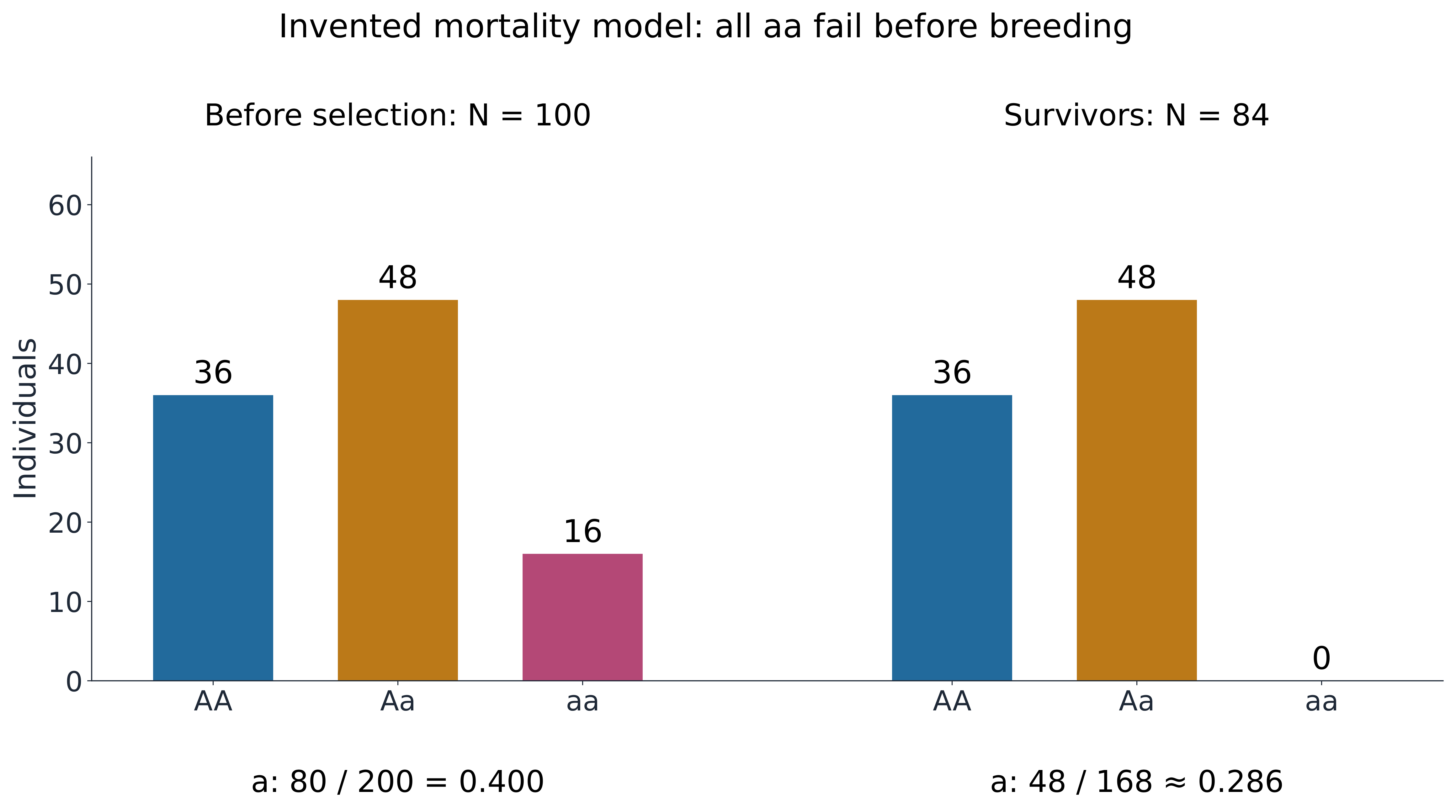
In an 100-plant model, genotypes are AA 36, Aa 48 and aa 16. Copies of a total $48+2(16)=80$ among 200, so frequency is 0.40. Copies of A total $2(36)+48=120$, giving 0.60. Frequencies of the two specified alleles sum to 1.
Suppose all aa plants fail before breeding, while the 36 AA and 48 Aa survive and contribute equally per individual. There are 84 survivors, hence 168 copies. The a frequency among them is $48/168=2/7\approx0.286$; A frequency is $120/168=5/7\approx0.714$. No surviving Aa plant changed its own genotype. The composition of the contributing population changed.
After mortality is not automatically a new offspring generation. Transmission carries the survivors' alleles forward; later frequencies depend on the stated breeding and selection conditions.
If those survivors contribute equally to gametes and no further process changes frequencies, a does not have to decline again merely because offspring are born. Continued selection against aa can cause further change, while a can remain hidden in heterozygotes. Root depth in real plants is more complex than this single-locus teaching model.
Another record has 90 of 200 copies of a named allele initially and 120 of 200 later: 45% to 60%, an increase of 15 percentage points. Relative increase is $15/45\times100\approx33.3\%$, a different comparison. A rise to 140 of 200 is 70%, ten percentage points above 60%.
A frequency shift alone does not uniquely prove natural selection. Migration, chance sampling of reproduction in a finite population, sampling error and changing sample definitions can also affect observations. Measure reproductive differences and heritability, compare suitable controls, and specify population boundaries and collection times.
探索
Selection changes the allele pool, not each plant's genotype
Count a alleles in 36 AA, 48 Aa and 16 aa plants. Compare the initial 80/200 = 40% with the drought survivors' 48/168 ≈ 28.57%. Vary the surviving subset to distinguish plant counts from allele frequencies and identify cases with no shift or no surviving pool.
Sexual selection arises through differences in mating or fertilization success. Competition for access to mates and mate choice can favour physical or behavioural traits even when those traits carry an energetic or predation cost. A benefit in one component of fitness need not be a benefit in every component.
Sexual selection: a mating benefit can outweigh a survival cost
Male birds of paradise provide a context: elaborate plumage and courtship displays can affect attraction of mates, while production, maintenance and display consume resources and can increase exposure. Do not assume that the most conspicuous male necessarily leaves the most offspring under every condition, or that preferences are identical in every population.
A clear explanation connects inherited variation, a mating-success difference and transmission to offspring. “Females liked it, so males grew new inherited colours” omits the existing variation and differential reproduction. Experiments can compare mate responses while controlling background, light and other visual cues, subject to suitable animal-care requirements.
38.10
恩德勒鳉鱼表明必须综合考虑背景色与捕食压力
English
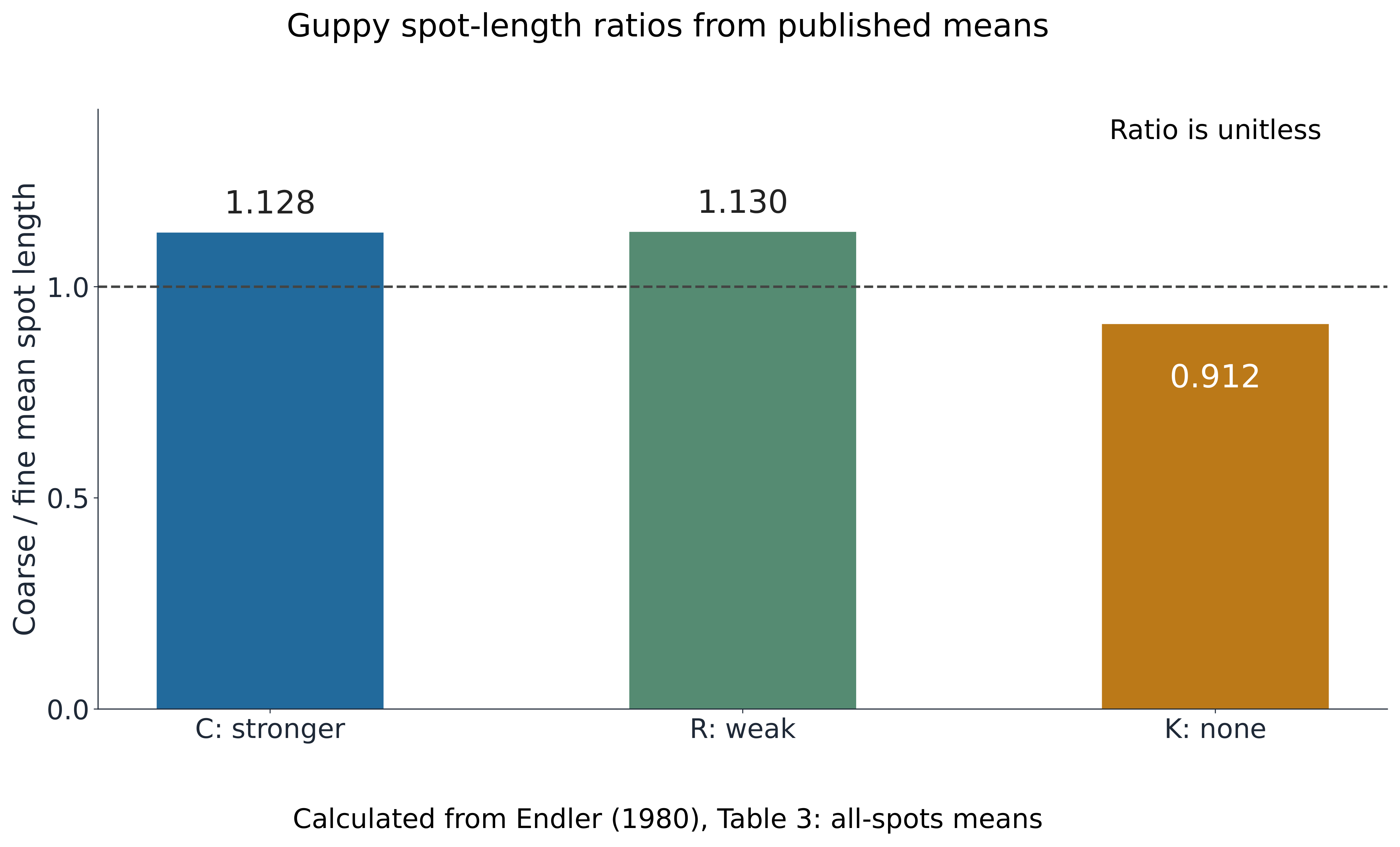
Endler's 1980 guppy study varied predation and gravel background. Table 3 reports these mean lengths for all colour spots, measured in millimetres (mm). C denotes stronger predation, R weaker predation and K no predators. The coarse/fine ratios summarize the published values without converting them into measurements.
Treatment
Fine / mm
Coarse / mm
Coarse/fine ratio
C
1.17
1.32
1.128
R
1.54
1.74
1.130
K
1.47
1.34
0.912
Ratios above one mean larger mean spots on coarse gravel; below one reverses that comparison. No uncertainty interval is supplied here.
Background matching occurred with predation, while the no-predator comparison reversed direction, consistent with a role for sexual selection. Different pattern components responded differently. Read the original paper, table 3 and discussion.
For an experimental comparison, identify the independent variables, measured outcome, treatment allocation and independent replicate units before drawing a conclusion. Many fish in one pond do not supply many independent ponds. A ratio of means is descriptive; it does not by itself establish statistical significance, remove body-size effects or prove one mechanism uniquely. These general evaluation principles apply beyond guppies.
38.11
AHL:基因库将遗传与种群进化联系起来
English
The gene pool comprises the genes and alleles present in a population. A change in its allele frequencies is a genetic description of evolution. Natural selection changes contributions according to heritable differences, while mutation introduces variants, gene flow moves alleles between populations and genetic drift reflects chance changes in finite populations.
How antibiotic resistance spreads through a population by natural selection
Neo-Darwinism integrates natural selection with genetics. Darwin's mechanism did not require knowledge of DNA, but segregation, recombination and inheritance explain how variants are retained and reshuffled rather than permanently blended away. Selection acts through phenotypes; the resulting transmission can change frequencies in the gene pool.
A pool is not one individual's genotype and does not contain only the most common or beneficial allele. Population boundaries matter: combining distinct groups can hide differences or produce misleading average genotype proportions.
38.12
AHL:人类数据库记录显示地理频率差异
English
Geographical separation can restrict gene flow, allowing selection, drift and population history to produce different allele frequencies. Human populations still exchange genes; widely separated sample groups must not be described as completely isolated or genetically uniform categories.
Observed rs671 A-allele frequencies in two 1000 Genomes sample groups; denominators are allele copies
For the human ALDH2 variant rs671, the Ensembl record for 1000 Genomes phase 3 gives 33 A copies and 173 G copies in CHB, Han Chinese in Beijing: $33/206\approx0.1602$. In CEU, Utah residents with Northern and Western European ancestry, the record lists 198 G copies and no A copies: observed A frequency $0/198=0$. These are allele-copy denominators, not 206 and 198 people. The labels are documented by IGSR CHB and IGSR CEU; see the Ensembl rs671 population record.
Record variant identifier, allele orientation, dataset release, sample group, count and denominator before comparing. Do not mix a frequency from one dataset with a denominator from another. These records describe sampled groups, not every person in China, Europe or Utah. Zero observed copies in a finite sample does not prove absence everywhere.
The frequency contrast alone does not identify natural selection as the cause or show its present direction. Distinguishing selection from demographic history requires additional evidence. A database sample supplies a real comparison while preserving uncertainty about mechanism.
38.13
AHL:三种选择模式对遗传变异的影响不同
English
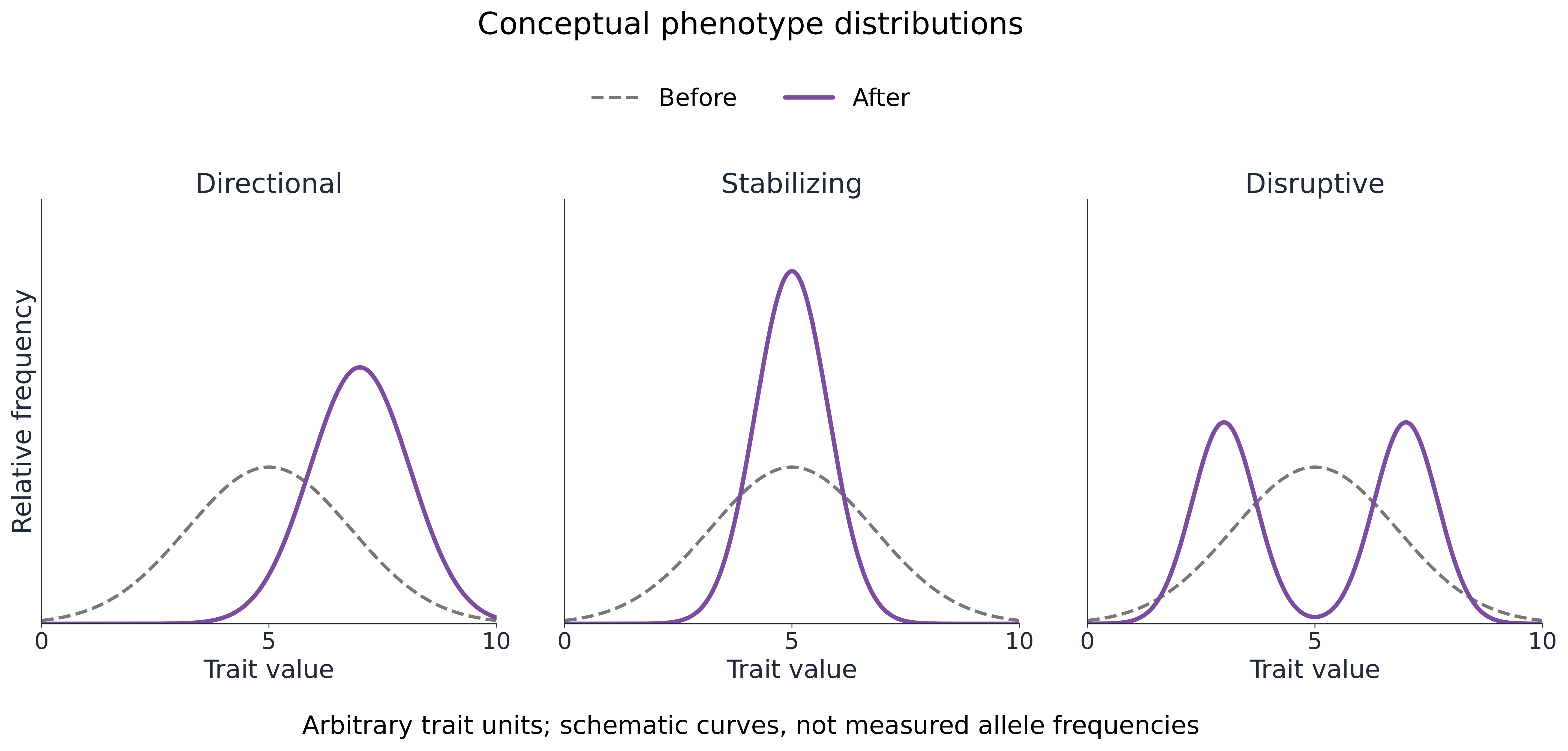
Directional selection favours one end of a trait distribution. If larger roots improve reproductive success in a drought and the difference is heritable, the distribution may shift toward greater depth. It need not continue shifting indefinitely, because costs and environmental conditions can change.
Stabilizing selection favours intermediate phenotypes over extremes. For a seed-size model, very small seeds fail to establish while very large seeds reduce the parent's seed number; intermediate size leaves the greatest reproductive contribution. The mean can remain similar while variation narrows. An unchanged trait mean therefore does not show that selection is absent.
Disruptive selection favours both extremes over intermediate phenotypes. In a habitat with mainly small soft seeds and large hard seeds, specialized small and large feeding structures might outperform intermediate ones. Two peaks can develop, but disruptive selection alone does not prove reproductive isolation or guarantee a new species.
These are conceptual phenotype distributions, not measured population records. Genotyping and breeding evidence are needed to connect a distribution change with particular allele frequencies.
All three patterns can change allele frequencies when phenotypic success has an inherited basis. However, a phenotype-frequency graph is not itself a graph of allele frequencies, and a mean or variance alone does not specify every underlying genotype. Environmental effects can also alter a measured distribution.
38.14
AHL:哈迪-温伯格预测始于随机配子结合
English
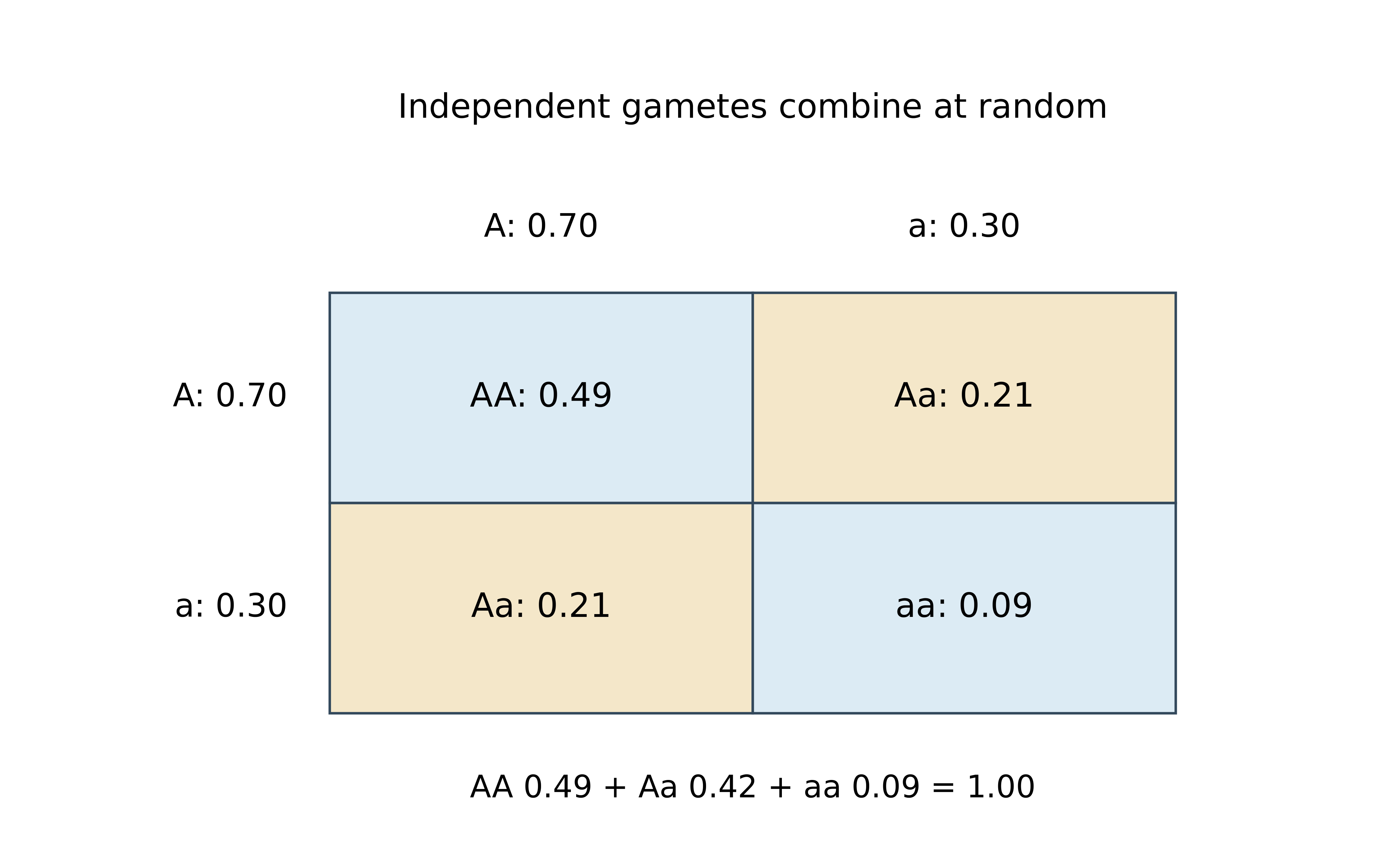
For a two-allele autosomal locus, let p be frequency of A and q frequency of a. The identity $p+q=1$ follows from counting all copies of those two alleles; it does not by itself establish equilibrium. If gametes combine randomly, the expected zygote proportions are AA $p^2$, Aa $pq+qp=2pq$ and aa $q^2$.
$$p^2+2pq+q^2=(p+q)^2=1.$$
For $p=0.70$ and $q=0.30$, predictions are 0.49 AA, 0.42 Aa and 0.09 aa. Among 1000 offspring, expected counts are 490, 420 and 90. These are population expectations under assumptions, not compulsory counts in one small family.
The two Aa routes each have probability pq. Equal-sized drawing boxes do not mean equal probabilities.
If the recessive phenotype uniquely identifies aa under complete dominance and the equilibrium assumptions are justified, aa frequency 0.09 gives $q=\sqrt{0.09}=0.30$ and $p=0.70$. The dominant-phenotype frequency is $p^2+2pq=0.91$, not p. Do not take the square root of the heterozygote frequency and call it q.
When genotype counts are known, direct allele counting works without assuming Hardy–Weinberg proportions: $p=(2N_{AA}+N_{Aa})/(2N)$. For the shared example's survivors, $p=5/7$ and $q=2/7$. Random combination then predicts $25/49$, $20/49$ and $4/49$ in the next generation; it preserves those allele frequencies unless another process changes them.
38.15
AHL:平衡是一个具有可检验假设的模型
English
The ideal Hardy–Weinberg model assumes no relevant mutation, migration or selection; random mating at the locus; and a population large enough for negligible drift. Real populations need not satisfy these conditions at every locus.
Non-random mating can change genotype proportions without initially changing allele frequencies. In a sample of 100 individuals, 40 AA, 20 Aa and 40 aa give $p=q=0.50$, but genotype proportions are 0.40, 0.20 and 0.40 rather than the equilibrium predictions 0.25, 0.50 and 0.25. A heterozygote deficit can involve inbreeding or population subdivision; it is not unique evidence of selection.
A departure beyond sampling expectations requires investigating assumptions, scoring and population definition. Agreement is consistent with the model, not proof of every assumption. Separate the calculation, comparison and bounded inference.
38.16
AHL:人工选择涉及有意的繁殖选择
English
Artificial selection deliberately chooses breeding parents for desired heritable traits. Crop breeders measure traits, select parents, control crosses and compare descendants under comparable conditions over generations. Selection uses available inherited variation; choosing a parent does not automatically create the desired allele.
Selective breeding makes a wanted feature more common over generations
A desired trait can bring trade-offs or correlated costs. Related parents can increase homozygosity and expose harmful recessives; reduced diversity can increase shared susceptibility. Record parentage, environment, trait distributions and other performance, not just one striking individual.
Antibiotic treatment unintentionally selects resistant bacteria: natural selection in a human-altered environment. People did not deliberately select breeding parents to obtain the trait. Deliberate reproductive choice differs from unintended environmental selection.
38.17
练习
English
Explain natural selection as a mechanism and why its adoption represented a change in explanatory framework. Distinguish population evolution from an individual's intentional improvement.
Compare the roles of mutation, meiosis and fertilization in variation. Correct “a drought produces the useful mutation because the plant needs it”.
Explain how overproduction and limited light, water or food can create intraspecific competition. Why is high offspring mortality alone insufficient to demonstrate selection for a named trait?
Distinguish an abiotic pressure from biological competition. Explain how density-independent weather can still affect genotypes differently, and give one adaptation trade-off.
In a comparison, 10 parents of genotype P leave 50 offspring reaching a specified reproductive stage; 10 of Q leave 30. Calculate mean contributions and relative fitness of Q if P is 1. Explain why strength or lifespan alone is insufficient.
Design a comparison of offspring from deep- and shallow-rooted parents to investigate heritability. Identify environmental controls, independent replicates and a remaining limitation.
Allele-copy counts change from 90/200 to 120/200 and later 140/200. Calculate frequencies, percentage-point changes and the relative increase from the first to second observation. Does this alone prove selection?
Explain sexual selection using a physical or behavioural bird-of-paradise trait, including a possible survival or resource cost.
Interpret the three published coarse/fine ratios in the guppy table. Why can treatment and background change the conclusion?
Explain why many fish from one experimental pond are not many independent ponds, and why a ratio of means alone does not demonstrate significance or remove confounding.
For AA 36, Aa 48 and aa 16, calculate A and a frequencies before mortality. If all aa fail and remaining individuals contribute equally, calculate survivor frequencies. Must a decline again in the next generation if no further frequency-changing process acts?
AHL: Define gene pool and connect inheritance with selection. Compare CHB/CEU rs671 A frequencies and denominators: explain geographical separation and two inference limits. Contrast the three selection patterns, including selection without a changed mean.
AHL: Under justified Hardy–Weinberg assumptions, 9% of a 1000-person model population has recessive phenotype aa. Calculate p, q, genotype frequencies/counts and dominant-phenotype frequency. Why do known genotypes allow direct allele counting without equilibrium?
AHL: For 40 AA, 20 Aa and 40 aa, calculate allele frequencies, compare equilibrium predictions and explain the mismatch cautiously. State equilibrium conditions. Distinguish crop breeding from antibiotic-driven resistance and identify a selective-breeding cost.
38.18
例题答案
English
Inherited differences affect reproductive contribution and transmission, changing populations over generations. Selection supplied a new explanatory mechanism, illustrating a paradigm shift. Individual acclimatization need not be inherited evolution.
Mutation introduces alleles; meiosis and fertilization reshuffle combinations. Mutations can occur before or during drought, without being directed toward need. Selection changes contributions of available variants.
Potential offspring exceed limited resources; same-species requirements overlap. Heritable acquisition differences can affect reproduction. Mortality unrelated to the named trait does not establish its selective advantage.
Temperature/drought are abiotic; competition is biological. Frost need not depend on crowding, yet genotypes can differ in response. Water-saving stomatal closure restricts carbon dioxide entry; roots consume resources.
P: $50/10=5$ offspring per parent; Q: $30/10=3$. Relative fitness Q $=3/5=0.60$. Use equivalent groups and outcomes; strength or long life without descendants does not establish contribution.
Compare independent families at matched ages; control soil, water and light. Allocate families across replicate pots and, if suitable, reciprocal environments. Persistent differences support inheritance, but parental effects or unmeasured factors can remain.
Frequencies 45%, 60%, 70%; changes +15 then +10 percentage points. First relative increase $=15/45\times100\approx33.3\%$. Drift, migration and sampling also change records; test inheritance and reproductive differences.
Plumage/display can aid mating but cost resources or predator exposure. Heritable variants leaving more descendants can spread. Neither universal preference nor cost-free improvement follows.
C/R ratios above one mean larger spots on coarse gravel; K below one reverses this. Background and predator regime interact; pattern components need not respond identically.
Pond is the independent treatment unit: fish share its environment. A mean ratio alone supplies no significance test or removal of body-size effects. Replication, allocation, controls and outcome definitions matter.
Initially A $=120/200=0.60$; a $=80/200=0.40$. Survivor N = 84: A $=120/168=5/7\approx0.714$; a $=48/168=2/7\approx0.286$. Genotypes did not change. Equal transmission alone need not lower a further; systematic further decline requires a frequency-changing process.
AHL: A pool contains the population's genes/alleles; genetic inheritance connects differential success with transmission. CHB A $=33/206\approx16.02\%$; CEU $0/198=0\%$ observed. Separation can restrict gene flow; finite samples and demographic history limit selection inference. Directional favours one end; stabilizing the middle; disruptive both ends. A stable mean can hide reduced variation.
AHL:$q^2=0.09$, q = 0.30, p = 0.70. AA 0.49/490, Aa 0.42/420, aa 0.09/90; dominant phenotype 0.91/910. Direct genotype counts need no equilibrium assumption. Dominant-phenotype frequency is not p.
AHL: A $=(80+20)/200=0.50$; a = 0.50. Observed 0.40/0.20/0.40 differs from predicted 0.25/0.50/0.25. Inbreeding or subdivision are possible; selection is not uniquely proven. Conditions: random mating, no relevant selection/migration/mutation, negligible drift in a large population. Crop breeding deliberately chooses parents; antibiotic exposure unintentionally selects bacteria. Breeding can reduce diversity, expose harmful recessives or bring correlated costs.
38.19
考试技巧
English
Link inherited variation, pressure, reproduction and transmission. Count gene copies with the correct denominator. Distinguish percentage points, relative change and evidence of causation.
AHL: Separate alleles, genotypes and phenotypes; justify equilibrium assumptions before square roots. A stable mean or frequency contrast alone does not identify a mechanism.