跳到主要内容

Q.G-geometry · Geometry: labelled facts, coordinates, circles and solids

GRE 普通考试知识点 13

本主题的视频课程 打开视频页面
7:03

几何:标注事实、坐标、圆及立体图形

本单元依据给定关系而非图示比例尺,连接坐标距离、斜率及几何性质,并区分…

英文讲解 · 可切换中英文字幕

13.1

几何:标注的已知条件、坐标、圆与立体图形

English

In 1899 the German mathematician David Hilbert published Grundlagen der Geometrie ("Foundations of Geometry"). He rebuilt Euclid's geometry so that every result followed from stated axioms, with no step resting on what a picture seemed to show. He is said to have remarked that one should be able to say "tables, chairs and beer mugs" instead of "points, lines and planes", and the proofs should still work. GRE geometry figures are "not necessarily drawn to scale" for the same reason: the given facts decide, not the picture.

These questions ask you to:

  • Reason from labelled facts, not from how a figure looks.
  • Use right triangles, coordinates, the distance formula and the midpoint 中点.
  • Find arc length and the area of a sector 扇形.
  • Use a scale factor 缩放比例 for lengths, areas and volumes.
词汇 训练
English 中文 拼音
midpoint/ˈmɪdpɔɪnt/ 中点 zhōng diǎn
sector/ˈsektə/ 扇形 shàn xíng
scale factor/skeɪl ˈfæktə/ 缩放比例 suō fàng bǐ lì
13.2

使用已知条件

English
  • Unless the question says the figure is to scale, do not measure it or trust apparent right angles, equal lengths or parallel lines.
  • Use what is labelled: lengths, angles, "parallel", "perpendicular", "tangent", "centre".
  • Points shown on a straight line are on that line, and the order of points shown can be relied on.
13.3

三角形与坐标

English
$$d = \sqrt{(x_2 - x_1)^2 + (y_2 - y_1)^2} \qquad M = \left(\tfrac{x_1 + x_2}{2}, \tfrac{y_1 + y_2}{2}\right)$$
  • The distance formula is Pythagoras applied to the horizontal and vertical legs.
  • Common right triangles: 3–4–5, 5–12–13, 6–8–10, and $45°$–$45°$–$90°$, $30°$–$60°$–$90°$.
Points A(-1, 2) and B(5, 10) on a grid with legs 6 and 8, distance 10 and midpoint M(2, 6)
Distance from a right triangle; midpoint by averaging.
13.4

圆和扇形

English
  • Circumference $2\pi r$; area $\pi r^2$.
  • A sector with central angle $\theta°$ is $\dfrac{\theta}{360}$ of the circle: arc $\dfrac{\theta}{360} \cdot 2\pi r$, area $\dfrac{\theta}{360} \cdot \pi r^2$.
  • A tangent is perpendicular to the radius at the point of contact.
13.5

立体图形与缩放

English
  • Rectangular box $V = lwh$; cylinder $V = \pi r^2 h$, surface area $2\pi r^2 + 2\pi r h$.
  • If every length is multiplied by $k$: areas by $k^2$, volumes by $k^3$.
  • Work backwards too: an area scale of 9 means a length scale of 3.
A unit square beside a square of side 2 split into four unit squares: lengths multiply by 2, areas by 4 and volumes by 8
Length k, area k squared, volume k cubed.
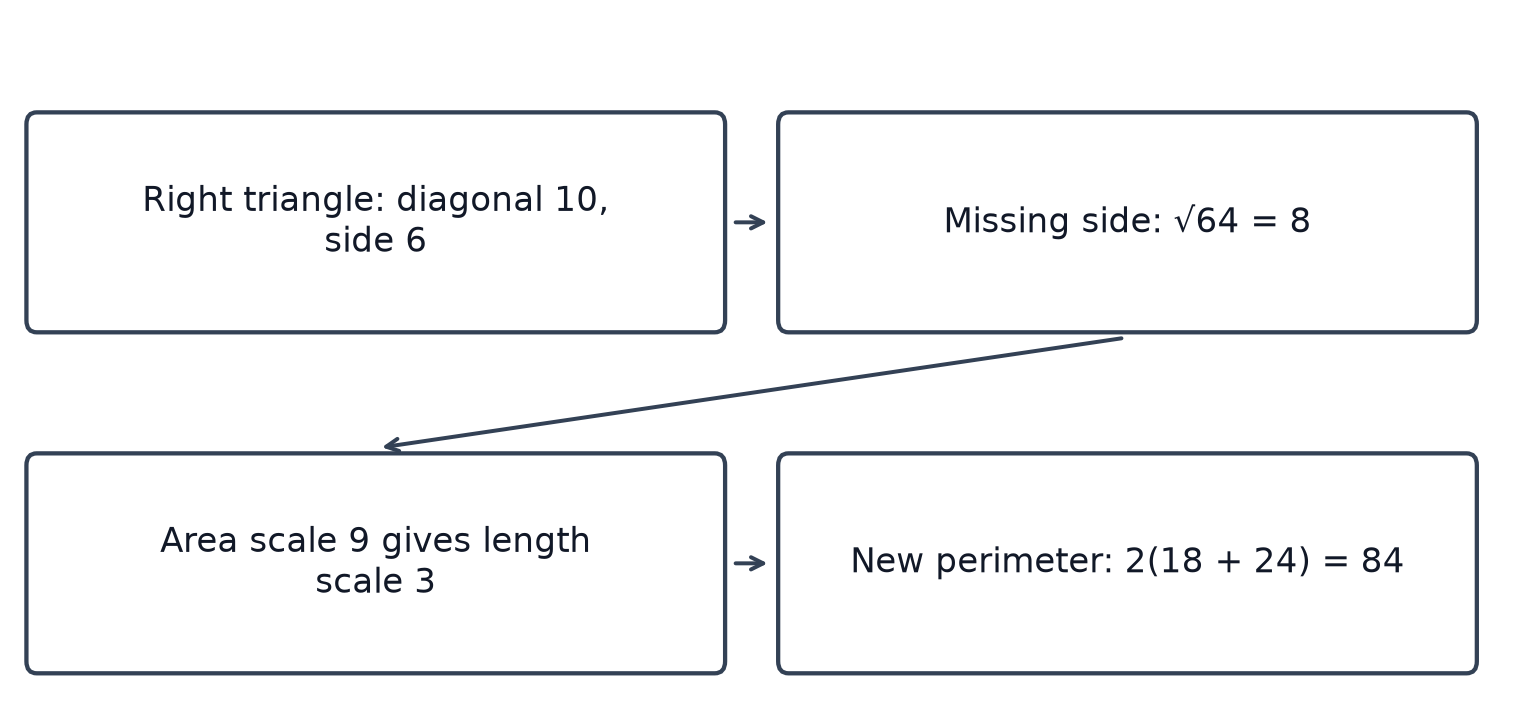
Four linked steps: Right triangle: diagonal 10, side 6; Missing side: √64 = 8; Area scale 9 gives length scale 3; New perimeter: 2(18 + 24) = 84
Area scale 9 means length scale 3: the 6 by 8 rectangle becomes 18 by 24
13.6

例题:坐标、扇形与缩放

English
  • $A(-1, 2)$ and $B(5, 10)$: the legs are 6 and 8, so $d = 10$; midpoint $(2, 6)$.
  • A circle of radius 6 with a 60° sector: area $\tfrac{60}{360} \cdot 36\pi = 6\pi$; arc $\tfrac{60}{360} \cdot 12\pi = 2\pi$.
  • Enlarging every length by 3 multiplies area by 9 and volume by 27, not by 3.
13.7

例题:原创应用

English

Points A=(-1,2) and B=(5,10) are given. Find their distance and midpoint. A right circular cylinder has radius 3 cm and height 4 cm. Find its volume and total surface area, including both ends.

Model and reasoning

Coordinate differences are six and eight. Distance is $\sqrt{6^2+8^2}=10$ and midpoint $(({-1}+5)/2,(2+10)/2)=(2,6)$. Cylinder volume is $V=\pi r^2h=\pi(3\ \mathrm{cm})^2(4\ \mathrm{cm})=36\pi\ \mathrm{cm^3}$. Total area is $S=2\pi r^2+2\pi rh=2\pi(3\ \mathrm{cm})^2+2\pi(3\ \mathrm{cm})(4\ \mathrm{cm})=42\pi\ \mathrm{cm^2}$. Volume and surface area measure different quantities.

13.8

独立迁移

English

A rectangle has diagonal 10 cm and one side 6 cm. A similar rectangle has area nine times as large. Find its perimeter. Explain which labelled facts permit Pythagoras, and whether the same calculation would hold for an arbitrary quadrilateral.

Check after attempting

A rectangle's adjacent sides are perpendicular. Its diagonal forms a right triangle, so the other side is $b=\sqrt{d^2-a^2}=\sqrt{(10\ \mathrm{cm})^2-(6\ \mathrm{cm})^2}=8\ \mathrm{cm}$. Area scale nine means length scale three. The new sides are 18 and 24 cm, giving perimeter $P=2(a+b)=2(18+24)\ \mathrm{cm}=84\ \mathrm{cm}$. An arbitrary quadrilateral need not supply a right angle, so its drawing alone would not justify the equation.

13.9

常见错误

English
  • Trusting a figure that is not to scale.
  • Forgetting the $\tfrac{\theta}{360}$ fraction for a sector.
  • Multiplying area or volume by $k$ instead of $k^2$ or $k^3$.
  • Leaving out one end when finding a cylinder's total surface area.
  • Mixing up radius and diameter.
13.10

关键术语

English

midpoint: The point halfway between two points.

sector: The part of a circle between two radii and an arc.

scale factor: The number every length is multiplied by in an enlargement.

13.11

自我检测

English
  • Find the circumference of a circle with radius 5.
  • Find the area of a 90° sector of a circle with radius 4.
  • A cube's side changes from 2 to 6. By what factor does its volume change?

Answers: $10\pi$. $\tfrac14 \cdot 16\pi = 4\pi$. 27.

这有帮助吗?

该知识点的互动课程

逐步完成,配合即时检查练习。

更多 GRE 普通考试 知识点

登录或创建账户

IGCSE, A-Level & AP