跳到主要内容

S1 · Statistics 1

Edexcel International A-Level 数学 · 知识点 7

本主题的视频课程 打开视频页面
21:59

力学2

WME02试卷:时长1小时30分钟,总分75分,默认已掌握P1至P4及M1内容。需背诵动能与势能、功与功率;速度v与位移s作为积分形式;以及……

英文讲解 · 可切换中英文字幕

2.1.1

Mechanics 2: projectiles, centres of mass, energy and collisions

English

Why it matters. In the Principia (London, 1687), Isaac Newton described an experiment to test his laws of motion. He hung two balls as pendulums, pulled them back, let them swing into each other, and measured how far each one swung back. For balls of tightly wound wool, the speed at which they separated was about $\tfrac59$ of the speed at which they approached. For steel it was about the same, and for glass it was about $\tfrac{15}{16}$. Whatever the speeds, the fraction for a given material stayed the same. This number is now called the coefficient of restitution, and engineers use it today, from designing car crumple zones to testing golf balls and footballs.

In this unit you will:

  • use calculus for motion with variable acceleration, and model projectiles;
  • find centres of mass of particles, laminas and wire frameworks, and the angle at which a suspended body hangs;
  • use work, energy and power;
  • solve direct collisions and successive impacts with restitution;
  • solve equilibrium problems for rigid bodies.

Edexcel International Advanced Level, Mechanics 2 (M2, paper WME02/01, 1 hour 30 minutes, 75 marks). It builds on M1 and uses the calculus from Pure Mathematics 1 and 2. Take $g = 9.8\ \text{m s}^{-2}$ unless the question gives another value (one June 2025 question uses $g = 10$).

The centres of mass of standard shapes are in the formula booklet. These results are not, so learn them:

Topic Results
energy kinetic energy 动能 $= \tfrac12mv^2$; potential energy 势能 $= mgh$; work $= Fs$; power $= Fv$
calculus $v = \int a\,dt$, $s = \int v\,dt$, $v = \dfrac{ds}{dt}$, $a = \dfrac{dv}{dt}$
restitution $e = \dfrac{\text{speed of separation}}{\text{speed of approach}}$, $0 \le e \le 1$
from M1 momentum $= mv$; impulse $= mv - mu$; $F \le \mu R$; moments
词汇 训练
English 中文 拼音
kinetic energy/kɪˈnetɪk ˈenədʒi/ 动能 dòng néng
potential energy/pəˈtenʃl ˈenədʒi/ 势能 shì néng
2.1.1 2.1.2 2.1.3 2.1.4

Kinematics with variable acceleration

English

If the acceleration changes with time, the suvat equations do not apply. Use calculus instead:

  • differentiate to go from displacement to velocity to acceleration;
  • use integration 积分 to go back, from acceleration to velocity to displacement, and use the starting conditions to find each constant of integration.

For vectors, differentiate or integrate the $\mathbf i$ and $\mathbf j$ parts separately.

If a particle turns around, the total distance is not the same as the final displacement. Find when $v = 0$, and add the distances of the separate parts of the journey.

Worked example 1. A particle starts from rest at O. Its acceleration is $a = k(3 - t^2)\ \text{m s}^{-2}$, and when $t = 1.5$ its speed is $13.5\ \text{m s}^{-1}$. Find $k$, and the total distance travelled before it returns to O.

  • Integrate: $v = k\left(3t - \tfrac{t^3}{3}\right)$. The constant is 0, because $v = 0$ when $t = 0$.
  • $k(4.5 - 1.125) = 13.5$, so $3.375k = 13.5$ and $k = 4$.
  • Integrate again: $s = 6t^2 - \tfrac{t^4}{3}$, again with constant 0.
  • $v = \tfrac{4t}{3}(9 - t^2) = 0$ when $t = 3$, and then $s = 54 - 27 = 27$ m.
  • The particle returns to O when $s = 0$, at $t = \sqrt{18}$. It travels 27 m out and 27 m back, so the total distance is 54 m.
Left: displacement s = 6t squared minus t to the fourth over 3 rising to 27 m at t = 3 and returning to 0 at t = root 18. Right: velocity positive until t = 3, then negative
The particle stops at t = 3, 27 m from O, then comes back: the total distance is 27 + 27 = 54 m, while the displacement at return is 0

Worked example 2. A particle of mass 3 kg has position $\mathbf r = 4\sqrt t\,\mathbf i - 3t\,\mathbf j$ metres at time $t$ seconds. When $t = 4$, it receives an impulse of $(6\mathbf i - 3\mathbf j)$ N s. Find its speed just afterwards.

  • Differentiate: $\mathbf v = 2t^{-1/2}\,\mathbf i - 3\,\mathbf j$, so when $t = 4$, $\mathbf v = \mathbf i - 3\mathbf j$.
  • Impulse $=$ change in momentum: $3(\mathbf v' - (\mathbf i - 3\mathbf j)) = 6\mathbf i - 3\mathbf j$, so $\mathbf v' = 3\mathbf i - 4\mathbf j$.
  • The speed is $\sqrt{9 + 16} = 5\ \text{m s}^{-1}$.

Projectiles

A projectile 抛体 is a particle moving freely under gravity, with no air resistance. Treat the horizontal and vertical motion separately. If it is projected with speed $u$ at angle $\alpha$ above the horizontal:

  • horizontally, there is no acceleration, so the velocity stays $u\cos\alpha$;
  • vertically, the acceleration is $g$ downwards, so use suvat with initial velocity $u\sin\alpha$.

Its path, called the trajectory 轨迹, is a parabola. At the highest point, the vertical velocity is zero. The two parts of the motion share the same time $t$, which links them.

Worked example 3. A ball is kicked from level ground at $20\ \text{m s}^{-1}$ at an angle $\alpha$ with $\tan\alpha = \tfrac34$. Find the time of flight, the range and the greatest height.

  • $\sin\alpha = \tfrac35$ and $\cos\alpha = \tfrac45$, so the initial components are $16\ \text{m s}^{-1}$ horizontally and $12\ \text{m s}^{-1}$ vertically.
  • Vertically, $s = 0$ when it lands: $0 = 12t - 4.9t^2$, so $t = \frac{12}{4.9} = 2.4$ s (2 s.f.).
  • Range: $16 \times 2.449 = 39$ m (2 s.f.).
  • Greatest height: $0 = 12^2 - 2(9.8)h$, so $h = \frac{144}{19.6} = 7.3$ m (2 s.f.).
探索

运动学与牛顿定律

选定正方向并绘制受力图

对比模型与已解案例,并说明其中一处变化。

词汇 训练
English 中文 拼音
integration/ˌɪntɪˈɡreɪʃn/ 积分 jī fēn
projectile/prəˈdʒektaɪl/ 抛体 pāo tǐ
trajectory/trəˈdʒektəri/ 轨迹 guǐ jì
2.2.1 2.2.2

Centres of mass: particles, laminas and wire frameworks

English

For particles of masses $m_1, m_2, \dots$ at $x_1, x_2, \dots$, the centre of mass 质心 is at

$$\bar x = \frac{\sum m x}{\sum m}$$

and in the same way for $\bar y$. For a uniform composite body, use a table:

  1. split the body into pieces whose centres of mass you know (the booklet gives arcs, sectors, semicircles and triangles);
  2. use area as the "mass" of a lamina, and length as the "mass" of a wire;
  3. take moments about a convenient line. A piece on the other side of the line has a negative distance, and a hole has a negative area.

Worked example 4. A wire framework 线框架 is made from a semicircular arc AB of radius $2a$, a semicircular arc CD of radius $a$, and two straight pieces AC and DB, each of length $a$. Both arcs have their centre at O, the midpoint of AB, and they lie on opposite sides of the line AB. Find the distance of the centre of mass from AB.

Piece Length Distance from AB Moment
arc AB $2\pi a$ $\frac{2(2a)}{\pi} = \frac{4a}{\pi}$ $8a^2$
arc CD $\pi a$ $-\frac{2a}{\pi}$ (other side) $-2a^2$
AC and DB $2a$ 0 0
whole $(3\pi + 2)a$ $\bar y$ $6a^2$

So $\bar y = \dfrac{6a^2}{(3\pi + 2)a} = \dfrac{6a}{3\pi + 2}$, on the side of the larger arc.

Worked examples 4 and 5. Left: the framework, with the arcs' centres of mass 4a/π and 2a/π from AB. Right: hanging from A, with G on OE and AG vertical.
词汇 训练
English 中文 拼音
centre of mass/ˈsentə ɒv mæs/ 质心 zhì xīn
wire framework/ˈwaɪə ˈfreɪmwɜːk/ 线框架 xiàn kuāng jià
2.2.3

Suspending laminas and frameworks

English

A body hanging freely from a point comes to rest with its centre of mass G vertically below that point. To find the angle between a line in the body and the vertical:

  1. draw the body with the line from the point of suspension to G vertical;
  2. use right-angled trigonometry with the coordinates of G;
  3. add or subtract any angles from the geometry of the shape (an isosceles right-angled triangle gives $45°$).

Worked example 5. The framework in worked example 4 hangs freely from A. Point E is on the larger arc with $\angle AOE = 90°$. Find the angle between AE and the vertical.

  • G lies on OE (the line of symmetry), $\frac{6a}{3\pi + 2}$ from O, and $OA = 2a$. So $\tan\angle OAG = \dfrac{3}{3\pi + 2}$.
  • $OA = OE$, so triangle AOE is isosceles and right-angled, and $\angle OAE = 45°$.
  • AG is vertical, so the angle between AE and the vertical is $\theta = 45° - \angle OAG$.
  • $\tan\theta = \dfrac{1 - \frac{3}{3\pi + 2}}{1 + \frac{3}{3\pi + 2}} = \dfrac{3\pi - 1}{3\pi + 5}$, so $\theta = 30.3°$.

Worked example 6. A uniform rectangular lamina OABC has $OA = 6$ cm and $OC = 4$ cm. A square of side 2 cm is cut from the corner at B. Find the centre of mass, and the angle between OA and the vertical when the lamina hangs from O.

  • With O as origin and OA along the $x$-axis: the rectangle has area 24 and centre $(3, 2)$; the square has area 4 and centre $(5, 3)$.
  • $\bar x = \dfrac{24 \times 3 - 4 \times 5}{20} = 2.6$ cm and $\bar y = \dfrac{24 \times 2 - 4 \times 3}{20} = 1.8$ cm.
  • OG is vertical, so the angle between OA and the vertical is $\tan^{-1}\frac{1.8}{2.6} = 34.7°$.
2.3.1

功、能量与功率

English

Work done 功 by a constant force $F$ moving its point of action a distance $s$ in the direction of the force is $Fs$. Work against a force (such as resistance) is negative. Moving a mass up a height $h$ gains it potential energy $mgh$.

  • The work-energy principle 功能原理: the work done by all the forces other than gravity equals the change in kinetic energy plus potential energy.
  • Conservation of mechanical energy 机械能守恒: if no forces other than gravity do work, KE + PE stays the same.
  • Power 功率 is the rate of doing work. For a vehicle with driving force $F$ moving at speed $v$, $P = Fv$. At a steady speed, the driving force equals the total of the forces against the motion.
A roller coaster with a vertical loop
A roller coaster: potential energy at the top becomes kinetic energy lower down, less the work done against resistance

Worked example 7. A car of mass 750 kg drives up a road inclined at $\alpha$ to the horizontal, where $\sin\alpha = \tfrac17$. The resistance is 200 N and the engine works at 20 kW.

  • At the top speed $V$, the forces balance: $\frac{20\,000}{V} = 750 \times 9.8 \times \tfrac17 + 200 = 1250$, so $V = 16\ \text{m s}^{-1}$.
  • At $10\ \text{m s}^{-1}$, the driving force is 2000 N: $2000 - 1250 = 750a$, so $a = 1\ \text{m s}^{-2}$.
  • The engine is then switched off, at $10\ \text{m s}^{-1}$. The car moves a distance $d$ up the road before it stops: $\tfrac12 \times 750 \times 10^2 = 750g \times d\sin\alpha + 200d$, so $37\,500 = 1250d$ and $d = 30$ m. The resistance acts over the distance $d$ along the road, and gravity over the height $d\sin\alpha$.

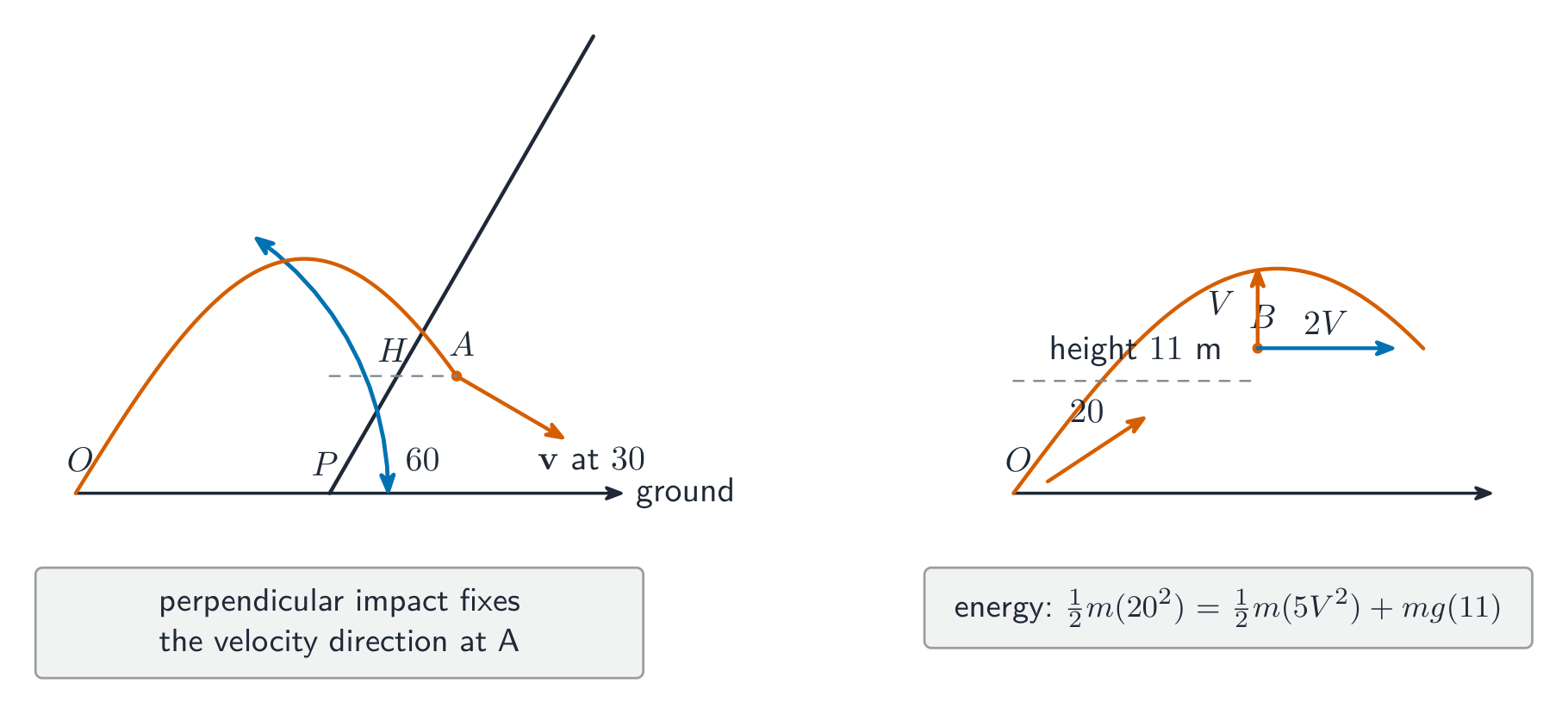
Worked example 8. A particle is projected from O at $20\ \text{m s}^{-1}$ (take $g = 10$). At a point 11 m above O, its velocity has vertical component $V$ and horizontal component $2V$. Later it hits a plane inclined at $60°$ to the horizontal, at right angles to the plane, at a height $H$ above O. Find $V$ and $H$.

  • Energy per unit mass: $\tfrac12(20^2) = \tfrac12(V^2 + 4V^2) + 10 \times 11$, so $200 = 2.5V^2 + 110$ and $V = 6$. The horizontal component, 12, never changes.
  • The velocity is at right angles to a $60°$ plane, so it points $30°$ below the horizontal. Its speed is $\frac{12}{\cos 30°} = 8\sqrt3$.
  • Energy: $200 = \tfrac12(8\sqrt3)^2 + 10H = 96 + 10H$, so $H = 10.4$ m.
Worked example 8. Left: the particle meets the 60° plane at right angles, moving 30° below the horizontal. Right: the components V and 2V at the 11 m point.
探索

功、能量、功率及碰撞

功等于力乘以该力方向上的位移

对比模型与已解案例,并说明其中一处变化。

词汇 训练
English 中文 拼音
work done/wɜːk dʌn/ 功 gōng
work-energy principle/wɜːk ˈenədʒi ˈprɪnsɪpl/ 功能原理 gōng néng yuán lǐ
conservation of mechanical energy/ˌkɒnsəˈveɪʃn ɒv mɪˈkænɪkl ˈenədʒi/ 机械能守恒 jī xiè néng shǒu héng
power/ˈpaʊə/ 功率 gōng lǜ
2.4.1 2.4.2

Collisions and restitution

English

For a direct collision between spheres A and B, Newton's experimental law gives the coefficient of restitution 恢复系数:

$$e = \frac{\text{speed of separation}}{\text{speed of approach}} = \frac{v_B - v_A}{u_A - u_B}$$
  • $e = 1$: perfectly elastic, no kinetic energy is lost;
  • $e = 0$: the spheres stay together.

Use conservation of momentum together with this law: two equations for the two speeds after the collision. Draw a diagram before and after, and choose one positive direction for all velocities. When a sphere hits a fixed wall at right angles, it bounces back with $e$ times its speed. Kinetic energy is lost unless $e = 1$; the impulse on each sphere is its own change in momentum.

A bouncing ball under a strobe: each bounce reaches a fixed fraction of the last height, so the total distance is a geometric series
A bouncing ball: each rebound speed is e times the impact speed, so the bounces shrink
Two spheres A and B before and after a direct collision with velocities u_A, u_B and v_A, v_B; e equals separation speed v_B − v_A over approach speed u_A − u_B
Newton's experimental law: separation speed = e × approach speed

Worked example 9. Sphere P (mass $2m$, speed $u$) hits sphere Q (mass $m$, at rest). The coefficient of restitution is $e$.

  • Momentum: $2mu = 2mv_P + mv_Q$. Restitution: $v_Q - v_P = eu$.
  • Solving: $v_P = \dfrac{(2 - e)u}{3}$ and $v_Q = \dfrac{2(1 + e)u}{3}$.
  • The kinetic energy after is $\tfrac12(2m)v_P^2 + \tfrac12 mv_Q^2 = \dfrac{mu^2}{3}(2 + e^2)$. Before, it was $mu^2$, so the loss is $\dfrac{mu^2}{3}(1 - e^2)$.
  • If the impulse on Q is $\tfrac89mu$, then $m \times \dfrac{2(1 + e)u}{3} = \dfrac{8mu}{9}$, so $e = \tfrac13$, $v_Q = \tfrac89u$ and $v_P = \tfrac59u$.
词汇 训练
English 中文 拼音
coefficient of restitution/ˌkəʊɪˈfɪʃənt ɒv rɪstɪˈtjuːʃn/ 恢复系数 huī fù xì shù
2.4.3

Successive impacts

English

In a question with several impacts, solve each collision completely before the next, and carry the speeds forward. Draw a new diagram for each stage, keeping the same positive direction. To decide whether there is another collision, compare the velocities: two spheres collide again only if the one behind is moving faster towards the other.

Worked example 10. In worked example 9, Q then hits a fixed wall at right angles, with coefficient of restitution $f$, and bounces back with speed $\tfrac59u$, the same speed as P.

  • $f \times \tfrac89u = \tfrac59u$, so $f = \tfrac58$.
  • P and Q now meet head-on with equal speeds. Take the direction towards the wall as positive: P has velocity $\tfrac59u$ and Q has $-\tfrac59u$.
  • Momentum: $2m\left(\tfrac59u\right) - m\left(\tfrac59u\right) = 2mv_P + mv_Q$, so $2v_P + v_Q = \tfrac59u$.
  • Restitution with $e = \tfrac13$: $v_Q - v_P = \tfrac13 \times \tfrac{10}{9}u = \tfrac{10}{27}u$.
  • Solving: $v_P = \tfrac{5}{81}u$ and $v_Q = \tfrac{35}{81}u$. Both move towards the wall, so Q hits the wall again and rebounds at $\tfrac58 \times \tfrac{35}{81}u = 0.27u$ towards P, which is still moving towards the wall. There is a further collision.
2.5.1 2.5.2

Statics of rigid bodies

English
Worked example 11: the rod on rough ground against a smooth rail at C, with weight mg, rail force S at right angles to the rod, and friction F and reaction at A.

A rigid body 刚体 is in equilibrium when the resultant force is zero and the total moment 力矩 about any point is zero. In practice:

  1. draw all the forces, including the normal reaction 法向反力 at each contact (perpendicular to a smooth surface) and friction 摩擦力 at each rough contact;
  2. take moments about the point where the most unknown forces act;
  3. resolve horizontally and vertically.

When the body is about to slip, it is in limiting equilibrium 极限平衡, and $F = \mu R$.

Worked example 11. A uniform rod AB of mass $m$ and length $2a$ rests with A on rough horizontal ground and touches a smooth horizontal rail at C, where $AC = 1.5a$. The rod makes an angle $\theta$ with the ground. The rail exerts a force $S$ at right angles to the rod. The coefficient of friction is $\tfrac47$, and the rod is about to slip. Find an equation for $\tan\theta$.

  • Moments about A: $S \times 1.5a = mg \times a\cos\theta$, so $S = \tfrac23 mg\cos\theta$.
  • Vertically: $R = mg - S\cos\theta = \tfrac{mg}{3}(3 - 2\cos^2\theta)$.
  • Horizontally: $F = S\sin\theta$, and $F = \tfrac47R$, so $\tfrac47 \times \tfrac{mg}{3}(3 - 2\cos^2\theta) = \tfrac23 mg\sin\theta\cos\theta$.
  • Divide by $\cos^2\theta$ and use $\sec^2\theta = 1 + \tan^2\theta$: $4(1 + 3\tan^2\theta) = 14\tan\theta$, so $6\tan^2\theta - 7\tan\theta + 2 = 0$.
  • This factorises as $(2\tan\theta - 1)(3\tan\theta - 2) = 0$, so $\tan\theta = \tfrac12$ or $\tfrac23$.
词汇 训练
English 中文 拼音
rigid body/ˈrɪdʒɪd ˈbɒdi/ 刚体 gāng tǐ
moment/ˈməʊmənt/ 力矩 lì jǔ
normal reaction/ˈnɔːml rɪˈækʃn/ 法向反力 fǎ xiàng fǎn lì
friction/ˈfrɪkʃn/ 摩擦力 mó cā lì
limiting equilibrium/ˈlɪmɪtɪŋ ˌiːkwɪˈlɪbrɪəm/ 极限平衡 jí xiàn píng héng
2.5.1 2.5.2

本课资料

English
  • Pearson Edexcel, International Advanced Level Mathematics, Further Mathematics and Pure Mathematics specification (2018), unit M2.
  • I. Newton, Philosophiae Naturalis Principia Mathematica (London, 1687), Book 1, Scholium to the Laws of Motion.
  • Pearson Edexcel, WME02/01 June 2025, questions 1 to 7 (adapted).
2.5.1 2.5.2

常见错误

English
  • Using suvat when the acceleration is not constant.
  • Forgetting the constant of integration, or not using the starting conditions to find it.
  • Giving the displacement when the question asks for the total distance.
  • In projectiles, using $g$ in the horizontal motion.
  • Using area for a wire, or length for a lamina, in a centre of mass table.
  • Forgetting the negative sign for a hole or for a piece on the other side of the line.
  • In energy questions, using the height for the resistance instead of the distance along the slope.
  • Writing the restitution equation with the speeds the wrong way round; it is always separation over approach.
2.5.1 2.5.2

关键术语

English
  • Projectile: a particle moving freely under gravity.
  • Centre of mass: the point where the whole weight of a body can be taken to act.
  • Work-energy principle: the work done by non-gravity forces equals the change in mechanical energy.
  • Power: the rate of doing work; $P = Fv$ for a vehicle.
  • Coefficient of restitution: the ratio of the speed of separation to the speed of approach.
  • Limiting equilibrium: the state of a body that is on the point of slipping, so $F = \mu R$.
2.5.1 2.5.2

自我检测

English
  1. A particle has velocity $v = 6t^2 - 4t\ \text{m s}^{-1}$ and starts at O. Find its displacement when $t = 2$.
  2. A stone is thrown horizontally at $15\ \text{m s}^{-1}$ from the top of a cliff 40 m high. How long does it take to land?
  3. Particles of mass 2 kg, 3 kg and 5 kg are at $x = 1$, $x = 4$ and $x = 6$. Find $\bar x$.
  4. A pump raises 50 kg of water through 12 m every second. Find its power.
  5. A ball hits a wall at right angles at $8\ \text{m s}^{-1}$ and rebounds at $6\ \text{m s}^{-1}$. Find $e$.
  6. A 1200 kg car travels along a level road at a steady $25\ \text{m s}^{-1}$ against a resistance of 800 N. Find the power of the engine.

Answers: 1. $s = 2t^3 - 2t^2$, so $s = 16 - 8 = 8$ m. 2. $40 = 4.9t^2$, so $t = 2.9$ s. 3. $\frac{2 + 12 + 30}{10} = 4.4$. 4. $50 \times 9.8 \times 12 = 5880$ W. 5. $\frac68 = 0.75$. 6. $800 \times 25 = 20\,000$ W $= 20$ kW.

该知识点的互动课程

逐步完成,配合即时检查练习。

更多 Edexcel International A-Level 数学 知识点

登录或创建账户

IGCSE, A-Level & AP