跳到主要内容

M1 · Mechanics 1

Edexcel International A-Level 数学知识点 5

本主题的视频课程 打开视频页面
17:10

力学1

为何重要。1638年,年迈、几乎失明且被软禁在佛罗伦萨附近的伽利略·伽利莱在荷兰莱顿出版了《两门新科学》,在……

英文讲解 · 可切换中英文字幕

1.1.1

Mechanics 1: models, motion and forces

English

Why it matters. In 1638 Galileo Galilei, old, nearly blind and under house arrest near Florence, published Two New Sciences in Leiden in the Netherlands, out of reach of the Church's censors. In it he described rolling bronze balls down a long, smooth wooden groove and timing them with a water clock: he weighed the water that flowed out of a container while each ball rolled. In equal intervals of time, the distances travelled were in the ratio $1 : 3 : 5 : 7$, so the total distance grew with the square of the time. This is $s = \tfrac12 at^2$, the first law of motion ever found by experiment. Mechanics turns everyday motion like this into equations that engineers use to design lifts, cranes and cars.

In this unit you will:

  • state and use the modelling assumptions of mechanics;
  • use vectors for position, velocity and force;
  • solve problems with constant acceleration, and read motion graphs;
  • apply Newton's laws, including to connected particles and pulleys;
  • use momentum and impulse, friction, equilibrium and moments.

Edexcel International Advanced Subsidiary, Mechanics 1 (M1, paper WME01/01, 1 hour 30 minutes, 75 marks). Pure Mathematics 1 and 2 are assumed. Take $g = 9.8\ \text{m s}^{-2}$ unless the question says otherwise, and give answers that use $g = 9.8$ to 2 or 3 significant figures.

These results are not in the formula booklet, so learn them:

Topic Results
momentum momentum $= mv$; impulse $= mv - mu$
constant acceleration $v = u + at$, $s = ut + \tfrac12 at^2$, $s = vt - \tfrac12 at^2$, $v^2 = u^2 + 2as$, $s = \tfrac12(u + v)t$
forces $F = ma$ in each direction; weight $= mg$; friction $F = \mu R$ when moving or about to move
vectors $\lvert a\mathbf i + b\mathbf j\rvert = \sqrt{a^2 + b^2}$
1.1.1

Mathematical models in mechanics

English

The words in a question tell you which model to use.

Word Meaning What it lets you assume
particle 粒子 has mass but no size all forces act at one point; no rotation
rod 杆 has length but no thickness it does not bend
lamina 薄片 has area but no thickness a flat shape
rigid body 刚体 does not change shape it can rotate but not bend
light has no mass the tension is the same all along a string
uniform has the same density throughout the centre of mass is at the middle
inextensible string 不可伸长绳 does not stretch connected particles have the same speed and acceleration
smooth surface 光滑表面 no friction
rough surface 粗糙表面 friction acts
smooth pulley 滑轮 no friction at the pulley the tension is the same on both sides

Questions often ask you to state an assumption, for example "the box is modelled as a particle, so air resistance and rotation are ignored".

词汇 训练
English 中文 拼音
particle/ˈpɑːtɪkl/ 粒子 lì zi
rod/rɒd/ 杆 gān
lamina/ˈlæmɪnə/ 薄片 báo piàn
rigid body/ˈrɪdʒɪd ˈbɒdi/ 刚体 gāng tǐ
inextensible string/ˌɪnekˈstensɪbl strɪŋ/ 不可伸长绳 bù kě shēn cháng shéng
smooth surface/smuːð ˈsɜːfɪs/ 光滑表面 guāng huá biǎo miàn
rough surface/rʌf ˈsɜːfɪs/ 粗糙表面 cū cāo biǎo miàn
pulley/ˈpʊli/ 滑轮 huá lún
1.2.1 1.2.2

Vectors in mechanics

English

Displacement, velocity, acceleration and force are vectors. With $\mathbf i$ pointing east and $\mathbf j$ pointing north, the vector $3\mathbf i - 4\mathbf j$ has magnitude $\sqrt{9 + 16} = 5$. To add vectors, add the $\mathbf i$ parts and the $\mathbf j$ parts separately. The resultant 合力 of several forces is their vector sum.

Two vectors a and b drawn tip-to-tail, with the resultant a+b running from the start of a to the tip of b
Adding by the triangle law: draw $\mathbf{b}$ from the tip of $\mathbf{a}$, and $\mathbf{a}+\mathbf{b}$ runs from start to finish.

A bearing 方位角 is an angle measured clockwise from north, written with three digits.

Worked example 1. Find the bearing of $-5\mathbf i - 12\mathbf j$. It points south and west. The angle west of south is $\tan^{-1}\frac{5}{12} = 22.6°$, so the bearing is $180° + 22.6° = 203°$ (3 s.f.).

For a particle moving with constant velocity $\mathbf v$, its position at time $t$ is $\mathbf r = \mathbf r_0 + t\mathbf v$, where $\mathbf r_0$ is its position when $t = 0$.

Worked example 2. Particle $A$ is at $-5\mathbf i + 16\mathbf j$ when $t = 2$ and at $10\mathbf i + 4\mathbf j$ when $t = 5$. Its velocity is $\dfrac{(10\mathbf i + 4\mathbf j) - (-5\mathbf i + 16\mathbf j)}{3} = 5\mathbf i - 4\mathbf j$, so $\mathbf r_A = (-5\mathbf i + 16\mathbf j) + (t - 2)(5\mathbf i - 4\mathbf j) = (5t - 15)\mathbf i + (24 - 4t)\mathbf j$. Particle $B$ has position $(-5 + 2t)\mathbf i + (7 - 3t)\mathbf j$. When $t = 5$, $B$ is at $5\mathbf i - 8\mathbf j$, so $\overrightarrow{AB} = -5\mathbf i - 12\mathbf j$, on a bearing of $203°$ (worked example 1).

探索

向量与变换几何

相加对应的向量分量并相减位置矢量以找到位移。

对比模型与已解案例,并说明其中一处变化。

词汇 训练
English 中文 拼音
resultant/rɪˈzʌltənt/ 合力 hé lì
bearing/ˈbeərɪŋ/ 方位角 fāng wèi jiǎo
1.3.1

Kinematics of a particle in a straight line

English

If the acceleration is constant, use the five equations in the table above. For each stage of the motion:

  1. choose a positive direction;
  2. list $s$, $u$, $v$, $a$ and $t$ with signs, marking the one you need and the one you do not know;
  3. choose the equation that contains the three you know and the one you need.
A high-speed train: kinematics describes displacement, velocity and acceleration over time
A high-speed train: constant acceleration in a straight line is modelled with the suvat equations

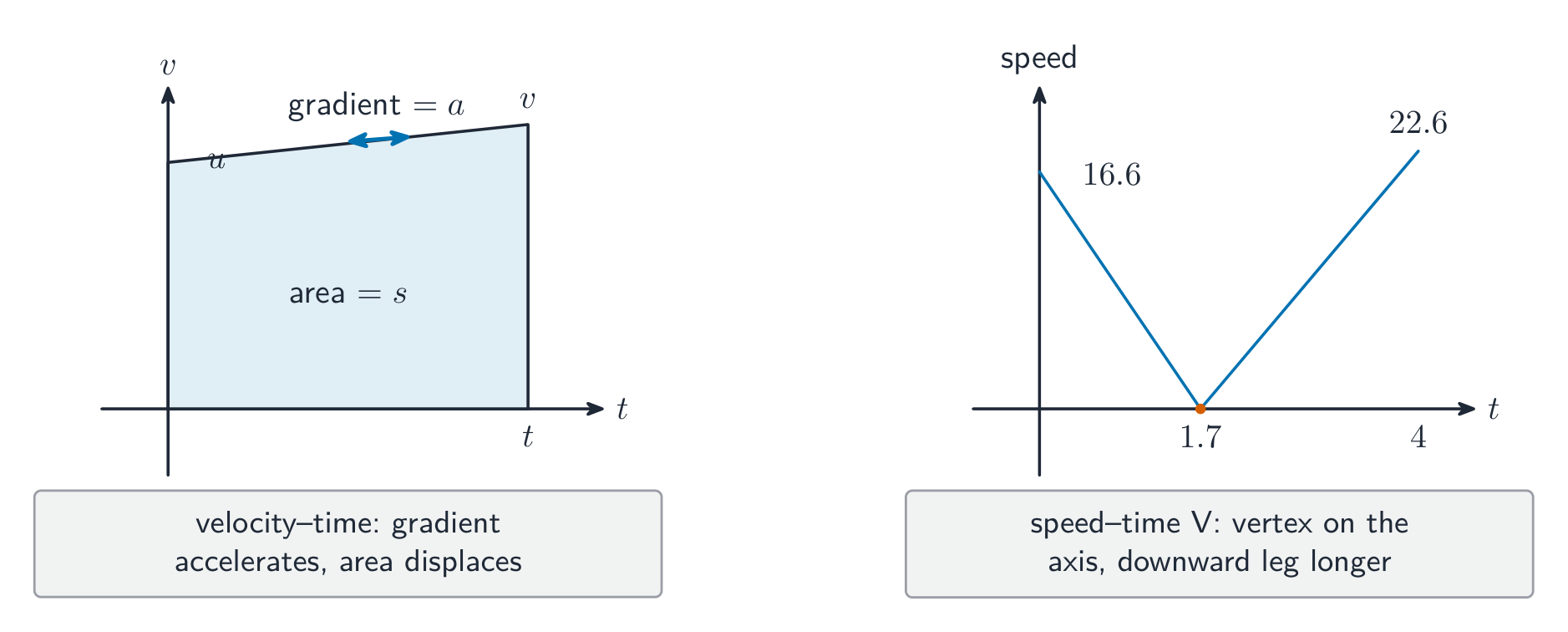
Motion graphs. On a velocity–time graph, the gradient is the acceleration and the area between the graph and the time axis is the displacement (area below the axis counts as negative). A speed–time graph never goes below the axis.

Worked example 3. A ball is thrown vertically upwards from a point $A$, 12 m above the ground, and hits the ground 4 s later. Find the speed of projection and the speed when it hits the ground.

  • Take upwards as positive, with $A$ as the origin. Then $s = -12$, $t = 4$, $a = -9.8$.
  • $s = ut + \tfrac12 at^2$: $-12 = 4u - 4.9 \times 16$, so $4u = 66.4$ and $u = 16.6\ \text{m s}^{-1}$.
  • $v^2 = u^2 + 2as = 16.6^2 + 2(-9.8)(-12) = 510.8$, so the speed is $22.6\ \text{m s}^{-1}$.

On a speed–time graph this is a V shape: the speed falls from 16.6 to 0 at the top, after $\frac{16.6}{9.8} = 1.7$ s, then rises to 22.6 at $t = 4$.

Left: a velocity-time trapezium with gradient a and area s marked. Right: the speed-time V of the worked example, vertex on the time axis, labelled 16.6, 22.6 and t = 4.
探索

运动学与牛顿定律

选定正方向并绘制受力图

对比模型与已解案例,并说明其中一处变化。

1.4.1 1.4.2

Newton's laws and connected particles

English

Newton's second law says that the resultant force equals mass times acceleration: $F = ma$. Resolve all the forces in the direction of motion, and use the direction of the acceleration as positive. If there is no acceleration in a direction, the forces in that direction balance.

Worked example 4. Two ropes pull a barge of mass 15 000 kg along a straight canal. One pulls with 800 N at $25°$ to one side of the direction of motion, the other with 500 N at $\alpha$ to the other side. The resistance is 750 N.

  • Perpendicular to the motion, there is no acceleration: $800\sin 25° = 500\sin\alpha$, so $\sin\alpha = 0.676$ and $\alpha = 43°$.
  • Along the motion: $800\cos 25° + 500\cos\alpha - 750 = 15\,000a$, so $a = 0.023\ \text{m s}^{-2}$.

Connected particles. For two particles joined by a light inextensible string, write a separate equation $F = ma$ for each particle. The tension is the same in both, and so is the size of the acceleration. Then eliminate the tension $T$.

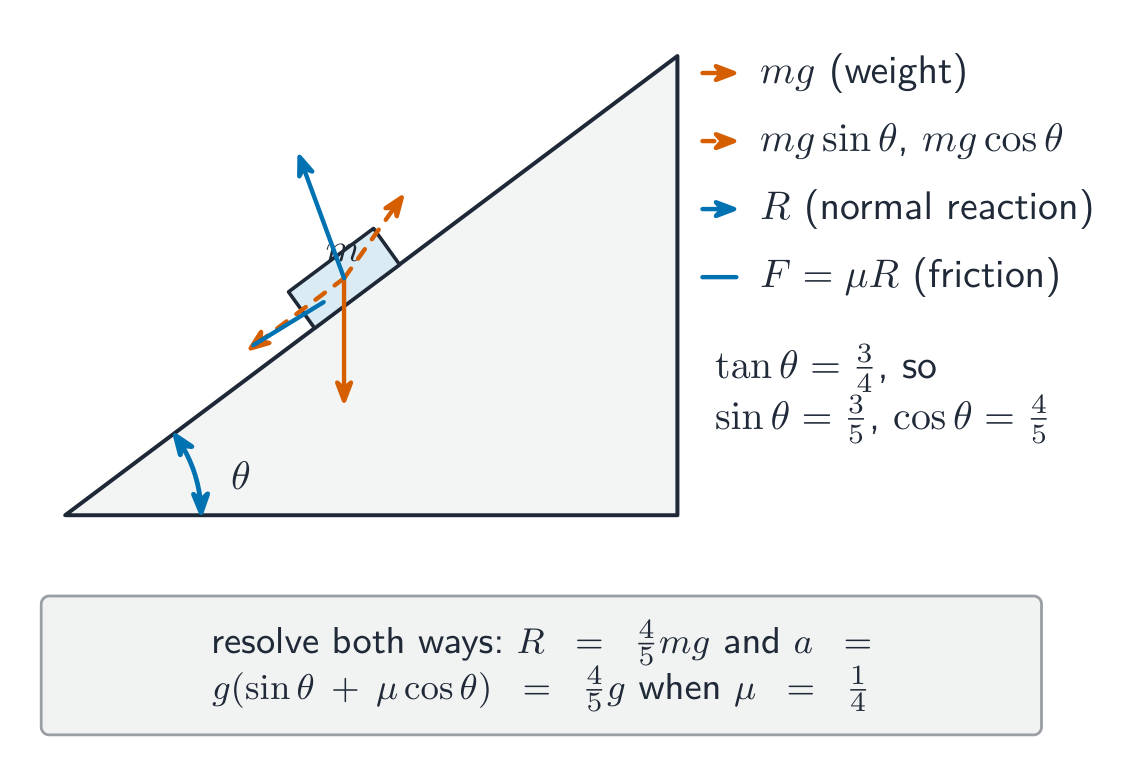
On an inclined plane, resolve along and perpendicular to the slope. If $\tan\theta = \tfrac34$, then $\sin\theta = \tfrac35$ and $\cos\theta = \tfrac45$.

Worked example 5: P (mass kM) and Q (mass 3M) over a smooth pulley, with tension T on each side and the force 2T on the pulley.

Worked example 5. Particles $P$ (mass $kM$) and $Q$ (mass $3M$) hang on either side of a smooth pulley, where $k < 3$. When released, they move with acceleration $\tfrac g5$.

  • For $P$ (moving up): $T - kMg = kM \times \tfrac g5$.
  • For $Q$ (moving down): $3Mg - T = 3M \times \tfrac g5$.
  • Add the equations: $3Mg - kMg = \tfrac g5(3M + kM)$, so $5(3 - k) = 3 + k$ and $k = 2$.
  • If $M = 0.5$ kg, then $T = 1 \times (9.8 + 1.96) = 11.76$ N. The string pulls down on the pulley with a force of $2T = 23.5$ N.
1.4.3

动量与冲量

English

The impulse 冲量 on a particle equals its change in momentum: $I = mv - mu$. Momentum and impulse are vectors, so choose a positive direction.

When two particles collide, they exert equal and opposite impulses on each other (Newton's third law), so the total momentum is conserved:

$$m_1u_1 + m_2u_2 = m_1v_1 + m_2v_2$$
A Newton’s cradle illustrates impacts between steel spheres
A Newton's cradle: momentum passes along the line of balls in each collision

Worked example 6. Particle $P$ (mass $km$, speed $5u$) collides with particle $Q$ (mass $3m$, speed $2u$), moving in the same direction. Afterwards $P$ moves at $2u$ in the same direction. The impulse on $Q$ is $4.5mu$. Find the speed of $Q$ and the value of $k$.

  • For $Q$: $3m(v - 2u) = 4.5mu$, so $v = 3.5u$.
  • For $P$: the impulse is $4.5mu$ backwards, so $km(5u - 2u) = 4.5mu$ and $k = 1.5$.

Worked example 7. In worked example 5, $Q$ hits the ground after falling 2.5 m from rest. Its speed is $v = \sqrt{2 \times \tfrac g5 \times 2.5} = \sqrt g = 3.13\ \text{m s}^{-1}$. If it bounces up at $0.4\ \text{m s}^{-1}$, the impulse from the ground is $1.5(0.4 - (-3.13)) = 5.3$ N s.

词汇 训练
English 中文 拼音
impulse/ˈɪmpʌls/ 冲量 chōng liàng
1.4.4

摩擦力

English

On a rough surface, the contact force has two parts: the normal reaction 法向反力 $R$, perpendicular to the surface, and friction $F$, along the surface, opposing motion or the tendency to move.

  • If the object is moving, or about to move (in limiting equilibrium), $F = \mu R$, where $\mu$ is the coefficient of friction 摩擦系数.
  • If it is at rest and not about to move, $F \le \mu R$.
A climber hanging from a rope on a steep sea cliff, held away from the rock face
A climber relies on friction: it can be at most μR, so pressing harder against the rock allows more grip

Worked example 8. A package is projected up a rough slope with $\tan\theta = \tfrac34$ and $\mu = \tfrac14$. Find its deceleration.

  • Perpendicular to the slope: $R = mg\cos\theta = \tfrac45 mg$.
  • Along the slope (up is positive): friction acts down the slope, so $-mg\sin\theta - \tfrac14 R = ma$.
  • $a = -g\left(\tfrac35 + \tfrac15\right) = -\tfrac45 g$, so the deceleration is $\tfrac45 g$.
A block moving up a rough slope with tan θ = 3/4: the weight resolved into mg sin θ and mg cos θ, the normal reaction R, and friction μR down the slope.

Worked example 9. A 2 kg package on the same slope is held on the point of slipping down by a force $X$ acting up the slope. Friction acts up the slope at its limiting value $\tfrac14 R = \tfrac14 \times 2g \times \tfrac45$. Resolving along the slope: $X + \tfrac25 g = 2g \times \tfrac35$, so $X = \tfrac45 g = 7.84$ N.

探索

斜面、摩擦力和连接体问题

沿平行于斜面和垂直于斜面的方向分解力

对比模型与已解案例,并说明其中一处变化。

词汇 训练
English 中文 拼音
normal reaction/ˈnɔːml rɪˈækʃn/ 法向反力 fǎ xiàng fǎn lì
coefficient of friction/ˌkəʊɪˈfɪʃənt ɒv ˈfrɪkʃn/ 摩擦系数 mó cā xì shù
1.5.1 1.5.2 1.5.3

Statics of a particle

English

A particle is in equilibrium 平衡 when the resultant force on it is zero. Resolve in two perpendicular directions and make each total zero. Remember the forces:

  • weight $mg$, vertically downwards;
  • normal reaction, perpendicular to the surface;
  • tension 张力 in a string, pulling away from the particle along the string (a rod can also push, which is called thrust);
  • friction, along the surface.

Worked example 10. A particle of weight 50 N hangs from two light strings at $40°$ and $60°$ to the vertical. Find the tensions.

  • Horizontally: $T_1\sin 40° = T_2\sin 60°$, so $T_2 = 0.742\,T_1$.
  • Vertically: $T_1\cos 40° + T_2\cos 60° = 50$, so $T_1(0.766 + 0.371) = 50$.
  • $T_1 = 44$ N and $T_2 = 33$ N (2 s.f.).
词汇 训练
English 中文 拼音
equilibrium/ˌiːkwɪˈlɪbrɪəm/ 平衡 píng héng
tension/ˈtenʃn/ 张力 zhāng lì
1.6.1

Moments

English

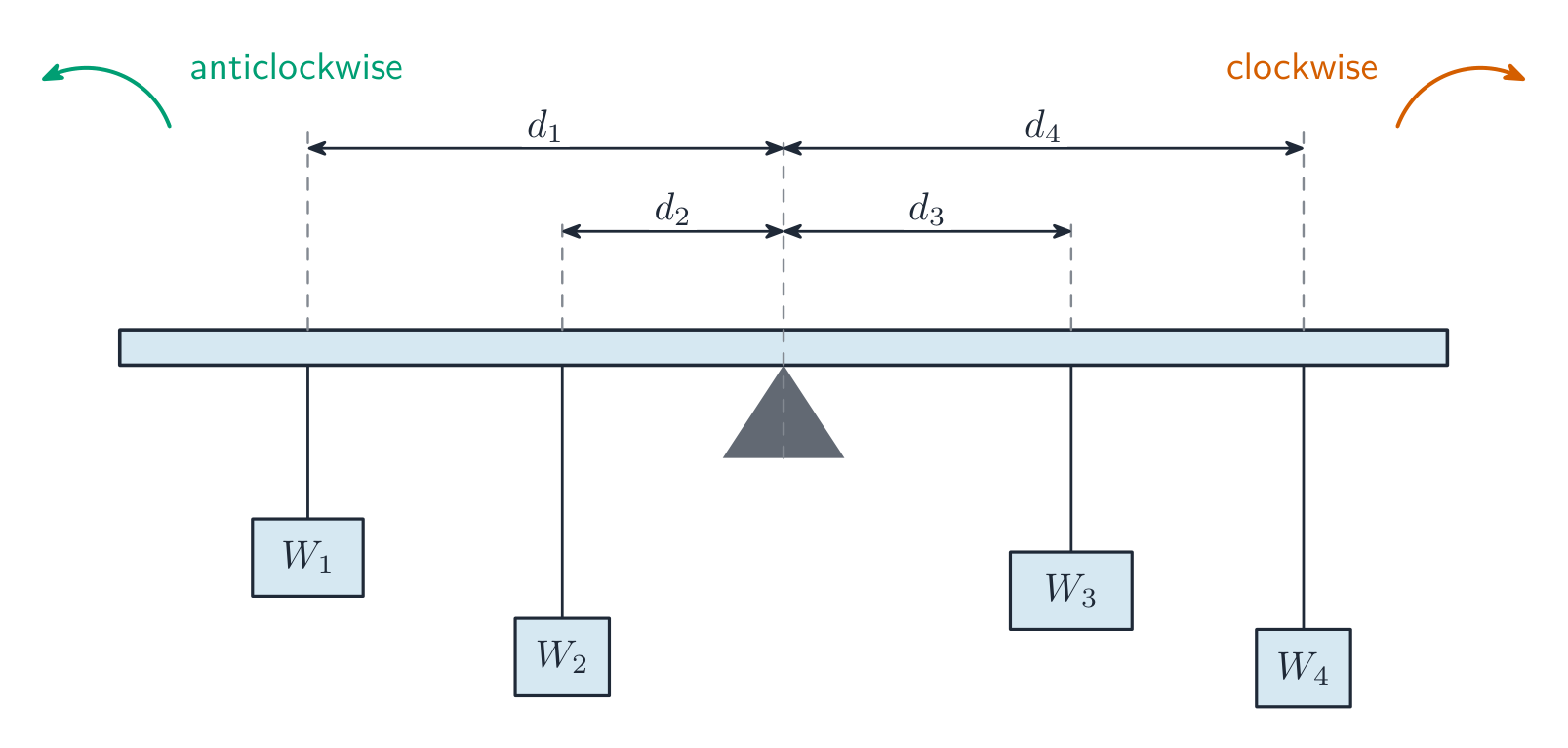
The moment of a force 力矩 about a point is the force multiplied by the perpendicular distance from the point to the line of the force. A rigid body is in equilibrium if:

  • the resultant force is zero, and
  • the total moment about any point is zero.

Take moments about the point where the most unknown forces act, because their moments are zero there. If a rod is "on the point of tilting" about a support, the reaction at any other support is zero.

Tower cranes on a city building site, each with its long jib and a counterweight on the short arm behind the mast
A tower crane: the counterweight's moment balances the load's moment about the mast
A horizontal rule balanced on a central pivot with weights hanging at different distances; weights on the left give anticlockwise moments and weights on the right give clockwise moments
Weights on a rule balanced at a pivot: the clockwise and anticlockwise moments are equal

Worked example 11. A non-uniform rod $AB$ of length $3a$ and weight $W$ rests on a horizontal ledge, with $A$ at one end of the ledge and the edge of the ledge at $C$, where $AC = 2a$. Its centre of mass is a distance $d$ from $A$. An upward force $P$ at $B$ makes the rod about to tilt about $A$; a downward force $1.25P$ at $B$ makes it about to tilt about $C$. Find $d$.

  • About to tilt about $A$, taking moments about $A$: $P \times 3a = W \times d$, so $P = \dfrac{Wd}{3a}$.
  • About to tilt about $C$, taking moments about $C$: $1.25P \times a = W \times (2a - d)$.
  • Substitute: $1.25 \times \dfrac{Wd}{3a} \times a = W(2a - d)$, so $1.25d = 6a - 3d$ and $d = \dfrac{24a}{17}$.
词汇 训练
English 中文 拼音
moment of a force/ˈməʊmənt əvə fɔːs/ 力矩 lì jǔ
1.6.1

本课资料

English
  • Pearson Edexcel, International Advanced Level Mathematics, Further Mathematics and Pure Mathematics specification (2018), unit M1.
  • G. Galilei, Discorsi e dimostrazioni matematiche intorno a due nuove scienze (Leiden, 1638), Third Day.
  • Pearson Edexcel, WME01/01 June 2025, questions 1 to 6 and 8 (adapted).
1.6.1

常见错误

English
  • Mixing signs: choose a positive direction for each stage and keep to it.
  • Using the constant acceleration equations when the acceleration is not constant.
  • Writing one equation for a whole system of connected particles but using the tension in it.
  • Using $F = \mu R$ when the object is at rest and not about to move.
  • Using $R = mg$ on a slope instead of $R = mg\cos\theta$.
  • Using the distance along a rod instead of the perpendicular distance in a moment.
  • Giving answers that use $g = 9.8$ to more than 3 significant figures.
1.6.1

关键术语

English
  • Particle: a body with mass but no size.
  • Resultant: the single force equal to the vector sum of all the forces.
  • Impulse: the change in momentum, $mv - mu$.
  • Coefficient of friction: $\mu$, the ratio of limiting friction to normal reaction.
  • Equilibrium: the state in which the resultant force (and the total moment) is zero.
  • Moment: force multiplied by perpendicular distance from a point.
1.6.1

自我检测

English
  1. A car accelerates uniformly from $8\ \text{m s}^{-1}$ to $20\ \text{m s}^{-1}$ in 6 s. Find the acceleration and the distance travelled.
  2. Find the magnitude and bearing of the velocity $6\mathbf i + 6\mathbf j\ \text{m s}^{-1}$.
  3. A 4 kg box is pulled along a smooth floor by a horizontal force of 10 N. Find its acceleration.
  4. A 0.2 kg ball hits a wall at $5\ \text{m s}^{-1}$ and rebounds at $3\ \text{m s}^{-1}$. Find the impulse on the ball.
  5. A 5 kg box rests on a rough horizontal floor with $\mu = 0.3$. What horizontal force is needed to make it about to move?
  6. A uniform 2 m rod of weight 40 N rests on supports at its ends. A 60 N weight hangs 0.5 m from one end. Find the reaction at the nearer support.

Answers: 1. $a = \frac{20 - 8}{6} = 2\ \text{m s}^{-2}$; $s = \tfrac12(8 + 20) \times 6 = 84$ m. 2. $6\sqrt2 = 8.49\ \text{m s}^{-1}$, bearing $045°$. 3. $\frac{10}{4} = 2.5\ \text{m s}^{-2}$. 4. $0.2 \times (3 - (-5)) = 1.6$ N s, away from the wall. 5. $0.3 \times 5 \times 9.8 = 14.7$ N. 6. Moments about the far end: $2R = 40 \times 1 + 60 \times 1.5 = 130$, so $R = 65$ N.

该知识点的互动课程

逐步完成,配合即时检查练习。

更多 Edexcel International A-Level 数学 知识点

登录或创建账户

IGCSE, A-Level & AP