跳到主要内容

P4 · Pure Mathematics 4

Edexcel International A-Level 数学知识点 4

本主题的视频课程 打开视频页面
21:08

纯数学4

为何重要。约公元前300年,欧几里得在亚历山大里亚将当时的数学知识汇集成《几何原本》十三卷。第九卷,命题20……

英文讲解 · 可切换中英文字幕

4.4.1

Pure Mathematics 4: proof, parametrics and the full calculus

English

Why it matters. About 300 BC, in Alexandria, Euclid collected the mathematics of his time into the thirteen books of the Elements. Book IX, Proposition 20, proves that there are more prime numbers than any finite list can hold. The argument is short: suppose the list is complete, multiply all its primes together and add 1, and the new number must have a prime factor that is not on the list. The assumption leads to an impossibility, so it must be false. More than two thousand years later, this proof by contradiction is still taught exactly as Euclid wrote it, and you will meet it in this unit. P4 completes the pure mathematics of the International A Level with proof, partial fractions, parametric equations, the binomial series, differential equations, further integration and vectors.

In this unit you will:

  • prove results by contradiction;
  • split rational functions into partial fractions;
  • convert between parametric and Cartesian equations, and differentiate implicitly and parametrically;
  • expand $(a + bx)^n$ for any rational $n$, and state when the expansion is valid;
  • form and solve differential equations, and integrate by substitution and by parts;
  • find volumes of revolution, and use vectors in three dimensions.

Edexcel International Advanced Level, Pure Mathematics 4 (P4, paper WMA14/01, 1 hour 30 minutes, 75 marks). It completes International A Level Mathematics and Pure Mathematics. Everything in P1 to P3 is assumed and may be tested. The calculator rules are the same as for P1. Give answers to 3 significant figures unless the question says otherwise.

These results are not in the formula booklet, so learn them:

Family Formulae
binomial series $(1 + x)^n = 1 + nx + \dfrac{n(n-1)}{2!}x^2 + \dfrac{n(n-1)(n-2)}{3!}x^3 + \cdots$, valid $\lvert x\rvert < 1$ for any rational $n$
volume of revolution $V = \pi\displaystyle\int_a^b y^2\,dx$ about the $x$-axis (parametric: $\pi\int y^2\dfrac{dx}{dt}\,dt$)
vectors column form $\begin{pmatrix}x\\y\\z\end{pmatrix} = x\mathbf i + y\mathbf j + z\mathbf k$; $\lvert\mathbf a\rvert = \sqrt{a_1^2 + a_2^2 + a_3^2}$; unit vector $\dfrac{\mathbf a}{\lvert\mathbf a\rvert}$; $\overrightarrow{AB} = \mathbf b - \mathbf a$
4.1.1

Proof by contradiction

English
Left: proof by contradiction as a flow from assumption to impossibility to conclusion. Right: triangle ABC with position vectors and the angle from the scalar product.

Proof by contradiction 反证法 assumes the opposite of the claim, derives an impossibility, and concludes the original claim. Two classics must be known:

Worked example 1: $\sqrt2$ is irrational. (A number is irrational 无理数 when no fraction $\tfrac pq$ equals it.) Suppose instead $\sqrt2 = \tfrac pq$ in lowest terms ($p, q$ coprime integers, $q \ne 0$).

  • Squaring: $2 = \tfrac{p^2}{q^2} \implies p^2 = 2q^2$, so $p^2$ is even, so $p$ is even: write $p = 2r$.
  • Then $4r^2 = 2q^2 \implies q^2 = 2r^2$, so $q$ is even too.
  • Both $p$ and $q$ even contradicts $\tfrac pq$ being in lowest terms. $\blacksquare$

Worked example 2: there are infinitely many primes. Suppose finitely many: $p_1, \ldots, p_k$.

  • Consider $N = p_1p_2\cdots p_k + 1$. Dividing $N$ by any $p_i$ leaves remainder 1.
  • So $N$ is either prime itself or has a prime factor not in the list — either way a prime outside $\{p_1, \ldots, p_k\}$, contradicting the assumption. $\blacksquare$

Worked example 3: a trigonometric contradiction (adapted from Edexcel IAL WMA14 June 2025 Q10). Prove that $\lvert\sin x + \cos x\rvert < 1$ for all $90° < x < 180°$.

  • Suppose not: some $x$ in the range has $\lvert\sin x + \cos x\rvert \ge 1$. Squaring (both sides non-negative):
    $$(\sin x + \cos x)^2 \ge 1 \implies \sin^2x + 2\sin x\cos x + \cos^2x \ge 1 \implies 1 + \sin 2x \ge 1 \implies \sin 2x \ge 0$$
  • But $90° < x < 180°$ gives $180° < 2x < 360°$, where $\sin 2x < 0$ — a contradiction.
  • So no such $x$ exists and $\lvert\sin x + \cos x\rvert < 1$ throughout the range. $\blacksquare$
  • Check at $x = 135°$: $\lvert\tfrac{\sqrt2}2 - \tfrac{\sqrt2}2\rvert = 0 < 1$ ✓; at $x = 100°$: $\lvert 0.985 - 0.174\rvert = 0.811 < 1$ ✓.
词汇 训练
English 中文 拼音
Proof by contradiction/pruːf baɪ ˌkɒntrəˈdɪkʃn/ 反证法 fǎn zhèng fǎ
irrational/ɪˈræʃənl/ 无理数 wú lǐ shù
4.2.1

Partial fractions

English

Decompose 分解 rational functions into partial fractions 部分分式. In P4 the denominators have linear factors, such as $(ax+b)(cx+d)(ex+f)$, or a repeated factor 重因式, such as $(cx+d)^2$ in $(ax+b)(cx+d)^2$, which needs one fraction for each power. Improper fractions 假分式 (numerator degree $\ge$ denominator's) divide first.

Worked example 4: distinct factors. Decompose $\dfrac{5x + 1}{(x+2)(x-1)}$ :

$$\frac{5x+1}{(x+2)(x-1)} = \frac{3}{x+2} + \frac{2}{x-1}$$
  • Check at $x = 0$: LHS $= \tfrac1{-2} = -\tfrac12$; RHS $= \tfrac32 - 2 = -\tfrac12$ ✓.
Partial fractions for (5x + 1)/((x + 2)(x − 1)): multiply through to 5x + 1 = A(x − 1) + B(x + 2); x = 1 gives B = 2, x = −2 gives A = 3
Choose x to make one bracket zero: each substitution gives one constant

Worked example 5: repeated factor. Decompose $\dfrac{3x^2 + 7x + 6}{x(x+1)^2}$.

  • Set up with the repeated factor split across both powers:
    $$\frac{3x^2+7x+6}{x(x+1)^2} = \frac{A}{x} + \frac{B}{x+1} + \frac{C}{(x+1)^2}$$
  • Multiply through: $3x^2 + 7x + 6 = A(x+1)^2 + Bx(x+1) + Cx$.
  • At $x = 0$: $6 = A$. At $x = -1$: $3 - 7 + 6 = 2 = -C \Rightarrow C = -2$.
  • Compare $x^2$: $3 = A + B \Rightarrow B = -3$.
    $$\frac{3x^2+7x+6}{x(x+1)^2} = \frac{6}{x} - \frac{3}{x+1} - \frac{2}{(x+1)^2}$$
  • Check at $x = 1$: LHS $= \tfrac{16}{4} = 4$; RHS $= 6 - \tfrac32 - \tfrac12 = 4$ ✓.
词汇 训练
English 中文 拼音
Decompose/ˌdiːkəmˈpəʊz/ 分解 fēn jiě
partial fractions/ˈpɑːʃl ˈfrækʃnz/ 部分分式 bù fèn fēn shì
repeated factor/rɪˈpiːtɪd ˈfæktə/ 重因式 zhòng yīn shì
Improper fractions/ɪmˈprɒpə ˈfrækʃnz/ 假分式 jiǎ fēn shì
4.3.1

Parametric equations

English
A parametric curve with parameter ticks, the tangent at P using dy/dx = (dy/dt)/(dx/dt), and the normal with the negative reciprocal slope.
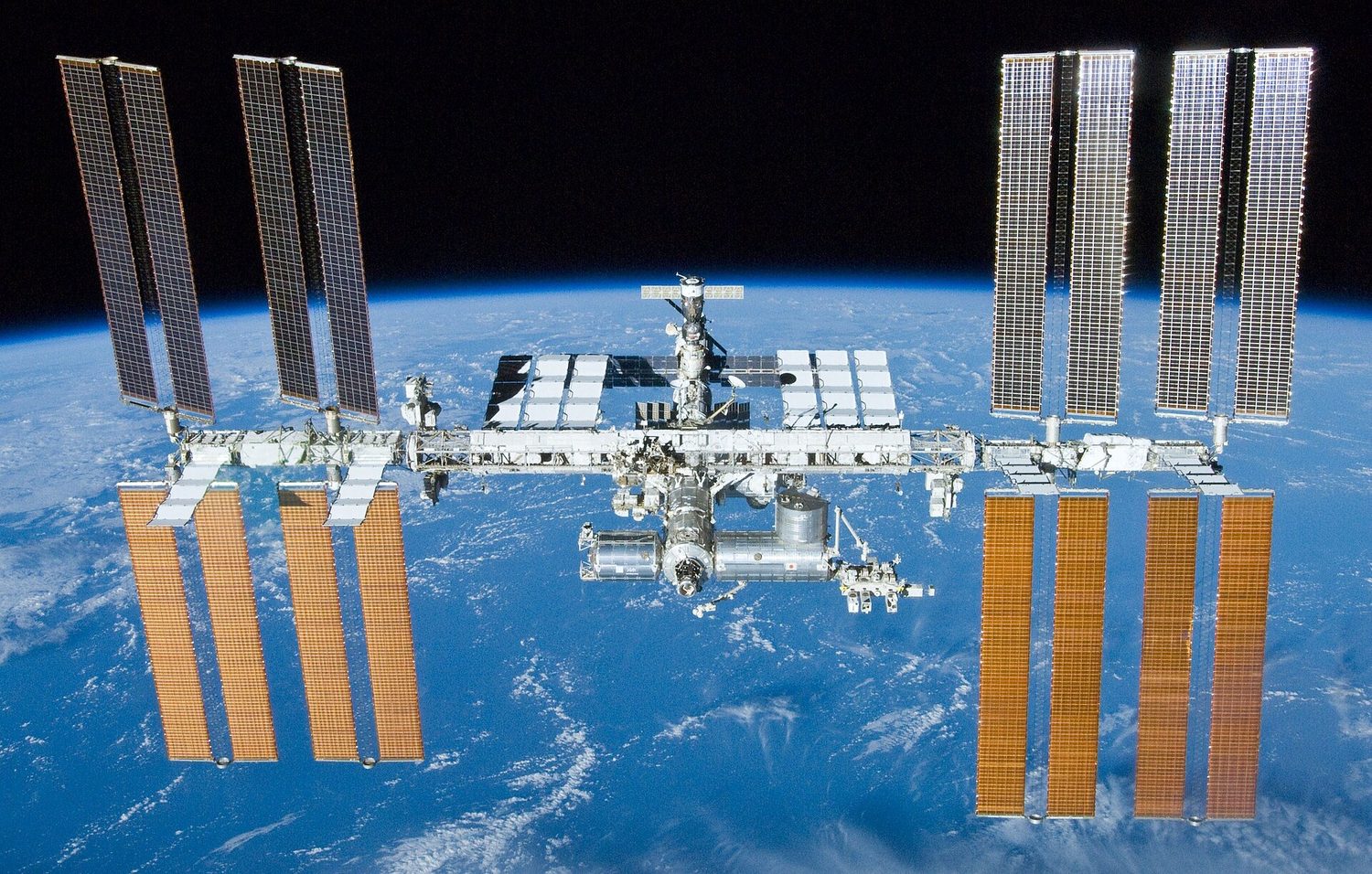
The ISS in orbit: parametric equations describe position as a function of time
The ISS in orbit: parametric equations give x and y separately as functions of time

Parametric equations 参数方程 give both coordinates through a parameter $t$: $x = f(t)$, $y = g(t)$. Convert to Cartesian 笛卡尔 form by making $t$ the subject of one equation and substituting into the other (or by exploiting an identity). Give any restriction on $x$ that comes from the range of $t$.

Worked example 6. A curve has $x = 2t$, $y = t^2 - 1$. Find the Cartesian equation.

  • From $x = 2t$: $t = \dfrac x2$, so
    $$y = \left(\frac x2\right)^2 - 1 = \frac{x^2}{4} - 1$$
  • Check at $t = 3$: $(x, y) = (6, 8)$; Cartesian: $36/4 - 1 = 8$ ✓.

Worked example 7: parametric point and normal (adapted from Edexcel IAL WMA14 June 2025 Q5). A parametric curve passes through $P(-7, -3)$ at $t = 2$ with $\dfrac{dy}{dx} = -\tfrac45$ there (from $\dfrac{dy}{dx} = \dfrac{dy/dt}{dx/dt}$).

  • Normal gradient: $-\dfrac{1}{-4/5} = \dfrac54$.
    $$y + 3 = \tfrac54(x + 7) \implies 5x - 4y + 23 = 0$$
  • Check: $5(-7) - 4(-3) + 23 = -35 + 12 + 23 = 0$ ✓.
词汇 训练
English 中文 拼音
Parametric equations/ˌpærəˈmetrɪk ɪˈkweɪʒnz/ 参数方程 cān shù fāng chéng
Cartesian/kɑːˈtiːzɪən/ 笛卡尔 dí kǎ ěr
4.4.1

The binomial series for any rational n

English

For any rational 有理数 $n$ and $\lvert x \rvert < 1$:

Left: y = (1 − 2x)^(1/2) and its expansion 1 − x − ½x² − ½x³ lying on top of each other inside the shaded band |x| < ½ and parting outside it. Right: bars for a salary of 25 000 rising by 3% a year, reaching 32 600 in year 10
The expansion matches the curve only where it is valid, |x| < ½; the salary bars grow by the same factor, 1.03, every year
$$(1 + x)^n = 1 + nx + \frac{n(n-1)}{2!}x^2 + \frac{n(n-1)(n-2)}{3!}x^3 + \cdots$$

Factor first: $(a + bx)^n = a^n\left(1 + \tfrac ba x\right)^n$, valid for $\lvert x\rvert < \left\lvert\tfrac ab\right\rvert$. Decompose rational functions into partial fractions, then expand each piece. Powers do not terminate unless $n$ is a positive integer.

Worked example 8 (adapted from Edexcel IAL WMA14 June 2025 Q8). Expand $\sqrt{4 + x}$ to three non-zero terms.

  • Factor: $\sqrt{4+x} = 2\left(1 + \tfrac x4\right)^{1/2}$, valid $\lvert x\rvert < 4$, with $n = \tfrac12$:
    $$\left(1 + \frac x4\right)^{1/2} = 1 + \frac12\cdot\frac x4 + \frac{\frac12\left(-\frac12\right)}{2}\left(\frac x4\right)^2 + \cdots = 1 + \frac x8 - \frac{x^2}{128} + \cdots$$
    $$\sqrt{4+x} = 2 + \frac x4 - \frac{x^2}{64} + \cdots$$
  • Check at $x = 1$: series gives $2 + 0.25 - 0.0156 = 2.234$; true $\sqrt5 = 2.2361\ldots$ ✓ (the third term pulls the two-term value 2.25 down to within 0.002).
探索

二项式展开及有效近似

对于正整数 n,(a+b)^n 是一个有限二项式展开

对比模型与已解案例,并说明其中一处变化。

词汇 训练
English 中文 拼音
rational/ˈræʃənl/ 有理数 yǒu lǐ shù
4.5.1

Implicit and parametric differentiation

English

Implicit differentiation 隐函数求导 differentiates both sides with respect to $x$, treating $y$ as a function of $x$: $\dfrac{d}{dx}y^2 = 2y\dfrac{dy}{dx}$, and products such as $xy$ need the product rule: $\dfrac{d}{dx}(xy) = y + x\dfrac{dy}{dx}$. Then solve for $\dfrac{dy}{dx}$.

The curve y cubed minus xy = 2 in two branches. The upper branch passes through (-1, 1) with an orange tangent line of slope one quarter. The lower branch turns back at (3, -1), where a green vertical line touches it: the vertical tangent
Where the denominator of $\frac{dy}{dx}$ is zero (and the numerator is not), the tangent is vertical

Parametric differentiation: $\dfrac{dy}{dx} = \dfrac{dy/dt}{dx/dt}$ when $dx/dt\ne0$; otherwise check the tangent directly.

Worked example 9: an implicit tangent (adapted from Edexcel IAL WMA14 June 2025 Q1). The curve $2y^2 - 6xy + 7\mathrm{e}^{1-2x} = 27$ passes through the point $\left(\tfrac12,\ 4\right)$. Find the tangent there.

  • Differentiate term by term:
    $$4y\frac{dy}{dx} - 6y - 6x\frac{dy}{dx} - 14\mathrm{e}^{1-2x} = 0 \implies \frac{dy}{dx} = \frac{6y + 14\mathrm{e}^{1-2x}}{4y - 6x}$$
  • At $\left(\tfrac12, 4\right)$: $\mathrm{e}^{1-1} = 1$, so
    $$\frac{dy}{dx} = \frac{24 + 14}{16 - 3} = \frac{38}{13}$$
  • Tangent: $y - 4 = \tfrac{38}{13}\left(x - \tfrac12\right) \implies 38x - 13y + 33 = 0$.
  • Check: $38\left(\tfrac12\right) - 13(4) + 33 = 19 - 52 + 33 = 0$ ✓.
探索

链式法则、乘积法则、商法则和隐函数求导

对于 y=f(g(x)),y'=f'(g(x))g'(x)

对比模型与已解案例,并说明其中一处变化。

词汇 训练
English 中文 拼音
Implicit differentiation/ɪmˈplɪsɪt ˌdɪfəˌrenʃɪˈeɪʃn/ 隐函数求导 yǐn hán shù qiú dǎo
4.5.2 4.6.4

Differential equations and connected rates

English

Form an equation from a rate description, then solve separable 可分离变量 equations:

A cooling cup of coffee: Newton's law of cooling is a classic differential equation model
A cooling cup of coffee: Newton's law of cooling is a first-order differential equation
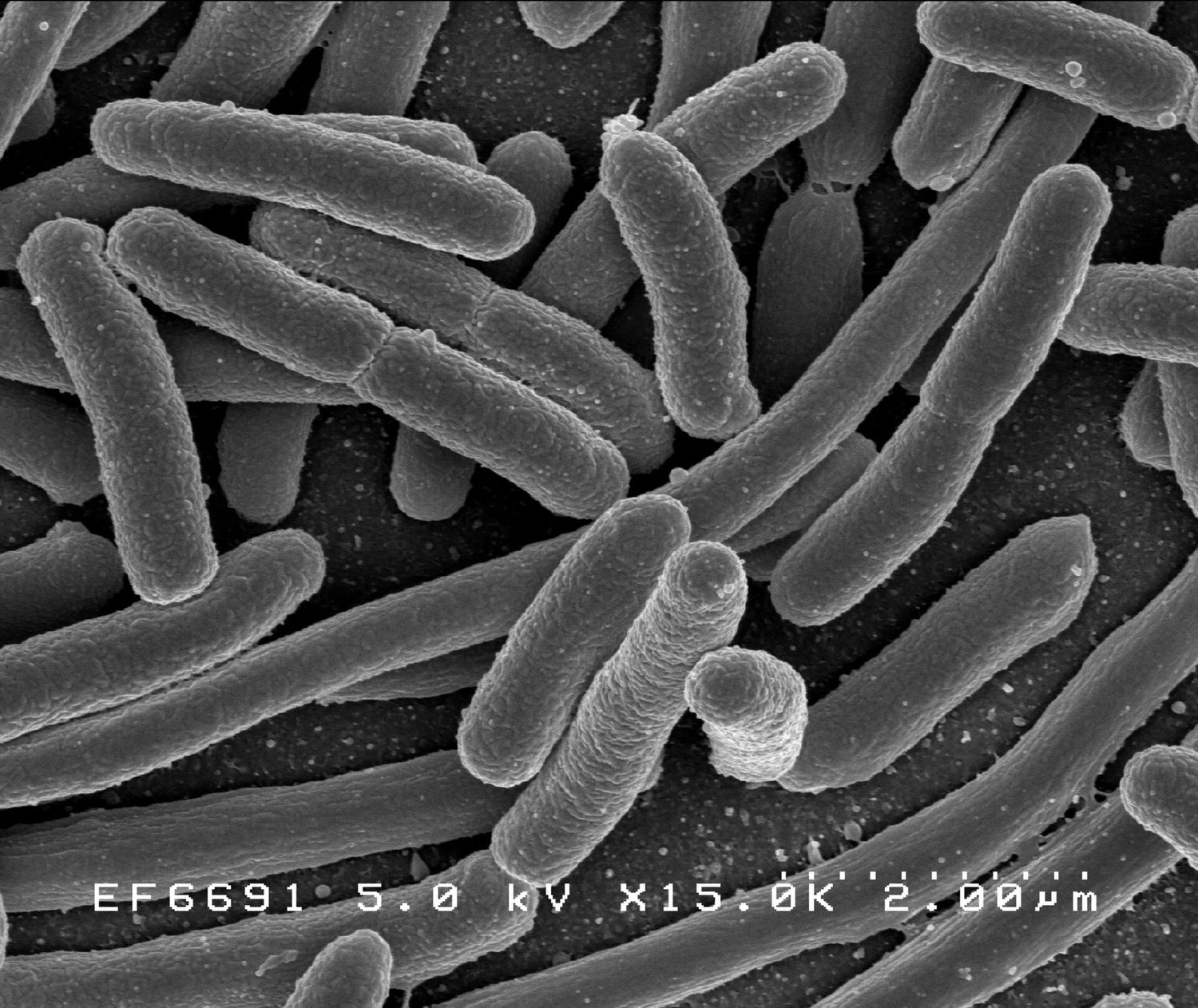
E. coli under a microscope: differential equations model exponential growth of populations
$$\frac{dy}{dx} = f(x)g(y) \implies \int\frac{dy}{g(y)} = \int f(x)\,dx$$

Check any value divided out while separating variables: constant solutions can be lost. Use a boundary condition for the particular solution 特解. Connected rates of change 连锁变化率 use the chain rule: $\dfrac{dV}{dt} = \dfrac{dV}{dr}\cdot\dfrac{dr}{dt}$.

Worked example 10: a melting sphere (Edexcel IAL WMA14 June 2025 Q2). A sphere of radius $r$ cm has volume $V = \tfrac43\pi r^3$ and melts with $\dfrac{dV}{dt} = k$ (constant, in cm³ per second). Show $\dfrac{dr}{dt} \propto \dfrac1{r^2}$.

  • Differentiate the volume link: $\dfrac{dV}{dr} = 4\pi r^2$.
  • Chain rule: $k = \dfrac{dV}{dt} = 4\pi r^2\dfrac{dr}{dt}$, so
    $$\frac{dr}{dt} = \frac{k}{4\pi r^2} = \frac{k}{4\pi}\cdot\frac{1}{r^2}$$
  • The constant $\dfrac{k}{4\pi}$ multiplies $\dfrac{1}{r^2}$: the rate of decrease of the radius is inversely proportional to $r^2$. $\blacksquare$
  • Interpretation: small spheres vanish disproportionately fast — the last millimetre melts quickest.

Worked example 11: a separable equation (adapted from Edexcel IAL WMA14 June 2025 Q3). Solve $y\dfrac{dy}{dx} = 3\sec 2x\tan 2x$, given $y = 4$ at $x = \tfrac\pi6$.

  • Separate: $\displaystyle\int y\,dy = \int 3\sec 2x\tan 2x\,dx$ (the right side integrates to $\tfrac32\sec 2x$, reversing $\dfrac{d}{dx}\sec 2x = 2\sec 2x\tan 2x$):
    $$\frac{y^2}{2} = \frac32\sec 2x + c \implies y^2 = 3\sec 2x + C$$
  • Substitute $\left(\tfrac\pi6, 4\right)$: $16 = 3\sec\tfrac\pi3 + C = 3(2) + C$, so $C = 10$:
    $$y^2 = 3\sec 2x + 10$$
  • Check: $3(2) + 10 = 16 = 4^2$ ✓.
探索

微分方程与数值解法

分离 dy/dx=ky 的变量,对两边积分并应用初始条件。

对比模型与已解案例,并说明其中一处变化。

词汇 训练
English 中文 拼音
separable/ˈsepərəbl/ 可分离变量 kě fēn lí biàn liàng
particular solution/pəˈtɪkjʊlə səˈluːʃn/ 特解 tè jiě
Connected rates of change/kəˈnektɪd reɪts ɒv tʃeɪndʒ/ 连锁变化率 lián suǒ biàn huà lǜ
4.6.2 4.6.3

Integration: substitution, parts and partial fractions

English
  • Substitution 换元积分 (usually given): rewrite the integral in $u$, adjust $dx$ via $\dfrac{du}{dx}$, integrate, substitute back. It is the chain rule reversed.
  • Integration by parts 分部积分: $\displaystyle\int u\dfrac{dv}{dx}dx = uv - \int v\dfrac{du}{dx}dx$ — the product rule reversed. Know $\displaystyle\int\ln x\,dx = x\ln x - x + c$ and repeated parts for $\int x^2\mathrm{e}^x dx$-type integrals.
  • Partial fractions turn a rational integrand into sums of $\dfrac{A}{ax+b}$ (integrating to logs) and $\dfrac{C}{(ax+b)^2}$ (to powers).

Worked example 12: parts with a repeat in sight. Find $\displaystyle\int \mathrm{e}^x\cos x\,dx$ (needed for volumes of revolution with trig curves).

  • Parts with $u = \mathrm{e}^x$, $\tfrac{dv}{dx} = \cos x$:
    $$\int \mathrm{e}^x\cos x\,dx = \mathrm{e}^x\sin x - \int\mathrm{e}^x\sin x\,dx$$
  • Parts again on the new integral ($u = \mathrm{e}^x$, $\tfrac{dv}{dx} = \sin x$):
    $$= \mathrm{e}^x\sin x + \mathrm{e}^x\cos x - \int\mathrm{e}^x\cos x\,dx$$
  • The original integral reappears; collect it:
    $$2\int\mathrm{e}^x\cos x\,dx = \mathrm{e}^x(\sin x + \cos x) + c \implies \int \mathrm{e}^x\cos x\,dx = \tfrac12\mathrm{e}^x(\sin x + \cos x) + c$$
  • Check by differentiating: $\tfrac12\mathrm{e}^x(\sin x + \cos x) + \tfrac12\mathrm{e}^x(\cos x - \sin x) = \mathrm{e}^x\cos x$ ✓.
Flow for the integral I of e to the x times cos x: parts gives e to the x sin x minus the integral of e to the x sin x; parts again gives e to the x sin x plus e to the x cos x minus I; adding I gives 2I
Two rounds of parts bring the original integral back. Collect it: 2I = e to the x (sin x + cos x)
探索

换元法、分部积分法和部分分式法

V/π = ∫(从0到3) x² dx = 9

小工具显示被积函数 y²=x²(对应 y=x);请将精确值 9 与体积校验结果进行比较。

词汇 训练
English 中文 拼音
Substitution/ˌsʌbstɪˈtjuːʃn/ 换元积分 huàn yuán jī fēn
Integration by parts/ˌɪntɪˈɡreɪʃn baɪ pɑːts/ 分部积分 fēn bù jī fēn
4.6.1 4.6.5

Volumes of revolution and parametric areas

English
Left: a region rotating about the x-axis with suggested cross-sections and V = π∫y²dx. Right: binomial partial sums of √(4+x) approaching the true curve.
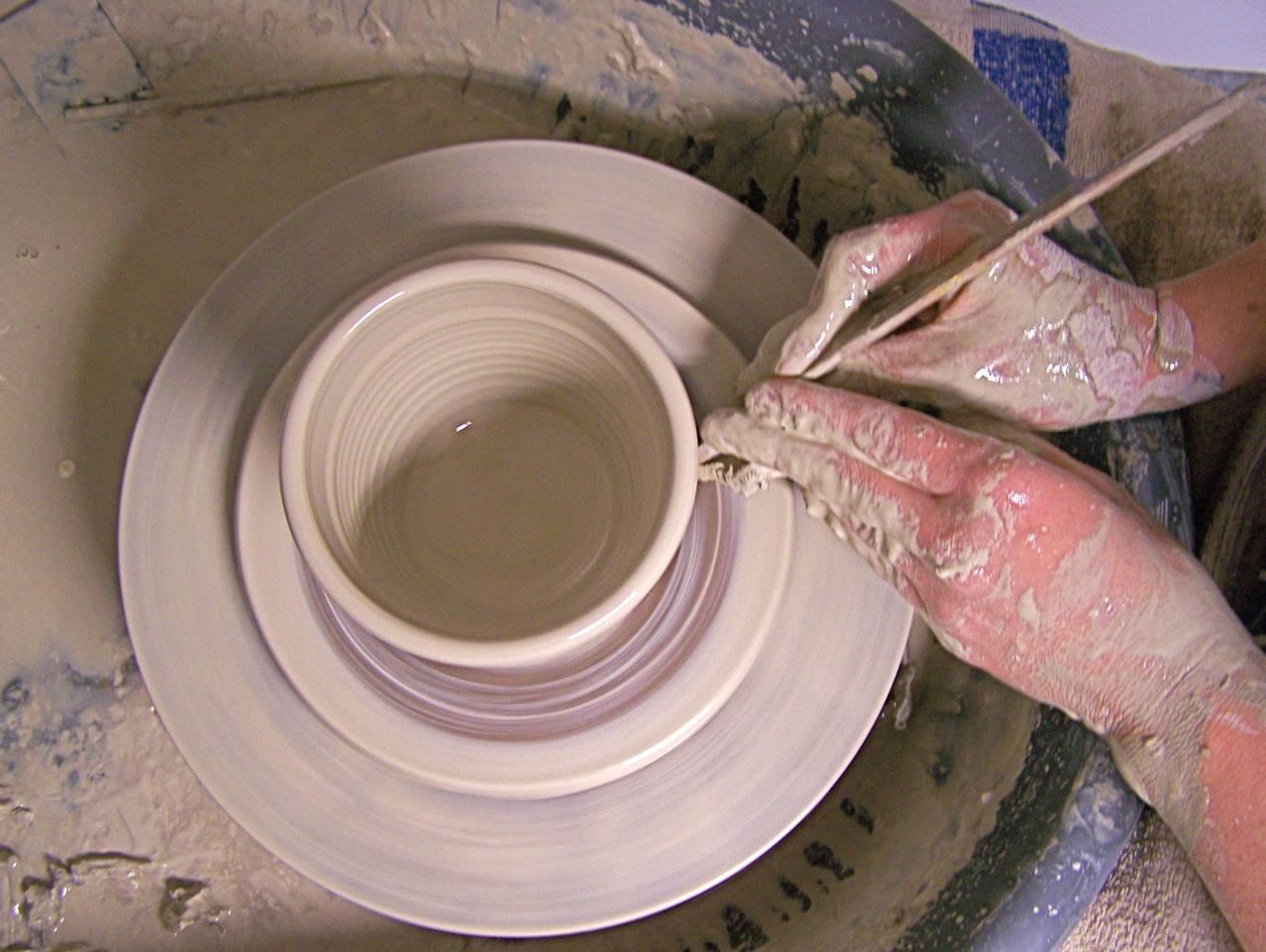
A potter shaping a vessel: volumes of revolution rotate a plane region about an axis
A potter's vessel is a solid of revolution: rotate a curve about an axis to find its volume

Rotating the region under $y = f(x) \ge 0$ about the $x$-axis sweeps a solid whose volume is

the volume of revolution 旋转体体积

$$V = \pi\int_a^b y^2\,dx$$

Square the function before integrating, use identities to handle $\sin^2$/$\cos^2$, and split by linearity. With parametric equations, replace $y^2\,dx$ by $y^2\dfrac{dx}{dt}\,dt$ between parameter values; areas under parametric curves use $y\dfrac{dx}{dt}\,dt$.

Worked example 13: volume with an identity (structure adapted from Edexcel IAL WMA14 June 2025 Q9). The region under $y = 3\cos x$ for $0 \le x \le \tfrac\pi2$ rotates about the $x$-axis; find the exact volume.

$$V = \pi\int_0^{\pi/2} 9\cos^2x\,dx = 9\pi\int_0^{\pi/2}\tfrac12(1 + \cos 2x)\,dx = \frac{9\pi}{2}\left[x + \frac{\sin 2x}{2}\right]_0^{\pi/2} = \frac{9\pi}{2}\cdot\frac\pi2 = \frac{9\pi^2}{4}$$
  • Check: the average of $\cos^2x$ over a half-turn is $\tfrac12$, so $V \approx 9\pi \times \tfrac12 \times \tfrac\pi2 = \tfrac{9\pi^2}{4}$ ✓ exactly.
词汇 训练
English 中文 拼音
volume of revolution/ˈvɒljuːm ɒv ˌrevəˈluːʃn/ 旋转体体积 xuán zhuǎn tǐ tǐ jī
4.7.1 4.7.2 4.7.3 4.7.4 4.7.5 4.7.6 4.7.7

向量

English

A vector 向量 has magnitude and direction, written $\mathbf a = a_1\mathbf i + a_2\mathbf j + a_3\mathbf k$ or as a column.

Two vectors from a point with the angle between them and the projection of one onto the other
The scalar product picks out $|\mathbf{b}|\cos\theta$, how far $\mathbf{b}$ reaches along $\mathbf{a}$.

The magnitude 模 is $\lvert\mathbf a\rvert = \sqrt{a_1^2+a_2^2+a_3^2}$; for $\mathbf a\ne\mathbf0$, the unit vector 单位向量 in its direction is $\mathbf a/\lvert\mathbf a\rvert$. The zero vector has no direction.

Addition and scalar multiplication have geometric meanings (translations, scaling, parallel 平行 when one is a multiple of the other).

The scalar product 数量积 $\mathbf a\cdot\mathbf b = a_1b_1 + a_2b_2 + a_3b_3$ gives angles between nonzero vectors through $\cos\theta$. The position vector 位置向量 of $B$ relative to $A$ is $\overrightarrow{AB} = \mathbf b - \mathbf a$.

Worked example 14: a 45° triangle (adapted from Edexcel IAL WMA14 June 2025 Q6). $A = \mathbf i + 2\mathbf j - 3\mathbf k$, $B = 5\mathbf i + 2\mathbf j + \mathbf k$, $C = 3\mathbf i + \alpha\mathbf j + 5\mathbf k$, and angle $BAC = 45°$.

  • $\overrightarrow{AB} = \begin{pmatrix}4\\0\\4\end{pmatrix}$, so $\lvert\overrightarrow{AB} \rvert = \sqrt{32}$; $\overrightarrow{AC} = \begin{pmatrix}2\\\alpha - 2\\8\end{pmatrix}$.
  • Scalar product: $\overrightarrow{AB}\cdot\overrightarrow{AC} = 8 + 0 + 32 = 40$.
  • Angle condition with $\cos 45° = \tfrac1{\sqrt2}$:
    $$\frac{40}{\sqrt{32}\sqrt{68 + (\alpha-2)^2}} = \frac{1}{\sqrt2} \implies \sqrt{68 + (\alpha-2)^2} = \frac{40\sqrt2}{\sqrt{32}} = \frac{40\sqrt2}{4\sqrt2} = 10$$
    $$(\alpha-2)^2 = 100 - 68 = 32 \implies \alpha = 2 \pm 4\sqrt2$$
  • Check: $\lvert\overrightarrow{AB}\rvert\lvert\overrightarrow{AC}\rvert\cos45° = \sqrt{32}\times 10 \times \tfrac1{\sqrt2} = 4\sqrt2\times10\times\tfrac1{\sqrt2} = 40$ ✓ matches the scalar product.
词汇 训练
English 中文 拼音
vector/ˈvektə/ 向量 xiàng liàng
magnitude/ˈmæɡnɪtjuːd/ 模 mó
unit vector/ˈjuːnɪt ˈvektə/ 单位向量 dān wèi xiàng liàng
parallel/ˈpærəlel/ 平行 píng xíng
scalar product/ˈskeɪlə ˈprɒdʌkt/ 数量积 shù liàng jī
position vector/pəˈzɪʃn ˈvektə/ 位置向量 wèi zhì xiàng liàng
4.7.1 4.7.2 4.7.3 4.7.4 4.7.5 4.7.6 4.7.7

本课资料

English
  • Pearson Edexcel, International Advanced Level Mathematics, Further Mathematics and Pure Mathematics specification (Issue 3, 2019), unit P4.
  • Euclid, Elements, Book IX, Proposition 20 (T. L. Heath's translation, Cambridge, 1908).
  • Pearson Edexcel, WMA14/01 June 2025, questions 1 to 10 (adapted).
4.7.1 4.7.2 4.7.3 4.7.4 4.7.5 4.7.6 4.7.7

常见错误

English
  • In a proof by contradiction, not stating the assumption clearly at the start, or not saying what the contradiction is.
  • Using only one fraction for a repeated factor; $(x + 1)^2$ needs $\frac{B}{x + 1}$ and $\frac{C}{(x + 1)^2}$.
  • Expanding $(a + bx)^n$ without taking out $a^n$ first.
  • Forgetting the validity condition, such as $\lvert x\rvert < 4$ for $\sqrt{4 + x}$.
  • Differentiating $y^2$ as $2y$ instead of $2y\frac{dy}{dx}$.
  • Forgetting the constant of integration before using the boundary condition.
  • Forgetting to square $y$ in $V = \pi\int y^2\,dx$.
  • Finding the angle between $\overrightarrow{BA}$ and $\overrightarrow{AC}$ instead of $\overrightarrow{AB}$ and $\overrightarrow{AC}$.
4.7.1 4.7.2 4.7.3 4.7.4 4.7.5 4.7.6 4.7.7

关键术语

English
  • Proof by contradiction: assuming that a statement is false and showing that this leads to something impossible.
  • Partial fractions: simpler fractions that add up to a given rational function.
  • Parametric equations: equations that give $x$ and $y$ in terms of a third variable, the parameter.
  • Particular solution: the solution of a differential equation that fits a given condition.
  • Volume of revolution: the volume of the solid formed by rotating a region about an axis.
  • Scalar product: $\mathbf a \cdot \mathbf b = a_1b_1 + a_2b_2 + a_3b_3 = \lvert\mathbf a\rvert\lvert\mathbf b\rvert\cos\theta$.
4.7.1 4.7.2 4.7.3 4.7.4 4.7.5 4.7.6 4.7.7

自我检测

English
  1. Write $\dfrac{7x - 1}{(x - 1)(x + 2)}$ in partial fractions.
  2. Find the Cartesian equation of the curve $x = t + 1$, $y = t^2$.
  3. Expand $(1 - 2x)^{-1}$ up to the term in $x^2$, and state when the expansion is valid.
  4. Find $\frac{dy}{dx}$ for the curve $x^2 + y^2 = 25$.
  5. Solve $\frac{dy}{dx} = 2xy$, given $y = 1$ when $x = 0$.
  6. Find $\int x e^x\,dx$.
  7. Find the angle between $\mathbf a = \mathbf i + \mathbf j$ and $\mathbf b = \mathbf j + \mathbf k$.

Answers: 1. $\frac{2}{x - 1} + \frac{5}{x + 2}$. 2. $y = (x - 1)^2$. 3. $1 + 2x + 4x^2$, valid for $\lvert x\rvert < \tfrac12$. 4. $\frac{dy}{dx} = -\frac xy$. 5. $\ln y = x^2$, so $y = e^{x^2}$. 6. $xe^x - e^x + c$. 7. $\cos\theta = \frac{1}{\sqrt2\sqrt2} = \frac12$, so $\theta = 60°$.

该知识点的互动课程

逐步完成,配合即时检查练习。

更多 Edexcel International A-Level 数学 知识点

登录或创建账户

IGCSE, A-Level & AP