3.1.A.1 默认网关使用地址解析协议(ARP)来建立一张表,将互联网协议(IP)地址与媒体访问控制(MAC)地址配对。ARP 中毒攻击是指攻击者向默认网关发送伪造的 ARP 数据包,修改该表,使攻击者的设备接收本应发往目标设备的流量,即将目标的 IP 地址链接到攻击者的 MAC 地址。伪造 MAC 地址被称为 MAC 欺骗。这是一种路径中间攻击(或称中间人攻击)的例子,即攻击者中断两方之间的数据流,捕获双方的数据,并在转发前复制或篡改数据。双方都以为自己在直接通信,但实际上他们各自都在与秘密拦截其消息的攻击者通信。
3.1.A.2 MAC 泛洪攻击是指攻击者向目标交换机发送大量以太网帧,每个帧都带有不同的 MAC 地址。这可能导致交换机进入广播模式,随后攻击者可以收集网络上所有被广播的帧,从而可能获取敏感信息。这是窃听(或嗅探)的一个例子,即攻击者捕获传输中的数据并记录或复制这些数据。
3.1.A.3 DNS 中毒攻击是指攻击者伪装成权威名称服务器(NS),在 DNS 服务器上植入虚假的 DNS 记录,将浏览器流量重定向到旨在窃取凭据的恶意网站。这是凭证收集的一个例子,即攻击者建立一个看似真实的虚假登录网站。不知情的用户输入其真实凭据,攻击者随即捕获并使用这些凭据。
3.1.A.4 Smurf 攻击试图通过 Internet 控制消息协议(ICMP)请求淹没网络。这是一种拒绝服务(DoS)攻击的类型,会导致系统或资源对授权用户不可用。在 Smurf 攻击期间,攻击者向网络的广播地址发送许多以受害者地址为源地址的 ICMP 请求。网络的网关随后将这些请求发送给网络中的所有设备。网络中的每个设备都会回复到受害者地址,产生大量的流量,可能会阻塞合法消息。当多个设备同时攻击同一目标时,称为分布式拒绝服务(DDoS)攻击。
学习目标 3.1.B: 解释攻击者如何利用网络漏洞窃取、干扰或破坏网络通信。
3.1.B.1 攻击者可以向网络发送恶意流量以造成 DoS 攻击、绘制内部网络结构或冒充合法设备。没有防火墙或防火墙配置不当的网络容易受到此类攻击。
3.1.B.2 已经攻破某台设备的攻击者通常会利用其访问权限去攻陷局域网(LAN)上的其他设备。
3.1.B.3 物理接入数据端口的攻击者可以通过交换机端口获得对 LAN 的访问权限,除非启用了端口安全功能。这使得攻击者能够发起 DoS 攻击或执行 MAC 泛洪及 MAC 欺骗攻击。
3.1.C.4 网络漏洞带来的高风险允许攻击者轻易地通过捕获网络流量、冒充网络上的合法设备或发起 DoS 攻击来产生重大影响。
3.1.C.4 的示例:
一个组织拥有一个单一且未分段的内部网络,可通过加密较弱的无线网络访问,并且在该网络上运行着其专有的 Web 应用程序服务器。
3.1.C.5 网络漏洞带来的中等风险可能包括那些赋予攻击者获取网络上系统或设备信息的能力的漏洞。
3.1.C.5 的示例:
一个组织的对外防火墙未配置为阻止外部 ICMP 流量。
3.1.C.6 网络漏洞带来的低风险包括那些难以利用且很可能对组织产生最小负面影响的漏洞。
3.1.C.6 的示例:
一个组织的无线接入点广播包含网络服务集标识符(SSID)和无线加密协议的信标帧。
来源:College Board AP 课程与考试说明
English
A man-in-the-middle attackDDoS: a botnet floods a server
A network connects devices so they can share data - and every connection is a possible way in. You must know the classic network attacks and the tricks behind them.
ARP poisoning 地址解析投毒 - the address resolution protocol (ARP) 地址解析协议 pairs IP addresses with hardware MAC addresses 物理地址. An adversary sends fake ARP messages so traffic meant for the target flows to the adversary instead. This is an on-path attack 中间人攻击 (also called man-in-the-middle): the adversary secretly sits between two parties, reading and even altering their messages.
MAC flooding 物理地址泛洪 - many fake source addresses may exhaust a switch 交换机 forwarding table. Some switches then flood unknown-destination frames to other ports, which may enable eavesdropping 窃听. Known-destination traffic and configured protections can behave differently; capturing all traffic is not guaranteed.
DNS poisoning 域名投毒 - planting a fake record on a domain name system (DNS) 域名系统 server redirects users to a malicious site to steal credentials (credential harvesting 凭据收集).
Smurf attack - sending ICMP echo requests to a network's broadcast address with the victim's address forged (spoofed) as the source, so every device on that network replies to the victim. It is a denial of service (DoS) 拒绝服务 attack; when many machines attack at once it becomes a distributed denial of service (DDoS) 分布式拒绝服务.
Adversaries exploit weak networks to flood, map, or spoof devices. A physical data port with no port security lets an attacker plug in; an open port lets them install a rogue access point 非法接入点 that bypasses the firewall entirely. We rate network risk by impact and by how much skill the exploit needs.
To find weaknesses before an adversary does, organisations run an automated vulnerability scanner 自动漏洞扫描器: a tool that checks networks, devices, and applications against a database of known vulnerabilities, then produces a report listing each one found, how severe it is, and a recommended mitigation 缓解措施. Fixing the highest-severity items first is a core part of managing network risk.
A man-in-the-middle attack sits between a user and a server
3.2.B.4 组织可以启用 MAC 地址过滤以防止未经授权的设备访问网络,并要求用户在加入网络时进行身份验证。
来源:College Board AP 课程与考试说明
English
Good network security starts with written policies that set a minimum standard: a router security policy and switch security policy ban local accounts and require port security; a VPN policy sets authentication rules and forbids split tunneling 分离隧道; and a wireless security policy requires strong encryption and authenticated access.
For wireless networks, use authenticated access and suitable encryption, such as WPA3 Wi-Fi 保护接入第三代 where supported; avoid obsolete WEP and original WPA. Hiding the network name does not stop beacon transmissions or reliably conceal the network. Signal-strength limits and MAC filtering are supplementary measures: radio reception can extend beyond a building, and an observed device address can be spoofed.
Wireless security protocols from weakest to strongest
3.3.B.4 交换机上的端口安全可以通过限制分配给任何单个交换机端口的地址数量,来防止 MAC 地址泛洪。
来源:College Board AP 课程与考试说明
English
Network segmentation 网络分段 divides a network into controlled sections, often using subnets 子网. Enforced filtering between sections can limit access and incident spread; an address boundary alone does not guarantee isolation.
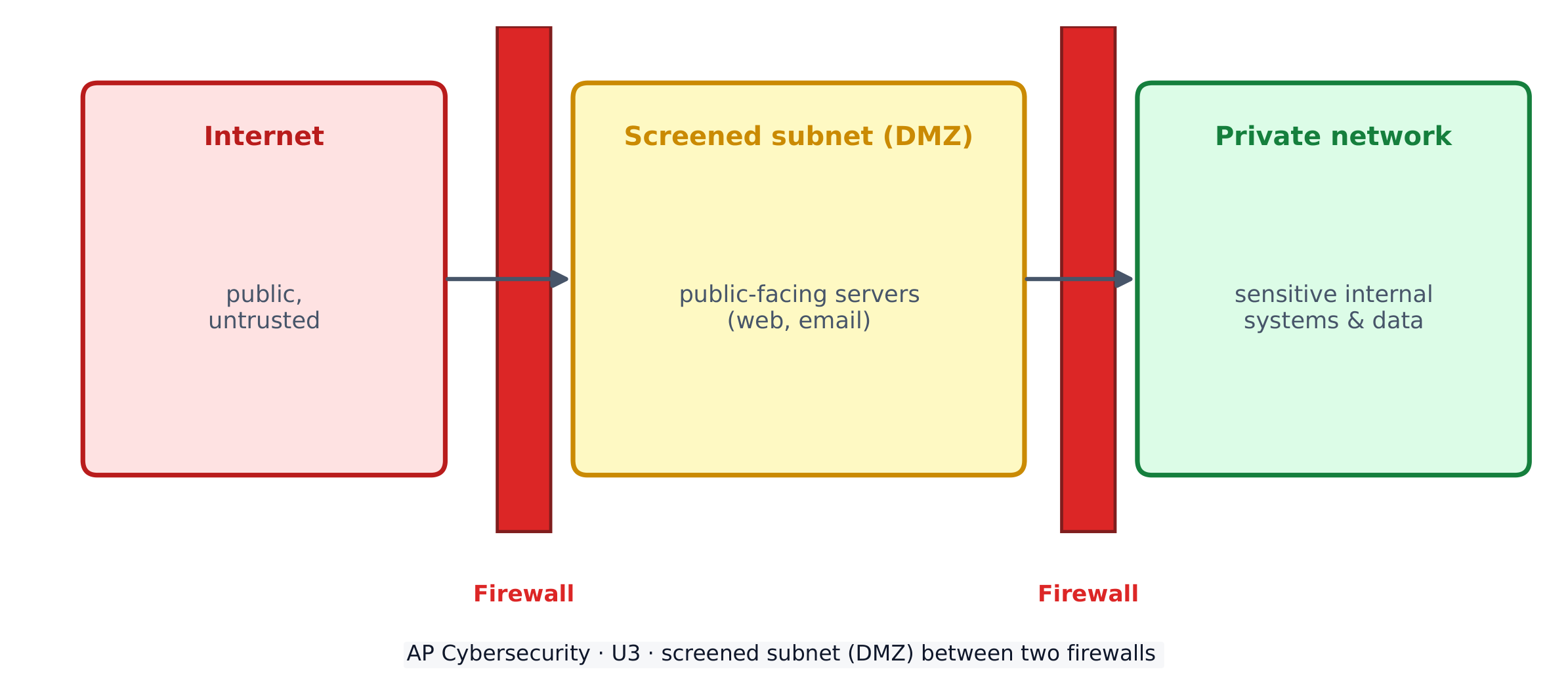
A key pattern is the screened subnet 屏蔽子网 (also called a DMZ 隔离区). It sits between the public internet and the private internal network, holding an organisation's public-facing servers in a lower-security zone - separated from the sensitive internal systems.
A screened subnet (DMZ) puts public servers between two firewalls, away from the private network
Segments can also be built with subnetting (by IP address) or VLANs 虚拟局域网 (logically separating devices on the same switch). Each segment can then get its own security policy - higher-security and lower-security zones.
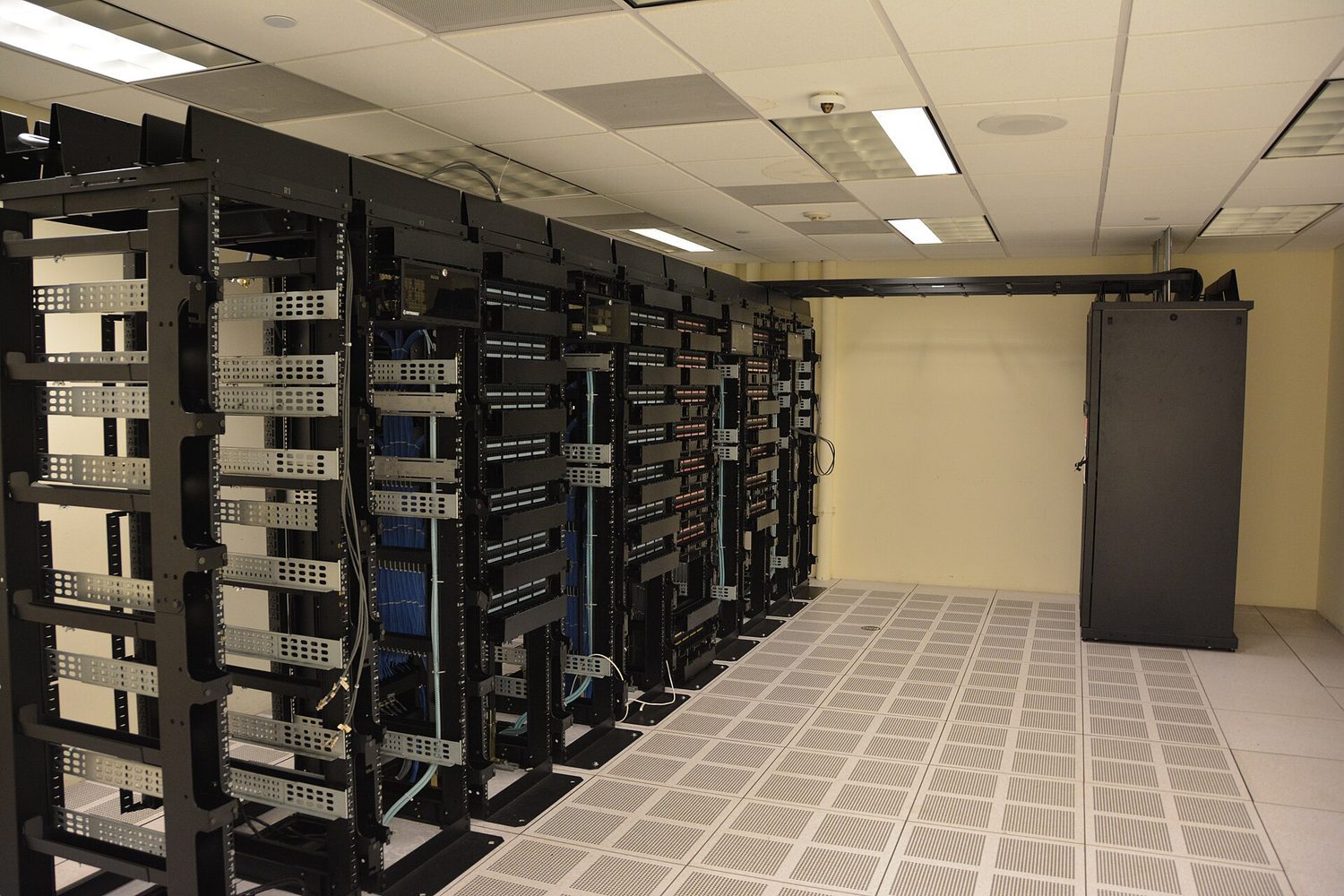
Server racks: network segmentation isolates systems so one breach does not open everything
Stateful 有状态 - also tracks the state of each connection for finer control.
Next-generation (NGFW) - adds advanced features like intrusion prevention and deep packet inspection.
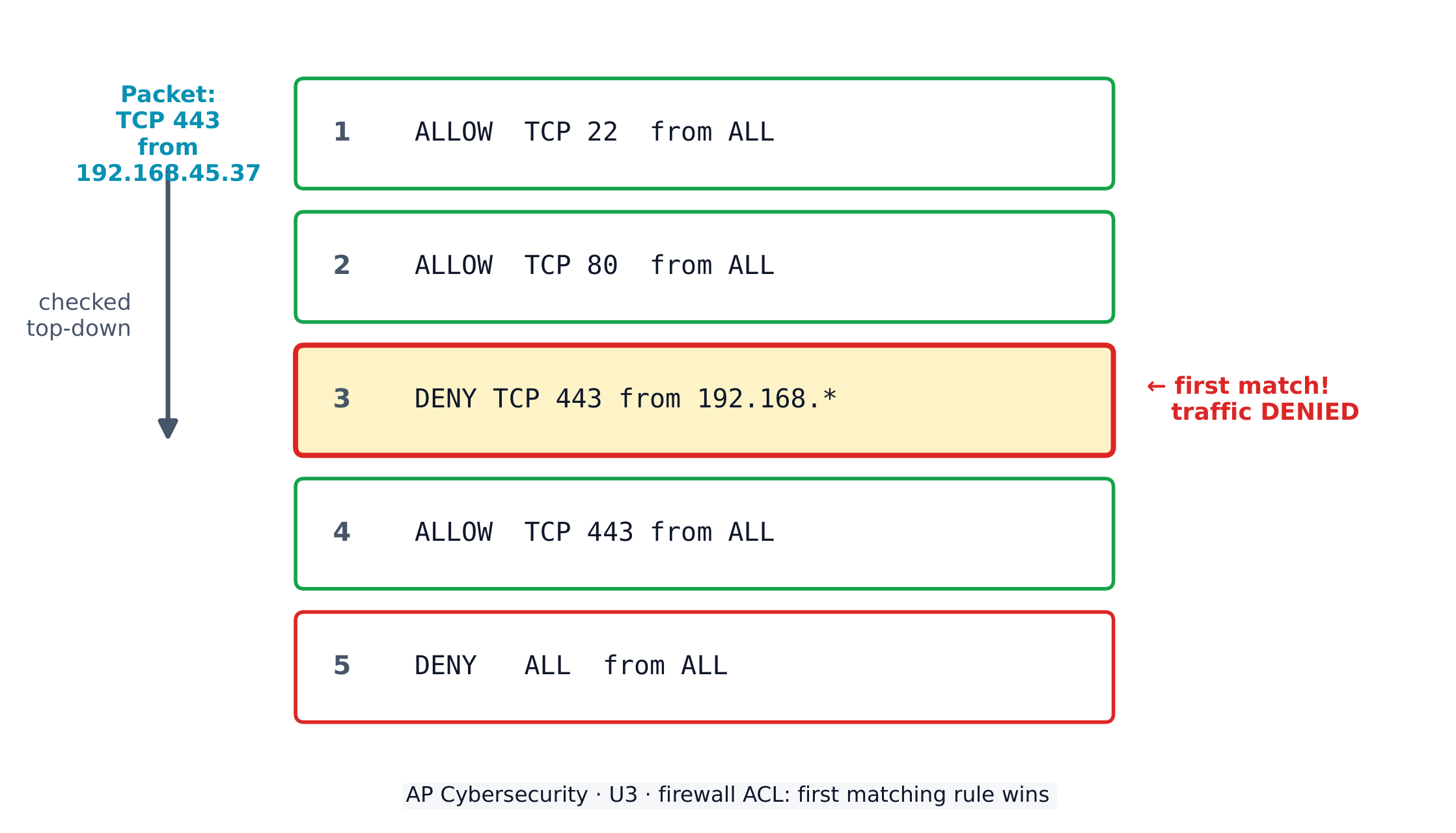
A firewall follows an access control list (ACL) 访问控制列表 - an ordered set of rules. Rules are checked in order, and the first match wins, so the order of rules changes which traffic gets through. Each rule specifies a direction, a thing to filter by (IP, port, service), and an action (permit or deny).
A firewall checks its ACL top to bottom; the first matching rule decides
Worked example. A firewall has Rule 3: DENY TCP 443 from 192.168.*, and lower down Rule 7: ALLOW TCP 443 from ALL. A user at 192.168.45.37 cannot reach port 443 - even though Rule 7 would allow them - because Rule 3 matches first, and the first match wins. If this specific host should have HTTPS access, add an ALLOW for 192.168.45.37above Rule 3 while retaining the broader DENY. Moving ALLOW-from-ALL above that DENY would allow the whole range. Choose rule order and scope to match the intended policy.
Firewalls belong at every point where data crosses between zones - at each network segment and at every gateway to the public internet.
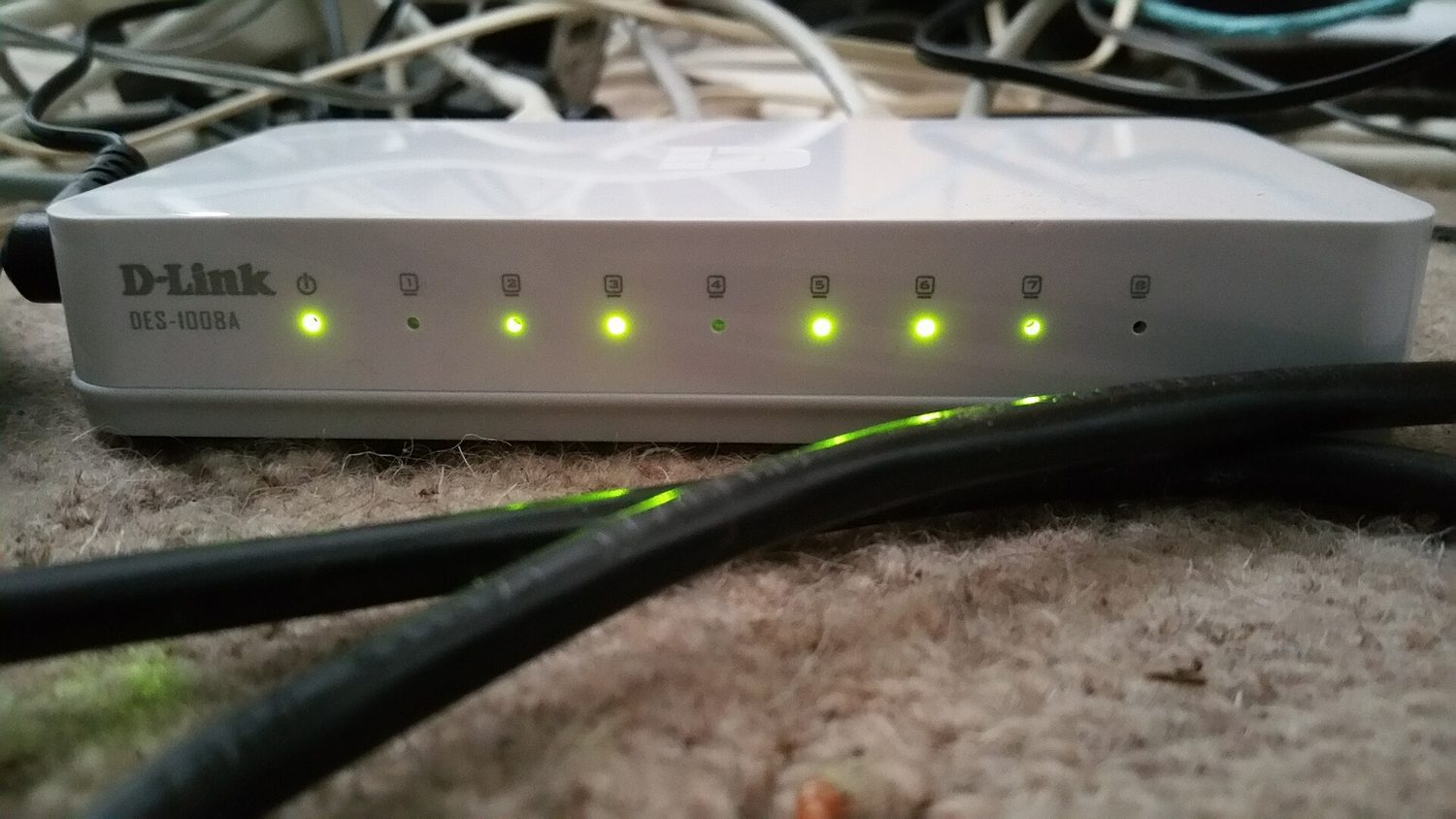
Real network hardware: a firewall is a device (or software) sitting where these cables meet the outside world
3.5.E.7 基于网络的 IoCs 是在分析网络流量时发现的,通常以数据包捕获文件的形式存在。指示器可以在源和目的 IP 地址、端口和协议中找到。这些包括:
连接到已知的恶意 IP 地址
未经授权的扫描
网络流量的异常激增或减缓
端口与应用流量不匹配
来源:College Board AP 课程与考试说明
English
When prevention fails, detection takes over. Automated tools read the log files 日志文件 that record network activity:
a network intrusion detection system (NIDS) 网络入侵检测系统 analyses traffic and raises an alert, but does not block;
a network intrusion prevention system (NIPS) 网络入侵防御系统 can also stop an attack by closing ports or blocking addresses;
a security information and event management (SIEM) 安全信息与事件管理 system gathers data from many sources to spot patterns.
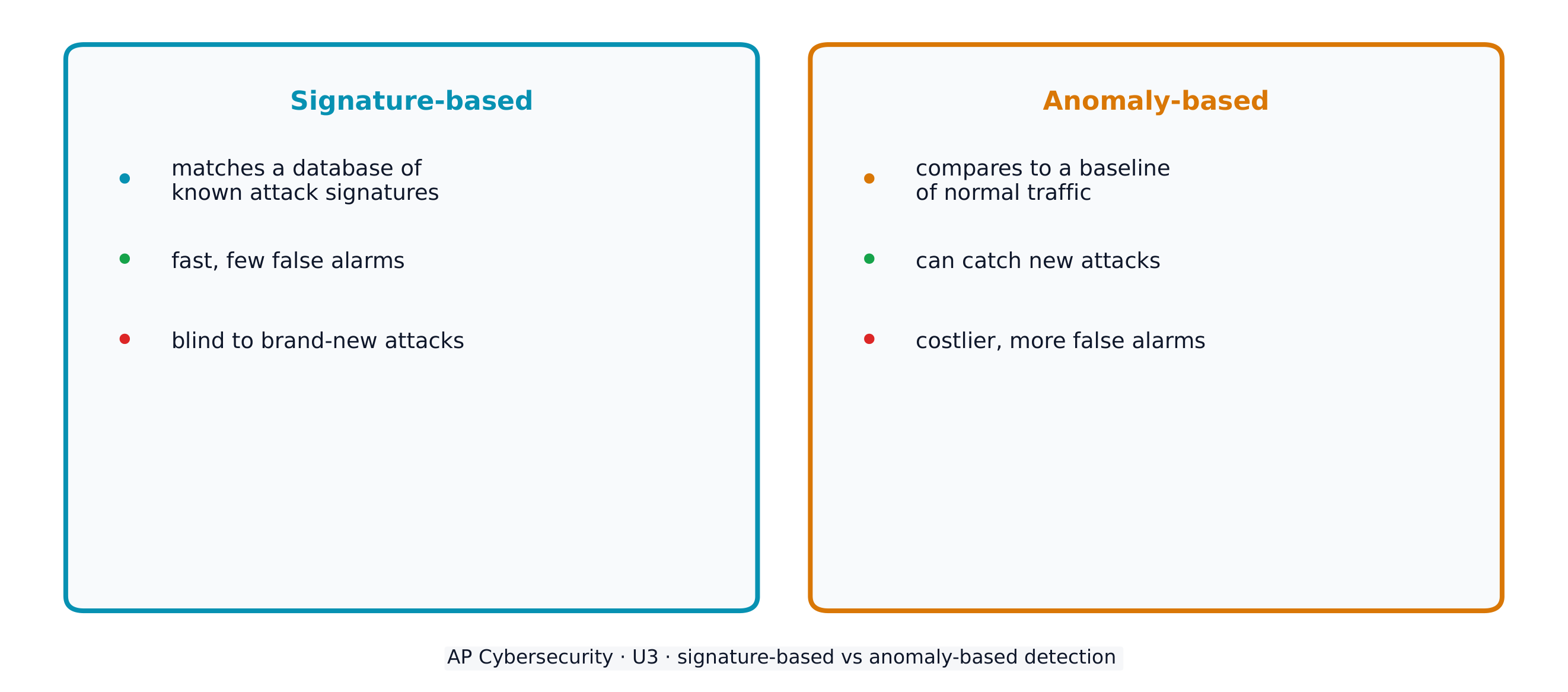
There are two detection methods. Signature-based 基于特征 detection compares traffic to a database of known attack signatures - often efficient, but may miss activity without a recognised pattern. Anomaly-based 基于异常 detection compares traffic to a normal baseline 基线 and flags anything unusual - it can catch novel attacks but needs more resources and raises more false alarms. A hybrid approach combines both.
Examining captured traffic (packet-capture files), analysts hunt for network-based indicators of compromise 网络入侵指标 in the source and destination IP addresses, ports, and protocols. Four common ones: connections to known-malicious IP addresses, unauthorized network scans (an outsider probing your ports), unusual spikes or slowdowns in traffic, and mismatched port-application traffic (for example, non-web traffic flowing over port 80). These complete the host-, file-, and behaviour-based indicators a single device logs.
AI, thresholds, and alert fatigue
A medium network logs millions of events a day - far more than any team can read - so organisations train AI models to sort likely-malicious patterns from normal ones. These models are probabilistic 概率的: a detector can report a percentage score for how suspicious an event appears. The course describes this as a likelihood; a reported percentage should not automatically be treated as a perfectly calibrated probability.
The organisation then sets a threshold 阈值 - the likelihood at which an alert fires - and that choice is a genuine trade-off:
set the threshold too high and real attacks slip through undetected;
set it too low and the team is overwhelmed with false alerts.
Try it — apply an explicit threshold. In this invented teaching dataset, higher scores mean more suspicious. Alert when score is greater than or equal to the threshold. Investigation has established the outcomes.
Event
Score
Outcome
A
90%
attack
B
70%
normal
C
60%
attack
D
40%
normal
E
30%
attack
F
10%
normal
At thresholds of 70% and 30%, list the alerted events, count normal events alerted, and count attacks missed. Include scores equal to the threshold.
Worked reasoning. At 70%, A and B alert: B is one normal event alerted, while attacks C and E are missed. At 30%, A, B, C, D and E alert: B and D are two normal events alerted, and no attack in this sample is missed. Lowering the threshold catches C and E, but adds normal D to the review queue. Even a high threshold can produce a false alert. These invented scores and investigated outcomes are not measured detector accuracy or a guarantee about future events.
Capacity transfer. Suppose the team can review only two alerts in the period. The 70% setting fits that capacity but misses two known attacks; the 30% setting produces five alerts and exceeds capacity, although it catches all three attacks in this sample. Neither is automatically best. Weigh the harm of misses, the cost of false alerts and investigation capacity. Priorities and other controls matter too; a threshold alone is not a complete defence.
Too many false alerts cause alert fatigue 警报疲劳: responders get so used to false positives that they start assuming an alert is false before investigating it - so a real attack, when it finally comes, is waved away. This is exactly why a low false-positive rate matters: signature-based detection often has fewer false alarms, while anomaly-based detection can flag unfamiliar activity but may add false alarms. Actual results depend on the signatures, baseline, thresholds and traffic; neither method guarantees detection.
Signature-based detection matches known attacks; anomaly-based detection flags deviations from normal
network intrusion detection system (NIDS)/ˈnetwɜːk ɪnˈtruːʒn dɪˈtekʃn ˈsɪstəm/
网络入侵检测系统
wǎng luò rù qīn jiǎn cè xì tǒng
network intrusion prevention system (NIPS)/ˈnetwɜːk ɪnˈtruːʒn prɪˈvenʃn ˈsɪstəm/
网络入侵防御系统
wǎng luò rù qīn fáng yù xì tǒng
security information and event management (SIEM)/sɪˈkjʊərɪti ˌɪnfəˈmeɪʃn ænd ɪˈvent ˈmænɪdʒmənt/
安全信息与事件管理
ān quán xìn xī yǔ shì jiàn guǎn lǐ
Signature-based/ˈsɪɡnɪtʃə beɪst/
基于特征
jī yú tè zhēng
Anomaly-based/əˈnɒməli beɪst/
基于异常
jī yú yì cháng
baseline/ˈbeɪslaɪn/
基线
jī xiàn
network-based indicators of compromise/ˈnetwɜːk beɪst ˈɪndɪkeɪtəz ɒv ˈkɒmprəmaɪz/
网络入侵指标
wǎng luò rù qīn zhǐ biāo
probabilistic/ˌprɒbəbɪˈlɪstɪk/
概率的
gài lǜ de
threshold/ˈθreʃəʊld/
阈值
yù zhí
alert fatigue/əˈlɜːt fəˈtiːɡ/
警报疲劳
jǐng bào pí láo
3.5
考试技巧
English
For firewall-ACL questions, read the rules top-to-bottom and stop at the first match - a Deny rule above an Allow blocks the traffic even though the Allow exists lower down.
Pair each attack with its tell-tale sign: ARP poisoning = one IP with two MAC addresses; MAC flooding = a surge of new MAC addresses; DNS poisoning = an unexplained drop in web traffic.
Read packet captures for network-based IoCs: known-malicious IPs, unauthorized scans, traffic spikes/slowdowns, and mismatched port-application traffic.
Run vulnerability scanners to find known weaknesses proactively, and fix the highest-severity findings first.
Signature-based matches known indicators; anomaly-based compares a baseline. Discuss coverage, false alerts and resource costs in the scenario; neither guarantees detection.
A screened subnet / DMZ holds public-facing servers between the internet and the private network - name it whenever a question separates public services from internal data.
WPA3 is the strong wireless encryption; WEP and original WPA are insecure.