Viruses
Đã giới thiệu| English | Ý nghĩa |
|---|---|
| capsid/ˈkæpsɪd/ | The protein coat surrounding a virus's genetic material. |
| envelope/ˈenvələʊp/ | envelope |
| incubation period | incubation period |
| antigenic drift | antigenic drift |
| antigenic shift | antigenic shift |
Six steps around one cell
- Structure: genome (DNA or RNA) + capsid ± envelope (host membrane with viral glycoproteins) ✓.
- The cycle: attachment → entry → uncoating → replication → assembly → release. Enveloped viruses bud; naked viruses lyse.
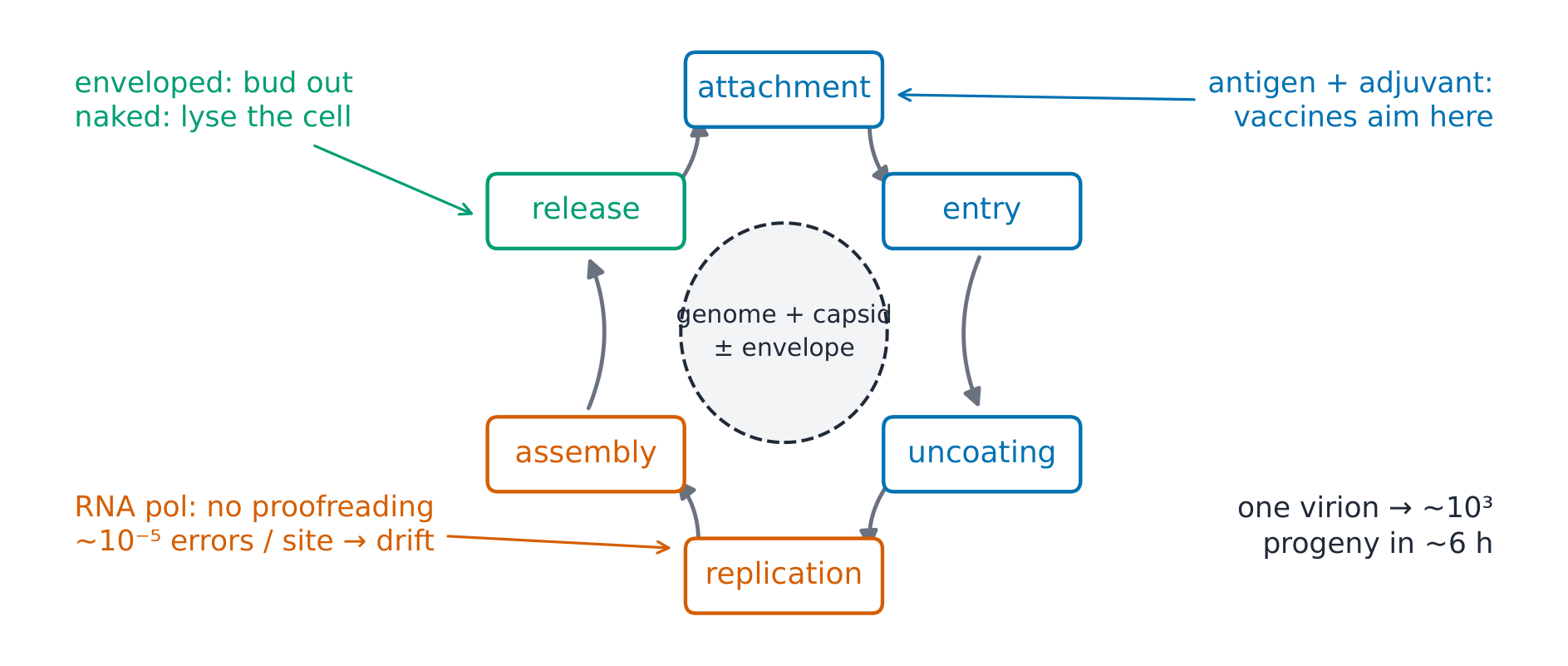
One influenza virion yields ~$10^{3}$ progeny in ~6 h; two rounds give $10^{6}$. A 1–2 day incubation period is only ~4–8 cell rounds ✓.
{exercise:uni-med0803-cycle} {exercise:uni-med0803-burst}
After entry and uncoating, the next steps of the cycle are —
Độ khó 1/5 · 100 xu + phần thưởng nhỏ khi hoàn thành lần đầu tiên hôm nay
The order is attachment, entry, uncoating, replication, assembly, release - every antiviral target and vaccine antigen sits on it.
One virion producing about 1000 progeny in ~6 hours means a 1-2 day incubation period is —
Độ khó 1/5 · 100 xu + phần thưởng nhỏ khi hoàn thành lần đầu tiên hôm nay
Each round multiplies by about 10 to the 3, so 10 to the 6 after two rounds; symptoms need only a few rounds.
Chemistry sets the mutation rate
- RNA polymerases lack proofreading: ~$10^{-5}$ errors per site per replication, ~10,000-fold above DNA viruses → antigenic drift; 8 segments reassort → antigenic shift, the pandemic mechanism ✓.
{exercise:uni-med0803-drift}
Antigenic drift year by year comes from —
Độ khó 1/5 · 100 xu + phần thưởng nhỏ khi hoàn thành lần đầu tiên hôm nay
Drift is point-mutation accumulation (no proofreading); shift is reassortment of the 8 influenza segments - the pandemic mechanism.