Sound
Đã giới thiệu| English | Ý nghĩa |
|---|---|
| longitudinal/ˌlɒŋɡɪˈtjuːdɪnl/ | sóng dọc |
| compressions/kəmˈpreʃnz/ | vùng nén |
| rarefactions/ˌreərɪˈfækʃnz/ | vùng giãn |
| vacuum/ˈvækjuːm/ | chân không |
| echo/ˈekəʊ/ | vọng âm |
Good vibrations
- Every sound starts with something vibrating — a guitar string, a drum skin, your vocal cords.
- In space films, explosions are silent for a real reason: sound needs a material to travel through.
- Let's see how sound moves.
Sound is a longitudinal 纵波 wave
- A vibrating object pushes the air into compressions 压缩 (particles squeezed together) and rarefactions 稀疏 (particles spread apart).
- This makes sound a longitudinal wave — the air vibrates along the direction of travel.
- Because it needs particles, sound cannot travel through a vacuum 真空 (empty space).
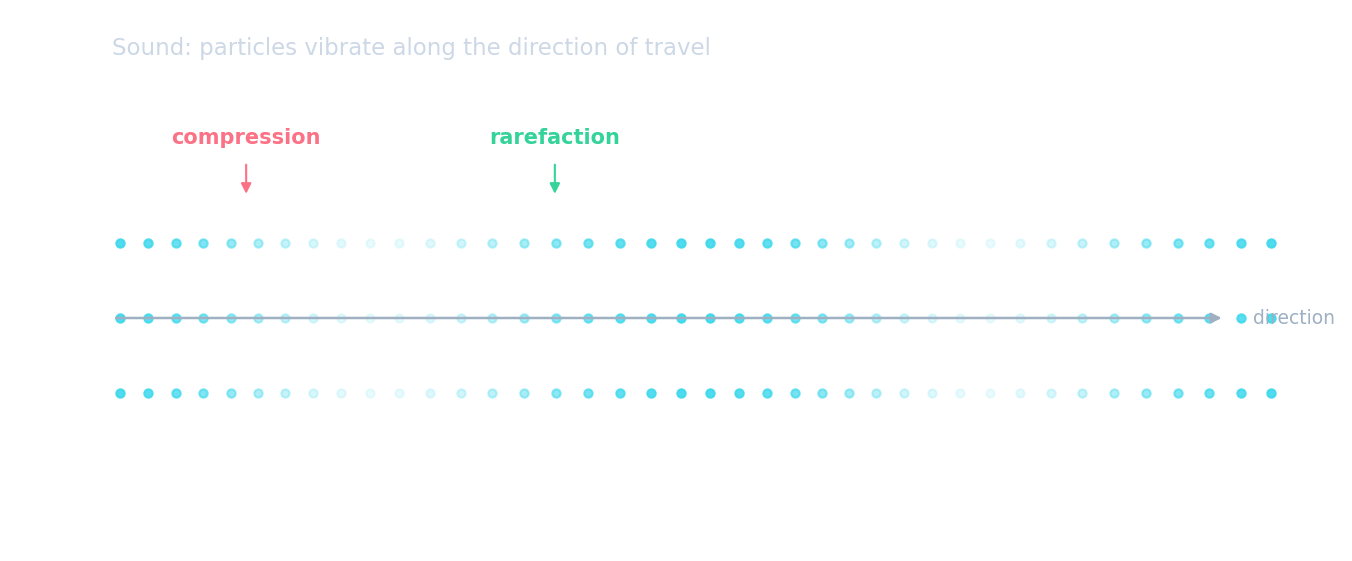
Sound as a longitudinal wave: particles vibrate back and forth, creating regions of high density (compressions) and low density (rarefactions).
Worked example. A ship sends a sonar pulse to the seabed $150\ \text{m}$ below. Sound speed in water $= 1500\ \text{m/s}$. The sound travels down and back ($300\ \text{m}$ total), so time $= \dfrac{300}{1500} = 0.2\ \text{s}$.
Sound is NOT like light. Light can travel through empty space (a vacuum); sound cannot. In space films, explosions are silent for a real physics reason — there are no particles to carry the vibration.
Sound
y = a sin(bt + c)
Louder = bigger amplitude; higher pitch = higher frequency.
Sound travels as a series of:
Độ khó 1/5 · 100 xu + một phần thưởng nhỏ cho lần hoàn thành đầu tiên trong ngày
A vibrating source squeezes and stretches the air into compressions and rarefactions — a longitudinal wave.
Sound can travel through a vacuum (empty space).
Độ khó 1/5 · 100 xu + một phần thưởng nhỏ cho lần hoàn thành đầu tiên trong ngày
Sound needs particles to pass the vibration along, so it cannot travel through a vacuum.
Speed and hearing range
- Humans can hear from about $20\ \text{Hz}$ to $20\,000\ \text{Hz}$.
- Sound travels at about $340\ \text{m/s}$ in air — far slower than light.
- It travels faster in liquids and solids than in gases, because their particles are closer together.

The parts of a wave: wavelength, amplitude, crest and trough
The approximate range of human hearing is:
Độ khó 1/5 · 100 xu + một phần thưởng nhỏ cho lần hoàn thành đầu tiên trong ngày
Most people hear from about 20 Hz (very low) up to about 20 000 Hz (very high).
Sound travels fastest through:
Độ khó 1/5 · 100 xu + một phần thưởng nhỏ cho lần hoàn thành đầu tiên trong ngày
The closer the particles, the faster the vibration is passed on — so sound is fastest in solids, slowest in gases.
Echoes 回声
- A reflected sound is an echo.
- You can measure the speed of sound by timing an echo over a known distance.
- The sound travels to the wall and back, so it covers twice the distance.
A boy shouts at a cliff $660\ \text{m}$ away and hears the echo $4.0\ \text{s}$ later. What is the speed of sound, in m/s?
Độ khó 2/5 · 140 xu + một phần thưởng nhỏ cho lần hoàn thành đầu tiên trong ngày
The sound travels there and back: $2 \times 660 = 1320\ \text{m}$ in $4.0\ \text{s}$, so $v = \dfrac{1320}{4.0} = 330\ \text{m/s}$.
You've got it
- sound is made by vibrations and is a longitudinal wave (compressions + rarefactions)
- it needs a medium — no sound in a vacuum
- human hearing: about $20\ \text{Hz}$ to $20\,000\ \text{Hz}$; speed ≈ $340\ \text{m/s}$ in air
- an echo is reflected sound — remember it travels there and back
Write from a sound speed of 320 metres per second
- A shout returns from a cliff 400 m away after 2.5 s.
- Find the speed. Remember the sound travels there and back.
A shout at a cliff 400 m away returns as an echo after 2.5 s. What is the speed of sound, and why is there no sound in a vacuum?
Twice 400 m is 800 m. 800 divided by 2.5 is 320 metres per second.
What speed does this echo give?
Độ khó 1/5 · 100 xu + một phần thưởng nhỏ cho lần hoàn thành đầu tiên trong ngày
800 divided by 2.5 is 320 metres per second.