Lenses and dispersion
Đã giới thiệu| English | Ý nghĩa |
|---|---|
| dispersion/dɪˈspɜːʃn/ | tán sắc |
| diverging lens/daɪˈvɜːdʒɪŋ lenz/ | thấu kính phân kỳ |
| converging lens/kənˈvɜːdʒɪŋ lenz/ | thấu kính hội tụ |
| principal focus/ˈprɪnsɪpl ˈfəʊkəs/ | tiêu điểm chính |
| focal length/ˈfəʊkl leŋθ/ | độ tiêu cự |
| real image/rɪəl ˈɪmɪdʒ/ | ảnh thật |
| virtual image/ˈvɜːtʃuːəl ˈɪmɪdʒ/ | ảnh ảo |
| spectrum/ˈspektrəm/ | quang phổ |
| monochromatic/ˌmɒnəʊkrəʊˈmætɪk/ | đơn sắc |
Focusing and splitting light
- A magnifying glass makes tiny print big; a prism turns white light into a rainbow.
- Both use refraction — bending light in a careful, shaped way.
- Meet the lens and dispersion 色散.
Converging and diverging lenses 凹透镜
- A converging lens 凸透镜 is fat in the middle. It bends parallel rays inwards to meet at the principal focus 焦点.
- The distance from the lens to that focus is the focal length 焦距 $f$.
- A diverging lens is thin in the middle and spreads rays out.
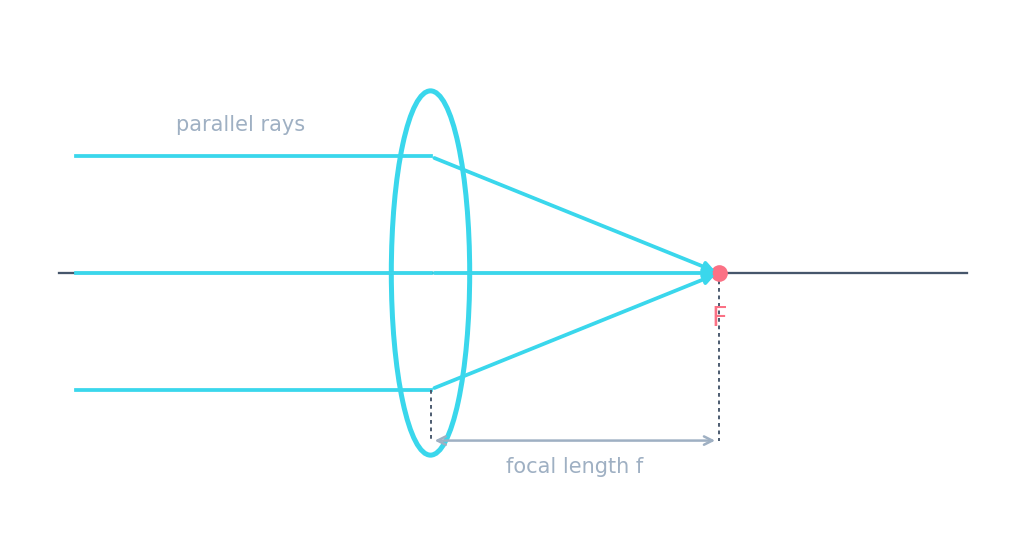
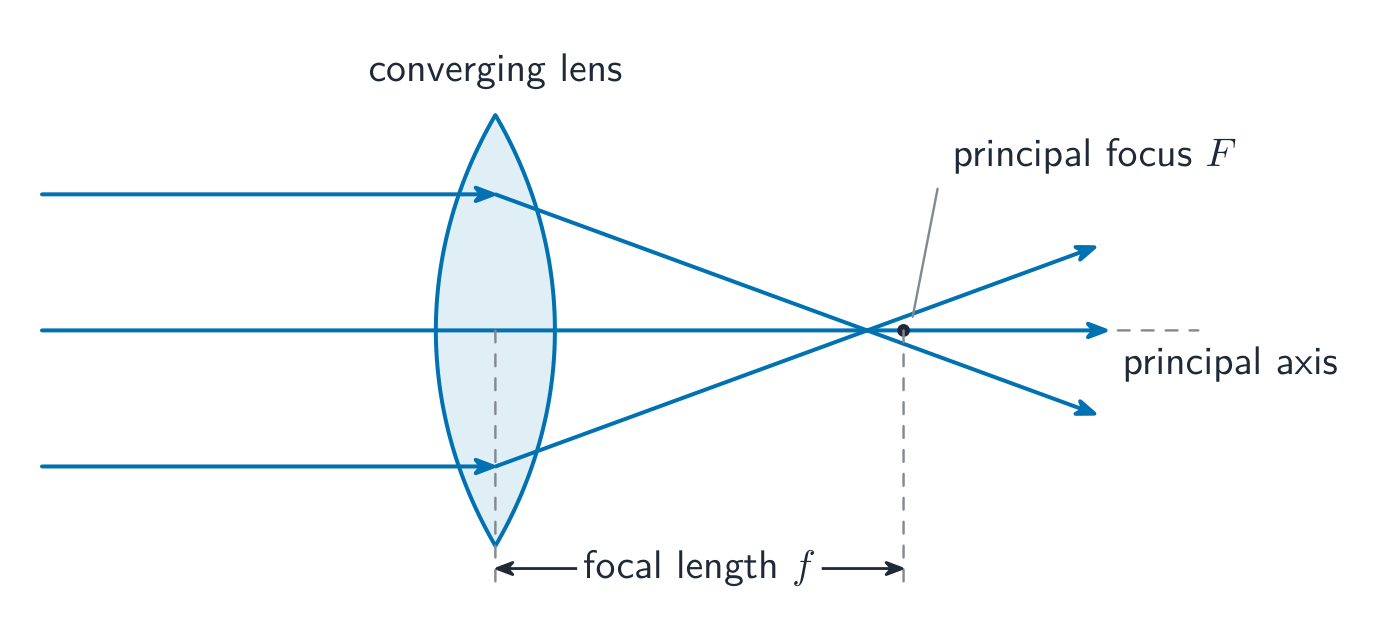
A converging lens and its principal focus
Image formation by a converging lens
Trace the three special rays from the object — where they meet is the image. Move the object closer than the focal point to flip it into a magnifying glass.
A converging lens makes parallel rays of light:
Độ khó 1/5 · 100 xu + một phần thưởng nhỏ cho lần hoàn thành đầu tiên trong ngày
A converging (convex) lens bends parallel rays inward so they meet at the principal focus.
The distance from the lens to its principal focus is called the ____ length.
Độ khó 1/5 · 100 xu + một phần thưởng nhỏ cho lần hoàn thành đầu tiên trong ngày
The focal length is the distance from the centre of the lens to the principal focus.
Images from a lens
- A converging lens can make a real image 实像 — the rays really meet, so it can be shown on a screen (as in a camera or the eye).
- When the object is very close, it makes a larger virtual image 虚像 instead.
- Used close to the eye like this, the lens is a magnifying glass.
Used close to the eye as a magnifying glass, a converging lens makes a:
Độ khó 1/5 · 100 xu + một phần thưởng nhỏ cho lần hoàn thành đầu tiên trong ngày
With the object very close, the lens forms an enlarged, upright virtual image — a magnifying glass.
Dispersion
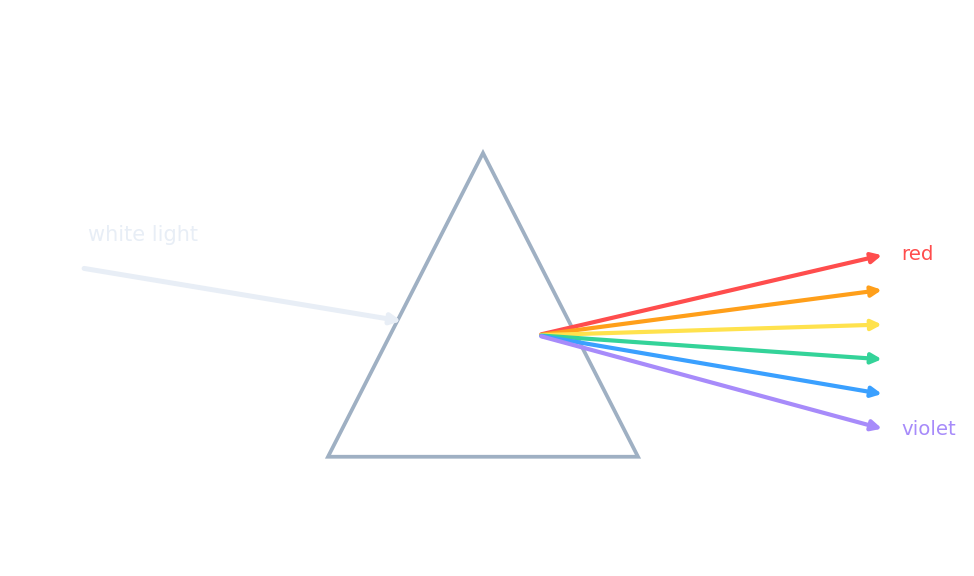
- A glass prism splits white light into a band of colours — the spectrum 光谱. This splitting is dispersion.
- The order is red, orange, yellow, green, blue, indigo, violet.
- Red bends least: it has the longest wavelength and lowest frequency. Violet is the opposite.
- Light of a single colour (one frequency) is monochromatic 单色.
Put these spectrum colours in order of wavelength, longest first.
Độ khó 3/5 · 200 xu + một phần thưởng nhỏ cho lần hoàn thành đầu tiên trong ngày
Red has the longest wavelength and violet the shortest, so: red, yellow, green, blue, violet.
Which colour of visible light has the longest wavelength?
Độ khó 1/5 · 100 xu + một phần thưởng nhỏ cho lần hoàn thành đầu tiên trong ngày
Red light has the longest wavelength and lowest frequency; violet has the shortest wavelength and highest frequency.
You've got it
- a converging lens brings parallel rays to the principal focus; lens-to-focus = focal length
- it makes a real image (on a screen) — or a magnified virtual image when the object is close (magnifying glass)
- a prism causes dispersion: white light → red…violet
- red = longest wavelength, lowest frequency; violet = shortest, highest
Write from a focal length of 15 cm
- A converging lens has a focal length of 15 cm. An object is placed 8 cm from the lens.
- Say where a distant object is imaged, and what kind of image the close object gives.
A converging lens has focal length 15 cm. Where does a distant object form its image, and what kind of image does an object 8 cm from the lens give?
The focal length is the lens-to-focus distance for parallel rays. Inside that distance the lens is a magnifying glass.
Where is the image of a distant object?
Độ khó 1/5 · 100 xu + một phần thưởng nhỏ cho lần hoàn thành đầu tiên trong ngày
Parallel rays from a distant object meet at the principal focus, 15 cm from the lens.