Transfer of thermal energy
Đã giới thiệu| English | Ý nghĩa |
|---|---|
| conduction/kənˈdʌkʃn/ | sự dẫn nhiệt |
| convection/kənˈvekʃn/ | sự đối lưu |
| radiation/ˌreɪdɪˈeɪʃn/ | sự tỏa nhiệt |
| insulators/ˈɪnsjuːleɪtəz/ | chất cách nhiệt |
| infrared/ˌɪnfrəˈred/ | tia hồng ngoại |
| emitter/ɪˈmɪtə/ | nguồn phát |
Three ways heat travels
- A metal spoon left in hot soup soon burns your hand.
- Yet the Sun warms you across millions of kilometres of empty space.
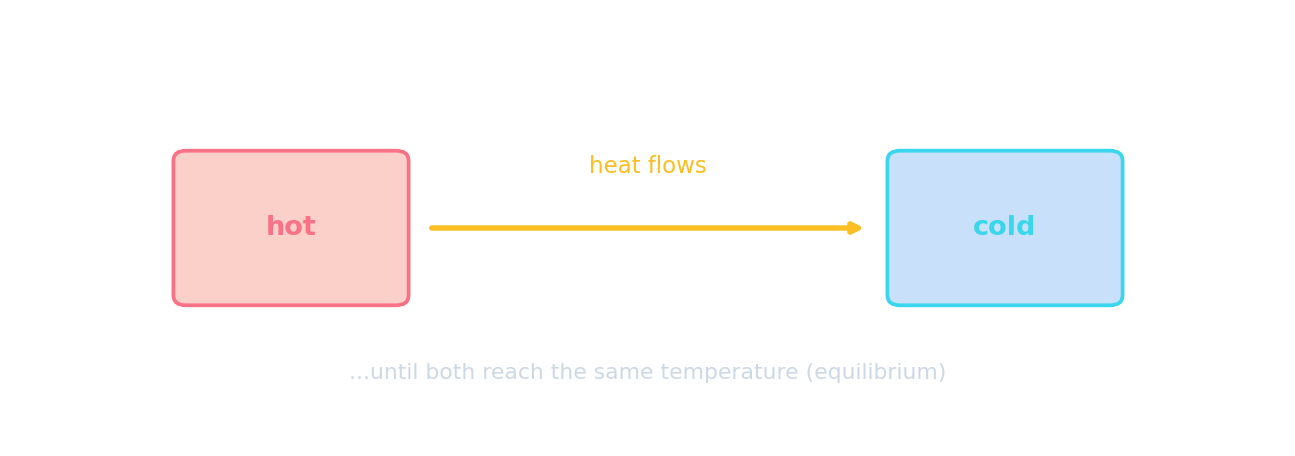
- Thermal energy always flows from hot to cold — by three routes: conduction 热传导, convection 对流 and radiation 辐射.
Heat transfer lab
Compare the routes by which thermal energy moves.
Conduction
- Conduction carries energy through a material without the material moving.
- Heated particles vibrate more and pass the energy to their neighbours.
- Metals are the best conductors: their free (delocalised) electrons carry energy quickly.
- Insulators 绝缘体 (air, wood, plastic) conduct badly — which is why we use them to keep things warm.

Conduction: vibrating particles pass energy along a metal bar
Why are metals such good conductors of thermal energy?
Độ khó 1/5 · 100 xu + một phần thưởng nhỏ cho lần hoàn thành đầu tiên trong ngày
Metals have free (delocalised) electrons that move through the metal and carry energy rapidly from the hot end to the cold end.
Convection
- Convection happens in liquids and gases.
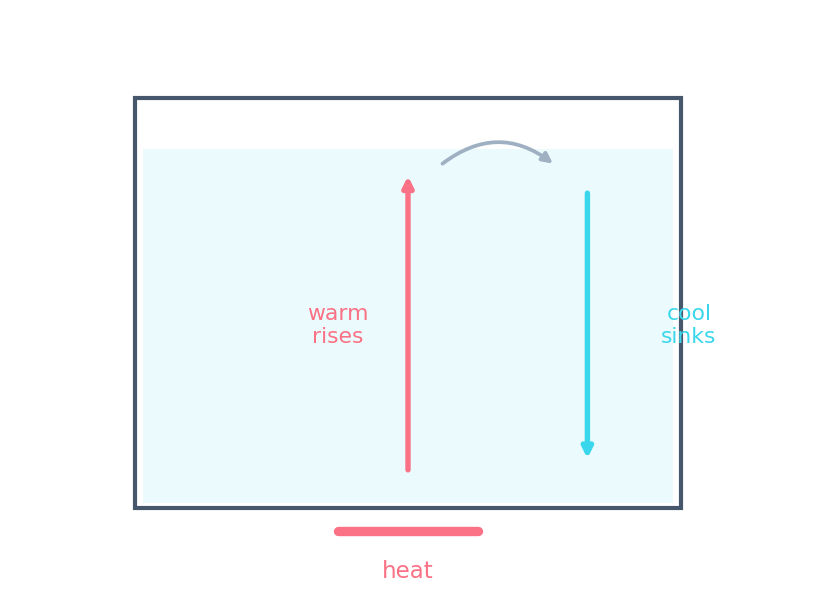
- Heated fluid expands, becomes less dense, and rises; cooler, denser fluid sinks to take its place.
- This circulation is a convection current — it carries energy around the fluid.
- It cannot happen in a solid, because the particles cannot move from place to place.
In convection, heated fluid rises because it has become:
Độ khó 1/5 · 100 xu + một phần thưởng nhỏ cho lần hoàn thành đầu tiên trong ngày
Heating makes the fluid expand, so it is less dense and floats upward; cooler, denser fluid sinks to replace it.
Convection can happen in a solid.
Độ khó 1/5 · 100 xu + một phần thưởng nhỏ cho lần hoàn thành đầu tiên trong ngày
Convection needs particles to move from place to place, so it only happens in liquids and gases — not solids.
Radiation
- Thermal radiation is energy carried by infrared 红外线 waves.
- All objects emit it, and it needs no material — it can cross empty space (this is how the Sun's energy reaches us).
- A dull, black surface is a good emitter 发射体 and absorber of infrared.
- A shiny, white surface is a poor emitter and a good reflector — which is why hot-water tanks and spacecraft are often shiny.

A dull, black surface emits (and absorbs) infrared much better than a shiny, white one
Which method of heat transfer can travel through empty space (a vacuum)?
Độ khó 1/5 · 100 xu + một phần thưởng nhỏ cho lần hoàn thành đầu tiên trong ngày
Radiation is carried by infrared waves, which need no material — so the Sun's energy reaches us across empty space.
Match each method of heat transfer to how it works.
Độ khó 2/5 · 140 xu + một phần thưởng nhỏ cho lần hoàn thành đầu tiên trong ngày
Conduction works through a material; convection moves the fluid itself in a current; radiation is infrared waves that need no material.
Which surface is the best emitter of thermal radiation?
Độ khó 1/5 · 100 xu + một phần thưởng nhỏ cho lần hoàn thành đầu tiên trong ngày
Dull black surfaces are the best emitters (and absorbers) of infrared; shiny, light surfaces are poor emitters and good reflectors.
You've got it
- thermal energy always flows from hot to cold
- conduction: through a material, particle to particle; metals best (free electrons)
- convection: warm fluid rises, cool sinks — a current; never in solids
- radiation: infrared, needs no material; dull black = best emitter/absorber
Write from a conduction rate of 30 joules per second
- A metal bar conducts 900 J from the hot end to the cold end in 30 s.
- Find the rate. Say which process can cross a vacuum.
A metal bar conducts 900 J in 30 s. What is the rate, and which thermal process can transfer energy across a vacuum?
900 divided by 30 is 30 joules per second. Energy still flows from hot to cold.
What is the rate of energy transfer along the bar?
Độ khó 1/5 · 100 xu + một phần thưởng nhỏ cho lần hoàn thành đầu tiên trong ngày
900 divided by 30 is 30 joules per second.