Sets
Đã giới thiệu| English | Ý nghĩa |
|---|---|
| set/set/ | tập hợp |
| elements/ˈelɪmənts/ | phần tử |
| universal set/ˌjuːnɪˈvɜːsl set/ | tập hợp toàn phần |
| empty set/ˈempti set/ | tập rỗng |
| intersection/ˌɪntəˈsekʃn/ | giao của hai tập hợp |
| union/ˈjuːnɪən/ | hợp của hai tập hợp |
| complement/ˈkɒmplɪmənt/ | bù của tập hợp |
| Venn diagram/ven ˈdaɪəɡræm/ | sơ đồ Venn |
The class of 2024
- A school has 30 students. 18 study French, 12 study Spanish, and 5 study both.
- How many study neither? You can't just add — you need sets 集合.
- Sets are the language of grouping, and they power everything from databases to probability.
What is a set?
- A set is a collection of distinct objects (the elements 元素 or members).
- Written with curly braces: $A = \{1, 2, 3, 4, 5\}$.
- $3 \in A$ means "$3$ is an element of $A$"; $7 \notin A$ means "$7$ is not".
- The universal set 全集 $\xi$ contains everything under discussion. The empty set 空集 $\emptyset$ has no elements.

$A\cap B=\{6\}$ is the only number in both circles; $A\cup B$ is everything inside either circle
Set operations on a Venn diagram
A Venn diagram shows two sets. Slide through the operations to see which region union, intersection and complement shade in.
The empty set ∅ is a subset of every set.
Độ khó 1/5 · 100 xu + một phần thưởng nhỏ cho lần hoàn thành đầu tiên trong ngày
The empty set has no elements, so it is trivially contained in every set.
Intersection 交集 and union 并集
- Intersection $A \cap B$: elements in both $A$ and $B$.
- Union $A \cup B$: elements in $A$ or $B$ (or both).
- Complement 补集 $A'$: everything in the universal set that is not in $A$.
$A = \{1, 2, 3, 4\}$, $B = \{3, 4, 5, 6\}$. Then $A \cap B = \{3, 4\}$ and $A \cup B = \{1, 2, 3, 4, 5, 6\}$.
A = {2,4,6,8,10} and B = {3,6,9}. How many elements are in A ∩ B?
Độ khó 2/5 · 140 xu + một phần thưởng nhỏ cho lần hoàn thành đầu tiên trong ngày
Only 6 is in both sets, so A ∩ B = {6}, which has 1 element.
For the same A and B, how many elements are in A ∪ B?
Độ khó 2/5 · 140 xu + một phần thưởng nhỏ cho lần hoàn thành đầu tiên trong ngày
A ∪ B = {2,3,4,6,8,9,10}, which has 7 elements.
The symbol ∩ means:
Độ khó 1/5 · 100 xu + một phần thưởng nhỏ cho lần hoàn thành đầu tiên trong ngày
∩ is intersection (elements in both A and B); ∪ is union.
Venn diagrams 维恩图
- A Venn diagram draws sets as overlapping circles inside a rectangle (the universal set).
- Overlapping region = intersection; everything inside a circle = that set's members.
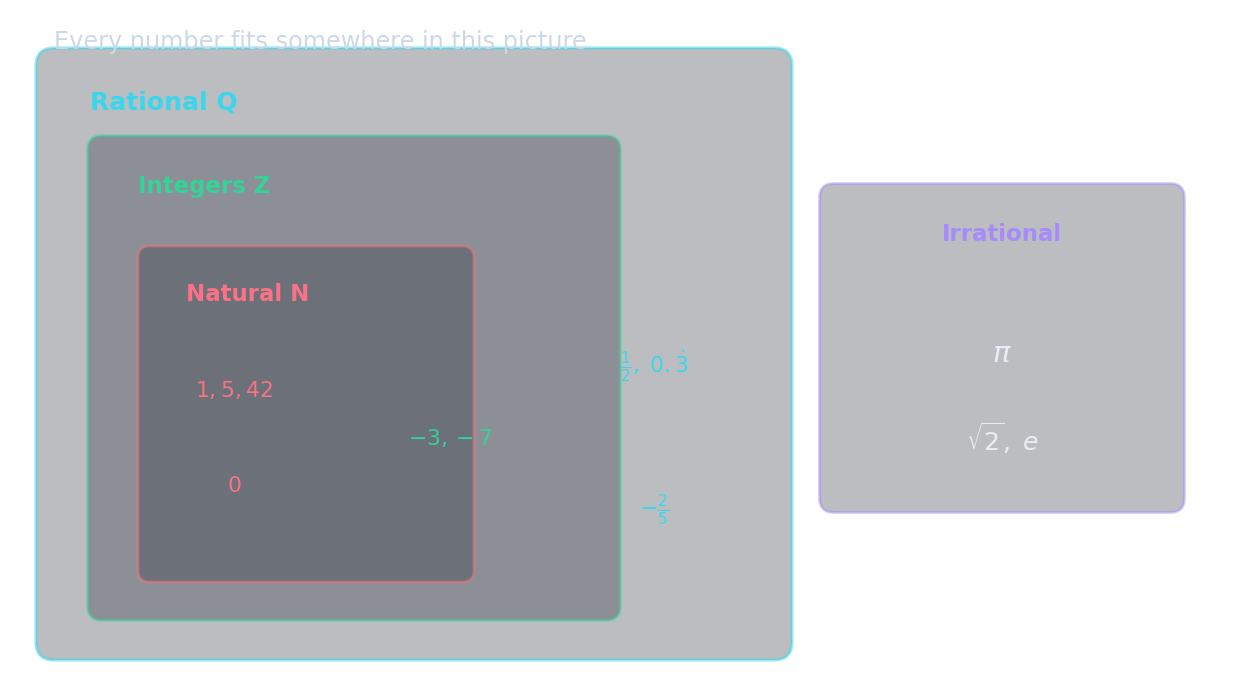
Venn diagrams show how sets relate — here, every natural number is also an integer and a rational.
Don't double-count. When finding $n(A \cup B)$, use $n(A) + n(B) - n(A \cap B)$. The intersection is counted once in each set, so subtract it once.
Worked example
- 30 students, $F =$ French (18), $S =$ Spanish (12), $F \cap S = 5$.
- $n(F \cup S) = 18 + 12 - 5 = 25$.
- Neither $= 30 - 25 = 5$ students study neither language.
n(A) = 5, n(B) = 3, n(A ∩ B) = 1. Find n(A ∪ B).
Độ khó 2/5 · 140 xu + một phần thưởng nhỏ cho lần hoàn thành đầu tiên trong ngày
n(A ∪ B) = n(A) + n(B) − n(A ∩ B) = 5 + 3 − 1 = 7.
In a class of 30, 18 study French, 12 study Spanish, and 5 study both. How many study neither?
Độ khó 2/5 · 140 xu + một phần thưởng nhỏ cho lần hoàn thành đầu tiên trong ngày
n(F ∪ S) = 18 + 12 − 5 = 25. Neither = 30 − 25 = 5.
Three sets (Extended)
- In a three-set Venn diagram, fill the triple overlap first, then the parts belonging to exactly two sets, then the single-set regions. If $n(A\cap B)=7$ includes 2 in all three, the AB-only region is $7-2=5$.
- For $n(A)=12,n(B)=10,n(C)=9$, pair intersections AB=4, AC=3, BC=2 and triple=1, the union is $n(A\cup B\cup C)=12+10+9-4-3-2+1=23$. The triple is added back because the three pair subtractions removed it too often.
Set sizes are 12,10,9; pair intersections 4,3,2; triple intersection 1. Find the union size.
Độ khó 2/5 · 140 xu + một phần thưởng nhỏ cho lần hoàn thành đầu tiên trong ngày
Add singles, subtract all pairs, add triple: 31−9+1 = 23.
You've got it
- $A \cap B$ = intersection (both); $A \cup B$ = union (either or both); $A'$ = complement
- $n(A \cup B) = n(A) + n(B) - n(A \cap B)$ — subtract the overlap
- Venn diagrams show set relationships visually; the rectangle is the universal set
- $\emptyset$ = empty set; $\xi$ = universal set
Write from an intersection of 2
- A is {1, 2, 3, 4, 5} and B is {4, 5, 6, 7}.
- Count the elements in both sets.
A is the set 1, 2, 3, 4, 5 and B is the set 4, 5, 6, 7. How many elements are in A intersection B?
Only 4 and 5 belong to both sets.
How many elements are in the intersection?
Độ khó 1/5 · 100 xu + một phần thưởng nhỏ cho lần hoàn thành đầu tiên trong ngày
Two numbers are shared. Other options — 1 (the lesson intersection); 7 (the union).