Kế hoạch học tập của bạn · Tiếp tục · Ôn tập →
恨不得 (wish one could / itching to)
Đã giới thiệuVị trí đã lưu của bạn vẫn nằm trong trình duyệt này. Việc tiếp tục sẽ không hoàn thành bài học hay trả lời các câu hỏi của nó.
I wish I could fly home
- Your exams have finished and you haven't seen your family for half a year.
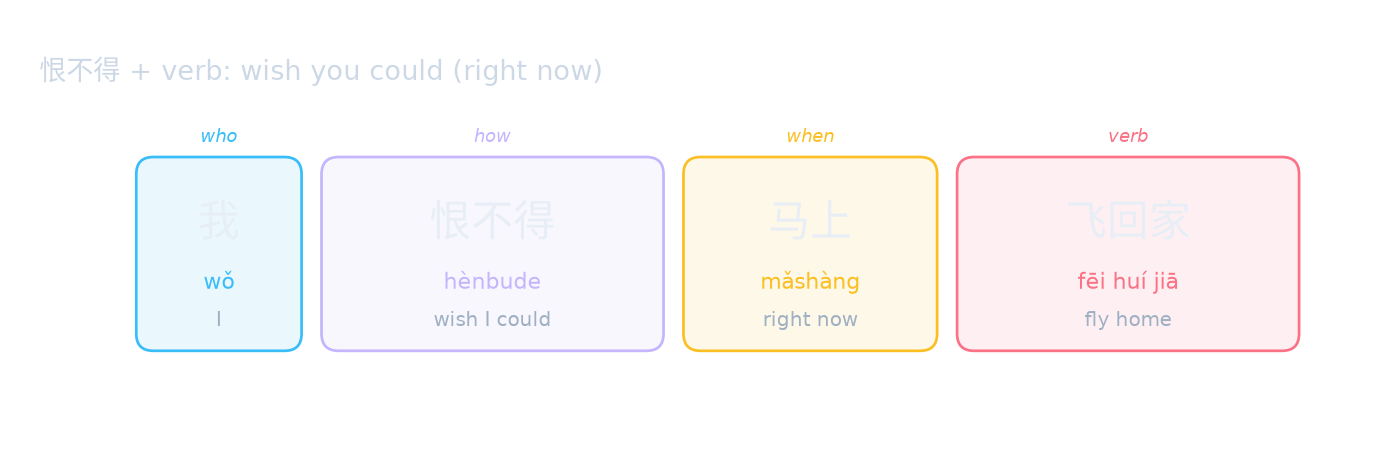
- I我wish I could恨不得right now马上to fly飞to return home回家。 — "I wish I could fly home right now."
- Goal: say you want something so much you'd do it at once (even if you can't) with wish I could恨不得.
wish I could恨不得 + verb
- wish I could恨不得 (hènbude) = "wish one could, be itching to". to hate恨 here does not mean "hate"; it shows a very strong wish.
- It is followed by an action, often with right now马上 or at once立刻: he / him他wish I could恨不得at once立刻to tell告诉(nominalizer)所had有person人。 — "He was itching to tell everyone at once."
I我wish I could恨不得right now马上fly home飞回家。
Complete: “I wish I could fly home right now.” 我____马上飞回家。
Độ khó 1/5 · 100 xu + phần thưởng nhỏ khi hoàn thành lần đầu tiên hôm nay
恨不得 + a verb phrase, often with 马上.
In 恨不得, 恨 means "hate".
Độ khó 1/5 · 100 xu + phần thưởng nhỏ khi hoàn thành lần đầu tiên hôm nay
恨不得 shows a very strong wish, not hate.
Strong, often impossible wishes
- wish I could恨不得 often describes a wish that can't really come true: I我wish I could恨不得a day一天had有forty-eight四十八个hours小时。 — "I wish a day had 48 hours."
- It also shows strong feeling: to hear听到this这个news; message消息,she / her她wish I could恨不得to cry哭(after a verb, indicates…出来。 — "Hearing the news, she felt like bursting into tears."
I我wish恨不得a day一天had有forty-eight四十八个hours小时。
Build: “I wish a day had 48 hours.”
Độ khó 3/5 · 200 xu + phần thưởng nhỏ khi hoàn thành lần đầu tiên hôm nay
恨不得 + a wish that can't really come true.
An action after it, not a thing
- wish I could恨不得 needs a verb phrase: ✓ I我wish I could恨不得right now马上to have a meal吃饭。 ✗ I我wish I could恨不得一碗flour面.
- It is about the speaker's wish, so it is not negated: ✗ I我not不wish I could恨不得. To say you don't want to, use unexpectedly不想.
Which sentence is correct?
Độ khó 1/5 · 100 xu + phần thưởng nhỏ khi hoàn thành lần đầu tiên hôm nay
恨不得 needs an action (喝), and it is not negated.
wish I could恨不得, be eager for巴不得 and can't bear to part with舍不得
- be eager for巴不得 = eager for something that can really happen: he / him他be eager for巴不得早点儿to have a holiday or…放假。 — "He can't wait for the holidays."
- can't bear to part with舍不得 = reluctant to part with: I我can't bear to part with舍不得to depart离开here这里。 — "I can't bear to leave this place."
“I can't bear to leave my old friends.” Which word fits? 我____离开老朋友。
Độ khó 1/5 · 100 xu + phần thưởng nhỏ khi hoàn thành lần đầu tiên hôm nay
舍不得 = can't bear to part with.
Recap
- wish I could恨不得 + verb phrase = wish one could (right now); often impossible, always strong.
- be eager for巴不得 = eager for (it can happen); can't bear to part with舍不得 = can't bear to part with.
Read the full reference: HSK 5 grammar — Adverbs.
You are stuck in a long, boring meeting and your favourite team is playing. Say what you wish you could do, using 恨不得.
Your answer need not copy the model. A partner or teacher must hear the spoken response to comment on pronunciation.