Kế hoạch học tập của bạn · Tiếp tục · Ôn tập →
Drill: build 把 sentences
Đã giới thiệuVị trí đã lưu của bạn vẫn nằm trong trình duyệt này. Việc tiếp tục sẽ không hoàn thành bài học hay trả lời các câu hỏi của nó.
Put the words in order
- In the HSK 4 writing paper (part 1), you get word pieces and must build one sentence: (把: marks the object)把 · please; to invite请 · to close (a door)关上 · door门 → please; to invite请to stand as a goalkeeper把门to close (a door)关上。 — "Please close the door."
- Goal: build any (把: marks the object)把 sentence quickly with one frame and four moves, then practise on exam-style items.
The (把: marks the object)把 frame
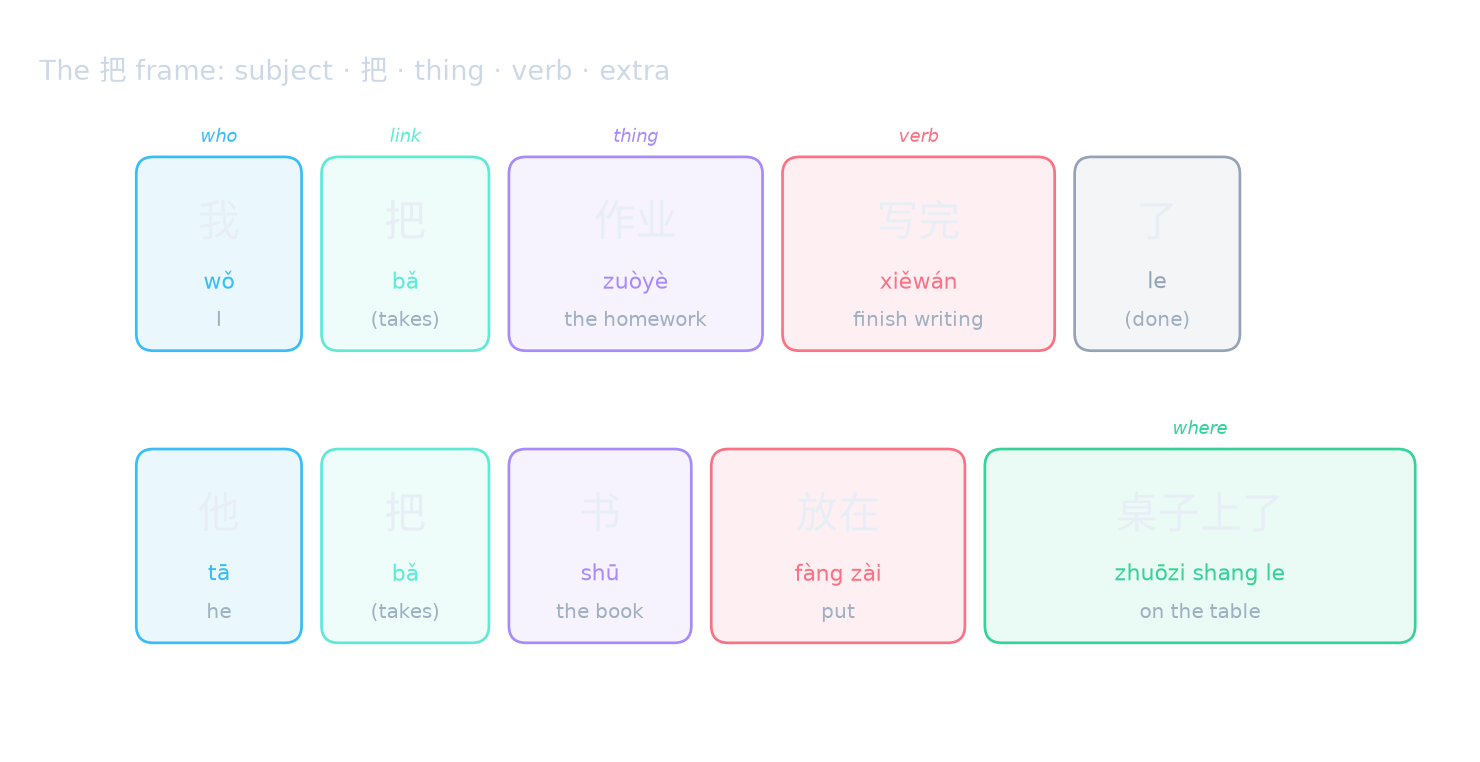
- Subject + (把: marks the object)把 + thing + verb + extra. The extra says what happened to the thing: a result (to close (a door)关上, to wash洗clean干净), a place (放在table桌子on; above; last (week)上) or (completed / change)了.
- I / me我(把: marks the object)把school assignment作业to write写to finish完(completed / change)了。 — "I finished my homework." he / him他(把: marks the object)把book书放在table桌子on; above; last (week)上(completed / change)了。 — "He put the book on the table."
I我(takes)把the homework作业finish writing写完了。
Build: “Please close the door.”
Độ khó 3/5 · 200 xu + phần thưởng nhỏ khi hoàn thành lần đầu tiên hôm nay
请 + 把 + thing + verb + result.
Four moves for any (把: marks the object)把 item
- 1 Find the verb with its extra (to close (a door)关上, 放在…, to write写to finish完(completed / change)了). 2 Find the thing it acts on (door门, book书, school assignment作业).
- 3 Put (把: marks the object)把 + thing right before the verb. 4 Put the subject (or please; to invite请) first, and words like already已经 / don't不要 / not / haven't没 before (把: marks the object)把.
- Example: already已经 · (把: marks the object)把 · he / him他 · to sell卖(completed / change)了 · bicycle自行车 → he / him他already已经(把: marks the object)把bicycle自行车to sell卖(completed / change)了。 — "He has already sold his bike."
Build: “He has already sold his bike.”
Độ khó 3/5 · 200 xu + phần thưởng nhỏ khi hoàn thành lần đầu tiên hôm nay
已经 goes before 把.
Build: “Put the milk in the fridge.”
Độ khó 3/5 · 200 xu + phần thưởng nhỏ khi hoàn thành lần đầu tiên hôm nay
把 + thing + 放在 + place.
Build: “I've washed the clothes clean.”
Độ khó 3/5 · 200 xu + phần thưởng nhỏ khi hoàn thành lần đầu tiên hôm nay
Verb + result (洗干净) + 了 at the end.
Two traps the exam loves
- Not / time words / want / will / need要 / can / be able to能 go before (把: marks the object)把: ✓ you你don't别(把: marks the object)把mobile phone手机to forget忘at / in在home家里 ✗ you你(把: marks the object)把mobile phone手机don't别to forget忘at / in在home家里. ✓ I / me我not / haven't没(把: marks the object)把money钱to bring带来 ✗ I / me我(把: marks the object)把money钱not / haven't没to bring带来.
- The verb never stands alone: ✗ I / me我to stand as a goalkeeper把门to close关 → ✓ I / me我to stand as a goalkeeper把门to close (a door)关上(completed / change)了. If a piece is a verb + result or a at / in在-place, it goes last.
Which sentence is correct?
Độ khó 1/5 · 100 xu + phần thưởng nhỏ khi hoàn thành lần đầu tiên hôm nay
别 / 不 / 没 go before 把.
Which sentence is complete?
Độ khó 1/5 · 100 xu + phần thưởng nhỏ khi hoàn thành lần đầu tiên hôm nay
The verb needs a result, place or 了.
Build: “I didn't bring my passport.”
Độ khó 3/5 · 200 xu + phần thưởng nhỏ khi hoàn thành lần đầu tiên hôm nay
没 before 把; 带来 = verb + direction.
Recap
- Subject + (don't别 / not / haven't没 / already已经 / want / will / need要) + (把: marks the object)把 + thing + verb + result / place / (completed / change)了.
- Find the verb first, then the thing, then put (把: marks the object)把 between them.
Build: “Can you translate this sentence into English?”
Độ khó 3/5 · 200 xu + phần thưởng nhỏ khi hoàn thành lần đầu tiên hôm nay
能 before 把; 翻译成 + language.
Build: “Don't put the medicine where children can reach it.”
Độ khó 3/5 · 200 xu + phần thưởng nhỏ khi hoàn thành lần đầu tiên hôm nay
不要 + 把 + thing + 放在 + place.
You are leaving a note for your roommate before a trip. Write three requests with 把 (plants, rubbish, door).
Your answer need not copy the model. A partner or teacher must hear the spoken response to comment on pronunciation.