Kế hoạch học tập của bạn · Tiếp tục · Ôn tập →
Drill: build 被 sentences
Đã giới thiệuVị trí đã lưu của bạn vẫn nằm trong trình duyệt này. Việc tiếp tục sẽ không hoàn thành bài học hay trả lời các câu hỏi của nó.
Something happened to it
- Exam pieces: (passive: by)被 · I / me我(modifier / structural particle)的 · 偷走(completed / change)了 · bicycle自行车 → I / me我(modifier / structural particle)的bicycle自行车(passive: by)被偷走(completed / change)了。 — "My bike was stolen."
- Goal: build (passive: by)被 sentences from word pieces, and switch between (把: marks the object)把 and (passive: by)被.
The (passive: by)被 frame
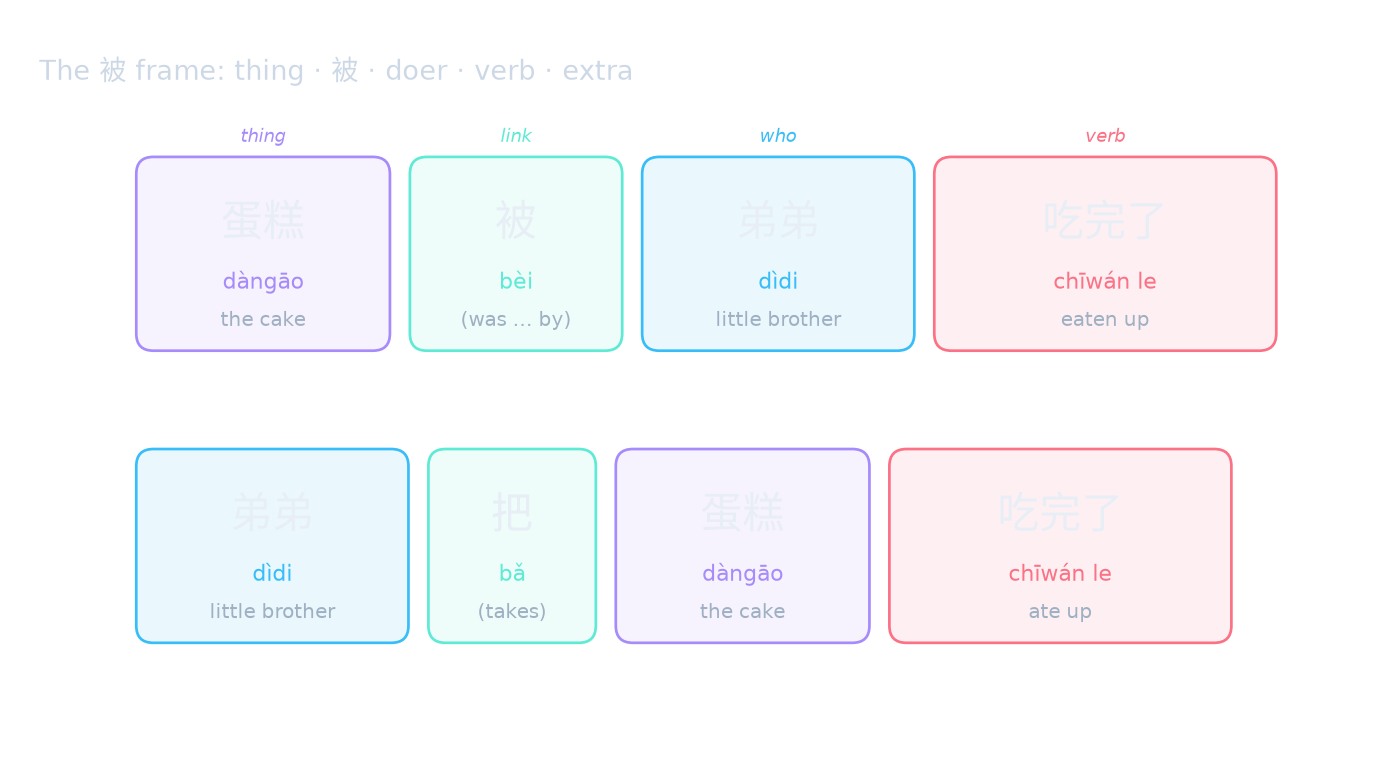
- Thing + (passive: by)被 + (doer) + verb + extra: the sentence starts with what was affected. The doer can be left out.
- cake蛋糕(passive: by)被younger brother弟弟to eat吃to finish完(completed / change)了。 — "The cake was eaten up by my little brother." window窗户(passive: by)被风吹to open; to drive开(completed / change)了。 — "The window was blown open by the wind."
the cake蛋糕(was … by)被little brother弟弟eat up吃完了。
Build: “My bike was stolen.”
Độ khó 3/5 · 200 xu + phần thưởng nhỏ khi hoàn thành lần đầu tiên hôm nay
Thing + 被 + verb + result.
Build: “The window was blown open by the wind.”
Độ khó 3/5 · 200 xu + phần thưởng nhỏ khi hoàn thành lần đầu tiên hôm nay
Thing + 被 + doer + verb + result.
Switch (把: marks the object)把 ↔ (passive: by)被
- younger brother弟弟(把: marks the object)把cake蛋糕to eat吃to finish完(completed / change)了。 (the doer first) ↔ cake蛋糕(passive: by)被younger brother弟弟to eat吃to finish完(completed / change)了。 (the thing first). Same verb and extra; swap the two people / things and (把: marks the object)把 ↔ (passive: by)被.
- (passive: by)被 often reports something unwanted: (passive: by)被to steal偷(completed / change)了, (passive: by)被to break打破(completed / change)了, (passive: by)被to criticize批评(completed / change)了.
Change to a 被 sentence. 小狗把我的鞋咬坏了。
Độ khó 1/5 · 100 xu + phần thưởng nhỏ khi hoàn thành lần đầu tiên hôm nay
The thing (我的鞋) moves to the front; 把 becomes 被.
Change to a 把 sentence. 杯子被妹妹打破了。
Độ khó 1/5 · 100 xu + phần thưởng nhỏ khi hoàn thành lần đầu tiên hôm nay
The doer (妹妹) goes first with 把.
Same traps as (把: marks the object)把
- not / haven't没 / already已经 / again又 go before (passive: by)被: ✓ I / me我(modifier / structural particle)的mobile phone手机not / haven't没(passive: by)被to take away拿走 ✗ I / me我(modifier / structural particle)的mobile phone手机(passive: by)被not / haven't没to take away拿走.
- The verb needs an extra: ✗ bicycle自行车(passive: by)被to steal偷 → ✓ bicycle自行车(passive: by)被to steal偷(completed / change)了 / (passive: by)被to steal偷to walk走(completed / change)了.
Which sentence is correct?
Độ khó 1/5 · 100 xu + phần thưởng nhỏ khi hoàn thành lần đầu tiên hôm nay
没 goes before 被.
Build: “He was criticised by the teacher again.”
Độ khó 3/5 · 200 xu + phần thưởng nhỏ khi hoàn thành lần đầu tiên hôm nay
又 before 被.
Recap
- Thing + (not / haven't没 / already已经) + (passive: by)被 + (doer) + verb + result / (completed / change)了.
- (把: marks the object)把: doer first. (passive: by)被: thing first. The rest stays the same.
Build: “The tickets have already been sold out.”
Độ khó 3/5 · 200 xu + phần thưởng nhỏ khi hoàn thành lần đầu tiên hôm nay
已经 + 被 + verb + result.
Build: “That book was borrowed by a classmate.”
Độ khó 3/5 · 200 xu + phần thưởng nhỏ khi hoàn thành lần đầu tiên hôm nay
Thing + 被 + doer + verb + result.
Tell a friend about a bad morning. Say two things that happened to your things with 被, then say one of them again with 把.
Your answer need not copy the model. A partner or teacher must hear the spoken response to comment on pronunciation.