Your learning plan · Continue · Review →
Present simple — everyday habits
Đã giới thiệuVị trí đã lưu của bạn vẫn giữ nguyên trong trình duyệt này. Tiếp tục sẽ không hoàn thành bài học hay trả lời câu hỏi của nó.
Present simple: routines and facts
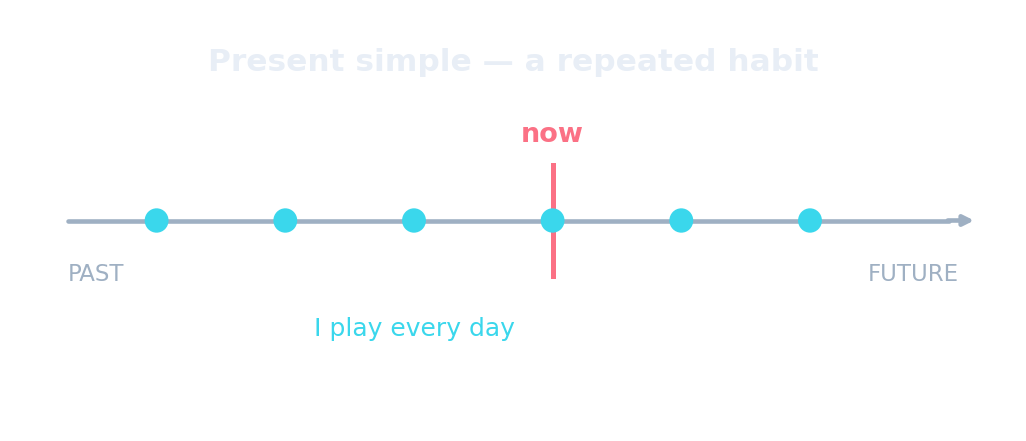
- The present simple can describe habits, routines and states: I walk on Sundays. I like tea. A habit need not happen every day.
- I get up at seven. The sun rises in the east.
- Outcome: describe a routine and make a question or negative. Start with be. Starting check: does Who lives here? need do? No — who asks about the person doing the action.
I drink tea every day. The tea does not get a day off.
Base form, and -s for he / she / it
- I / you / we / they → the base verb: I play, we work.
- In simple positive sentences here, use the third-person form with he / she / it or one name/thing: He plays. Mina works. The bus stops here. Some forms change differently: have → has.
- go → goes, watch → watches, study → studies.
Does the verb need -s?
These positive play/work examples use plays/works with he/she/it, and play/work with the other shown pronouns. One name follows the singular pattern too; be, can and questions have other forms.
Choose: He ___ football every day.
Độ khó 1/5 · 100 xu + một phần thưởng nhỏ cho lần hoàn thành đầu tiên trong ngày
he / she / it → add -s: “He plays football.”
Use the present simple for her usual routine: She ___ (go) to school by bus.
Độ khó 1/5 · 100 xu + một phần thưởng nhỏ cho lần hoàn thành đầu tiên trong ngày
The requested present-simple third-person form is goes. Learn this spelling with the example; it is not a rule for every verb or every sentence containing she.
Translate into English: 我喜欢茶。
Độ khó 3/5 · 200 xu + một phần thưởng nhỏ cho lần hoàn thành đầu tiên trong ngày
I → base verb: “I like tea.” (not “I likes tea”)
Negatives: don't / doesn't
- I / you / we / they → don't + base verb: I don't eat meat.
- he / she / it → doesn't + base verb: He doesn't like tea.
- After don't / doesn't, no -s.
Is this correct? “He doesn't likes tea.”
Độ khó 1/5 · 100 xu + một phần thưởng nhỏ cho lần hoàn thành đầu tiên trong ngày
After doesn't, use the base verb: “He doesn't like tea.”
Questions: Do / Does …?
- Do you …? · Does he …?
- Do you speak English? Does she live here?
- Short answers: Yes, I do. / No, he doesn't. These are full yes/no questions with verbs such as like and live. Is she tired?, Can she swim? and the subject question Who lives here? use other patterns.
Common mistakes
- To strengthen like here, use I like English very much or I very much like English, not I very like English. Use very much in these examples, not very alone before like.
- ❌ He go to school. → ✓ He goes to school. — remember the -s!
- Do you like tea? is a useful full question. You like tea? is common in conversation, for example when you are surprised or checking what you heard. Here we practise the full do/does question.
Match the verb to its he / she form.
Độ khó 2/5 · 140 xu + một phần thưởng nhỏ cho lần hoàn thành đầu tiên trong ngày
-ch / -o → -es (watches, goes); consonant + y → -ies (studies); most verbs just add -s.
For a straightforward statement meaning “I like music a lot”, which of these supplied sentences uses the natural pattern?
Độ khó 1/5 · 100 xu + một phần thưởng nhỏ cho lần hoàn thành đầu tiên trong ngày
I like music very much is natural. I very much like music is another natural order, though it is not one of these choices. The problem in I very like music is very alone before like, not a ban on every very phrase near a verb.
- Present simple = habits + facts.
- In these positive sentences, use the third-person form with he / she / it or one name/thing.
- For negatives and full yes/no questions with verbs such as like, use do / does + base verb. Be and can use other patterns. Later recall: write one new routine, its negative and a question. Continue with can: ability and requests. These guided form checks do not certify independent use.
Usage guidance checked 2026-10-20: British Council, present simple.
Write one sentence about something you do every day. Use the present simple.
Độ khó 3/5 · 200 xu + một phần thưởng nhỏ cho lần hoàn thành đầu tiên trong ngày
Example: “I get up at seven every day.”