Are My Results Unexpected?
Đã giới thiệu| English | Ý nghĩa |
|---|---|
| counts/kaʊnts/ | Đếm |
| observed counts/ɒbˈzɜːvd kaʊnts/ | Tần số quan sát |
| expected counts/ekˈspektɪd kaʊnts/ | Tần số kỳ vọng |
| chi-square/kaɪ skweə/ | Chi-squared |
| goodness-of-fit/ˈɡʊdnəs ɒv fɪt/ | Độ phù hợp |
When counts surprise us
- Some questions ask whether observed counts 计数 differ from what we'd expect.
- "Do the colors in a candy bag match the advertised mix?"
- We compare the observed counts 观测频数 to the expected counts 期望频数 under a claim.
- Big gaps between observed and expected are the signal of something unusual.
The chi-square family
- The tool is the chi-square 卡方 family of tests, written $\chi^2$.
- It's built for categorical data — counts in categories, not measurements.
- Every chi-square test compares observed counts to expected counts.
- A larger total gap → a larger $\chi^2$ → stronger evidence against the claim.
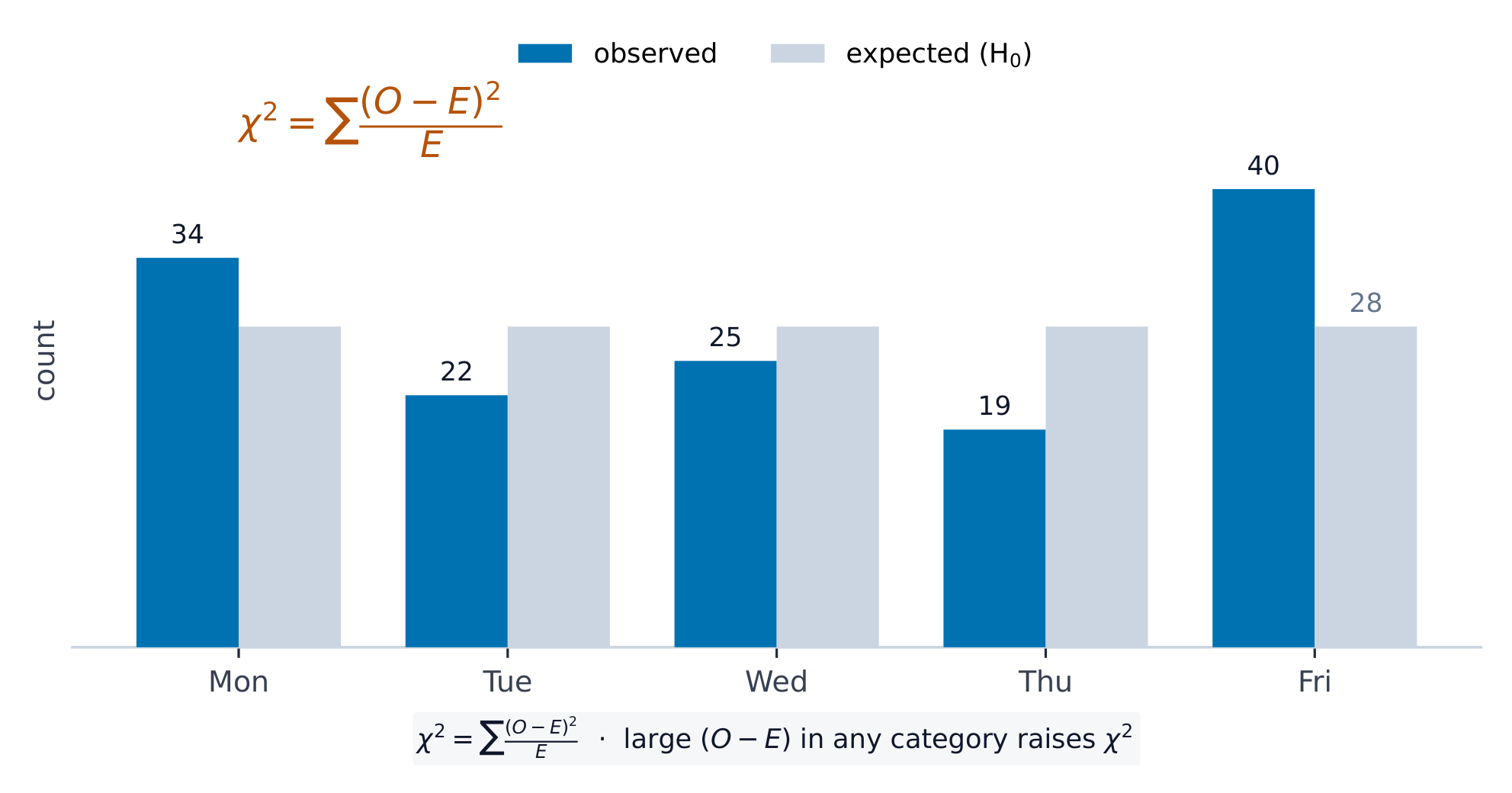
Observed against expected counts: large gaps make χ² large
Which chi-square question?
- Goodness-of-fit 拟合优度: does one categorical variable match a claimed distribution?
- Two-way table questions: are two categorical variables related (across groups or within one)?
- One variable, one sample → goodness-of-fit; a table of two variables → homogeneity/independence.
- Spotting the type is the first decision.
Observed vs. expected
- Every chi-square test rests on one comparison: observed vs. expected counts.
- Expected = what the null hypothesis predicts each count should be.
- Observed = what the data actually show.
- The test measures how far, overall, observed strays from expected.
Chi-square tests use COUNTS, not proportions or percentages. If a problem gives percentages, convert them back to actual counts before computing anything. And the whole logic is observed vs. expected: expected counts come from the null model, and a big total discrepancy is what makes $\chi^2$ large.
A bag claims equal numbers of $4$ candy colors; you count $100$ candies.
- Expected (equal mix): $25$ of each color.
- Observed: $30, 20, 28, 22$ — close, but not exact.
- A chi-square test judges whether these gaps are surprising or just chance.
Chi-square tests ask whether observed counts differ from expected counts for categorical data. A goodness-of-fit test checks one variable against a claimed distribution; two-way table tests check whether two variables are related. Every $\chi^2$ test compares observed vs. expected counts.
Write from an expected count of 20
- A category is expected to hold 20 observations if the model is right.
- The study sees 28. The lesson expected count 25 is another model.
What count does the model predict?
Expected counts are what the null model predicts.
What is the expected count?
Độ khó 1/5 · 100 xu + một phần thưởng nhỏ cho lần hoàn thành đầu tiên trong ngày
The model, not the observation, sets 20. Other options — 28 (the observed count); 25 (the other model).
A categorical count breakdown
Chi-square tests compare observed slices to expected slices.
Chi-square tests are designed for which kind of data?
Độ khó 1/5 · 100 xu + một phần thưởng nhỏ cho lần hoàn thành đầu tiên trong ngày
Chi-square compares counts in categories.
A goodness-of-fit test involves how many categorical variables?
Độ khó 1/5 · 100 xu + một phần thưởng nhỏ cho lần hoàn thành đầu tiên trong ngày
GOF checks one variable against a claimed distribution.
Chi-square tests should be run on percentages, not counts.
Độ khó 1/5 · 100 xu + một phần thưởng nhỏ cho lần hoàn thành đầu tiên trong ngày
Convert percentages back to counts first — chi-square uses counts.
A bag of 100 candies claims 4 equally likely colors. What is the expected count per color?
Độ khó 2/5 · 140 xu + một phần thưởng nhỏ cho lần hoàn thành đầu tiên trong ngày
100 ÷ 4 = 25 expected per color.
Every chi-square test compares observed counts to ___ counts (one word).
Độ khó 1/5 · 100 xu + một phần thưởng nhỏ cho lần hoàn thành đầu tiên trong ngày
Observed vs. expected is the heart of chi-square.