Mutually Exclusive Events
Đã giới thiệu| English | Ý nghĩa |
|---|---|
| mutually exclusive/ˈmjuːtʃuːəli eksˈkluːsɪv/ | tương đối loại |
| disjoint/dɪsˈdʒɔɪnt/ | không giao nhau |
| addition rule/əˈdɪʃn ruːl/ | quy tắc cộng |
| union/ˈjuːnɪən/ | hợp |
Events that can't overlap
- Two events are mutually exclusive 互斥 (or disjoint 不相交) if they can't happen together.
- Rolling a die: "get a $2$" and "get a $5$" can't both occur on one roll.
- On a Venn diagram, disjoint events are circles that don't overlap.
- Their intersection is empty: $P(A \cap B) = 0$.
The general addition rule
- To find $P(A \text{ or } B)$ — the union 并集 — use the addition rule 加法法则:
-
$$P(A \cup B) = P(A) + P(B) - P(A \cap B)$$
- You subtract the overlap so it isn't counted twice.
- This rule works for any two events, overlapping or not.
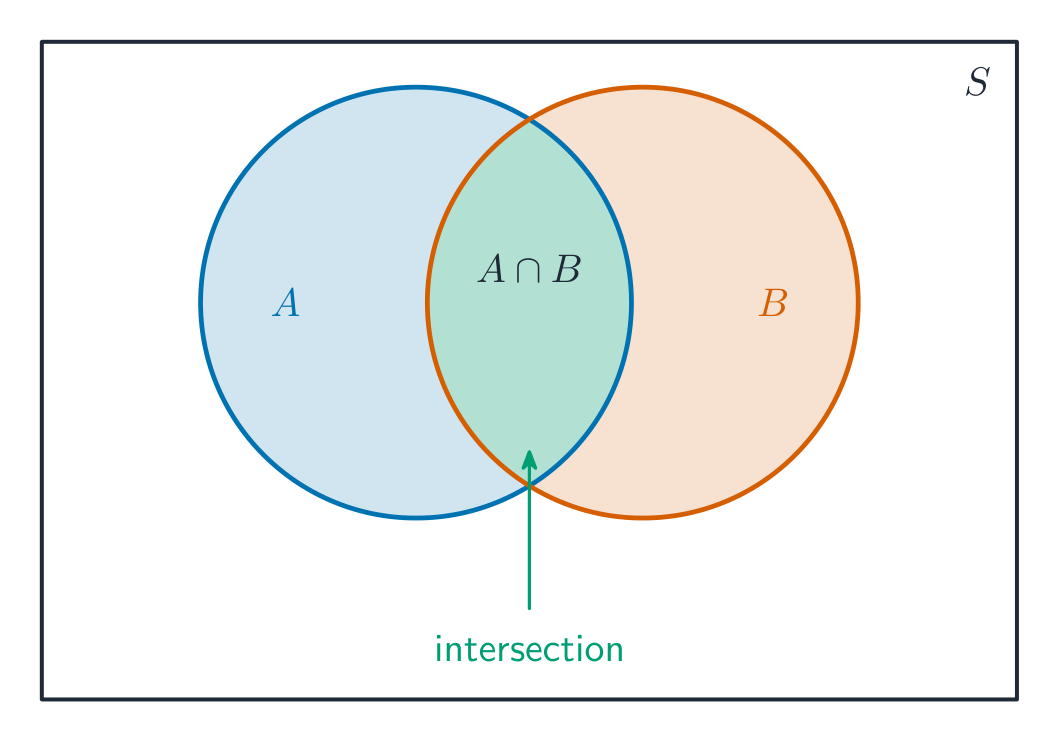
A Venn diagram: the overlap is the intersection of two events
The disjoint shortcut
- If $A$ and $B$ are mutually exclusive, their overlap is $0$.
- So the rule simplifies to $P(A \cup B) = P(A) + P(B)$.
- Just add — there's nothing to subtract.
- This shortcut is only valid when the events truly can't co-occur.
From a table or diagram
- A two-way table or Venn diagram gives you the pieces directly.
- Read off $P(A)$, $P(B)$, and the overlap $P(A \cap B)$, then apply the rule.
- The overlap is the cell (or region) belonging to both events.
- Careful bookkeeping of the overlap is the whole trick.
Don't forget to subtract the overlap. The general rule is $P(A\cup B)=P(A)+P(B)-P(A\cap B)$; dropping the $-P(A\cap B)$ double-counts the overlap and overstates the probability. Only when events are mutually exclusive (overlap $=0$) may you just add. Check for overlap before choosing the shortcut.
Draw one card. $P(\text{king}) = 4/52$, $P(\text{heart}) = 13/52$, $P(\text{king and heart}) = 1/52$.
- Union: $P(\text{king or heart}) = \tfrac{4}{52} + \tfrac{13}{52} - \tfrac{1}{52} = \tfrac{16}{52}$.
- The $-\tfrac{1}{52}$ removes the king of hearts, counted in both.
- "King" and "queen," by contrast, are disjoint → just add.
Events are mutually exclusive (disjoint) when they can't co-occur, so $P(A \cap B) = 0$. The addition rule $P(A \cup B) = P(A) + P(B) - P(A \cap B)$ finds a union; for disjoint events it simplifies to $P(A) + P(B)$. Always subtract the overlap unless it's truly zero.
Write from a union of 0.5
- Events A and B cannot happen together.
- P of A is 0.2 and P of B is 0.3. The lesson probabilities 0.6 and 0.7 are another pair.
What is the probability of A or B?
For disjoint events, add the probabilities.
What is P of A or B?
Độ khó 1/5 · 100 xu + một phần thưởng nhỏ cho lần hoàn thành đầu tiên trong ngày
0.2 plus 0.3 is 0.5 when the events cannot overlap.
Union of two events
The union is everything in A or B; subtract the overlap once.
P(A)=0.3, P(B)=0.4, P(A and B)=0.1. Find P(A or B).
Độ khó 2/5 · 140 xu + một phần thưởng nhỏ cho lần hoàn thành đầu tiên trong ngày
0.3 + 0.4 − 0.1 = 0.6.
Two events are mutually exclusive. Then P(A and B) equals...
Độ khó 1/5 · 100 xu + một phần thưởng nhỏ cho lần hoàn thành đầu tiên trong ngày
Disjoint events can't co-occur, so their intersection is 0.
For mutually exclusive events with P(A)=0.2 and P(B)=0.5, find P(A or B).
Độ khó 2/5 · 140 xu + một phần thưởng nhỏ cho lần hoàn thành đầu tiên trong ngày
Disjoint → just add: 0.2 + 0.5 = 0.7.
For any two events, P(A or B) = P(A) + P(B), no subtraction needed.
Độ khó 1/5 · 100 xu + một phần thưởng nhỏ cho lần hoàn thành đầu tiên trong ngày
You must subtract the overlap unless the events are disjoint.
Events that cannot happen at the same time are called mutually ___.
Độ khó 1/5 · 100 xu + một phần thưởng nhỏ cho lần hoàn thành đầu tiên trong ngày
Mutually exclusive = disjoint = can't co-occur.