Are Variables Related?
Đã giới thiệu| English | Ý nghĩa |
|---|---|
| statistical question/stəˈtɪstɪkl ˈkwestʃn/ | vấn đề thống kê |
| association/əˌsəʊsɪˈeɪʃn/ | liên kết |
| response variable/rɪˈspɒns ˈveərɪəbl/ | biến phản hồi |
| explanatory variable/ekˈsplænətəri ˈveərɪəbl/ | biến giải thích |
| variability/ˌveərɪəˈbɪlɪti/ | sự biến thiên |
Do two things move together?
- Unit 1 looked at one variable at a time; now we ask how two variables relate.
- A statistical question 统计问题 about a relationship: "Do students who study more score higher?"
- We look for an association 关联 — a pattern where the two variables tend to move together.
- The whole unit is about finding, describing, and modeling these relationships.
Explanatory and response
- The response variable 响应变量 is the outcome you want to explain or predict (the score).
- The explanatory variable 解释变量 is the one you think helps explain it (hours studied).
- Roughly: explanatory is the "input," response is the "output."
- By convention the explanatory variable goes on the $x$-axis, the response on the $y$-axis.
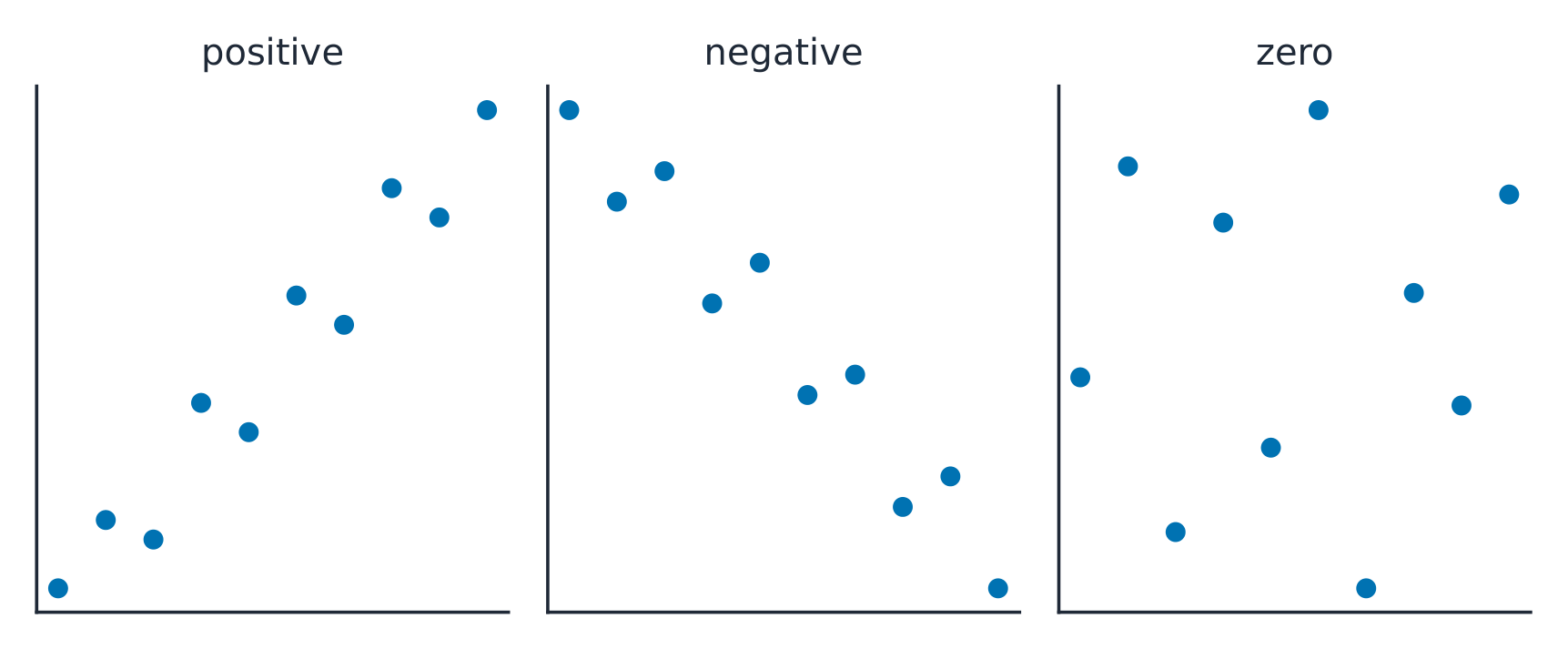
Positive correlation rises together; negative correlation moves in opposite directions
Association, not proof
- An association just means the two variables vary together in some pattern.
- More studying tends to go with higher scores — that's an association.
- But association alone does not tell you one causes the other.
- Naming the association is the first step; explaining why comes much later.
Why variability makes it tricky
- Real data are noisy — two people who study the same amount rarely score the same.
- This variability 变异性 blurs the pattern, so a weak relationship is hard to be sure about.
- An apparent link could be real, or it could be a fluke of this particular sample.
- Statistics gives us tools to judge whether a relationship is real or just chance.
Deciding which variable is explanatory and which is response is a choice about the question, not something the data force on you. "Do taller people weigh more?" makes height explanatory; "do heavier people tend to be taller?" flips it. State your question first, then assign the roles — and remember that an association is not yet a cause.
A study records each student's hours slept and their reaction time in a game.
- Explanatory: hours slept (the suspected cause). Response: reaction time (the outcome).
- Association: more sleep tends to go with faster reactions.
- But we can't yet say sleep causes faster reactions — other factors vary too.
A statistical question about two variables asks whether they are associated — whether they vary together. The explanatory variable ($x$) is used to explain or predict the response variable ($y$). Because of variability, an apparent association may be real or may be chance — that's what the rest of the unit sorts out.
Write from association without causation
- Cities with more ice cream sales also have more swimming accidents.
- No experiment assigned the ice cream.
Does the ice cream cause the accidents?
A lurking variable can create a relationship.
What do the ice cream and accident counts show?
Độ khó 1/5 · 100 xu + một phần thưởng nhỏ cho lần hoàn thành đầu tiên trong ngày
They move together. The study did not assign a cause.
An association between two variables
Points drifting upward together — a positive association.
In 'do students who study more score higher?', which is the response variable?
Độ khó 1/5 · 100 xu + một phần thưởng nhỏ cho lần hoàn thành đầu tiên trong ngày
The score is the outcome we want to explain — the response. Hours studied is explanatory.
An observed association between two variables proves that one causes the other.
Độ khó 1/5 · 100 xu + một phần thưởng nhỏ cho lần hoàn thành đầu tiên trong ngày
Association is not causation — other explanations remain possible.
By convention, the explanatory variable is placed on the ___-axis.
Độ khó 1/5 · 100 xu + một phần thưởng nhỏ cho lần hoàn thành đầu tiên trong ngày
Explanatory on x, response on y.
Why can an apparent relationship in one sample be uncertain?
Độ khó 1/5 · 100 xu + một phần thưởng nhỏ cho lần hoàn thành đầu tiên trong ngày
Variability blurs patterns, so a weak apparent link may not be real.
Which are true about explanatory and response variables?
Độ khó 2/5 · 140 xu + một phần thưởng nhỏ cho lần hoàn thành đầu tiên trong ngày
Explanatory goes on the x-axis, not y — the rest are correct.