Writing the Rate Law
Đã giới thiệu| English | Ý nghĩa |
|---|---|
| rate law/reɪt lɔː/ | luật tốc độ |
| rate constant/reɪt ˈkɒnstənt/ | hằng số tốc độ |
| order/ˈɔːdə/ | bậc phản ứng |
The formula for speed
- Double a reactant and the speed might double — or quadruple.
- Each reaction has its own sensitivity to concentration.
- A short equation captures exactly how speed depends on amounts.
- But you can only find it by experiment, not by guessing.
The rate law
- The rate law 速率定律 links speed to concentrations:
- Here $k$ is the rate constant 速率常数, and $m$ and $n$ are the orders.
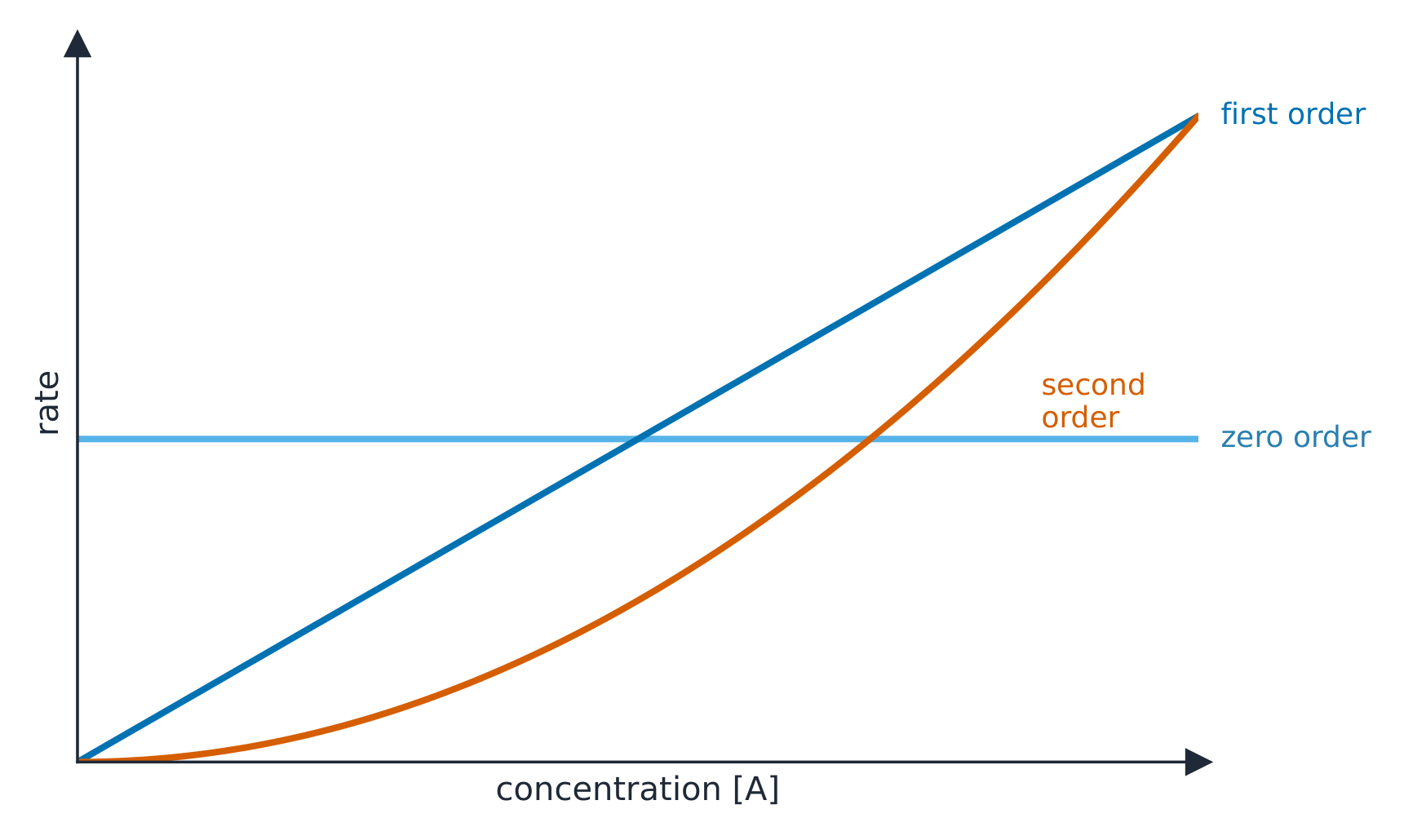
Rate against concentration for zero-, first-, and second-order reactions
The rate constant $k$ changes when the reactant concentrations change.
Độ khó 1/5 · 100 xu + một phần thưởng nhỏ cho lần hoàn thành đầu tiên trong ngày
False. $k$ depends on temperature (and catalysts), not on concentration; concentrations appear separately in the rate law.
Reaction orders
- The order 反应级数 tells how strongly a concentration affects the rate.
- First order: double $[A]$ and the rate doubles. Second order: double and it quadruples.
- Orders come from experiments, not from the equation's coefficients.
For $\text{rate} = k[A]^2$, doubling $[A]$ multiplies the rate by...
Độ khó 1/5 · 100 xu + một phần thưởng nhỏ cho lần hoàn thành đầu tiên trong ngày
Second order means $2^2 = 4$ times the rate.
Reaction orders are determined by...
Độ khó 1/5 · 100 xu + một phần thưởng nhỏ cho lần hoàn thành đầu tiên trong ngày
Orders must be found experimentally, not from coefficients.
A reaction is first order in $[A]$. Tripling $[A]$ changes the rate by a factor of...
Độ khó 1/5 · 100 xu + một phần thưởng nhỏ cho lần hoàn thành đầu tiên trong ngày
First order means the rate scales directly, so 3 times.
Overall order
- Add the individual orders to get the overall order ($m + n$).
- It sums up the reaction's total sensitivity to concentration.
- The units of $k$ depend on that overall order.
For $\text{rate} = k[A]^2[B]^1$, what is the overall order?
Độ khó 2/5 · 140 xu + một phần thưởng nhỏ cho lần hoàn thành đầu tiên trong ngày
Overall order $= 2 + 1 = 3$.
For $\text{rate} = k[A]^2[B]$, what happens if you double $[A]$?
- $[A]$ is second order, so doubling it multiplies the rate by $2^2 = 4$.
- The rate quadruples.
Find the reaction order
Use how the rate responds to concentration to find the order in A.
The rate law normally contains only the ____ concentrations, not the products.
Độ khó 1/5 · 100 xu + một phần thưởng nhỏ cho lần hoàn thành đầu tiên trong ngày
Products usually do not appear in the rate law.
Orders are found by experiment, not read off the balanced equation's coefficients — a very common trap. Only reactants normally appear in the rate law; products usually do not. And the rate constant $k$ changes with temperature but not with concentration.
The rate law $\text{rate} = k[A]^m[B]^n$ links speed to concentrations through the rate constant $k$ and the orders $m$, $n$. Orders come from experiment, not coefficients, and their sum is the overall order. A concentration's order sets how strongly it changes the rate.