Vẽ Trường Độ Dốc
Đã giới thiệu| English | Ý nghĩa |
|---|---|
| slope field/sləʊp fiːld/ | trường độ dốc |
A map of slopes across the plane
- A differential equation $\dfrac{dy}{dx}=F(x,y)$ gives a slope at every point.
- Draw a short segment with that slope at each point of a grid, and you get a slope field 斜率场.
- It's a "map" showing which way solution curves must travel everywhere.
- You don't need to solve the equation to draw it — just evaluate the slope.
Trường độ dốc cho dy/dx = ay
Mỗi đoạn gạch có độ dốc $\tfrac{dy}{dx}$ tại điểm của nó — phẳng gần $y=0$ và dốc hơn xa hơn đối với $\tfrac{dy}{dx}=ay$.
Trường độ dốc hiển thị, tại mỗi điểm, là...
Độ khó 1/5 · 100 xu + một phần thưởng nhỏ cho lần hoàn thành đầu tiên trong ngày
Mỗi đoạn gạch là hướng tiếp tuyến tại đó.
Để vẽ trường độ dốc, bạn chỉ cần tính toán độ dốc — bạn ____ cần giải phương trình.
Độ khó 1/5 · 100 xu + một phần thưởng nhỏ cho lần hoàn thành đầu tiên trong ngày
Phương trình cho trực tiếp độ dốc.
Compute the slope at each point
- At a grid point $(x,y)$, plug into $\dfrac{dy}{dx}=F(x,y)$ to get the number — that's the segment's slope.
- Slope $0$ → a horizontal dash; large positive → a steep upward dash; negative → downward.
- Repeat over a lattice of points to fill the field.
- The equation tells you the slope directly; no antiderivative needed.
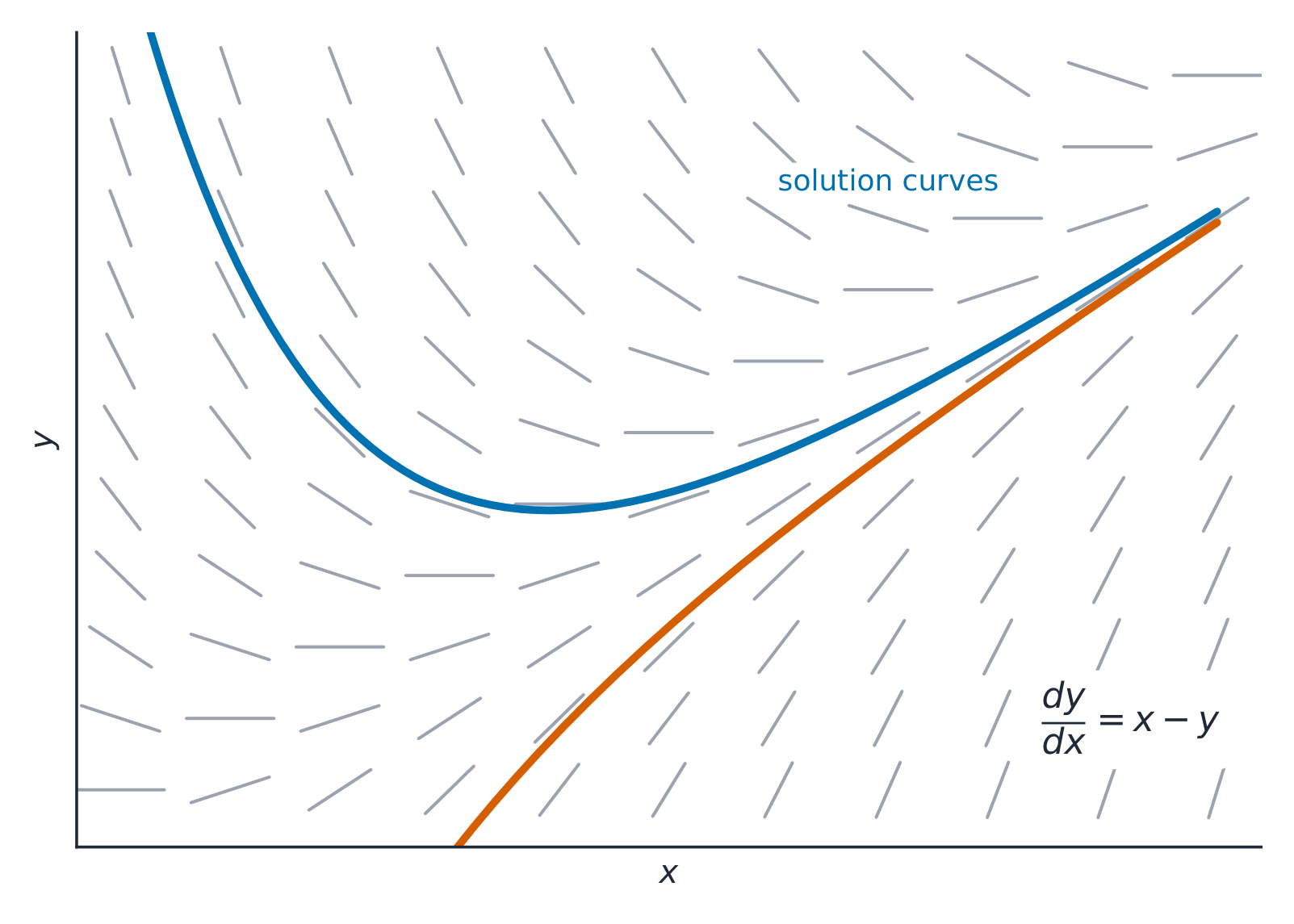
A slope field shows the gradient everywhere; solution curves follow it
Đối với $\dfrac{dy}{dx}=x+y$, tìm độ dốc của đoạn gạch tại điểm $(2,3)$.
Độ khó 2/5 · 140 xu + một phần thưởng nhỏ cho lần hoàn thành đầu tiên trong ngày
$2+3=5$.
Đối với $\dfrac{dy}{dx}=xy$, độ dốc tại $(3,2)$ là...
Độ khó 1/5 · 100 xu + một phần thưởng nhỏ cho lần hoàn thành đầu tiên trong ngày
$xy=3\cdot2=6$ (sử dụng cả hai tọa độ).
Spotting patterns quickly
- If $F$ depends only on $x$: the slope is the same all along a vertical line (columns look identical).
- If $F$ depends only on $y$: the slope is the same all along a horizontal line (rows look identical).
- For $\dfrac{dy}{dx}=y$: slopes grow with height — flat near $y=0$, steep far away.
- Recognizing these patterns speeds up sketching enormously.
Nếu $\dfrac{dy}{dx}$ chỉ phụ thuộc vào $x$, các gạch chéo trong mỗi cột dọc sẽ song song.
Độ khó 1/5 · 100 xu + một phần thưởng nhỏ cho lần hoàn thành đầu tiên trong ngày
Cùng $x$ → cùng độ dốc xuống theo cột.
Equilibrium lines
- Where $F(x,y)=0$, the slope is $0$ — a row (or curve) of horizontal dashes.
- For $\dfrac{dy}{dx}=y$, that happens at $y=0$: a whole horizontal line of flat segments.
- These lines often mark equilibrium behavior — solutions can level off there.
- They're the easiest points to plot, so start with them.
Đối với $\dfrac{dy}{dx}=y$, các đoạn gạch nằm ngang dọc theo đường...
Độ khó 1/5 · 100 xu + một phần thưởng nhỏ cho lần hoàn thành đầu tiên trong ngày
Độ dốc $=y=0$ dọc theo $y=0$.
A slope field shows the differential equation's slopes, not the solution curves themselves. The little segments are tangent directions; a solution is a curve that stays tangent to them. And compute the slope with the point's $(x,y)$, using $y$ too when $F$ depends on it — not just $x$.
Sketch a few slopes for $\dfrac{dy}{dx}=x$.
- At $(1,0)$: slope $=1$. At $(2,5)$: slope $=2$. At $(-1,3)$: slope $=-1$.
- Since $F=x$ (no $y$), every point in a vertical column has the same slope.
- Columns of parallel dashes: flat at $x=0$, tilting more as $|x|$ grows.
A slope field draws a short segment of slope $\frac{dy}{dx}=F(x,y)$ at each grid point — a map of tangent directions, no solving needed. Compute the slope at each $(x,y)$; look for patterns (columns match if $F$ depends only on $x$, rows if only on $y$) and horizontal dashes where $F=0$.