Reasoning Using Slope Fields
Introduced 8:26
Modeling with Differential Equations
Normally you are handed a function and asked for its slope. A differential equation turns that around. You are handed a rule for the slope at every point, and…
English narration · English and 中文 subtitles you can switch
In this lesson
| English | Meaning |
|---|---|
| solution curve/səˈluːʃn kɜːv/ | The graph of a function satisfying a differential equation over an interval. |
| long-term behavior/lɒŋ tɜːm bɪˈheɪvjə/ |
Following the dashes to a curve
- A slope field shows the direction a solution takes at each point. A solution curve 解曲线 threads through it, staying tangent to the dashes.
- Start at the given point and let the curve bend as the dashes turn. A different starting point gives a different curve of the same family.
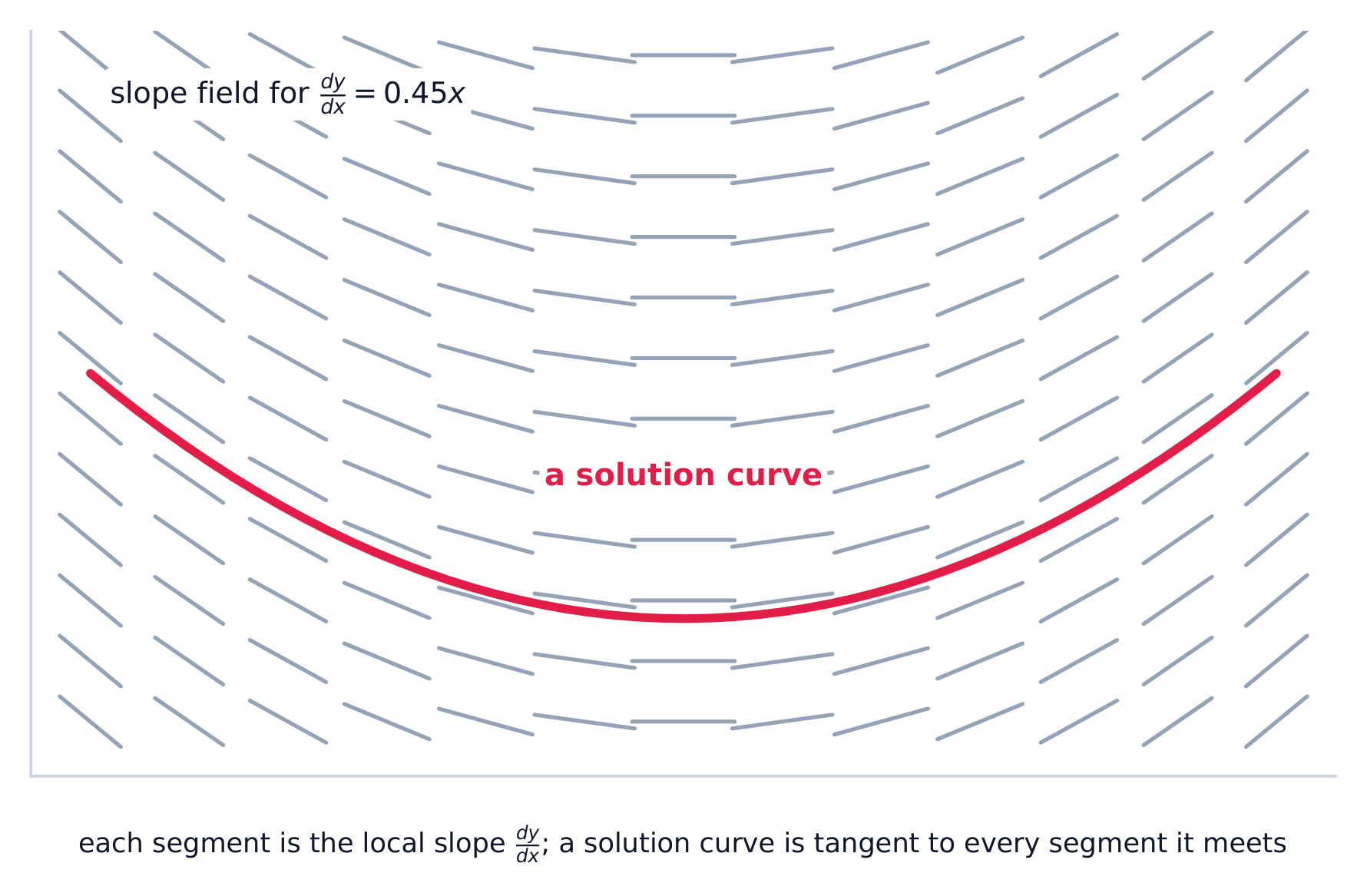
Each segment of a slope field is the local slope; a solution curve follows them
Thread a curve through the field
A solution curve stays tangent to every dash it passes — drag the start point and watch it follow the field.
A solution curve through the slope field must always stay...
Difficulty 1/5 · 100 coins + a small bonus on first completion today
It follows the tangent directions.
Matching a field to its equation
| What you see in the field | What it means |
|---|---|
| every column (fixed $x$) has the same slopes | $\dfrac{dy}{dx}$ depends on $x$ only |
| every row (fixed $y$) has the same slopes | $\dfrac{dy}{dx}$ depends on $y$ only |
| horizontal dashes along a line | $\dfrac{dy}{dx}=0$ there: solve the equation $=0$ |
| slopes negative in a region | test a point there in each candidate |
Which equation? In a field, every row has equal slopes, the dashes are horizontal along $y=2$, and the slopes are positive below $y=2$. Choose from $\dfrac{dy}{dx}=x-2$, $\;2-y$, $\;y-2$.
- Equal rows: depends on $y$ only, so not $x-2$.
- Below $y=2$, take $y=0$: $2-y=2>0$ but $y-2=-2<0$. The answer is $\dfrac{dy}{dx}=2-y$.
In a slope field every column has equal slopes, the dashes are horizontal along $x=1$, and slopes are negative to the left of $x=1$. Which equation fits?
Difficulty 1/5 · 100 coins + a small bonus on first completion today
Equal columns: depends on $x$ only. At $x=0$ (left of 1), $x-1=-1<0$, as required; $1-x$ would be positive.
Equilibria: stable or unstable
- A whole line $y=c$ of horizontal dashes is an equilibrium: the constant function $y=c$ is a solution.
- Nearby curves move toward it: stable. They move away: unstable.
A horizontal row of dashes in a slope field represents a...
Difficulty 1/5 · 100 coins + a small bonus on first completion today
Slope $0$ everywhere along it → a constant solution.
Two equilibria. For $\dfrac{dy}{dx}=y(3-y)$, describe the solutions.
- Equilibria where $y(3-y)=0$: $y=0$ and $y=3$.
- For $0<y<3$, slopes are positive, so curves rise toward 3. For $y>3$, they are negative, so curves fall toward 3. For $y<0$, they are negative, so curves fall away from 0.
- So $y=3$ is stable and $y=0$ is unstable. The solution through $(0,1)$ increases and $\displaystyle\lim_{x\to\infty}y=3$.
For $\dfrac{dy}{dt}=y$, the equilibrium $y=0$ is...
Difficulty 1/5 · 100 coins + a small bonus on first completion today
Above $0$ slopes push up, below they push down → away from $0$.
Select all true statements about equilibria.
Difficulty 2/5 · 140 coins + a small bonus on first completion today
Equilibria can be at any $y$ where the rate is $0$; toward = stable, away = unstable.
Long-term behaviour
- To predict the long-term behaviour 长期性态, follow a curve to the right. It may level off at a stable equilibrium or grow without bound.
- Give the answer as a limit: "$y\to3$ as $x\to\infty$".
The overall pattern of a slope field forecasts the ____ behavior of solutions.
Difficulty 1/5 · 100 coins + a small bonus on first completion today
Read where the dashes send solutions as $x$ grows.
For $\dfrac{dy}{dx}=y(5-y)$, the solution through $(0,7)$ approaches what value as $x\to\infty$?
Difficulty 2/5 · 140 coins + a small bonus on first completion today
At $y=7$, $y(5-y)=-14<0$, so the curve falls. It levels off at the equilibrium $y=5$, which is stable.
- A solution curve runs along the dashes, never across them.
- An equilibrium needs horizontal dashes along the whole line $y=c$, not just at a few points.
- When solutions are unique (true for the AP equations), two different solution curves never meet.
Two different solution curves of the same equation can cross each other.
Difficulty 1/5 · 100 coins + a small bonus on first completion today
Each point has one slope, so solution curves never cross.
Sketch a solution curve by staying tangent to the dashes. Match a field by its rows, columns and zero-slope lines, and test a point. Equilibria are lines $y=c$ where $\frac{dy}{dx}=0$; nearby curves move toward a stable one and away from an unstable one.
What went wrong? Only the site team sees this.