Viên đạo ẩn
Đã giới thiệu| English | Ý nghĩa |
|---|---|
| implicit differentiation/ɪmˈplɪsɪt ˌdɪfəˌrenʃɪˈeɪʃn/ | implicit differentiation |
| implicit/ɪmˈplɪsɪt/ | implicit |
When you can't solve for $y$
- The circle $x^2+y^2=25$ defines $y$ implicitly — you can't write it as a single $y=f(x)$.
- Yet the curve still has a slope at each point. How do we get $\tfrac{dy}{dx}$ without solving for $y$?
- The trick: differentiate both sides with respect to $x$, treating $y$ as a hidden function of $x$.
- This is implicit differentiation 隐函数求导.
Một phương trình như $x^2+y^2=25$ xác định $y$ ____, vì nó chưa được giải theo $y$.
Độ khó 1/5 · 100 xu + một phần thưởng nhỏ cho lần hoàn thành đầu tiên trong ngày
Đó là lý do chúng ta dùng viên đạo ẩn.
Every $y$ term triggers the chain rule
- Because $y$ secretly depends on $x$, differentiating a $y$-term needs the chain rule.
- $\dfrac{d}{dx}[y^2]=2y\cdot\dfrac{dy}{dx}$ — the extra $\tfrac{dy}{dx}$ is the inner derivative.
- $\dfrac{d}{dx}[x^2]=2x$ as usual (no $y$, no extra factor).
- So each time you differentiate a term containing $y$, tack on a $\tfrac{dy}{dx}$.
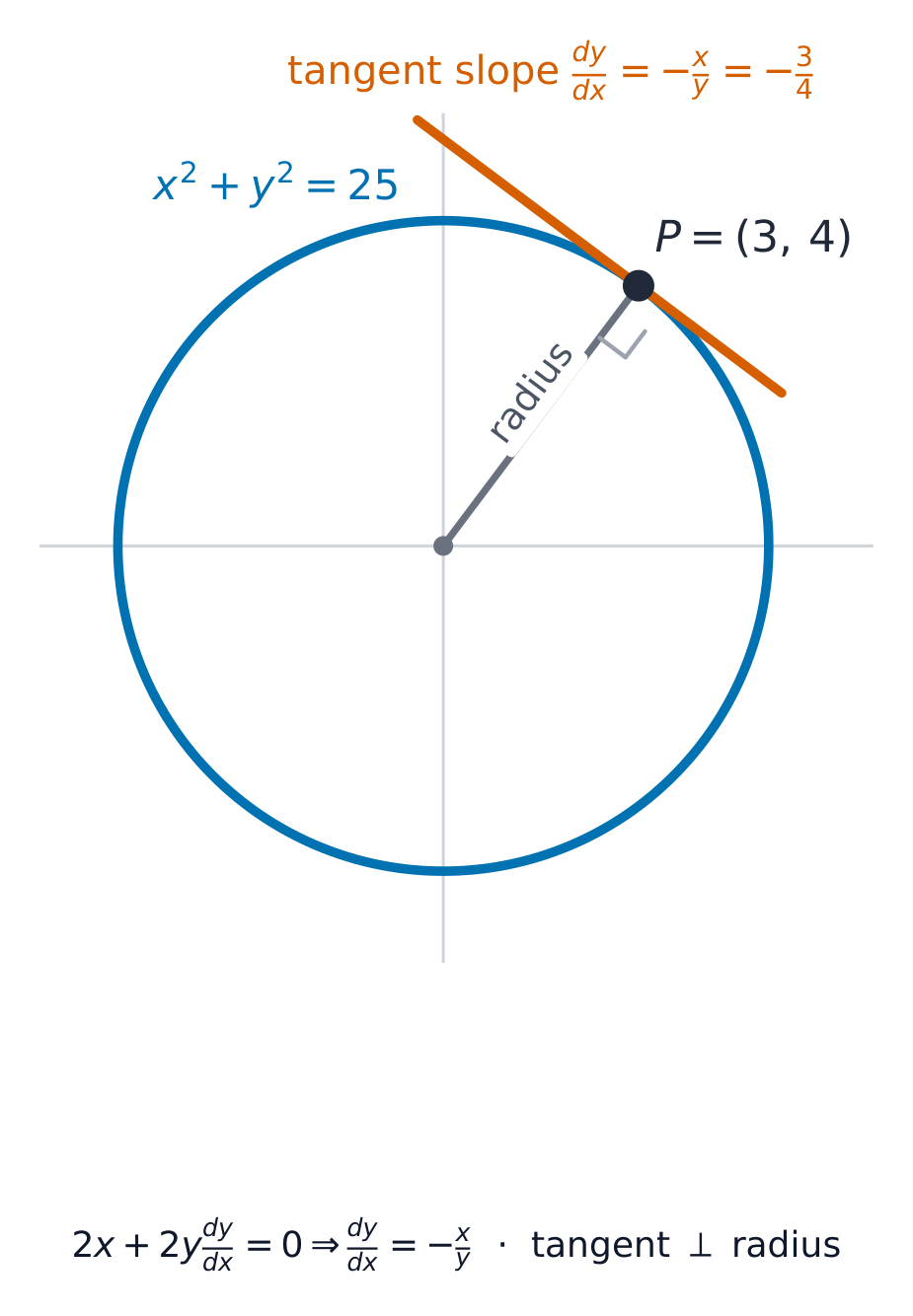
Implicit 隐式 differentiation on the circle x² + y² = 25: the tangent slope at (3, 4) is −3/4
Viên đạo theo $x$, $\dfrac{d}{dx}[y^2]=$
Độ khó 1/5 · 100 xu + một phần thưởng nhỏ cho lần hoàn thành đầu tiên trong ngày
Chain rule: $2y$ times đạo hàm bên trong $\tfrac{dy}{dx}$.
Solve for $\tfrac{dy}{dx}$
- After differentiating, you get an equation with $\tfrac{dy}{dx}$ scattered around.
- Collect all $\tfrac{dy}{dx}$ terms on one side, everything else on the other.
- Factor out $\tfrac{dy}{dx}$ and divide to isolate it.
- The result usually depends on both $x$ and $y$ — that's expected for a curve.
Độ dốc tiếp tuyến trên một đường cong
y = √(25 − x²) (nửa trên của đường tròn)
Ngay cả đường cong bạn không giải được cho $y$ cũng có tiếp tuyến tại mỗi điểm — viên đạo ẩn tìm ra độ dốc đó.
Sắp xếp các bước viên đạo ẩn theo thứ tự.
Độ khó 3/5 · 200 xu + một phần thưởng nhỏ cho lần hoàn thành đầu tiên trong ngày
Lấy đạo hàm, thu thập, giải, sau đó thay giá trị.
Evaluate at a point
- To get an actual slope, plug a point $(x,y)$ on the curve into your $\tfrac{dy}{dx}$ formula.
- For $x^2+y^2=25$: differentiating gives $2x+2y\tfrac{dy}{dx}=0$, so $\tfrac{dy}{dx}=-\dfrac{x}{y}$.
- At $(3,4)$: slope $=-\tfrac34$. At $(3,-4)$: slope $=+\tfrac34$.
- The same $x$ can give different slopes — because the curve has two $y$-branches.
Đối với $x^2+y^2=25$, $\dfrac{dy}{dx}=-\dfrac{x}{y}$. Tìm độ dốc tại $(3,4)$ (một số thập phân).
Độ khó 2/5 · 140 xu + một phần thưởng nhỏ cho lần hoàn thành đầu tiên trong ngày
$-\tfrac{3}{4}=-0.75$.
Yếu tố $\tfrac{dy}{dx}$ được thêm vào mọi số hạng, kể cả số hạng thuần túy $x$ như $x^2$.
Độ khó 1/5 · 100 xu + một phần thưởng nhỏ cho lần hoàn thành đầu tiên trong ngày
Chỉ các số hạng chứa $y$ mới nhận yếu tố $\tfrac{dy}{dx}$.
Viên đạo $xy$ theo $x$ cho...
Độ khó 1/5 · 100 xu + một phần thưởng nhỏ cho lần hoàn thành đầu tiên trong ngày
Quy tắc tích: $\frac{d}{dx}[xy]=1\cdot y+x\cdot\tfrac{dy}{dx}$.
The chain-rule factor $\tfrac{dy}{dx}$ appears only on terms containing $y$. $\frac{d}{dx}[x^3]=3x^2$ (no factor), but $\frac{d}{dx}[y^3]=3y^2\tfrac{dy}{dx}$. Forgetting the $\tfrac{dy}{dx}$ on $y$-terms is the defining mistake of implicit differentiation. And a product like $xy$ needs the product rule: $\frac{d}{dx}[xy]=y+x\tfrac{dy}{dx}$.
Find $\tfrac{dy}{dx}$ for $x^2+y^2=25$ at the point $(3,4)$.
- Differentiate: $2x+2y\dfrac{dy}{dx}=0$.
- Solve: $\dfrac{dy}{dx}=-\dfrac{2x}{2y}=-\dfrac{x}{y}$.
- At $(3,4)$: $\dfrac{dy}{dx}=-\dfrac{3}{4}$ — the tangent slope there.
Implicit differentiation: differentiate both sides with respect to $x$, treating $y$ as a function of $x$ so every $y$-term picks up a $\tfrac{dy}{dx}$ (chain rule); then collect, factor, and solve for $\tfrac{dy}{dx}$. Plug in a point on the curve to get a slope. The answer usually depends on both $x$ and $y$.