Differentiating Inverse Functions
Introduced 7:57
The Chain Rule
Think of two gears joined together. Turn the first one, and it drives the second. If the second turns three times as fast as the first, and the first turns…
English narration · English and 中文 subtitles you can switch
In this lesson
| English | Meaning |
|---|---|
| inverse function/ɪnˈvɜːs ˈfʌŋkʃn/ | A function that reverses another function's mapping on a domain where that mapping is one-to-one. |
| reciprocals/rɪˈsɪprəklz/ | The value obtained by dividing one by a non-zero number. |
Slopes of a function and its mirror
- An inverse function 反函数 $f^{-1}$ undoes $f$: it reflects the graph across the line $y=x$.
- Reflecting swaps the roles of rise and run — so it flips the slope upside down.
- That gives a neat shortcut: you can find the inverse's derivative from the original's.
- Best of all, you often don't need a formula for $f^{-1}$ at all.
The reciprocal-slope rule
- At matching points, the slopes of $f$ and $f^{-1}$ are reciprocals 倒数.
-
$$\big(f^{-1}\big)'(x)=\frac{1}{f'\!\big(f^{-1}(x)\big)}$$
- Read it as: the inverse's slope at $x$ is $1$ divided by $f$'s slope at the matching input. This needs that slope to be nonzero; where $f'=0$, the inverse has a vertical tangent.
- The matching input is $f^{-1}(x)$ — the point on $f$ that maps to $x$.
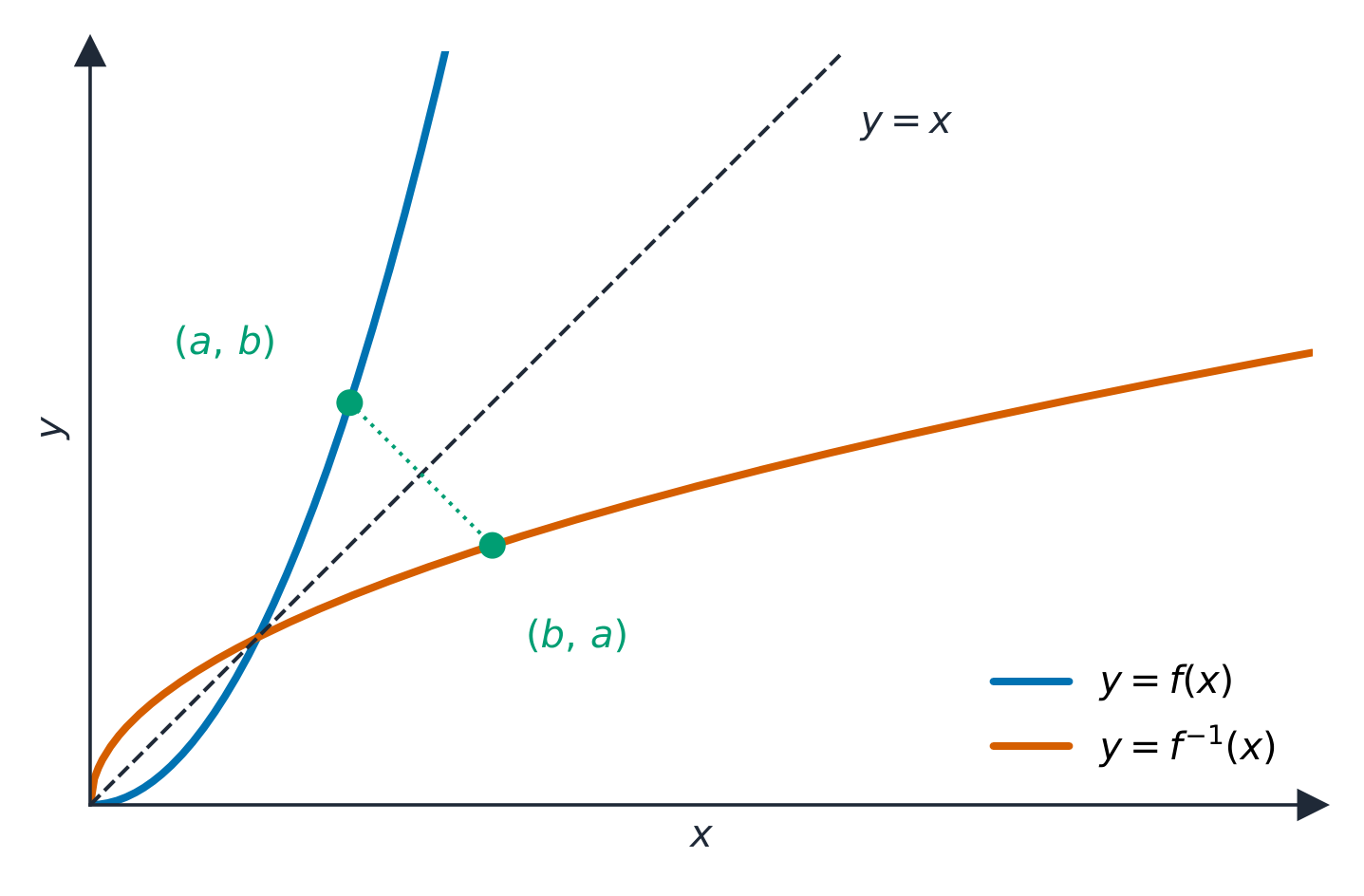
The inverse function is the mirror image of the function in the line y = x
The derivative of an inverse is $\big(f^{-1}\big)'(x)=$
Difficulty 1/5 · 100 coins + a small bonus on first completion today
One over the original derivative at the matching input $f^{-1}(x)$.
Evaluate without inverting
- Usually you only need the derivative at one point, and you can skip finding $f^{-1}$.
- Say $f(2)=5$ and $f'(2)=3$. Then the point $(5,2)$ is on $f^{-1}$, so $f^{-1}(5)=2$.
- Apply the rule: $\big(f^{-1}\big)'(5)=\dfrac{1}{f'(2)}=\dfrac{1}{3}$.
- You never needed a formula — just the matching pair and one derivative value.
If $f(2)=5$ and $f'(2)=4$, find $\big(f^{-1}\big)'(5)$.
Difficulty 2/5 · 140 coins + a small bonus on first completion today
$f^{-1}(5)=2$, so $\big(f^{-1}\big)'(5)=\tfrac{1}{f'(2)}=\tfrac14$.
To compute $\big(f^{-1}\big)'(c)$ at a point, which do you need?
Difficulty 2/5 · 140 coins + a small bonus on first completion today
You need the matching input and $f'$ there (nonzero, so the reciprocal exists) — no full inverse formula.
Why reciprocal? See the reflection
- Reflecting across $y=x$ turns a "rise of $3$ over run of $1$" into a "rise of $1$ over run of $3$."
- So a slope of $3$ becomes a slope of $\tfrac13$ — literally flipped.
- This is why $f$ and $f^{-1}$ have reciprocal slopes at corresponding points.
- (It also warns you: if $f'=0$ at a point, the inverse has a vertical tangent there — its slope is undefined.)
A slope and its reciprocal
y = x³ + 1
Reflecting a curve across $y=x$ flips rise and run — a slope of $3$ becomes $\tfrac13$ on the inverse.
To find $\big(f^{-1}\big)'(5)$, you evaluate $f'$ at $5$.
Difficulty 1/5 · 100 coins + a small bonus on first completion today
You evaluate $f'$ at the matching input $f^{-1}(5)$, not at $5$.
At corresponding points, the slopes of $f$ and $f^{-1}$ are ____ of each other.
Difficulty 1/5 · 100 coins + a small bonus on first completion today
Reflection across $y=x$ flips the slope.
If $f'(a)=0$ at the matching input, the inverse at the corresponding point has...
Difficulty 1/5 · 100 coins + a small bonus on first completion today
Dividing by $0$ is undefined — the reflected tangent is vertical.
Use the derivative of $f$ at the matching input $f^{-1}(x)$, not at $x$ itself. For $\big(f^{-1}\big)'(5)$ you need $f'$ at the input that maps to $5$, i.e. $f'(f^{-1}(5))$, not $f'(5)$. Plugging $5$ straight into $f'$ is the classic error.
$f(x)=x^3+1$ has $f(1)=2$ and $f'(x)=3x^2$. Find $\big(f^{-1}\big)'(2)$.
- The matching input: $f^{-1}(2)=1$ (since $f(1)=2$).
- $f'(1)=3(1)^2=3$.
- $\big(f^{-1}\big)'(2)=\dfrac{1}{f'(1)}=\dfrac{1}{3}$.
Solve for the matching input. $f(x)=x^3+x$. Find $\big(f^{-1}\big)'(10)$.
- Find the input with $f(x)=10$ by solving $x^3+x=10$. Try $x=2$, since $8+2=10$. So $f^{-1}(10)=2$.
- $f'(x)=3x^2+1$, so $f'(2)=13$ and $\big(f^{-1}\big)'(10)=\dfrac{1}{13}$.
$f(x)=x^3+2x$. What is $\big(f^{-1}\big)'(3)$?
Difficulty 1/5 · 100 coins + a small bonus on first completion today
x³ + 2x = 3 at x = 1. f′(x) = 3x² + 2, so f′(1) = 5 and the answer is 1/5.
The AP table question
- AP often gives a table of $x$, $f(x)$ and $f'(x)$, with $g=f^{-1}$. Find the row where $f(x)$ equals the input to $g$, then take $f'$ from that row.
| $x$ | 1 | 2 | 3 | 4 |
|---|---|---|---|---|
| $f(x)$ | 3 | 7 | 4 | 9 |
| $f'(x)$ | 5 | 2 | 6 | 8 |
- For $g'(4)$, look for 4 in the $f(x)$ row. It is in the column $x=3$, so $g'(4)=\dfrac{1}{f'(3)}=\dfrac16$. Not $\dfrac{1}{f'(4)}=\dfrac18$.
Use the table in this step, with $g=f^{-1}$. What is $g'(7)$?
Difficulty 1/5 · 100 coins + a small bonus on first completion today
f(2) = 7, so g′(7) = 1/f′(2) = 1/2.
Use the same table, with $g=f^{-1}$. Find $g'(9)$ as a decimal.
Difficulty 2/5 · 140 coins + a small bonus on first completion today
f(4) = 9, so g′(9) = 1/f′(4) = 1/8 = 0.125.
The derivative of an inverse function is the reciprocal of the original's derivative at the matching point: $\big(f^{-1}\big)'(x)=\dfrac{1}{f'(f^{-1}(x))}$. Reflection across $y=x$ swaps rise and run, flipping the slope. You can evaluate it at a point using just a matching pair — no formula for $f^{-1}$ required.
What went wrong? Only the site team sees this.