Trigonometry
Đã giới thiệu| English | Ý nghĩa |
|---|---|
| period/ˈpɪərɪəd/ | chu kỳ |
| asymptotes/ˈæsɪmptəʊts/ | tiếp cận |
| reference angle/ˈrefrəns ˈæŋɡl/ | The acute angle between an angle’s terminal side and the x-axis, used to find related trigonometric values. |
| amplitude/ˈæmplɪtjuːd/ | The maximum vertical distance from a sine or cosine graph to its midline. |
| principal value/ˈprɪnsɪpl ˈvæljuː/ | The single inverse-trig output chosen from the restricted interval, such as arcsin in [−π/2, π/2]. |
| trigonometric/ˌtrɪɡənəʊˈmetrɪk/ | lượng giác |
| identities/aɪˈdentɪtiz/ | đẳng thức |
A cycle has a height and a timing
- A point on a turning wheel rises and falls. A sine or cosine model describes its height over a turn.
- To use that model, you need its graph, its scale and the angles at which a chosen height occurs. One calculator answer may miss another valid time.
Read the unit circle and the basic graphs
- On the unit circle, $(\cos\theta,\sin\theta)$ gives a point's coordinates. The signs come from its quadrant, including negative angles and turns beyond $360^\circ$.
- Sine and cosine have range $[-1,1]$ and period 周期 $2\pi$ radians or $360^\circ$. Tangent has period $\pi$ radians or $180^\circ$; its asymptotes 渐近线 occur where $\cos\theta=0$.
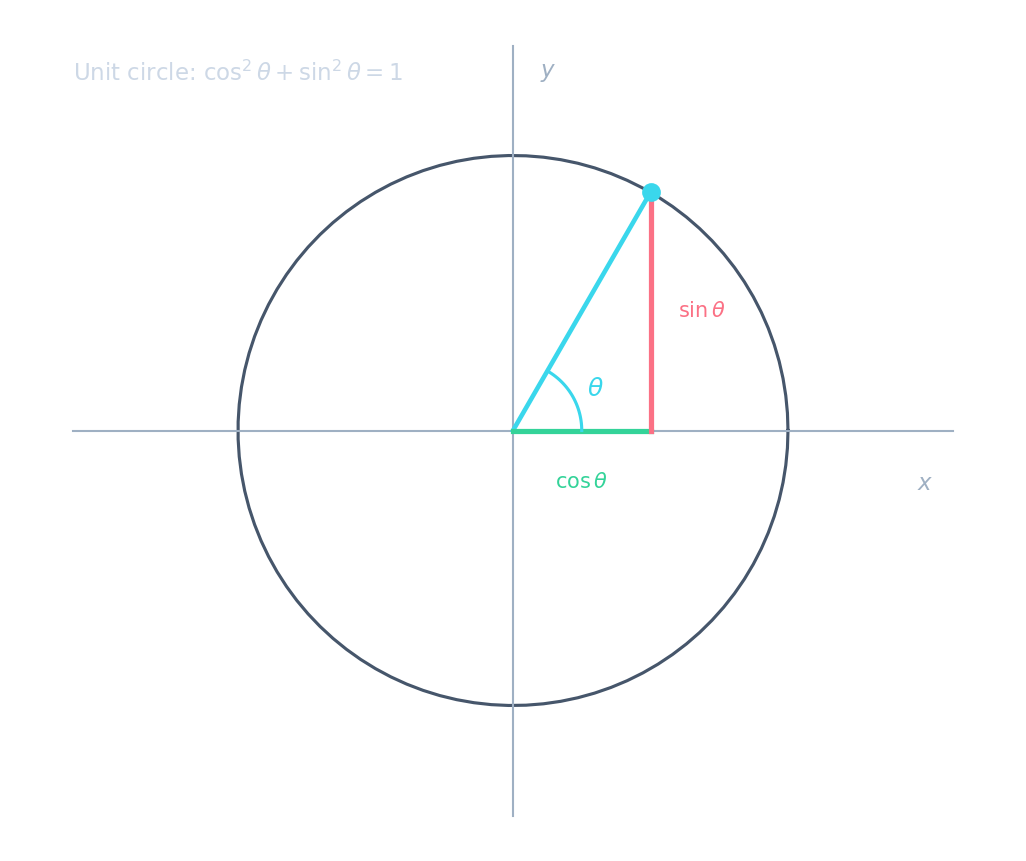
For any angle, $\sin^2\theta+\cos^2\theta=1$. Tangent is $\sin\theta/\cos\theta$ only where $\cos\theta\ne0$.
The unit circle
(cos θ, sin θ)
Spin the angle θ around the circle: the horizontal leg is cos θ and the vertical leg is sin θ.
Use exact and related angles
- Learn these exact values; use the quadrant to choose a sign for related angles. A reference angle 参考角 is the acute angle to the $x$-axis.
- For example, $\cos150^\circ=-\cos30^\circ=-\sqrt3/2$, $\sin(-\pi/6)=-1/2$, and $\sin(3\pi/4)=1/\sqrt2$. The notation $\sin^2\theta$ means $(\sin\theta)^2$.
| $\theta$ | $0^\circ$ | $30^\circ$ | $45^\circ$ | $60^\circ$ | $90^\circ$ |
|---|---|---|---|---|---|
| $\sin$ | $0$ | $1/2$ | $1/\sqrt2$ | $\sqrt3/2$ | $1$ |
| $\cos$ | $1$ | $\sqrt3/2$ | $1/\sqrt2$ | $1/2$ | $0$ |
| $\tan$ | $0$ | $1/\sqrt3$ | $1$ | $\sqrt3$ | undefined |
The sine entries at $0^\circ,30^\circ,45^\circ,60^\circ,90^\circ$ follow $\sqrt0/2,\sqrt1/2,\sqrt2/2,\sqrt3/2,\sqrt4/2$. Cosine reverses that order. Beyond the first quadrant, keep the size but check the sign.
What is the exact value of sin 30°?
Độ khó 2/5 · 140 xu + một phần thưởng nhỏ cho lần hoàn thành đầu tiên trong ngày
sin 30° = 1/2 = 0.5.
What is the value of tan 45°?
Độ khó 2/5 · 140 xu + một phần thưởng nhỏ cho lần hoàn thành đầu tiên trong ngày
tan 45° = 1.
What is the exact value of cos 60°?
Độ khó 2/5 · 140 xu + một phần thưởng nhỏ cho lần hoàn thành đầu tiên trong ngày
cos 60° = 1/2 = 0.5.
Without a calculator, find sin(−5π/6), cos(7π/6) and tan(5π/3). State the reference angle and sign used in each case.
Exact first-quadrant values need a sign check when the angle is negative or lies elsewhere.
Sketch a transformed graph
- For $y=d+a\sin(bx+c)$ or $d+a\cos(bx+c)$, with $a,b\ne0$, the midline is $y=d$, amplitude 振幅 is $|a|$ and period is $2\pi/|b|$ in radians. Use $360^\circ/|b|$ in degrees. Find key points from the angle inside the function.
- For $y=2+3\cos2x$, range is $[-1,5]$ and period is $\pi$. Over $0\le x\le2\pi$, maxima occur at $0,\pi,2\pi$ and minima at $\pi/2,3\pi/2$. Join key points with a smooth curve; label the axes and values.

The factor $2$ changes the horizontal period. The line is used later to count intersections.
For $y=\tan(x+\pi/4)$, shift the basic tangent graph left by $\pi/4$. Asymptotes in $[-\pi,\pi]$ are at $x=-3\pi/4$ and $x=\pi/4$; zeros are $-\pi/4$ and $3\pi/4$. Do not join across an asymptote. Tangent has no finite amplitude.
Sine & cosine graphs
Drag the amplitude, period and shifts of y = a·sin(bx + c) + d and watch the curve change against the base wave.
Sketch y=1−2 cos 3 x for 0≤x≤2π/3. State its range and period, and label its endpoint values, maximum and midline crossings. Draw the curve itself.
The negative output multiplier reverses maxima and minima; the inside factor 3 divides the period by 3.
Sketch y=tan(x+π/4) for −π≤x≤π. Label every vertical asymptote and x-axis crossing in the interval, the y-intercept and the period. Explain why there is no finite amplitude.
A horizontal shift changes the asymptotes as well as the zeros.
Interpret principal inverse values
- The notation $\sin^{-1}u$ means the principal value 主值 of the inverse trigonometric 三角的 relation, not $1/\sin u$. Its output lies in $[-\pi/2,\pi/2]$. For cosine inverse the output lies in $[0,\pi]$; for tangent inverse it lies in $(-\pi/2,\pi/2)$.
- In degree mode these ranges are $[-90^\circ,90^\circ]$, $[0^\circ,180^\circ]$ and $(-90^\circ,90^\circ)$. Sine/cosine inverse need inputs in $[-1,1]$; tangent inverse accepts any real input.
$\sin^{-1}(\sin150^\circ)=30^\circ$, because $150^\circ$ is outside the principal sine range. But $\sin\theta=1/2$ has both $30^\circ$ and $150^\circ$ in $[0^\circ,360^\circ]$.
To solve $\tan^{-1}(2x-1)=-\pi/4$, take tangent: $2x-1=-1$, so $x=0$. The given inverse value lies in its principal range.
Find the exact principal values sin⁻¹(sin(5π/6)), cos⁻¹(cos(7π/6)) and tan⁻¹(tan(3π/4)). Then solve tan⁻¹(3 x+2)=−π/4. Explain why the inverse notation is not a reciprocal.
An inverse returns an angle in its principal range even when the original angle was outside it.
Prove an identity from one side
- The identities 恒等式 are $\sin^2\theta+\cos^2\theta\equiv1$ and $\tan\theta\equiv\sin\theta/\cos\theta$ where the quotient is defined. Use them to simplify an expression or rewrite an equation with one trig function.
- To prove an identity, start with one side and show each valid algebra step until you reach the other. State any excluded denominator values; do not assume the result you are meant to prove.
Where both sides are defined:
Here $\sin\theta\ne0$; this also excludes $\cos\theta=-1$. The square of a sum, $(\sin\theta+\cos\theta)^2$, is not the same as the sum of squares.
For any angle θ, what does sin²θ + cos²θ equal?
Độ khó 2/5 · 140 xu + một phần thưởng nhỏ cho lần hoàn thành đầu tiên trong ngày
This is the identity sin²θ + cos²θ ≡ 1.
Where all expressions are defined, which identity is correct?
Độ khó 1/5 · 100 xu + một phần thưởng nhỏ cho lần hoàn thành đầu tiên trong ngày
tan θ ≡ sin θ / cos θ; and sin²θ + cos²θ ≡ 1.
Prove sin θ/(1+cos θ)+(1+cos θ)/sin θ≡2/sin θ where the expressions are defined. State the excluded values and show the combined numerator before cancelling.
An identity is valid wherever both sides exist, not at angles making its denominators zero.
Solve a quadratic in one trig function
- Replace $\sin^2\theta$ by $1-\cos^2\theta$, or the reverse, to make a quadratic. Solve for the trig value first; reject values outside $[-1,1]$ for sine or cosine.
- For $2\cos^2\theta-\sin\theta-1=0$, substitution gives $2\sin^2\theta+\sin\theta-1=0$. Thus $(2\sin\theta-1)(\sin\theta+1)=0$.
On $0\le\theta\le2\pi$, the values $\sin\theta=1/2$ and $-1$ give $\theta=\pi/6,5\pi/6,3\pi/2$. The calculator's principal value for $-1$ is $-\pi/2$, outside this interval, so use $3\pi/2$ instead.
For $\sin^2\theta=u$, finding $u$ is not the final answer. Recover both $\sin\theta=\sqrt u$ and $-\sqrt u$ when $0<u<1$, then find their angles in the interval.
If sin θ = 0.5 and 0° ≤ θ ≤ 360°, then θ = 30° is the only solution.
Độ khó 1/5 · 100 xu + một phần thưởng nhỏ cho lần hoàn thành đầu tiên trong ngày
sin θ = 0.5 also has solution θ = 180° − 30° = 150° in the given range.
Solve 2 sin²θ+3 cos θ−3=0 for 0°≤θ≤360°. Show the quadratic in cos θ and check whether both interval endpoints are solutions.
A closed interval may include two endpoint angles describing the same direction; check both rather than silently dropping one.
Transform the interval as well as the angle
- To solve $\sin2x=1/2$ for $-\pi<x<\pi$, let $u=2x$. Then $-2\pi<u<2\pi$: the inner angle spans two turns.
- In that interval, $u=-11\pi/6,-7\pi/6,\pi/6,5\pi/6$. Divide each by $2$ to get $x=-11\pi/12,-7\pi/12,\pi/12,5\pi/12$.
Do not search only one turn of the inner angle. With $\sin(2x-\pi/6)$, transform both endpoints to $2x-\pi/6$ first. Check whether interval endpoints are included, and substitute the final $x$ values into the original equation.
Solve sin(2 x−π/6)=−1/2 for −π≤x≤π. Show the transformed interval for u=2 x−π/6 and list every u-value before converting back to x.
The inner interval spans two full turns and both ends happen to be solutions here.
Preserve roots and exclude undefined values
- Dividing by a trig expression can lose roots. For $\sin\theta\cos\theta=\sin\theta$, factor to $\sin\theta(\cos\theta-1)=0$, keeping the possibility $\sin\theta=0$.
- Clearing a denominator can introduce forbidden angles. In $6\sin\theta=1+2/\sin\theta$, first note $\sin\theta\ne0$, then multiply to get $(3\sin\theta-2)(2\sin\theta+1)=0$.
For the fractional equation on $-180^\circ<\theta<180^\circ$, $\sin\theta=2/3$ gives $41.8^\circ,138.2^\circ$ and $\sin\theta=-1/2$ gives $-150^\circ,-30^\circ$. All four satisfy the original denominator restriction. Keep calculator precision until the final angles.
Solve tan θ=2 sin θ for 0°≤θ≤360°. State where the original equation is undefined and avoid dividing by sin θ.
Do not remove a possibly zero factor before solving the separate zero case.
Solve tan²θ+2 sin²θ=3 for 0°<θ<270°, giving angles to 1 decimal place. Use u=sin²θ, reject impossible roots and recover both signs of sin θ.
Solving a quadratic in sin²θ does not determine the sign of sin θ.
Count solutions using intersections
- On the transformed cosine graph above, the equation $2+3\cos2x=x+1$ asks where the curve meets the line $y=x+1$. There are three intersections on $[0,2\pi]$.
- A graph can give the number of solutions even when an exact algebraic angle is not required. Draw the comparison line on the same axes and check the whole interval, including its endpoints.
The graph of a transformed function is not the base graph: its starting height, range and number of cycles may all change. A correct count needs a sketch at the correct scale.
On the same axes, sketch y=1+sinx and y=x/2 for 0≤x≤2π. Label the sine curve’s key points and state how many solutions 1+sinx=x/2 has in this interval. Explain the count from the graph.
The line is a second graph, not a horizontal height. A different transformed curve can give a different number of intersections.
Finish with all valid angles
- Use the unit-circle signs and exact values for related angles.
- Sketch with range, period, key points and any asymptotes labelled.
- An inverse button gives a principal value, not every equation solution.
- Reduce to one trig function, preserve possible zero factors, and check the original domain and interval.
Write and sketch independently
- For equations, show the algebra, the possible trig values and all valid angles. State the angle unit.
- For a graph, draw the actual curve and label its key points or asymptotes. A list of properties alone is not a sketch.
A right triangle has sides 5, 12 and 13, with 5 opposite the angle. What is the tangent of that angle?
5 squared plus 12 squared is 13 squared, so the triangle is right-angled.
A right triangle has opposite side 5 and adjacent side 12 for an angle θ. What is tan θ?
Độ khó 1/5 · 100 xu + một phần thưởng nhỏ cho lần hoàn thành đầu tiên trong ngày
Opposite 5 over adjacent 12 is 5/12. Other options — 1 (the lesson value of tan 45 degrees); 5/13 (which is the sine).