Skip to content · ⁨Bỏ qua nội dung⁩
Subjects · ⁨Môn học⁩

GAC Science · ⁨Khoa học GAC⁩

Tips · ⁨Mẹo⁩

GAC Science is two modules and they do different jobs. GAC013 is about science itself, its history, the scientific method, the language of units and notation, how the discipline is organised and the issues it raises. GAC023 is combined subject content, covering biology and classification, ecosystems, earth resources, chemistry and its environmental effects, and wave motion in physics.

The investigation is the centrepiece. Planning and carrying out an experiment, then writing it up to scientific and academic conventions, appears as an outcome in both modules and carries substantial weight.

Units and notation are assessed explicitly. Writing a quantity with the right symbol, the right unit and a sensible number of significant figures is a named outcome, not a presentation detail.

The breadth is deliberate. GAC023 crosses biology, chemistry, earth science and physics in one semester, so the aim is confident general science in English rather than specialist depth in one subject.

Practice on this site is original, and the science content borrows explanations and diagrams from our IGCSE and A-Level material where the topic is genuinely the same.

  • 1

    GAC013 Science II: Scientific Principles · ⁨GAC013 Khoa học II: Nguyên lý Khoa học⁩

    1.1

    What this module is, and how it is marked

    Two paper samples retain different amounts of water. Does that mean one is best for every cleaning task? To answer well, a scientist asks how the comparison was made, which properties were tested and what remains unknown.

    This guide supports GAC013: the development of scientific ideas, investigation, scientific language, the organisation of research and scientific issues. Science includes evidence, methods, explanations and a growing body of knowledge. Its questions connect physics, chemistry, biology and other fields.

    A practical investigation 探究实验 needs a safe, permitted method that fits its question. An investigation report 实验报告 records that method, the actual observations and a conclusion limited by the evidence. Follow your teacher's current brief for assessment criteria, structure and deadlines. The original companion sheets are practice, not official assessment papers. No result or phrase guarantees a mark. Never replace an unexpected observation with a predicted answer.

    Vocabulary · ⁨Từ vựng⁩ Train · ⁨Luyện tập⁩
    English Tiếng Việt
    practical investigation/ˈpræktɪkl ɪnˌvestɪˈɡeɪʃn/ khảo sát thực hành
    investigation report/ɪnˌvestɪˈɡeɪʃn rɪˈpɔːt/ báo cáo khảo sát
    1.1

    The history of science

    Syllabus · ⁨Chương trình⁩
    English

    Unit 1 of 5 in GAC013 Science II: Scientific Principles (Level II). The module is taught over about 40 class hours plus 20 hours of independent study, and is assessed at the teaching centre and moderated by ACT — there is no external exam.

    Module purpose: On completion of this module, students should be able to demonstrate knowledge and understanding of the basic laws, theories and principles of contemporary science.

    The module outcomes this unit works towards:

    Learning Objective GAC013.1: Demonstrate knowledge and understanding of the historical development of scientific ideas, and apply that knowledge to differentiate between the different areas of science.

    Tiếng Việt

    Đơn vị 1 trong 5 của GAC013 Khoa học II: Nguyên lý Khoa học (Mức độ II). Mô-đun được giảng dạy trong khoảng 40 giờ học trên lớp cộng thêm 20 giờ tự học, và được đánh giá tại trung tâm giảng dạy cùng với sự giám sát của ACT — không có kỳ thi bên ngoài.

    Mục đích mô-đun: Sau khi hoàn thành mô-đun này, sinh viên sẽ có khả năng chứng minh kiến thức và sự hiểu biết về các định luật, lý thuyết và nguyên lý cơ bản của khoa học đương đại.

    Các kết quả học tập mà đơn vị này hướng tới:

    Mục tiêu học tập GAC013.1: Chứng minh kiến thức và sự hiểu biết về sự phát triển lịch sử của các ý tưởng khoa học, và áp dụng kiến thức đó để phân biệt giữa các lĩnh vực khoa học khác nhau.

    Source: Cambridge International syllabus · ⁨Nguồn: Chương trình Cambridge International⁩

    A paradigm 范式 is a broad framework shaping explanations and questions. A paradigm shift 范式转换 is a substantial change in that framework. Not every revised number or new observation is a shift of this scale.

    Scientific explanations are provisional 暂定的: they remain open to evidence-led revision. This does not mean that every explanation is equally uncertain. A model represents selected features of a system; observations test how well its predictions and explanations work within a stated scope.

    Selected evidence about electrons, atomic structure and neutrons contributed to changing atomic ideas.

    Worked example: separate event dates from award dates

    Thomson identified the electron in 1897. Rutherford's 1911 atomic-structure analysis drew on scattering measurements, including work by Geiger and Marsden. Chadwick established evidence for the neutron in 1932. These are selected developments, not a complete history of science. A scientist's award year is not automatically the discovery or publication year.

    Sources checked 2 October 2026: Nobel atomic-history timeline, electron discovery, and Chadwick facts.

    Physics studies matter and energy. Chemistry studies substances and their changes. Biology studies living systems. A plant-growth investigation can be biological while using physical measurements of light and chemical ideas about materials. Naming its main field does not supply its result.

    Vocabulary · ⁨Từ vựng⁩ Train · ⁨Luyện tập⁩
    English Tiếng Việt
    paradigm/ˈpærədaɪm/ mô hình
    paradigm shift/ˈpærədaɪm ʃɪft/ thay đổi mô hình
    provisional/prəˈvɪʒənl/ tạm thời
    1.2

    The scientific method

    Syllabus · ⁨Chương trình⁩
    English

    Unit 2 of 5 in GAC013 Science II: Scientific Principles (Level II). The module is taught over about 40 class hours plus 20 hours of independent study, and is assessed at the teaching centre and moderated by ACT — there is no external exam.

    The module outcomes this unit works towards:

    Learning Objective GAC013.2: Apply the scientific method to plan and conduct scientific investigations.

    Learning Objective GAC013.3: Create an investigation report following scientific and academic conventions.

    Tiếng Việt

    Đơn vị 2 trong 5 của GAC013 Khoa học II: Nguyên lý Khoa học (Mức độ II). Mô-đun được giảng dạy trong khoảng 40 giờ học trên lớp cộng thêm 20 giờ tự học, và được đánh giá tại trung tâm giảng dạy cùng với sự giám sát của ACT — không có kỳ thi bên ngoài.

    Các kết quả học tập mà đơn vị này hướng tới:

    Mục tiêu học tập GAC013.2: Áp dụng phương pháp khoa học để lên kế hoạch và tiến hành các cuộc điều tra khoa học.

    Mục tiêu học tập GAC013.3: Tạo báo cáo điều tra theo các quy ước khoa học và học thuật.

    Source: Cambridge International syllabus · ⁨Nguồn: Chương trình Cambridge International⁩

    A hypothesis 假设 is a testable proposed explanation or prediction. Identify what observations would support or challenge it. Research can involve controlled experiments, observation, modelling and revision; it does not always follow one straight sequence.

    In a controlled experiment, the independent variable 自变量 is deliberately changed, the dependent variable 因变量 is the measured response, and control variables 控制变量 are kept comparable. A control group 对照组 can provide a comparison without the treatment where the design requires it. Comparing two materials is not automatically a treatment-versus-no-treatment design.

    Repeat 重复 trials to examine variation and reduce dependence on one reading. Repeats do not repair a systematically unequal procedure, and a single careful observation is not automatically worthless. Report what the evidence permits and what further checking would help.

    The paper comparison holds area and timing comparable before measuring wet-minus-dry mass.

    Worked example: controlled conditions and a mean

    In the fictional written task, fresh squares of two paper types have the same area. Each is immersed for 60 seconds, drained for 10 seconds without squeezing, and weighed using the same checked balance. Retained-water mass is wet mass minus dry mass. Type A records 3.0, 3.2 and 2.8 grams; B records 4.2, 4.0 and 4.4 grams.

    The mean summarises the three trials:

    $$\bar m=\frac{m_1+m_2+m_3}{3}$$
    $$\bar m_A=\frac{3.0+3.2+2.8}{3}=3.0\ \text{g}$$
    $$\bar m_B=\frac{4.2+4.0+4.4}{3}=4.2\ \text{g}$$

    The difference between means is 1.2 grams. Individual trials vary. Squeezing only A adds another changed condition and undermines a comparison of paper type. Strength, price and other uses were not tested, so “B is always best” is unsupported. Any real practical activity requires the teacher's approved procedure and supervision.

    Vocabulary · ⁨Từ vựng⁩ Train · ⁨Luyện tập⁩
    English Tiếng Việt
    hypothesis/haɪˈpɒθəsɪs/ giả thuyết
    independent variable/ˌɪndɪˈpendənt ˈveərɪəbl/ biến số độc lập
    dependent variable/dɪˈpendənt ˈveərɪəbl/ biến phụ thuộc
    control variables/kənˈtrəʊl ˈveərɪəblz/ biến kiểm soát
    control group/kənˈtrəʊl ɡruːp/ nhóm đối chứng
    Repeat/rɪˈpiːt/ Lặp lại
    1.3

    The language of science

    Syllabus · ⁨Chương trình⁩
    English

    Unit 3 of 5 in GAC013 Science II: Scientific Principles (Level II). The module is taught over about 40 class hours plus 20 hours of independent study, and is assessed at the teaching centre and moderated by ACT — there is no external exam.

    The module outcomes this unit works towards:

    Learning Objective GAC013.5: Demonstrate knowledge of scientific concepts and terminology from the different areas of science.

    Learning Objective GAC013.6: Demonstrate familiarity with and ability to use scientific language, units and notation correctly.

    Tiếng Việt

    Đơn vị 3 trong 5 của GAC013 Khoa học II: Nguyên lý Khoa học (Mức độ II). Mô-đun được giảng dạy trong khoảng 40 giờ học trên lớp cộng thêm 20 giờ tự học, và được đánh giá tại trung tâm giảng dạy cùng với sự giám sát của ACT — không có kỳ thi bên ngoài.

    Các kết quả học tập mà đơn vị này hướng tới:

    Mục tiêu học tập GAC013.5: Chứng minh kiến thức về các khái niệm và thuật ngữ khoa học từ các lĩnh vực khoa học khác nhau.

    Mục tiêu học tập GAC013.6: Chứng minh sự quen thuộc và khả năng sử dụng đúng ngôn ngữ, đơn vị và ký hiệu khoa học.

    Source: Cambridge International syllabus · ⁨Nguồn: Chương trình Cambridge International⁩

    Units 单位 identify the scale of a physical quantity. Some quantities, such as a count or a ratio, are dimensionless but still need a clear definition. A unit conversion changes representation, not the physical quantity. For area, square the length conversion factor.

    Accuracy 准确度 concerns closeness to a suitable reference or true value. Precision 精密度 concerns closeness of repeated readings. An instrument can give close repeats with a systematic offset. Significant figures help communicate the supported numerical precision; calculator output is not evidence for extra digits.

    Uncertainty 不确定度 describes limitations on a measurement or estimate. Instrument resolution, procedure and variation can contribute. Do not invent an uncertainty range or confidence level that was never established.

    Distance and elapsed time define average speed; repeat precision still needs an accuracy check.

    Worked example: average speed is not constant speed

    For the supplied trolley record, travelled distance is 3.60 metres and elapsed time is 48.0 seconds. Average speed is distance per elapsed time:

    $$v_{\text{avg}}=\frac{d}{t}$$
    $$v_{\text{avg}}=\frac{3.60\ \text{m}}{48.0\ \text{s}}=0.0750\ \frac{\text{m}}{\text{s}}$$

    This is an interval average, not a speed at every moment. Separately, timer repeats of 10.1, 10.1 and 10.2 seconds are close, but they disagree with a supplied 12.0-second reference. Investigate the timing procedure instead of claiming accuracy from closeness alone.

    Vocabulary · ⁨Từ vựng⁩ Train · ⁨Luyện tập⁩
    English Tiếng Việt
    Units/ˈjuːnɪts/ Đơn vị
    Accuracy/ˈækjʊrəsi/ Độ chính xác
    precision/prɪˈsɪʒn/ độ chính xác (precision)
    Uncertainty/ʌnˈsɜːtənti/ sự không chắc chắn
    1.4

    The organization of science

    Syllabus · ⁨Chương trình⁩
    English

    Unit 4 of 5 in GAC013 Science II: Scientific Principles (Level II). The module is taught over about 40 class hours plus 20 hours of independent study, and is assessed at the teaching centre and moderated by ACT — there is no external exam.

    The module outcomes this unit works towards:

    Learning Objective GAC013.1: Demonstrate knowledge and understanding of the historical development of scientific ideas, and apply that knowledge to differentiate between the different areas of science.

    Learning Objective GAC013.5: Demonstrate knowledge of scientific concepts and terminology from the different areas of science.

    Tiếng Việt

    Đơn vị 4 trong 5 của GAC013 Khoa học II: Nguyên lý Khoa học (Mức độ II). Mô-đun được giảng dạy trong khoảng 40 giờ học trên lớp cộng thêm 20 giờ tự học, và được đánh giá tại trung tâm giảng dạy cùng với sự giám sát của ACT — không có kỳ thi bên ngoài.

    Các kết quả học tập mà đơn vị này hướng tới:

    Mục tiêu học tập GAC013.1: Chứng minh kiến thức và sự hiểu biết về sự phát triển lịch sử của các ý tưởng khoa học, và áp dụng kiến thức đó để phân biệt giữa các lĩnh vực khoa học khác nhau.

    Mục tiêu học tập GAC013.5: Chứng minh kiến thức về các khái niệm và thuật ngữ khoa học từ các lĩnh vực khoa học khác nhau.

    Source: Cambridge International syllabus · ⁨Nguồn: Chương trình Cambridge International⁩

    Peer review 同行评审 asks relevant specialists to examine a study's methods and reasoning. It can identify weaknesses, but is not automatic product certification. Replication 可重复性 obtains new observations using an appropriately comparable procedure to investigate a finding. Checking calculations on the same readings is useful, but does not supply a new independent experiment.

    Research institutions 机构 provide people, resources and rules. Disclose funding and relevant interests. Examine whether they affect design, analysis or reporting; funding alone proves neither honesty nor dishonesty. Transparent records and independent scrutiny help readers judge a claim.

    The original study, specialist review and planned independent test have different evidential roles.

    Worked example: a review finds a condition that matters

    A fictional insulating-sleeve report compares cups starting at different temperatures. A reviewer flags that difference. A second calculation cannot remove the unequal starting condition. A second school's independent experiment could improve checking, but it supplies no confirmation until performed. Keep the original record and explain its limit rather than inventing a successful replication.

    Vocabulary · ⁨Từ vựng⁩ Train · ⁨Luyện tập⁩
    English Tiếng Việt
    Peer review/pɪə rɪˈvjuː/ bình duyệt đồng nghiệp
    Replication/ˌreplɪˈkeɪʃn/ Lặp lại
    institutions/ˌɪnstɪˈtjuːʃnz/ chế độ
    1.5

    Scientific issues

    Syllabus · ⁨Chương trình⁩
    English

    Unit 5 of 5 in GAC013 Science II: Scientific Principles (Level II). The module is taught over about 40 class hours plus 20 hours of independent study, and is assessed at the teaching centre and moderated by ACT — there is no external exam.

    The module outcomes this unit works towards:

    Learning Objective GAC013.4: Discuss the contribution of scientific advances.

    Tiếng Việt

    Đơn vị 5 trong 5 của GAC013 Khoa học II: Nguyên lý Khoa học (Mức độ II). Mô-đun được giảng dạy trong khoảng 40 giờ học trên lớp cộng thêm 20 giờ tự học, và được đánh giá tại trung tâm giảng dạy cùng với sự giám sát của ACT — không có kỳ thi bên ngoài.

    Các kết quả học tập mà đơn vị này hướng tới:

    Mục tiêu học tập GAC013.4: Thảo luận về đóng góp của các tiến bộ khoa học.

    Source: Cambridge International syllabus · ⁨Nguồn: Chương trình Cambridge International⁩

    Scientific work can inform decisions about technologies and their effects. Evidence does not by itself decide every value, cost or acceptable trade-off. A risk 风险 concerns both the chance and seriousness of harm; a possible harm is not automatically frequent, and uncertainty is not proof of zero risk.

    Communicating uncertainty 传达不确定性 means describing the assumptions, scope and unknowns accurately. Use an established range where available, but do not invent one because a single number looks insufficient. A bounded estimate can still be useful.

    A power-and-time estimate informs a lamp comparison before suitability and approval decisions.

    Worked example: an energy benefit is one decision input

    Assume a lamp operates 5 hours daily for 20 days: 100 hours. Compare constant powers of 60 watts and 10 watts. Convert to kilowatts because the requested energy unit is kilowatt-hours:

    $$E=Pt$$
    $$E_{old}=0.060\ \text{kW}\times100\ \text{h}=6.0\ \text{kWh}$$
    $$E_{new}=0.010\ \text{kW}\times100\ \text{h}=1.0\ \text{kWh}$$

    The estimated reduction is 5.0 kilowatt-hours under those assumptions. No tariff establishes a monetary saving, and no lighting measurement establishes equal brightness. Check required performance, purchase and installation costs, compatibility and reliability. Replacement needs school approval and authorised personnel. Students should analyse the supplied data, not carry out electrical installation.

    Vocabulary · ⁨Từ vựng⁩ Train · ⁨Luyện tập⁩
    English Tiếng Việt
    Risk/rɪsk/ Rủi ro
    Communicating uncertainty/kəˈmjuːnɪkeɪtɪŋ ʌnˈsɜːtənti/ truyền đạt sự không chắc chắn
    Additional notes PDF

    From readings to an investigation report

    A paper holds more water in one comparison. What should its report actually claim? A strong report lets the reader trace the conclusion back to the method and readings. These extra notes develop the reporting outcome alongside the original GAC013 handout. Your teacher's actual brief sets the required structure and assessment criteria.

    Plan, conduct and record

    A research question 研究问题 identifies what you want to find out. For example: which of two paper types retains more water under the stated procedure? A hypothesis 假设 gives a testable prediction or explanation. Predict a difference between paper types, then identify which readings could challenge that prediction.

    Specify the independent variable 自变量, measured response and relevant controlled conditions before starting. Here, paper type is the independent variable. Retained-water mass, measured as wet mass minus dry mass, is the dependent variable 因变量. Use fresh squares with the same area, the same immersion and draining times, and the same checked balance. Do not squeeze only one paper type. State how the order of trials will be chosen. A change in procedure must be recorded; it cannot be repaired by hiding a reading.

    Obtain teacher agreement on a safe, permitted method before conducting any practical activity. Keep a dated record of materials, instructions, units, readings and changes to the plan. Record what happened, including unexpected observations and missing readings. Do not invent completed trials.

    Show the evidence and the calculation

    The following table repeats the original handout's fictional data. It is written practice, not a new completed investigation.

    Trial A retained-water mass / g B retained-water mass / g
    1 3.0 4.2
    2 3.2 4.0
    3 2.8 4.4
    Mean 平均值 3.0 4.2

    A mean summarises the readings. Show enough calculation for a reader to check it:

    $$\bar m_A=\frac{3.0+3.2+2.8}{3}=3.0\ \text{g}$$
    $$\bar m_B=\frac{4.2+4.0+4.4}{3}=4.2\ \text{g}$$

    The difference between these means is $4.2-3.0=1.2\ \text{g}$. Each paper's readings span 0.4 grams. This spread is not automatically the full measurement uncertainty 测量不确定度. The balance, timing and draining procedure may also contribute to uncertainty. No statistical test 统计检验 or confidence level 置信水平 has been supplied; do not invent one.

    Write a conclusion that fits the test

    A conclusion 结论 answers the research question using the recorded evidence. For these fictional readings, B retained more water on average under the supplied conditions. The observed difference is 1.2 grams. Both types show variation between trials.

    Do not write “B is best for every task”. Strength, price and performance in other uses were not tested. Do not claim that repeats repaired an unequal procedure. Repeats help examine variation, not remove systematic bias 系统性偏差. A limitation should identify a specific problem and explain its effect on the interpretation. An improvement should address that problem, not promise perfect results.

    Worked evaluation. One trial used a longer draining time for A. Its reading may be lower because of the changed draining procedure, rather than paper type alone. Keep the original record and flag the departure from the plan. A later permitted trial using the agreed timing can add evidence; it does not make the earlier event disappear.

    Organise and reference the report

    Report part What the reader needs
    Question and background The question, prediction and relevant scientific ideas
    Method Materials, variables, procedure, safety and reasons for key choices
    Results Actual observations, units, tables and checked calculations
    Discussion and conclusion The answer, alternative explanations, limits and justified improvements
    References and supporting material Sources of background claims and the records needed to check the work

    A reference 参考文献 identifies where a borrowed fact, idea or image came from. Use the reference style required by your brief. Keep enough information to locate each source. Mark supplied case data as supplied data. Distinguish research you propose from work actually completed. Copying a claim from a website is not independent confirmation of it. Check who produced the source, which evidence it provides and whether it addresses your question.

    Practice and explained answers

    1. Identify the changed variable and measured response.
    2. Why do three repeats not repair squeezing only A?
    3. Calculate the mean difference and each set's range.
    4. Write a conclusion without a universal product claim.
    5. How should a report describe a test that is only planned?

    Answers.

    1. Change paper type; measure wet mass minus dry mass, in grams.
    2. Squeezing changes another condition. Repeats do not isolate paper type.
    3. Mean difference: 1.2 g. Each range: 0.4 g, not the whole uncertainty.
    4. B retained more water under these conditions; other properties were not tested.
    5. Label it as planned; it adds no observations or confirmation until performed.
  • 2

    GAC023 Science III: General Science · ⁨GAC023 Khoa học III: Khoa học Tổng hợp⁩

    2.1

    What this module is, and how it is marked · ⁨Mô-đun này là gì và cách chấm điểm⁩

    English

    A pond contains organisms, water, minerals and energy transfers. Understanding it needs several kinds of science, and no single observation answers every question. A plant can be present without proving drinking-water safety. A lower chemical concentration can be useful without proving that a substance has been destroyed.

    This guide supports GAC023: biology, classification, ecosystems, Earth resources, chemistry, environmental chemistry and waves. A collaborative investigation 合作探究 assigns clear roles and uses a safe, approved procedure. Its report connects recorded observations with a question, method and bounded conclusion. Follow your actual assignment brief; the companion exercise sheets are original practice, not official assessment papers. Invented case data are labelled separately from cited background facts.

    Tiếng Việt

    Một ao chứa sinh vật, nước, khoáng chất và quá trình chuyển giao năng lượng. Hiểu biết về nó đòi hỏi nhiều loại khoa học, và không có quan sát đơn lẻ nào trả lời mọi câu hỏi. Sự hiện diện của thực vật không chứng minh an toàn nước uống. Nồng độ hóa học thấp hơn có thể hữu ích mà không chứng minh rằng một chất đã bị phá hủy.

    Hướng dẫn này hỗ trợ GAC023: sinh học, phân loại, hệ sinh thái, tài nguyên Trái Đất, hóa học, hóa môi trường và sóng. Một nghiên cứu hợp tác phân bổ vai trò rõ ràng và sử dụng quy trình an toàn, được phê duyệt. Báo cáo của nó kết nối các quan sát đã ghi với câu hỏi, phương pháp và kết luận có biên độ. Làm theo yêu cầu nhiệm vụ thực tế của bạn; các tờ bài tập đi kèm là bài tập thực hành nguyên bản, không phải đề thi đánh giá chính thức. Dữ liệu tình huống giả định được gắn nhãn riêng biệt với các sự kiện nền tảng được trích dẫn.

    2.1

    The history, nature and practice of biology · ⁨Lịch sử, bản chất và thực tiễn của sinh học⁩

    Syllabus · ⁨Chương trình⁩
    English

    Unit 1 of 7 in GAC023 Science III: General Science (Level III). The module is taught over about 40 class hours plus 20 hours of independent study, and is assessed at the teaching centre and moderated by ACT — there is no external exam.

    Module purpose: On completion of this module, students should be able to demonstrate a sound understanding of the laws, theories and principles of Biology, Chemistry, Physics, Environmental Science and Earth Sciences.

    The module outcomes this unit works towards:

    Learning Objective GAC023.1: Demonstrate knowledge and understanding of major biological concepts and ideas.

    Learning Objective GAC023.7: Collaboratively plan and implement a scientific investigation following scientific and academic conventions.

    Tiếng Việt

    Đơn vị 1 trong 7 của GAC023 Khoa học III: Khoa học Tổng hợp (Mức độ III). Mô-đun được giảng dạy trong khoảng 40 giờ học trên lớp cộng thêm 20 giờ tự học, và được đánh giá tại trung tâm giảng dạy cùng với sự giám sát của ACT — không có kỳ thi bên ngoài.

    Mục đích mô-đun: Sau khi hoàn thành mô-đun này, sinh viên sẽ có khả năng chứng minh sự hiểu biết vững chắc về các định luật, lý thuyết và nguyên lý của Sinh học, Hóa học, Vật lý, Khoa học Môi trường và Khoa học Trái đất.

    Các kết quả học tập mà đơn vị này hướng tới:

    Mục tiêu học tập GAC023.1: Chứng minh kiến thức và sự hiểu biết về các khái niệm và ý tưởng sinh học chính.

    Mục tiêu học tập GAC023.7: Cùng nhau lên kế hoạch và thực hiện một cuộc điều tra khoa học theo các quy ước khoa học và học thuật.

    Source: Cambridge International syllabus · ⁨Nguồn: Chương trình Cambridge International⁩

    English

    Biology 生物学 studies living systems, including structure, function and change. A cell 细胞 is the basic structural and functional unit of organisms. Prokaryotic 原核 cells have DNA without a membrane-bound nucleus. Eukaryotic 真核 cells typically contain a nucleus and other membrane-bound structures, with specialised exceptions. Do not infer that a structure is absent simply because one poor image does not show it.

    Homeostasis 稳态 is regulation of internal conditions within suitable limits as external conditions vary. It does not mean every internal value stays exactly constant. Biological observations should distinguish what is seen, what is inferred and what would need another method.

    Historical context and a scale check

    Hooke's Micrographia, published in 1665, used “cell” for the tiny spaces observed in cork. This is a selected historical development, not the whole history of cell theory. Sources checked 2 October 2026: Royal Society account and digitised Micrographia.

    In the supplied case, a printed cell is 30.0 millimetres long and its stated actual length is 0.0500 millimetres. Use the same units in the ratio:

    $$M=\frac{L_{image}}{L_{actual}}$$
    $$M=\frac{30.0\ \text{mm}}{0.0500\ \text{mm}}=600$$

    The magnification is ×600, not a length. Shape and scale alone do not establish growth rate. A permitted growth study needs a specified measure, comparable organisms, conditions and observation period.

    Tiếng Việt

    Sinh học nghiên cứu các hệ thống sống, bao gồm cấu trúc, chức năng và sự thay đổi. Tế bào là đơn vị cấu trúc và chức năng cơ bản của sinh vật. Tế bào nhân sơ có DNA mà không có nhân được bao bọc bởi màng. Tế bào nhân thực thường chứa nhân và các cấu trúc được bao bọc bởi màng khác, với những ngoại lệ chuyên biệt. Không suy diễn rằng một cấu trúc bị thiếu chỉ vì một hình ảnh kém chất lượng không hiển thị nó.

    Quá trình nội cân bằng là điều chỉnh các điều kiện bên trong trong giới hạn phù hợp khi các điều kiện bên ngoài thay đổi. Điều này không có nghĩa là mọi giá trị bên trong đều giữ nguyên chính xác. Các quan sát sinh học nên phân biệt những gì được nhìn thấy, những gì được suy luận và những gì cần phương pháp khác để xác minh.

    Bối cảnh lịch sử và kiểm tra tỷ lệ

    Micrographia của Hooke, xuất bản năm 1665, đã sử dụng từ “tế bào” để chỉ các khoảng trống nhỏ được quan sát trong nút chai. Đây là một phát triển lịch sử được chọn lọc, không phải toàn bộ lịch sử của thuyết tế bào. Các nguồn đã được kiểm tra vào ngày 2 tháng 10 năm 2026: Bản kể của Hội Hoàng gia và Micrographia số hóa.

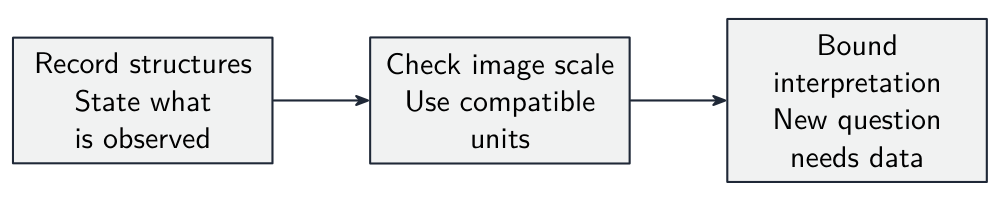
    Các cấu trúc được ghi lại và việc kiểm tra tỷ lệ hỗ trợ cách diễn giải, trong khi những câu hỏi mới đòi hỏi bằng chứng mới.

    Trong trường hợp được cung cấp, một tế bào in trên giấy dài 30,0 milimet và độ dài thực tế được nêu là 0,0500 milimet. Sử dụng cùng đơn vị cho tỷ lệ:

    $$M=\frac{L_{image}}{L_{actual}}$$
    $$M=\frac{30.0\ \text{mm}}{0.0500\ \text{mm}}=600$$

    Độ phóng đại là ×600, không phải là độ dài. Hình dạng và tỷ lệ riêng lẻ không xác định được tốc độ tăng trưởng. Một nghiên cứu tăng trưởng được phép cần một thước đo cụ thể, các sinh vật tương đương, điều kiện và khoảng thời gian quan sát.

    Vocabulary · ⁨Từ vựng⁩ Train · ⁨Luyện tập⁩
    English Tiếng Việt
    collaborative investigation/kəˈlæbrətɪv ɪnˌvestɪˈɡeɪʃn/ khảo sát hợp tác
    Biology/baɪˈɒlədʒi/ Sinh học
    cell/sel/ pin
    Prokaryotic/ˌprɒkərɪˈɒtɪk/ sinh vật nhân sơ
    eukaryotic/ˌjuːkərɪˈɒtɪk/ eukaryotic
    Homeostasis/ˌhəʊmiːəˈstɑːsiz/ Nội cân bằng
    2.2

    The classification of living things · ⁨Phân loại các sinh vật sống⁩

    Syllabus · ⁨Chương trình⁩
    English

    Unit 2 of 7 in GAC023 Science III: General Science (Level III). The module is taught over about 40 class hours plus 20 hours of independent study, and is assessed at the teaching centre and moderated by ACT — there is no external exam.

    The module outcomes this unit works towards:

    Learning Objective GAC023.1: Demonstrate knowledge and understanding of major biological concepts and ideas.

    Tiếng Việt

    Đơn vị 2 trong 7 đơn vị của GAC023 Khoa học III: Khoa học Tổng hợp (Cấp độ III). Mô-đun được giảng dạy trong khoảng 40 giờ học trên lớp cộng thêm 20 giờ tự học, và được đánh giá tại trung tâm giảng dạy và được ACT kiểm duyệt — không có kỳ thi ngoài trường.

    Các kết quả học tập mà đơn vị này hướng tới:

    Mục tiêu học tập GAC023.1: Chứng minh kiến thức và sự hiểu biết về các khái niệm và ý tưởng sinh học chính.

    Source: Cambridge International syllabus · ⁨Nguồn: Chương trình Cambridge International⁩

    English

    Classification 分类 organises organisms using evidence about relationships, including inherited traits and molecular information. A traditional hierarchy is kingdom, phylum, class, order, family, genus and species 物种. Broader groups can contain several groups at the next level. A visible feature helps identification but does not alone establish ancestry.

    Binomial nomenclature 双名法 gives a species a genus name and a specific epithet. Capitalise the genus, use lower case for the epithet and italicise both words in print. When handwriting, underline both as required by the task. The epithet alone is not the full species name.

    Worked example: one genus, different species

    The supplied table places lion, tiger and domestic cat in Felidae. Lion and tiger share Panthera, but their species names are Panthera leo and Panthera tigris. The domestic cat is Felis catus, a different genus within that family. Names checked 2 October 2026 against ITIS records.

    A classroom leaf key can separate needle-like leaves from broad leaves, then smooth margins from toothed margins. This identifies prepared cards from stated features. The key's branch order is not evidence that plants evolved in that order.

    Tiếng Việt

    Phân loại tổ chức các sinh vật dựa trên bằng chứng về mối quan hệ, bao gồm cả đặc điểm di truyền và thông tin phân tử. Một cấp bậc truyền thống là giới, ngành, lớp, bộ, họ, chi và loài. Các nhóm rộng hơn có thể chứa nhiều nhóm ở cấp tiếp theo. Một đặc điểm dễ quan sát giúp nhận diện nhưng không tự thiết lập được tổ tiên.

    Hệ danh pháp hai tên gán cho một loài tên chi và tên riêng. Viết hoa tên chi, viết thường tên riêng và in nghiêng cả hai từ khi in ấn. Khi viết tay, gạch chân cả hai như yêu cầu của bài tập. Tên riêng riêng lẻ không phải là tên đầy đủ của loài.

    Một họ có thể chứa nhiều chi, mỗi chi có thể chứa nhiều loài.

    Ví dụ mẫu: một chi, các loài khác nhau

    Bảng được cung cấp đặt sư tử, hổ và mèo nhà vào Họ Mèo (Felidae). Sư tử và hổ chung Panthera, nhưng tên loài của chúng là Panthera leo và Panthera tigris. Mèo nhà là Felis catus, một chi khác trong họ đó. Các tên đã được kiểm tra vào ngày 2 tháng 10 năm 2026 so với Bản ghi ITIS.

    Chìa khóa lá trong phòng thí nghiệm có thể tách lá kim khỏi lá rộng, sau đó tách mép trơn khỏi mép răng cưa. Điều này giúp xác định các thẻ chuẩn bị sẵn từ các đặc điểm đã nêu. Thứ tự nhánh của chìa khóa không phải là bằng chứng cho thấy cây tiến hóa theo thứ tự đó.

    Vocabulary · ⁨Từ vựng⁩ Train · ⁨Luyện tập⁩
    English Tiếng Việt
    Classification/ˌklæsɪfɪˈkeɪʃn/ Phân loại
    species/ˈspiːsiːz/ loài
    Binomial nomenclature/baɪˈnəʊmɪəl nəˈmeŋklətʃə/ danh pháp hai phần
    2.3

    Ecosystems · ⁨Hệ sinh thái⁩

    Syllabus · ⁨Chương trình⁩
    English

    Unit 3 of 7 in GAC023 Science III: General Science (Level III). The module is taught over about 40 class hours plus 20 hours of independent study, and is assessed at the teaching centre and moderated by ACT — there is no external exam.

    The module outcomes this unit works towards:

    Learning Objective GAC023.2: Describe the main components of an ecosystem and the main processes that take place in it.

    Tiếng Việt

    Đơn vị 3 trong 7 đơn vị của GAC023 Khoa học III: Khoa học Tổng hợp (Cấp độ III). Mô-đun được giảng dạy trong khoảng 40 giờ học trên lớp cộng thêm 20 giờ tự học, và được đánh giá tại trung tâm giảng dạy và được ACT kiểm duyệt — không có kỳ thi ngoài trường.

    Các kết quả học tập mà đơn vị này hướng tới:

    Mục tiêu học tập GAC023.2: Mô tả các thành phần chính của hệ sinh thái và các quá trình chính diễn ra trong đó.

    Source: Cambridge International syllabus · ⁨Nguồn: Chương trình Cambridge International⁩

    English

    An ecosystem 生态系统 includes organisms and nonliving conditions. Producers 生产者 make organic material using an energy source. Consumers 消费者 obtain it from other organisms. Decomposers 分解者 break down dead material and waste, helping return nutrients to available forms.

    Food-chain arrows point from food to consumer. Energy enters and transfers through the system, with dissipation through respiration and other pathways. It does not disappear from existence or cycle indefinitely back to the producer. Matter can cycle through living and nonliving parts, although a local system can also gain or lose matter across its boundary.

    Biodiversity 生物多样性 concerns the variety of life. Species richness and distributions of abundance are possible measures, depending on the question. Counting only one species does not describe all this variety. Diversity may affect ecosystem responses, but it does not guarantee resistance to every disturbance.

    Worked example: transfer percentages are case-specific

    For the separate meadow record, grass has 5,000 joules in its defined level, grasshoppers receive 600 and frogs receive 60. The efficiency relation is:

    $$\eta=\frac{E_{next}}{E_{previous}}\times100\%$$
    $$\eta_1=\frac{600}{5000}\times100\%=12\%$$
    $$\eta_2=\frac{60}{600}\times100\%=10\%$$

    Neither result makes ten percent a universal law. Not all material is eaten or assimilated, and energy is used and dissipated. This period's budget contains no population trend, so it cannot predict an exact frog decline the next week.

    Tiếng Việt

    Một hệ sinh thái bao gồm các sinh vật và các điều kiện phi sống. Nhà sản xuất tạo ra vật liệu hữu cơ bằng cách sử dụng một nguồn năng lượng. Người tiêu dùng thu nhận nó từ các sinh vật khác. Vi sinh vật phân hủy phá vỡ vật liệu chết và chất thải, giúp hoàn trả dinh dưỡng về các dạng có sẵn.

    Mũi tên trong chuỗi thức ăn chỉ từ thức ăn sang người tiêu dùng. Năng lượng đi vào và chuyển qua hệ thống, với sự tiêu hao qua hô hấp và các đường dẫn khác. Nó không biến mất khỏi tồn tại hay tuần hoàn vô tận trở lại nhà sản xuất. Vật chất có thể tuần hoàn qua các phần sống và phi sống, mặc dù một hệ thống cục bộ cũng có thể nhận hoặc mất vật chất qua biên giới của nó.

    Đa dạng sinh học liên quan đến sự đa dạng của sự sống. Độ phong phú của loài và sự phân bố mức độ phổ biến là các thước đo khả thi, tùy thuộc vào câu hỏi. Đếm chỉ một loài không mô tả hết sự đa dạng này. Đa dạng có thể ảnh hưởng đến phản ứng của hệ sinh thái, nhưng không đảm bảo khả năng chống chịu với mọi tác động.

    Chuỗi tảo minh họa sử dụng các giá trị năng lượng được cung cấp, không phải quy tắc chuyển giao phổ quát.

    Ví dụ mẫu: tỷ lệ chuyển giao phụ thuộc từng trường hợp

    Đối với bản ghi đồng cỏ riêng biệt, cỏ chứa 5,000 joule ở mức xác định của nó, côn trùng grasshopper nhận được 600 và ếch nhận được 60. Mối quan hệ hiệu suất là:

    $$\eta=\frac{E_{next}}{E_{previous}}\times100\%$$
    $$\eta_1=\frac{600}{5000}\times100\%=12\%$$
    $$\eta_2=\frac{60}{600}\times100\%=10\%$$

    Không kết quả nào làm cho mười phần trăm thành luật phổ quát. Không phải tất cả vật chất đều được ăn hoặc hấp thụ, và năng lượng được sử dụng và tiêu hao. Ngân sách kỳ này không chứa xu hướng quần thể, do đó không thể dự đoán chính xác sự suy giảm của ếch vào tuần sau.

    Vocabulary · ⁨Từ vựng⁩ Train · ⁨Luyện tập⁩
    English Tiếng Việt
    ecosystem/ˈiːkəʊsɪstəm/ hệ sinh thái
    Producers/prəˈdjuːsəz/ Nhà sản xuất
    consumers/kənˈsuːməz/ người tiêu dùng
    decomposers/ˌdiːkəmˈpəʊzəz/ sinh vật phân hủy
    Biodiversity/ˌbaɪəʊdaɪˈvɜːsɪti/ Đa dạng sinh học
    rock cycle/rɒk ˈsaɪkl/ chu kỳ đá
    Renewable/rɪˈnjuːəbl/ Tái tạo
    non-renewable/nɒn rɪˈnjuːəbl/ không tái tạo
    water cycle/ˈwɔːtə ˈsaɪkl/ chu kỳ nước
    2.4

    Earth resources · ⁨Tài nguyên Trái Đất⁩

    Syllabus · ⁨Chương trình⁩
    English

    Unit 4 of 7 in GAC023 Science III: General Science (Level III). The module is taught over about 40 class hours plus 20 hours of independent study, and is assessed at the teaching centre and moderated by ACT — there is no external exam.

    The module outcomes this unit works towards:

    Learning Objective GAC023.3: Identify and describe the physical, chemical and biological features of the local environment.

    Learning Objective GAC023.8: Create a written report following scientific and academic conventions using Internet research.

    Tiếng Việt

    Đơn vị 4 trong 7 đơn vị của GAC023 Khoa học III: Khoa học Tổng hợp (Cấp độ III). Mô-đun được giảng dạy trong khoảng 40 giờ học trên lớp cộng thêm 20 giờ tự học, và được đánh giá tại trung tâm giảng dạy và được ACT kiểm duyệt — không có kỳ thi ngoài trường.

    Các kết quả học tập mà đơn vị này hướng tới:

    Mục tiêu học tập GAC023.3: Xác định và mô tả các đặc điểm vật lý, hóa học và sinh học của môi trường địa phương.

    Mục tiêu học tập GAC023.8: Soạn thảo báo cáo viết theo các quy ước khoa học và học thuật bằng cách sử dụng nghiên cứu qua Internet.

    Source: Cambridge International syllabus · ⁨Nguồn: Chương trình Cambridge International⁩

    English

    The rock cycle 岩石循环 connects formation and change. Cooling and solidification form igneous rock; sediment deposition, compaction and cementation can form sedimentary rock; heat and pressure can alter rock into metamorphic rock without melting it. Weathering and erosion produce sediment, while melting and later cooling form another route. These processes are not one compulsory circular sequence for every rock.

    Renewable 可再生 resources can be replenished on a relevant timescale. Non-renewable 不可再生 resources are not replenished fast enough on human-use timescales. Renewable does not mean unlimited: demand can exceed replacement, and ecosystem needs also matter.

    The water cycle 水循环 includes evaporation, condensation, precipitation and movement or storage through runoff, infiltration and groundwater. A local pond is open to inputs and losses. A report should combine physical layout, dated chemical measurements and non-destructive biological records, citing their sources and methods.

    Worked example: renewal versus extraction

    In the simplified supplied budget, inputs are 30 cubic metres, outlet loss is 18 and evaporation is 7. Other changes are excluded by assumption:

    $$\Delta S=I-O-E$$
    $$\Delta S=30-18-7=5\ \text{m}^3$$

    With a proposed additional extraction of 12 cubic metres:

    $$\Delta S=I-O-E-X$$
    $$\Delta S=30-18-7-12=-7\ \text{m}^3$$

    That period's estimate does not establish long-term sustainability, initial storage or permission to extract. Reeds do not prove drinking-water safety. A rock photograph does not establish every rock's type or exact age.

    Tiếng Việt

    Chu kỳ đá kết nối quá trình hình thành và biến đổi. Sự nguội lạnh và đông đặc tạo ra đá magma; sự lắng đọng trầm tích, nén chặt và kết dính có thể tạo ra đá trầm tích; nhiệt và áp suất có thể biến đổi đá thành đá biến chất mà không làm tan chảy nó. Phong hóa và xói mòn tạo ra trầm tích, trong khi tan chảy và sau đó nguội lạnh tạo ra một lộ trình khác. Các quá trình này không phải là một chu trình vòng tròn bắt buộc duy nhất cho mọi loại đá.

    Tài nguyên tái tạo có thể được bổ sung trên thang thời gian thích hợp. Tài nguyên không tái tạo không được bổ sung nhanh enough trên thang thời gian sử dụng của con người. Tái tạo không có nghĩa là vô hạn: nhu cầu có thể vượt quá tốc độ tái tạo, và nhu cầu của hệ sinh thái cũng quan trọng.

    Chu kỳ nước bao gồm sự bay hơi, ngưng tụ, mưa và sự di chuyển hoặc lưu trữ thông qua dòng chảy mặt, thẩm thấu và nước ngầm. Một hồ địa phương mở cửa với các đầu vào và tổn thất. Một báo cáo nên kết hợp bố trí vật lý, các phép đo hóa học có ngày tháng và các bản ghi sinh học không phá hủy, trích dẫn nguồn gốc và phương pháp của chúng.

    Ngân sách hồ địa phương ghi nhận các đầu vào, lưu trữ và tổn thất trong biên giới và khoảng thời gian đã nêu.

    Ví dụ mẫu: tái tạo so với khai thác

    Trong ngân sách đơn giản được cung cấp, đầu vào là 30 mét khối, tổn thất đầu ra là 18 và bay hơi là 7. Các thay đổi khác bị loại trừ theo giả định:

    $$\Delta S=I-O-E$$
    $$\Delta S=30-18-7=5\ \text{m}^3$$

    Với việc khai thác thêm đề xuất là 12 mét khối:

    $$\Delta S=I-O-E-X$$
    $$\Delta S=30-18-7-12=-7\ \text{m}^3$$

    Đánh giá trong thời kỳ đó không xác định được khả năng bền vững lâu dài, lưu trữ ban đầu hay giấy phép khai thác. Cỏ sậy không chứng minh an toàn cho nước uống. Một bức ảnh chụp đá không xác định loại hoặc tuổi chính xác của mọi viên đá.

    2.5

    Chemistry · ⁨Hóa học⁩

    Syllabus · ⁨Chương trình⁩
    English

    Unit 5 of 7 in GAC023 Science III: General Science (Level III). The module is taught over about 40 class hours plus 20 hours of independent study, and is assessed at the teaching centre and moderated by ACT — there is no external exam.

    The module outcomes this unit works towards:

    Learning Objective GAC023.4: Demonstrate an understanding of atomic structure, the changes it can undergo and the use of the Periodic Table.

    Tiếng Việt

    Đơn vị 5 trong 7 đơn vị của GAC023 Khoa học III: Khoa học Tổng hợp (Cấp độ III). Mô-đun được giảng dạy trong khoảng 40 giờ học trên lớp cộng thêm 20 giờ tự học, và được đánh giá tại trung tâm giảng dạy và được ACT kiểm duyệt — không có kỳ thi ngoài trường.

    Các kết quả học tập mà đơn vị này hướng tới:

    Mục tiêu học tập GAC023.4: Thể hiện sự hiểu biết về cấu tạo nguyên tử, những biến đổi mà nó có thể trải qua và việc sử dụng Bảng tuần hoàn.

    Source: Cambridge International syllabus · ⁨Nguồn: Chương trình Cambridge International⁩

    English

    An atom 原子 has a nucleus and electrons. Its atomic number 原子序数 is its proton count, while its mass number 质量数 counts protons and neutrons. Most nuclei contain both, but hydrogen-1 has one proton and no neutron. Isotopes 同位素 of an element have the same proton count and different neutron counts.

    The periodic table 元素周期表 orders elements by atomic number. In an introductory main-group model, outer electron arrangements help explain similarities within groups. The elements are not identical, and the simplified rule should not be extended without care to every element.

    Ionic bonds 离子键 are attractions between oppositely charged ions. Electron transfer can explain their formation; it is not the attraction itself. Covalent bonds 共价键 involve shared electron pairs. These are explanatory models, not instructions to handle reactive materials.

    Worked example: keep proton number unchanged

    Sodium-23 has 11 protons and mass number 23:

    $$N=A-Z$$
    $$N=23-11=12$$

    Its neutral atom has 11 electrons. Losing one gives Na⁺ with ten electrons and the same eleven protons. Sodium-24 has thirteen neutrons but remains sodium. Neutral chlorine has seventeen electrons; gaining one gives Cl⁻ with eighteen. Their opposite charges explain attraction.

    Tiếng Việt

    Một nguyên tử có hạt nhân và electron. Số hiệu nguyên tử là số proton của nó, trong khi số khối đếm cả proton và neutron. Hầu hết các hạt nhân chứa cả hai, nhưng hydro-1 chỉ có một proton và không có neutron. Đồng vị của một nguyên tố có cùng số lượng proton nhưng khác nhau về số lượng neutron.

    Bảng tuần hoàn sắp xếp các nguyên tố theo số hiệu nguyên tử. Trong mô hình nhóm chính sơ cấp, cấu hình electron lớp ngoài giúp giải thích sự tương đồng trong các nhóm. Các nguyên tố không giống hệt nhau, và quy tắc đơn giản hóa này không nên mở rộng tùy tiện ra mọi nguyên tố.

    Liên kết ion là lực hút giữa các ion mang điện tích trái dấu. Sự chuyển giao electron có thể giải thích sự hình thành của chúng; đây không phải là bản thân lực hút. Liên kết cộng hóa trị liên quan đến các cặp electron chung. Đây là các mô hình giải thích, không phải hướng dẫn xử lý vật liệu phản ứng.

    Proton xác định nguyên tố, neutron phân biệt đồng vị, và sự thay đổi electron quyết định điện tích ion.

    Ví dụ minh họa: giữ nguyên số proton

    Natri-23 có 11 proton và số khối là 23:

    $$N=A-Z$$
    $$N=23-11=12$$

    Nguyên tử trung hòa của nó có 11 electron. Mất đi một electron sẽ tạo ra Na⁺ với mười electron nhưng vẫn giữ nguyên Drivers eleven proton. Natri-24 có mười ba neutron nhưng vẫn là natri. Clo trung hòa có mười bảy electron; nhận thêm một electron tạo thành Cl⁻ với mười tám electron. Điện tích trái dấu của chúng giải thích lực hút.

    Vocabulary · ⁨Từ vựng⁩ Train · ⁨Luyện tập⁩
    English Tiếng Việt
    atom/ˈætəm/ nguyên tử
    atomic number/əˈtɒmɪk ˈnʌmbə/ số nguyên tử
    mass number/mæs ˈnʌmbə/ số khối
    isotopes/ˈaɪsətəʊps/ đồng vị
    periodic table/ˌpɪərɪˈɒdɪk ˈteɪbl/ bảng tuần hoàn
    Ionic bonds/aɪˈɒnɪk bɒndz/ liên kết ion
    covalent bonds/ˈkəʊvələnt bɒndz/ liên kết cộng hóa trị
    Combustion/kəmˈbʌstʃn/ Đốt cháy
    greenhouse effect/ˈɡriːnhaʊs ɪˈfekt/ hiệu ứng nhà kính
    Acid rain/ˈæsɪd reɪn/ Mưa axit
    Pollution/pəˈluːʃn/ Ô nhiễm
    2.6

    Chemistry and the environment · ⁨Hóa học và môi trường⁩

    Syllabus · ⁨Chương trình⁩
    English

    Unit 6 of 7 in GAC023 Science III: General Science (Level III). The module is taught over about 40 class hours plus 20 hours of independent study, and is assessed at the teaching centre and moderated by ACT — there is no external exam.

    The module outcomes this unit works towards:

    Learning Objective GAC023.5: Explain how applications of chemistry affect the environment.

    Tiếng Việt

    Đơn vị 6 trong 7 đơn vị của GAC023 Khoa học III: Khoa học Tổng hợp (Cấp độ III). Mô-đun được giảng dạy trong khoảng 40 giờ học trên lớp cộng thêm 20 giờ tự học, và được đánh giá tại trung tâm giảng dạy và được ACT kiểm duyệt — không có kỳ thi ngoài trường.

    Các kết quả học tập mà đơn vị này hướng tới:

    Mục tiêu học tập GAC023.5: Giải thích cách các ứng dụng của hóa học ảnh hưởng đến môi trường.

    Source: Cambridge International syllabus · ⁨Nguồn: Chương trình Cambridge International⁩

    English

    Combustion 燃烧 of carbon-containing fuels can release carbon dioxide. The greenhouse effect 温室效应 involves absorption and emission of thermal infrared by gases including carbon dioxide. Acid rain 酸雨 involves atmospheric reactions of sulfur dioxide and nitrogen oxides forming acidic compounds. These are different mechanisms, with different evidence and responses.

    Pollution 污染 depends on a substance or agent, its amount, pathway and effects. Chemistry can help monitor and treat it, but moving material into another output is not necessarily destroying it. Assess benefits alongside energy use, residual material and appropriate waste handling. Sources checked 2 October 2026: EPA acid-rain explanation and NASA radiation budget.

    Worked example: a reduction can still miss a target

    An invented 10-litre treatment record falls from 12.0 to 3.0 milligrams per litre. At unchanged volume:

    $$m=CV$$
    $$m_{remaining}=3.0\ \frac{\text{mg}}{\text{L}}\times10.0\ \text{L}=30\ \text{mg}$$

    The initial mass was 120 milligrams, so ninety are retained on the filter under the stated assumptions. The concentration reduction is seventy-five percent, but the final 3.0 still exceeds the fictional task target of 2.0 milligrams per litre. This is not a real safety standard. Students analyse the supplied data and do not discharge chemicals.

    Tiếng Việt

    Quá trình đốt cháy nhiên liệu chứa carbon có thể giải phóng carbon dioxide. Hiệu ứng nhà kính liên quan đến sự hấp thụ và phát xạ tia hồng ngoại nhiệt bởi các khí bao gồm carbon dioxide. Mưa axit liên quan đến các phản ứng trong khí quyển của sulfur dioxide và oxit nitơ tạo thành các hợp chất có tính axit. Đây là những cơ chế khác nhau, với bằng chứng và phản ứng riêng biệt.

    Ô nhiễm phụ thuộc vào một chất hoặc tác nhân, lượng của nó, đường truyền và tác động. Hóa học có thể giúp giám sát và xử lý ô nhiễm, nhưng việc di chuyển vật liệu sang một đầu ra khác chưa hẳn đã là phá hủy nó. Hãy đánh giá lợi ích song song với mức tiêu thụ năng lượng, vật liệu dư thừa và cách xử lý chất thải phù hợp. Nguồn kiểm tra ngày 2 tháng 10 năm 2026: Giải thích mưa axit của EPA và Ngân sách bức xạ của NASA.

    Quy trình xử lý được cung cấp có đầu ra là chất lỏng và chất thải lọc, cả hai đều vẫn nằm trong kế toán chất.

    Ví dụ minh họa: một sự giảm thiểu vẫn có thể bỏ lỡ mục tiêu

    Một bản ghi xử lý giả định 10 lít giảm từ 12,0 xuống 3,0 miligam trên lít. Ở thể tích không đổi:

    $$m=CV$$
    $$m_{remaining}=3.0\ \frac{\text{mg}}{\text{L}}\times10.0\ \text{L}=30\ \text{mg}$$

    Khối lượng ban đầu là 120 miligam, nên chín mươi phần trăm bị giữ lại trên bộ lọc theo các giả định nêu. Mức độ giảm nồng độ là 75%, nhưng 3,0 cuối cùng vẫn vượt quá mục tiêu bài tập giả định là 2,0 miligam trên lít. Đây không phải là tiêu chuẩn an toàn thực tế. Học sinh phân tích dữ liệu được cung cấp và không được xả hóa chất.

    2.7

    Physics · ⁨Vật lý⁩

    Syllabus · ⁨Chương trình⁩
    English

    Unit 7 of 7 in GAC023 Science III: General Science (Level III). The module is taught over about 40 class hours plus 20 hours of independent study, and is assessed at the teaching centre and moderated by ACT — there is no external exam.

    The module outcomes this unit works towards:

    Learning Objective GAC023.6: Demonstrate an understanding of wave motion.

    Tiếng Việt

    Đơn vị 7 trong 7 đơn vị của GAC023 Khoa học III: Khoa học Tổng hợp (Cấp độ III). Mô-đun được giảng dạy trong khoảng 40 giờ học trên lớp cộng thêm 20 giờ tự học, và được đánh giá tại trung tâm giảng dạy và được ACT kiểm duyệt — không có kỳ thi ngoài trường.

    Các kết quả học tập mà đơn vị này hướng tới:

    Mục tiêu học tập GAC023.6: Thể hiện sự hiểu biết về chuyển động sóng.

    Source: Cambridge International syllabus · ⁨Nguồn: Chương trình Cambridge International⁩

    English

    A wave 波 transfers energy through a travelling disturbance without carrying each medium particle along with it. Frequency 频率 counts complete oscillations per second. Wavelength 波长 is the spacing of successive points in the same phase. Speed 波速 relates them through the wave equation. Amplitude is maximum displacement from equilibrium, not crest-to-trough height.

    Transverse waves 横波 oscillate perpendicular to propagation; longitudinal waves 纵波 oscillate parallel to it. The direction drawn on a page alone does not decide the type. A string point may oscillate vertically while the disturbance moves horizontally.

    The electromagnetic spectrum 电磁波谱 runs through radio, microwaves, infrared, visible light, ultraviolet, X-rays and gamma rays. Electromagnetic waves do not require a material medium. They share the same vacuum speed while differing in frequency and wavelength; mechanical waves do not all have that speed.

    Worked example: choose the equation for the question

    The supplied string wave has frequency 5.0 hertz and wavelength 0.40 metres:

    $$v=f\lambda$$
    $$v=5.0\ \text{Hz}\times0.40\ \text{m}=2.0\ \frac{\text{m}}{\text{s}}$$

    Its period is the time per complete oscillation:

    $$T=\frac{1}{f}$$
    $$T=\frac{1}{5.0}=0.20\ \text{s}$$

    An amplitude of 0.030 metres gives a crest-to-trough height of 0.060 metres. Neither is the 0.40-metre wavelength. A marked point oscillates about equilibrium; no supplied observation establishes that changing amplitude changes frequency.

    Tiếng Việt

    Một sóng truyền năng lượng qua sự dao động lan truyền mà không kéo theo từng hạt môi trường đi cùng. Tần số đếm số lần dao động hoàn chỉnh mỗi giây. Bước sóng là khoảng cách giữa các điểm liên tiếp cùng pha. Tốc độ liên hệ chúng thông qua phương trình sóng. Biên độ là độ lệch cực đại so với vị trí cân bằng, không phải chiều cao từ đỉnh đến đáy sóng.

    Sóng ngang dao động vuông góc với phương truyền; sóng dọc dao động song song với phương truyền. Hướng vẽ trên trang giấy duy nhất không quyết định loại sóng. Một điểm trên dây có thể dao động theo phương đứng trong khi sự dao động lan chuyển theo phương ngang.

    Phổ điện từ trải qua vô tuyến, vi sóng, hồng ngoại, ánh sáng nhìn thấy, tia cực tím, tia X và tia gamma. Sóng điện từ không cần môi trường vật chất. Chúng chia sẻ cùng tốc độ trong chân không nhưng khác nhau về tần số và bước sóng; sóng cơ học không phải loại nào cũng có tốc độ như vậy.

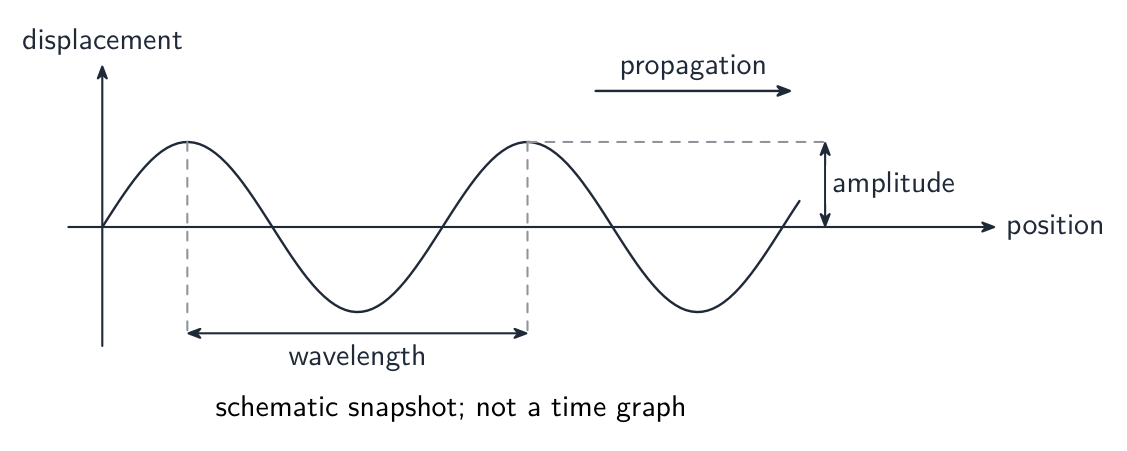
    Sơ đồ cắt ngang sóng ngang tách biệt bước sóng và biên độ khỏi phương truyền.

    Ví dụ minh họa: chọn phương trình cho câu hỏi

    Sóng dây được cung cấp có tần số 5,0 hertz và bước sóng 0,40 mét:

    $$v=f\lambda$$
    $$v=5.0\ \text{Hz}\times0.40\ \text{m}=2.0\ \frac{\text{m}}{\text{s}}$$

    Chu kỳ là thời gian cho một lần dao động hoàn chỉnh:

    $$T=\frac{1}{f}$$
    $$T=\frac{1}{5.0}=0.20\ \text{s}$$

    Biên độ 0,030 mét tương ứng với chiều cao từ đỉnh đến đáy là 0,060 mét. Cả hai đều không phải là bước sóng 0,40 mét. Một điểm đánh dấu dao động quanh vị trí cân bằng; không có quan sát nào được cung cấp thiết lập rằng thay đổi biên độ làm thay đổi tần số.

    Vocabulary · ⁨Từ vựng⁩ Train · ⁨Luyện tập⁩
    English Tiếng Việt
    wave/weɪv/ sóng
    Frequency/ˈfriːkwənsi/ Tần số
    wavelength/ˈweɪvleŋθ/ bước sóng
    speed/spiːd/ tốc độ
    Transverse waves/trænsˈvɜːs weɪvz/ Sóng ngang
    longitudinal waves/ˌlɒŋɡɪˈtjuːdɪnl weɪvz/ sóng dọc
    electromagnetic spectrum/ɪˌlektrəʊməɡˈnetɪk ˈspektrəm/ phổ điện từ
    Additional notes PDF

    A team investigation needs more than divided writing

    Two teams describe the same pond. One records where and when observations were made; the other combines undated photographs and a website's general statements. Which report lets a reader check its conclusions? This supplement develops the collaborative investigation and Internet-research outcomes alongside the original GAC023 handout. Follow the current centre brief for the required task, methods and assessment criteria.

    Agree a question, method and team record

    A collaborative investigation 合作探究 shares a scientific task with clear responsibilities and a common method. Choose a narrow question that permitted observations can address. For example: how does the proportion of ground covered by the selected plant differ between two accessible, teacher-approved areas? This is a comparison of coverage, not automatically a test of growth rate or proof of the cause of a difference.

    A sampling method 取样方法 specifies how observations are selected. Define the areas and observation period before collecting records. Use the same frame size and counting rule at both areas. Select positions by an agreed method, rather than choosing only attractive examples. Random selection within an accessible area can reduce deliberate selection, but cannot represent places excluded from that area. Keep repeats 重复测量 distinct from revisiting the exact same record: ten photographs of one patch are not ten independent patches.

    Agree which member records location and time, which estimates coverage and which checks the entries. Rotate or check roles if different observers could systematically use different rules. A common recording sheet needs labels, units, the selection method and any deviations. Keep each original record and identify its observer. Resolve a disagreement by checking the agreed rule and evidence; do not replace an inconvenient result with the group average.

    Obtain teacher agreement before fieldwork. Respect access restrictions, weather and local site rules. Use permitted observations without entering unsafe water or collecting unknown organisms or chemicals. A report about a proposed investigation must call it proposed. Research does not replace required fieldwork.

    Analyse a supplied case without inventing causes

    The following supplied data 给定数据 are fictional practice records, not a completed field investigation. Both areas use the same coverage rule and frame size. Each row represents a different selected position.

    Position Area A coverage / % Area B coverage / %
    1 20 40
    2 30 50
    3 40 60
    Mean 30 50

    Calculate each mean from its three records. The mean difference is 50 − 30 = 20 percentage points 百分点. Each area's range is twenty percentage points. A difference of twenty percentage points is not the same statement as a twenty-percent relative increase: relative to A's mean, the increase would be 20 ÷ 30 × 100%, approximately 66.7%.

    A suitable conclusion 结论 is: in the supplied samples, mean coverage was greater in B, with variation within both areas. Three samples do not establish all seasons or every part of the pond. The table gives no light, soil, water or time-series measurements. It therefore cannot show that pollution caused the difference or that a plant grew faster. Coverage also does not measure species richness. Identify the additional question and measurements needed rather than inventing an explanation.

    Describe the local environment through different evidence

    A physical feature 物理特征 concerns conditions such as layout, slope, shade or water movement. A chemical feature 化学特征 concerns substances and quantities, such as a dated concentration measured by a stated method. A biological feature 生物特征 concerns organisms, their distribution and relationships. Keep the categories connected without treating one as proof of another.

    For a local environment report, use a labelled location description and dated records. State which observations your team made and which came from another source. An organism photograph can support an identification within its limits; it cannot establish drinking-water safety. A chemical result without a date, unit or method may be unsuitable for the comparison. If the assignment uses secondary information only, state that limitation rather than presenting it as your own measurement.

    Research online and make the report traceable

    A secondary source 二手资料 reports information collected or interpreted by someone else. Check the producer, date, purpose, method and relevance to your question. Prefer the original measurement record or research report when available. A search-result preview does not replace reading the source. Two websites repeating one report are not two independent observations.

    Keep a source log as you research: author or organisation, title, date, address, the exact claim used and its limits. Use the reference style required by your brief. A citation 引用标注 links a claim to its source; the reference list gives the details needed to locate it. Explain the idea in your own words while citing it. Cite borrowed images and respect their permitted use. Do not make a missing date, method or author up.

    Organise the report around question and background, method and team responsibilities, results, discussion and conclusion, and references. Distinguish observation from explanation, and your records from published background. Show checked calculations, units and labelled tables. Discuss a specific limitation and a matching improvement. A reflection should identify each person's actual contribution and a concrete coordination issue; equal-length paragraphs do not demonstrate equal participation.

    Practice and explained answers

    1. Why are ten photographs of one patch not ten independent patches?
    2. Calculate the mean difference for the supplied coverage data, with its unit.
    3. Can these data prove pollution caused the coverage difference? Explain.
    4. What must accompany a borrowed chemical measurement?
    5. Two sites repeat one report. How many independent records does this establish?
    6. What should a team do when its members disagree about one coverage entry?

    Answers.

    1. The sampled location has not changed; extra photographs do not broaden sampling.
    2. 50 − 30 = 20 percentage points, not twenty percent relative to A.
    3. No. Pollution was not measured, and alternative explanations remain.
    4. Its source, date, unit, method and relevant limitations.
    5. One underlying report; repetition alone adds no independent observation.
    6. Check the shared rule and evidence; retain the original record and correction trail.

Log in or create account · ⁨Đăng nhập hoặc tạo tài khoản⁩

IGCSE, A-Level & AP