Skip to content

GAC023 Science III: General Science

GAC Science · Topic 2

Video lesson for this topic Open the video page
23:58

General Science: Living Systems, Materials, Waves and Evidence

Imagine a pond beside a school. You see plants, water and a label describing a treatment. What can you establish from those observations? Plants do not prove…

English narration · English + 中文 subtitles burned in

2.1

What this module is, and how it is marked

A pond contains organisms, water, minerals and energy transfers. Understanding it needs several kinds of science, and no single observation answers every question. A plant can be present without proving drinking-water safety. A lower chemical concentration can be useful without proving that a substance has been destroyed.

This guide supports GAC023: biology, classification, ecosystems, Earth resources, chemistry, environmental chemistry and waves. A collaborative investigation 合作探究 assigns clear roles and uses a safe, approved procedure. Its report connects recorded observations with a question, method and bounded conclusion. Follow your actual assignment brief; the companion exercise sheets are original practice, not official assessment papers. Invented case data are labelled separately from cited background facts.

Vocabulary Train
English
collaborative investigation/kəˈlæbrətɪv ɪnˌvestɪˈɡeɪʃn/
2.1

The history, nature and practice of biology

Syllabus

Unit 1 of 7 in GAC023 Science III: General Science (Level III). The module is taught over about 40 class hours plus 20 hours of independent study, and is assessed at the teaching centre and moderated by ACT — there is no external exam.

Module purpose: On completion of this module, students should be able to demonstrate a sound understanding of the laws, theories and principles of Biology, Chemistry, Physics, Environmental Science and Earth Sciences.

The module outcomes this unit works towards:

Learning Objective GAC023.1: Demonstrate knowledge and understanding of major biological concepts and ideas.

Learning Objective GAC023.7: Collaboratively plan and implement a scientific investigation following scientific and academic conventions.

Source: Cambridge International syllabus

Biology 生物学 studies living systems, including structure, function and change. A cell 细胞 is the basic structural and functional unit of organisms. Prokaryotic 原核 cells have DNA without a membrane-bound nucleus. Eukaryotic 真核 cells typically contain a nucleus and other membrane-bound structures, with specialised exceptions. Do not infer that a structure is absent simply because one poor image does not show it.

Homeostasis 稳态 is regulation of internal conditions within suitable limits as external conditions vary. It does not mean every internal value stays exactly constant. Biological observations should distinguish what is seen, what is inferred and what would need another method.

Historical context and a scale check

Hooke's Micrographia, published in 1665, used “cell” for the tiny spaces observed in cork. This is a selected historical development, not the whole history of cell theory. Sources checked 2 October 2026: Royal Society account and digitised Micrographia.

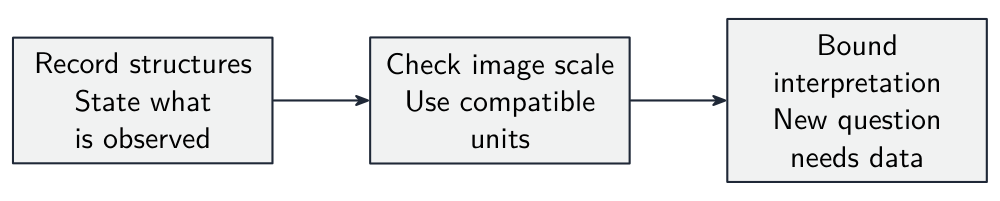
Recorded structures and a scale check support interpretation, while new questions require new evidence.

In the supplied case, a printed cell is 30.0 millimetres long and its stated actual length is 0.0500 millimetres. Use the same units in the ratio:

$$M=\frac{L_{image}}{L_{actual}}$$
$$M=\frac{30.0\ \text{mm}}{0.0500\ \text{mm}}=600$$

The magnification is ×600, not a length. Shape and scale alone do not establish growth rate. A permitted growth study needs a specified measure, comparable organisms, conditions and observation period.

Vocabulary Train
English
Biology/baɪˈɒlədʒi/
cell/sel/
Prokaryotic/ˌprɒkərɪˈɒtɪk/
eukaryotic/ˌjuːkərɪˈɒtɪk/
Homeostasis/ˌhəʊmiːəˈstɑːsiz/
2.2

The classification of living things

Syllabus

Unit 2 of 7 in GAC023 Science III: General Science (Level III). The module is taught over about 40 class hours plus 20 hours of independent study, and is assessed at the teaching centre and moderated by ACT — there is no external exam.

The module outcomes this unit works towards:

Learning Objective GAC023.1: Demonstrate knowledge and understanding of major biological concepts and ideas.

Source: Cambridge International syllabus

Classification 分类 organises organisms using evidence about relationships, including inherited traits and molecular information. A traditional hierarchy is kingdom, phylum, class, order, family, genus and species 物种. Broader groups can contain several groups at the next level. A visible feature helps identification but does not alone establish ancestry.

Binomial nomenclature 双名法 gives a species a genus name and a specific epithet. Capitalise the genus, use lower case for the epithet and italicise both words in print. When handwriting, underline both as required by the task. The epithet alone is not the full species name.

A family can contain several genera, each of which can contain several species.

Worked example: one genus, different species

The supplied table places lion, tiger and domestic cat in Felidae. Lion and tiger share Panthera, but their species names are Panthera leo and Panthera tigris. The domestic cat is Felis catus, a different genus within that family. Names checked 2 October 2026 against ITIS records.

A classroom leaf key can separate needle-like leaves from broad leaves, then smooth margins from toothed margins. This identifies prepared cards from stated features. The key's branch order is not evidence that plants evolved in that order.

Vocabulary Train
English
Classification/ˌklæsɪfɪˈkeɪʃn/
species/ˈspiːsiːz/
Binomial nomenclature/baɪˈnəʊmɪəl nəˈmeŋklətʃə/
2.3

Ecosystems

Syllabus

Unit 3 of 7 in GAC023 Science III: General Science (Level III). The module is taught over about 40 class hours plus 20 hours of independent study, and is assessed at the teaching centre and moderated by ACT — there is no external exam.

The module outcomes this unit works towards:

Learning Objective GAC023.2: Describe the main components of an ecosystem and the main processes that take place in it.

Source: Cambridge International syllabus

An ecosystem 生态系统 includes organisms and nonliving conditions. Producers 生产者 make organic material using an energy source. Consumers 消费者 obtain it from other organisms. Decomposers 分解者 break down dead material and waste, helping return nutrients to available forms.

Food-chain arrows point from food to consumer. Energy enters and transfers through the system, with dissipation through respiration and other pathways. It does not disappear from existence or cycle indefinitely back to the producer. Matter can cycle through living and nonliving parts, although a local system can also gain or lose matter across its boundary.

Biodiversity 生物多样性 concerns the variety of life. Species richness and distributions of abundance are possible measures, depending on the question. Counting only one species does not describe all this variety. Diversity may affect ecosystem responses, but it does not guarantee resistance to every disturbance.

An illustrative algae chain uses its supplied energy values, not a universal transfer rule.

Worked example: transfer percentages are case-specific

For the separate meadow record, grass has 5,000 joules in its defined level, grasshoppers receive 600 and frogs receive 60. The efficiency relation is:

$$\eta=\frac{E_{next}}{E_{previous}}\times100\%$$
$$\eta_1=\frac{600}{5000}\times100\%=12\%$$
$$\eta_2=\frac{60}{600}\times100\%=10\%$$

Neither result makes ten percent a universal law. Not all material is eaten or assimilated, and energy is used and dissipated. This period's budget contains no population trend, so it cannot predict an exact frog decline the next week.

Vocabulary Train
English
ecosystem/ˈiːkəʊsɪstəm/
Producers/prəˈdjuːsəz/
consumers/kənˈsuːməz/
decomposers/ˌdiːkəmˈpəʊzəz/
Biodiversity/ˌbaɪəʊdaɪˈvɜːsɪti/
2.4

Earth resources

Syllabus

Unit 4 of 7 in GAC023 Science III: General Science (Level III). The module is taught over about 40 class hours plus 20 hours of independent study, and is assessed at the teaching centre and moderated by ACT — there is no external exam.

The module outcomes this unit works towards:

Learning Objective GAC023.3: Identify and describe the physical, chemical and biological features of the local environment.

Learning Objective GAC023.8: Create a written report following scientific and academic conventions using Internet research.

Source: Cambridge International syllabus

The rock cycle 岩石循环 connects formation and change. Cooling and solidification form igneous rock; sediment deposition, compaction and cementation can form sedimentary rock; heat and pressure can alter rock into metamorphic rock without melting it. Weathering and erosion produce sediment, while melting and later cooling form another route. These processes are not one compulsory circular sequence for every rock.

Renewable 可再生 resources can be replenished on a relevant timescale. Non-renewable 不可再生 resources are not replenished fast enough on human-use timescales. Renewable does not mean unlimited: demand can exceed replacement, and ecosystem needs also matter.

The water cycle 水循环 includes evaporation, condensation, precipitation and movement or storage through runoff, infiltration and groundwater. A local pond is open to inputs and losses. A report should combine physical layout, dated chemical measurements and non-destructive biological records, citing their sources and methods.

A local pond budget records inputs, storage and losses within a stated boundary and period.

Worked example: renewal versus extraction

In the simplified supplied budget, inputs are 30 cubic metres, outlet loss is 18 and evaporation is 7. Other changes are excluded by assumption:

$$\Delta S=I-O-E$$
$$\Delta S=30-18-7=5\ \text{m}^3$$

With a proposed additional extraction of 12 cubic metres:

$$\Delta S=I-O-E-X$$
$$\Delta S=30-18-7-12=-7\ \text{m}^3$$

That period's estimate does not establish long-term sustainability, initial storage or permission to extract. Reeds do not prove drinking-water safety. A rock photograph does not establish every rock's type or exact age.

Vocabulary Train
English
rock cycle/rɒk ˈsaɪkl/
Renewable/rɪˈnjuːəbl/
non-renewable/nɒn rɪˈnjuːəbl/
water cycle/ˈwɔːtə ˈsaɪkl/
2.5

Chemistry

Syllabus

Unit 5 of 7 in GAC023 Science III: General Science (Level III). The module is taught over about 40 class hours plus 20 hours of independent study, and is assessed at the teaching centre and moderated by ACT — there is no external exam.

The module outcomes this unit works towards:

Learning Objective GAC023.4: Demonstrate an understanding of atomic structure, the changes it can undergo and the use of the Periodic Table.

Source: Cambridge International syllabus

An atom 原子 has a nucleus and electrons. Its atomic number 原子序数 is its proton count, while its mass number 质量数 counts protons and neutrons. Most nuclei contain both, but hydrogen-1 has one proton and no neutron. Isotopes 同位素 of an element have the same proton count and different neutron counts.

The periodic table 元素周期表 orders elements by atomic number. In an introductory main-group model, outer electron arrangements help explain similarities within groups. The elements are not identical, and the simplified rule should not be extended without care to every element.

Ionic bonds 离子键 are attractions between oppositely charged ions. Electron transfer can explain their formation; it is not the attraction itself. Covalent bonds 共价键 involve shared electron pairs. These are explanatory models, not instructions to handle reactive materials.

Protons identify the element, neutrons distinguish isotopes, and electron changes determine ionic charge.

Worked example: keep proton number unchanged

Sodium-23 has 11 protons and mass number 23:

$$N=A-Z$$
$$N=23-11=12$$

Its neutral atom has 11 electrons. Losing one gives Na⁺ with ten electrons and the same eleven protons. Sodium-24 has thirteen neutrons but remains sodium. Neutral chlorine has seventeen electrons; gaining one gives Cl⁻ with eighteen. Their opposite charges explain attraction.

Vocabulary Train
English
atom/ˈætəm/
atomic number/əˈtɒmɪk ˈnʌmbə/
mass number/mæs ˈnʌmbə/
isotopes/ˈaɪsətəʊps/
periodic table/ˌpɪərɪˈɒdɪk ˈteɪbl/
Ionic bonds/aɪˈɒnɪk bɒndz/
covalent bonds/ˈkəʊvələnt bɒndz/
2.6

Chemistry and the environment

Syllabus

Unit 6 of 7 in GAC023 Science III: General Science (Level III). The module is taught over about 40 class hours plus 20 hours of independent study, and is assessed at the teaching centre and moderated by ACT — there is no external exam.

The module outcomes this unit works towards:

Learning Objective GAC023.5: Explain how applications of chemistry affect the environment.

Source: Cambridge International syllabus

Combustion 燃烧 of carbon-containing fuels can release carbon dioxide. The greenhouse effect 温室效应 involves absorption and emission of thermal infrared by gases including carbon dioxide. Acid rain 酸雨 involves atmospheric reactions of sulfur dioxide and nitrogen oxides forming acidic compounds. These are different mechanisms, with different evidence and responses.

Pollution 污染 depends on a substance or agent, its amount, pathway and effects. Chemistry can help monitor and treat it, but moving material into another output is not necessarily destroying it. Assess benefits alongside energy use, residual material and appropriate waste handling. Sources checked 2 October 2026: EPA acid-rain explanation and NASA radiation budget.

The supplied treatment has liquid and filter-waste outputs, both of which remain in the substance accounting.

Worked example: a reduction can still miss a target

An invented 10-litre treatment record falls from 12.0 to 3.0 milligrams per litre. At unchanged volume:

$$m=CV$$
$$m_{remaining}=3.0\ \frac{\text{mg}}{\text{L}}\times10.0\ \text{L}=30\ \text{mg}$$

The initial mass was 120 milligrams, so ninety are retained on the filter under the stated assumptions. The concentration reduction is seventy-five percent, but the final 3.0 still exceeds the fictional task target of 2.0 milligrams per litre. This is not a real safety standard. Students analyse the supplied data and do not discharge chemicals.

Vocabulary Train
English
Combustion/kəmˈbʌstʃn/
greenhouse effect/ˈɡriːnhaʊs ɪˈfekt/
Acid rain/ˈæsɪd reɪn/
Pollution/pəˈluːʃn/
2.7

Physics

Syllabus

Unit 7 of 7 in GAC023 Science III: General Science (Level III). The module is taught over about 40 class hours plus 20 hours of independent study, and is assessed at the teaching centre and moderated by ACT — there is no external exam.

The module outcomes this unit works towards:

Learning Objective GAC023.6: Demonstrate an understanding of wave motion.

Source: Cambridge International syllabus

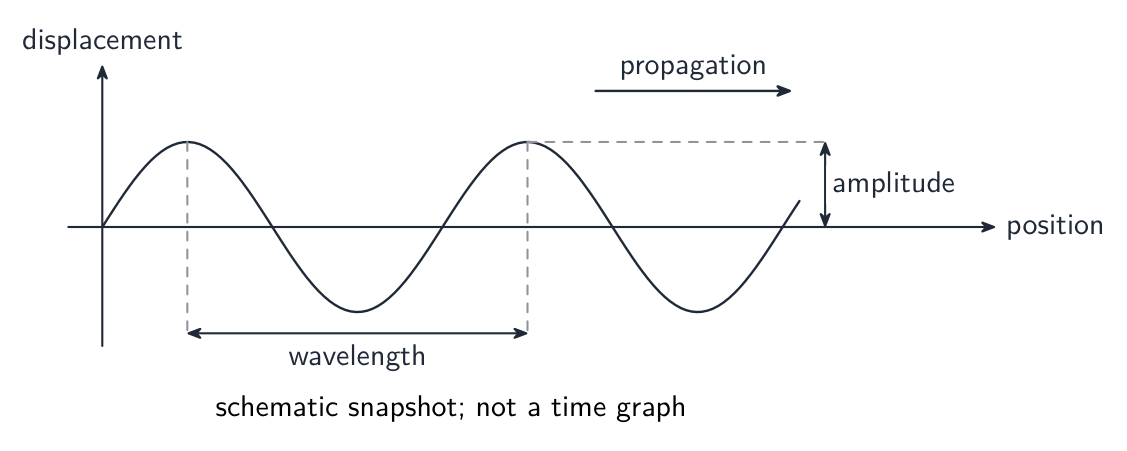
A wave 波 transfers energy through a travelling disturbance without carrying each medium particle along with it. Frequency 频率 counts complete oscillations per second. Wavelength 波长 is the spacing of successive points in the same phase. Speed 波速 relates them through the wave equation. Amplitude is maximum displacement from equilibrium, not crest-to-trough height.

Transverse waves 横波 oscillate perpendicular to propagation; longitudinal waves 纵波 oscillate parallel to it. The direction drawn on a page alone does not decide the type. A string point may oscillate vertically while the disturbance moves horizontally.

The electromagnetic spectrum 电磁波谱 runs through radio, microwaves, infrared, visible light, ultraviolet, X-rays and gamma rays. Electromagnetic waves do not require a material medium. They share the same vacuum speed while differing in frequency and wavelength; mechanical waves do not all have that speed.

A schematic transverse-wave snapshot separates wavelength and amplitude from propagation direction.

Worked example: choose the equation for the question

The supplied string wave has frequency 5.0 hertz and wavelength 0.40 metres:

$$v=f\lambda$$
$$v=5.0\ \text{Hz}\times0.40\ \text{m}=2.0\ \frac{\text{m}}{\text{s}}$$

Its period is the time per complete oscillation:

$$T=\frac{1}{f}$$
$$T=\frac{1}{5.0}=0.20\ \text{s}$$

An amplitude of 0.030 metres gives a crest-to-trough height of 0.060 metres. Neither is the 0.40-metre wavelength. A marked point oscillates about equilibrium; no supplied observation establishes that changing amplitude changes frequency.

Vocabulary Train
English
wave/weɪv/
Frequency/ˈfriːkwənsi/
wavelength/ˈweɪvleŋθ/
speed/spiːd/
Transverse waves/trænsˈvɜːs weɪvz/
longitudinal waves/ˌlɒŋɡɪˈtjuːdɪnl weɪvz/
electromagnetic spectrum/ɪˌlektrəʊməɡˈnetɪk ˈspektrəm/
Additional notes PDF

A team investigation needs more than divided writing

Two teams describe the same pond. One records where and when observations were made; the other combines undated photographs and a website's general statements. Which report lets a reader check its conclusions? This supplement develops the collaborative investigation and Internet-research outcomes alongside the original GAC023 handout. Follow the current centre brief for the required task, methods and assessment criteria.

Agree a question, method and team record

A collaborative investigation 合作探究 shares a scientific task with clear responsibilities and a common method. Choose a narrow question that permitted observations can address. For example: how does the proportion of ground covered by the selected plant differ between two accessible, teacher-approved areas? This is a comparison of coverage, not automatically a test of growth rate or proof of the cause of a difference.

A sampling method 取样方法 specifies how observations are selected. Define the areas and observation period before collecting records. Use the same frame size and counting rule at both areas. Select positions by an agreed method, rather than choosing only attractive examples. Random selection within an accessible area can reduce deliberate selection, but cannot represent places excluded from that area. Keep repeats 重复测量 distinct from revisiting the exact same record: ten photographs of one patch are not ten independent patches.

Agree which member records location and time, which estimates coverage and which checks the entries. Rotate or check roles if different observers could systematically use different rules. A common recording sheet needs labels, units, the selection method and any deviations. Keep each original record and identify its observer. Resolve a disagreement by checking the agreed rule and evidence; do not replace an inconvenient result with the group average.

Obtain teacher agreement before fieldwork. Respect access restrictions, weather and local site rules. Use permitted observations without entering unsafe water or collecting unknown organisms or chemicals. A report about a proposed investigation must call it proposed. Research does not replace required fieldwork.

Analyse a supplied case without inventing causes

The following supplied data 给定数据 are fictional practice records, not a completed field investigation. Both areas use the same coverage rule and frame size. Each row represents a different selected position.

Position Area A coverage / % Area B coverage / %
1 20 40
2 30 50
3 40 60
Mean 30 50

Calculate each mean from its three records. The mean difference is 50 − 30 = 20 percentage points 百分点. Each area's range is twenty percentage points. A difference of twenty percentage points is not the same statement as a twenty-percent relative increase: relative to A's mean, the increase would be 20 ÷ 30 × 100%, approximately 66.7%.

A suitable conclusion 结论 is: in the supplied samples, mean coverage was greater in B, with variation within both areas. Three samples do not establish all seasons or every part of the pond. The table gives no light, soil, water or time-series measurements. It therefore cannot show that pollution caused the difference or that a plant grew faster. Coverage also does not measure species richness. Identify the additional question and measurements needed rather than inventing an explanation.

Describe the local environment through different evidence

A physical feature 物理特征 concerns conditions such as layout, slope, shade or water movement. A chemical feature 化学特征 concerns substances and quantities, such as a dated concentration measured by a stated method. A biological feature 生物特征 concerns organisms, their distribution and relationships. Keep the categories connected without treating one as proof of another.

For a local environment report, use a labelled location description and dated records. State which observations your team made and which came from another source. An organism photograph can support an identification within its limits; it cannot establish drinking-water safety. A chemical result without a date, unit or method may be unsuitable for the comparison. If the assignment uses secondary information only, state that limitation rather than presenting it as your own measurement.

Research online and make the report traceable

A secondary source 二手资料 reports information collected or interpreted by someone else. Check the producer, date, purpose, method and relevance to your question. Prefer the original measurement record or research report when available. A search-result preview does not replace reading the source. Two websites repeating one report are not two independent observations.

Keep a source log as you research: author or organisation, title, date, address, the exact claim used and its limits. Use the reference style required by your brief. A citation 引用标注 links a claim to its source; the reference list gives the details needed to locate it. Explain the idea in your own words while citing it. Cite borrowed images and respect their permitted use. Do not make a missing date, method or author up.

Organise the report around question and background, method and team responsibilities, results, discussion and conclusion, and references. Distinguish observation from explanation, and your records from published background. Show checked calculations, units and labelled tables. Discuss a specific limitation and a matching improvement. A reflection should identify each person's actual contribution and a concrete coordination issue; equal-length paragraphs do not demonstrate equal participation.

Practice and explained answers

  1. Why are ten photographs of one patch not ten independent patches?
  2. Calculate the mean difference for the supplied coverage data, with its unit.
  3. Can these data prove pollution caused the coverage difference? Explain.
  4. What must accompany a borrowed chemical measurement?
  5. Two sites repeat one report. How many independent records does this establish?
  6. What should a team do when its members disagree about one coverage entry?

Answers.

  1. The sampled location has not changed; extra photographs do not broaden sampling.
  2. 50 − 30 = 20 percentage points, not twenty percent relative to A.
  3. No. Pollution was not measured, and alternative explanations remain.
  4. Its source, date, unit, method and relevant limitations.
  5. One underlying report; repetition alone adds no independent observation.
  6. Check the shared rule and evidence; retain the original record and correction trail.

Interactive lessons on this topic

Work through it step by step, with instant-check exercises.

Log in or create account

IGCSE, A-Level & AP