แผนการเรียนรู้ของคุณ · ดำเนินต่อ · ทบทวน →
非(要) … 不可 (จำเป็นต้อง / มั่นใจอย่างยิ่ง)
แนะนำใหม่ตำแหน่งที่คุณบันทึกจะคงอยู่ในเบราว์เซอร์นี้ การต่อจากตำแหน่งจะไม่ทำให้บทเรียนเสร็จสิ้นหรือตอบคำถามในบทเรียน
 6:57
HSK 6 Grammar 7: รูปแบบขั้นสูง
มินาเชื่อแล้วว่าทำโปสเตอร์ใหม่คืนนี้เป็นเรื่องไม่ดี และเธอกำลังกดดันให้กลุ่มเห็นด้วย:都十一点了,现在重做海报岂不是更耽误事? ถึงสิบหนึ่งแล้วตอนนี้ทำโปสเตอร์ใหม่ไม่ใช่ยิ่งเสียเวลาเหรอ?
คำอธิบายภาษาอังกฤษ + ตัวอย่างภาษา mandarins · คำบรรยายตามข้อความที่พูด
ในบทเรียนนี้
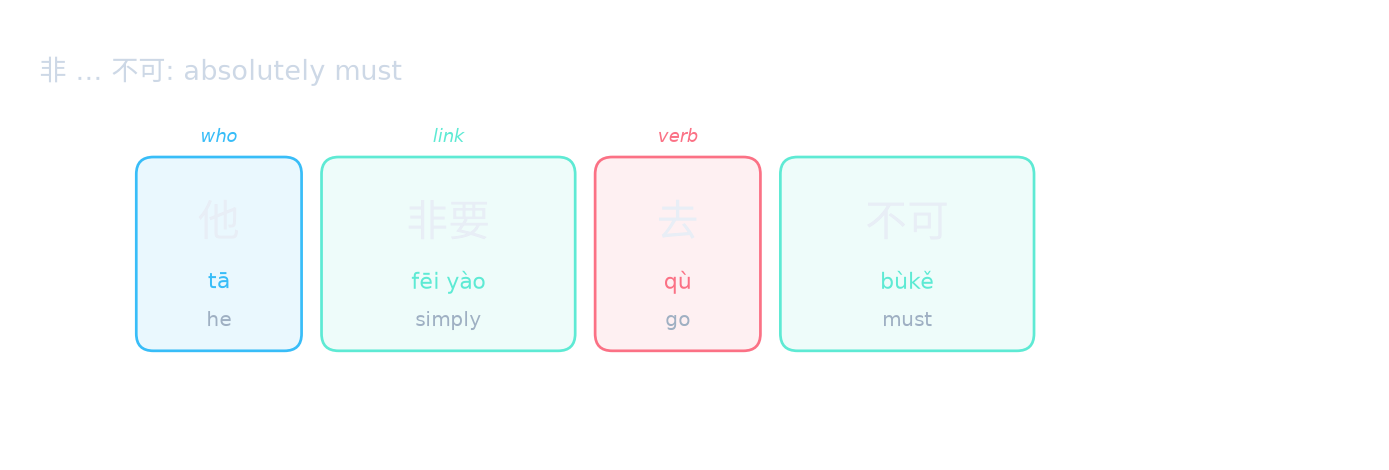
He simply must go
- Your little brother wants to go to the amusement park in the rain and won't take no for an answer.
- down / next; to fall (rain), get off下so much这么big大(modifier / structural particle)的rain雨,he他to want absolutely非要go去(must)不可。 — "It's pouring, and he simply insists on going."
- Goal: say someone insists on something with (must)非 (want / will / need要) + verb + (must)不可.
(must)非 (want / will / need要) + verb + (must)不可 = must, insist on
- (must)非…(must)不可 is a double negative: "not doing it is not allowed" → must, absolutely have to.
- With want / will / need要, it often shows insistence: he他to want absolutely非要go去(must)不可 — "He insists on going."
this matter这件事(must)非he他go去(must)不可。
Complete: “This problem absolutely must be solved.” 这个问题非解决____。
ความยาก 1/5 · 100 เหรียญ + บอนัสน้อยๆ เมื่อทำสำเร็จครั้งแรกในวันนี้
非…不可.
Necessity and stubbornness
- Necessity: this这个problem问题(must)非be solved解决(must)不可。 — "This problem absolutely must be solved."
- Stubbornness: I / me我to speak说need not不用,she / her她to want absolutely非要to treat (someone to a meal)请客(must)不可。 — "I said there was no need, but she insisted on paying."
this这个problem问题(must)非be solved解决(must)不可。
Build: “She insisted on paying.”
ความยาก 3/5 · 200 เหรียญ + บอนัสน้อยๆ เมื่อทำสำเร็จครั้งแรกในวันนี้
非要 + verb + 不可.
Keep both parts
- In careful style, keep (must)不可 (or won't do不行 / won't do / (…不成?) surely not不成) at the end: (must)非go去(must)不可. In speech (must)不可 is sometimes dropped: he他to want absolutely非要go去.
- (must)非 + verb, then (must)不可: not (must)非(must)不可go去.
- (must)非 + person + verb + (must)不可 = only this person will do: 这件matter事(must)非he他go去(must)不可。 — "He's the one who has to go." he他(must)非go去(must)不可。 — "He simply must go."
Which order is correct?
ความยาก 1/5 · 100 เหรียญ + บอนัสน้อยๆ เมื่อทำสำเร็จครั้งแรกในวันนี้
The frame is 非 + (要) + verb + 不可, meaning “must, insist on”: 他非要去不可. 非 comes before the verb phrase and 不可 closes the sentence.
(must)非…(must)不可 versus must必须 and definitely / certain一定want / will / need要
- must必须 / definitely / certain一定want / will / need要 = must (plain).
- (must)非…(must)不可 is more emphatic, often with a sense of insistence or "no other way".
you你must必须on time按时finish完成。
非…不可 is more emphatic than 必须.
ความยาก 1/5 · 100 เหรียญ + บอนัสน้อยๆ เมื่อทำสำเร็จครั้งแรกในวันนี้
It stresses there is no other way.
Recap
- (must)非 (want / will / need要) + verb + (must)不可 = absolutely must / insist on (emphatic double negative).
- Plainer: must必须 / definitely / certain一定want / will / need要.
Read the full reference: HSK 6 grammar — Sentence patterns.
Your little brother wants to go to the amusement park in the rain and won't take no for an answer. Close the examples. Say a Mandarin response, then write it in Chinese. Explain briefly in English what the lesson’s pattern adds. Compare with the model, then change one detail and try again.
This is supported productive practice. Compare meaning and structure; your answer need not copy the model. A partner or teacher must hear the spoken response to comment on pronunciation.
เกิดปัญหาอะไรขึ้น? เฉพาะทีมเว็บไซต์เท่านั้นที่เห็นข้อมูลนี้