แผนการเรียนรู้ของคุณ · ดำเนินต่อ · ทบทวน →
เขียนเรื่องราวที่เชื่อมโยงกันโดยมีจุดเปลี่ยน
แนะนำใหม่ตำแหน่งที่คุณบันทึกจะคงอยู่ในเบราว์เซอร์นี้ การต่อจากตำแหน่งจะไม่ทำให้บทเรียนเสร็จสิ้นหรือตอบคำถามในบทเรียน
 3:41
ไวยากรณ์ HSK 5 10: กริยา — เปรียบเทียบและการเปลี่ยนแปลง
กริยา + shenme ผลักกลับต่อกริยา Mang shenme, คุณหมายถึงอะไรว่ายุ่ง Jinzhang shenme, ผ่อนคลาย ทำไมต้อง紧张的 The tone is dismissive or reassuring……
คำอธิบายภาษาอังกฤษ + ตัวอย่างภาษา mandarins · คำบรรยายตามข้อความที่พูด
In this lesson
A useful situation
- Your goal: Develop events without confusing observation and invention.
- Before you start, recall sequence, contrast and discovery expressions. Separate a character’s initial interpretation, the information later discovered and the action that follows; source retelling and fictional continuation have different evidence limits.
林安以为活动取消了,后来发现通知是去年的。以为 means believed, 后来发现 later discovered and 去年的 last year’s. Which fact is established?
ความยาก 1/5 · 100 เหรียญ + บอนัสน้อยๆ เมื่อทำสำเร็จครั้งแรกในวันนี้
以为 attributes the initial interpretation to Lin An. The later discovery concerns the notice’s age; it does not establish a current cancellation or anyone’s emotions.
Words you will use
- misunderstanding误会 wùhuì — misunderstanding. 这是一个misunderstanding误会。 ("This is a misunderstanding")
- so / thereupon于是 yúshì — so / thereupon. so / thereupon于是she / her她to go去to ask问teacher老师。 ("So she went to ask the teacher")
- it turned out原来 yuánlái — it turned out. it turned out原来to be / is是old (of things)旧notice通知。 ("It turned out to be an old notice")
- confirm确认 quèrèn — confirm. first先confirm确认time时间。 ("Confirm the time first")
- notice通知 tōngzhī — notice. she / her她to look at; to watch; to read看(completed / change)了notice通知。 ("She read the notice")
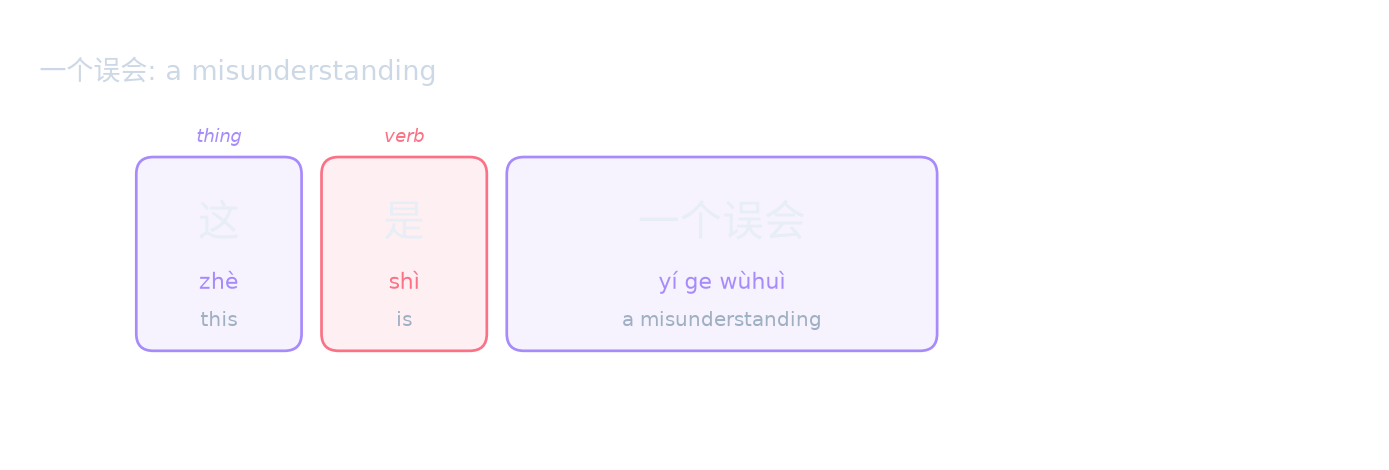
Match each word with its meaning in this unit.
ความยาก 2/5 · 140 เหรียญ + บอนัสน้อยๆ เมื่อทำสำเร็จครั้งแรกในวันนี้
Use the example sentences to check each word’s meaning in context.
Build the meaning
- A story links a setting, problem, action, and outcome. A turning point changes what the character understands or does.
- Use it turned out原来 to introduce a discovery and so / thereupon于是 for an action that follows. Do not use a connector merely to make a sentence look advanced.
Work through a decision: A fictional account says Wang Li (a name)王力to see看到classroom教室not / haven't没person人,to think以为course课程to end结束(completed / change)了。it turned out原来everyone大家to exchange换(completed / change)了classroom教室,so / thereupon于是he / him他to go去new新classroom教室to look for; to give change找classmate同学 — Wang Li thought the class was over after seeing an empty room, then discovered the room change and went to find classmates. Mark observation, belief, discovery and subsequent action separately. An empty room did not by itself prove the class had ended.
Compare a plausible mistake: it turned out原来 can introduce what the character discovers; so / thereupon于是 links a subsequent action in this account. Merely inserting either word does not supply a coherent turning point. A source summary may report the character’s stated belief but should not invent fear, anger or dialogue that the source never supplies.
In a source-based account, do not invent emotions or dialogue as facts. In an original fictional story, invented details must still agree with each other.
Complete the discovery phrase: ____,那是上个月的旧通知。
ความยาก 1/5 · 100 เหรียญ + บอนัสน้อยๆ เมื่อทำสำเร็จครั้งแรกในวันนี้
原来 introduces the explanation discovered.
林安以为图书馆关门了,后来发现入口换到另一边,于是从新入口进去。入口 means entrance and 换到另一边 moved to the other side. First identify the discovery that changes her action. What does she discover?
ความยาก 1/5 · 100 เหรียญ + บอนัสน้อยๆ เมื่อทำสำเร็จครั้งแรกในวันนี้
后来发现 introduces the changed entrance, which explains using the new one. Permanent closure was not the discovery, and no friend or book return appears. Preserve the turning point rather than the initial mistaken interpretation.
Listen for a fresh detail
- Listen before revealing the script.
- Replay as often as you need. If the audio will not play, read the script instead.
Show the listening script and meaning
Wang Li (a name)王力to see看到new新notice通知after / back后to notice发现place地点to change变(completed / change)了。he / him他first先towards向teacher老师confirm确认,again / then / (再…也) however再to tell告诉classmate同学to go去library图书馆。
Wang Li sees a new notice showing a location change. He confirms with the teacher, then tells classmates to go to the library.
Which information changed in the recording?
ความยาก 1/5 · 100 เหรียญ + บอนัสน้อยๆ เมื่อทำสำเร็จครั้งแรกในวันนี้
地点变了 explicitly names the changed information.
Read a different account
林安to see看到classroom教室门上(modifier / structural particle)的notice通知,to think以为competition比赛in advance / move earlier提前(completed / change)了。she / her她hastily急忙to go去to look for; to give change找teacher老师,but; yet却to notice发现everyone大家still仍at / in在normal正常to go to class上课。teacher老师to explain / explanation解释,that那to be / is是一张last month上个月(modifier / structural particle)的old (of things)旧notice通知。林安so / thereupon于是to check检查(completed / change)了date日期,confirm确认competition比赛still仍at / in在Friday星期五。she / her她(把: marks the object)把new新notice通知to stick贴at / in在old (of things)旧notice通知beside; next to旁边,to remind提醒classmate同学先看date日期。
- The reading and listening have different details. Use the material for the question you are answering.
- Read once for the situation, then again for the relevant detail. Reveal help when needed.
Show the reading meaning
Lin An mistakes an old notice for a changed competition date. The teacher explains it is last month’s notice. She checks the date, confirms Friday, and posts the new notice beside it.
What resolves Lin An’s misunderstanding?
ความยาก 1/5 · 100 เหรียญ + บอนัสน้อยๆ เมื่อทำสำเร็จครั้งแรกในวันนี้
The old date explains the error; teacher confirmation establishes Friday.
王力读错了通知上的日期,以为讲座今天举行。向工作人员确认后,他知道讲座在星期五,便修改了自己的计划。读错日期 means misread the date; 讲座 lecture; 确认 confirm. Which retelling fits?
ความยาก 1/5 · 100 เหรียญ + บอนัสน้อยๆ เมื่อทำสำเร็จครั้งแรกในวันนี้
The account states a reading mistake and subsequent confirmation, not an organiser’s date change. 修改自己的计划 is Wang Li’s response. It reports neither staff confirmation of today nor Wang Li changing the organiser’s notice.
Speak, write, and review
- Retell the misunderstanding in four stages. Your partner asks which information came from the notice and which from the teacher.
- Record yourself or practise with a partner. Try it without the model first, then compare the meaning and word order.
she / her她to see看见old (of things)旧notice通知,to think以为competition比赛in advance / move earlier提前。teacher老师to explain / explanation解释after / back后,she / her她confirm确认(completed / change)了date日期,again / then / (再…也) however再to stick贴to make new advances出新notice通知。
- Write a new short story about a mistaken time or place. Include discovery and resolution.
- Tomorrow, recall a story’s observation/belief/discovery/action sequence. Later, change the discovery and adjust the action consistently. Ask which details are source facts and which are possible inventions.
- Words: misunderstanding误会 misunderstanding · so / thereupon于是 so / thereupon · it turned out原来 it turned out · confirm确认 confirm · notice通知 notice
- A story links a setting, problem, action, and outcome.
- Use it turned out原来 to introduce a discovery and so / thereupon于是 for an action that follows.
- Watch for: In a source-based account, do not invent emotions or dialogue as facts. In an original fictional story, invented details must still agree with each other.
Practise this unit’s words and skills · Choose the next guided unit
Write a new short story about a mistaken time or place. Include discovery and resolution.
Compare the meaning and structure with the checklist. Your own response may differ from the model.
Use Mandarin for your written or spoken response. Write or tell an original fictional story with an observation, an initial interpretation, a discovery and a resulting action. Then give a shorter Mandarin source-style retelling of your own story that leaves out any detail you did not actually state. Explain the turning point.
If your summary turns the initial belief into the final fact, return to the discovery. If you add dialogue or feelings, either mark them as new fictional additions or remove them from the source-style retelling.