แผนการเรียนรู้ของคุณ · ดำเนินต่อ · ทบทวน →
Verb + 起来 (ในแง่ของการทำมัน)
แนะนำใหม่ตำแหน่งที่คุณบันทึกจะคงอยู่ในเบราว์เซอร์นี้ การต่อจากตำแหน่งจะไม่ทำให้บทเรียนเสร็จสิ้นหรือตอบคำถามในบทเรียน
 3:15
HSK 4 ไวยากรณ์ 20: ส่วนเติมเต็ม (Complements)
สี่ครอบครัวของคำเสริม 起来 ในสามหน้าที่, ทิศทาง 来 หรือ 去, กรอบกริยาความรู้สึก, และความเป็นไปได้ 得 หรือ 不: แต่ละกลุ่มมีกฎปิดประตูหนึ่งข้อ ตำแหน่งช่อง…
คำอธิบายภาษาอังกฤษ + ตัวอย่างภาษา mandarins · คำบรรยายตามข้อความที่พูด
In this lesson
Easy to use?
- A friend asks what you think of your new phone after a week.
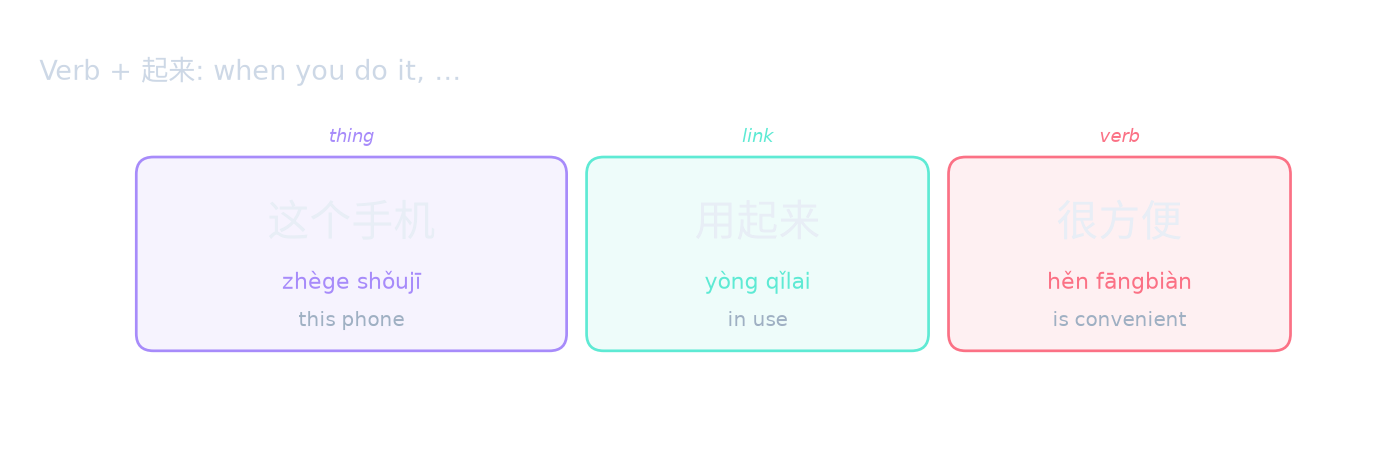
- this这个mobile phone手机to use / with用(in doing)起来very很convenient方便。 — "This phone is very convenient to use."
- Goal: give an impression of doing something with verb + (in doing)起来 (to use / with用(in doing)起来, say说(in doing)起来, to eat吃(in doing)起来).
Verb + (in doing)起来 + comment = when you do it
- Verb + (in doing)起来 = "when it comes to doing it, in the doing": the comment judges the experience.
- say说(in doing)起来easy容易,do做(in doing)起来hard难 — "Easier said than done."
say说(in doing)起来easy容易,do做(in doing)起来hard难。
Complete: “This method sounds simple but is hard to do.” 这个方法听____简单,做起来难。
ความยาก 1/5 · 100 เหรียญ + บอนัสน้อยๆ เมื่อทำสำเร็จครั้งแรกในวันนี้
Verb + 起来 + comment.
说起来容易,做起来难 means “easier said than done”.
ความยาก 1/5 · 100 เหรียญ + บอนัสน้อยๆ เมื่อทำสำเร็จครั้งแรกในวันนี้
It judges saying versus doing.
Senses and experience
- this这个dish (of food); vegetable菜to eat吃(in doing)起来slightly有点儿spicy辣。 — "This dish tastes a bit spicy."
- this这(measure word)首song歌listen听(in doing)起来very很familiar熟悉。 — "This song sounds familiar."
this这(measure word)首song歌listen听(when)起来very很familiar熟悉。
Build: “This song sounds familiar.”
ความยาก 3/5 · 200 เหรียญ + บอนัสน้อยๆ เมื่อทำสำเร็จครั้งแรกในวันนี้
Thing + Verb + 起来 + comment.
The thing judged comes first
- Put what you are judging first: this这本书to read (aloud); to study读(in doing)起来very很interesting有意思, not to read (aloud); to study读(in doing)起来this这本书very很interesting有意思 in most speech.
- (in doing)起来 here does not mean "get up" or "start"; it marks the experience of doing.
Three uses of (in doing)起来
- Judging: to use / with用(in doing)起来very很convenient方便 ("It's convenient to use"). Starting: he他laugh笑(completed / change)了(in doing)起来 — "He started laughing."
- Upward movement: to stand站(in doing)起来 — "stand up". Context and the following comment tell you which.
he他laugh笑了(start)起来。
Match each sentence to the use of 起来.
ความยาก 2/5 · 140 เหรียญ + บอนัสน้อยๆ เมื่อทำสำเร็จครั้งแรกในวันนี้
The comment and the verb tell you which use it is.
Recap
- Thing + Verb + (in doing)起来 + comment = it is … to do: to use / with用(in doing)起来convenient方便, say说(in doing)起来easy容易 — "It's easy to say."
- Other (in doing)起来: start (laugh笑(in doing)起来), upward (to stand站(in doing)起来).
Read the full reference: HSK 4 grammar — Complements.
A friend asks what you think of your new phone after a week. Close the examples. Say a Mandarin response, then write it in Chinese. Explain briefly in English what the lesson’s pattern adds. Compare with the model, then change one detail and try again.
This is supported productive practice. Compare meaning and structure; your answer need not copy the model. A partner or teacher must hear the spoken response to comment on pronunciation.