แผนการเรียนรู้ของคุณ · ดำเนินต่อ · ทบทวน →
Result complements 完 / 好 / 错 / 见 / 懂 / 到 (how it turned out)
แนะนำใหม่ตำแหน่งที่คุณบันทึกจะคงอยู่ในเบราว์เซอร์นี้ การต่อจากตำแหน่งจะไม่ทำให้บทเรียนเสร็จสิ้นหรือตอบคำถามในบทเรียน
 4:29
HSK 3Grammar 3: คำกริยา, ความสามารถ และคำเติม
หัวข้อนี้เกี่ยวกับกริยาที่รายงาน 着 แสดงสถานะ 了 ที่ท้ายประโยคประกาศการเปลี่ยนแปลง: ตอนนี้มันเป็นเรื่องจริงแล้ว กริยาเติมผล báo...
คำอธิบายภาษาอังกฤษ + ตัวอย่างภาษา mandarins · คำบรรยายตามข้อความที่พูด
In this lesson
Finished or not?
- Your mum asks about your homework before you go out to play.
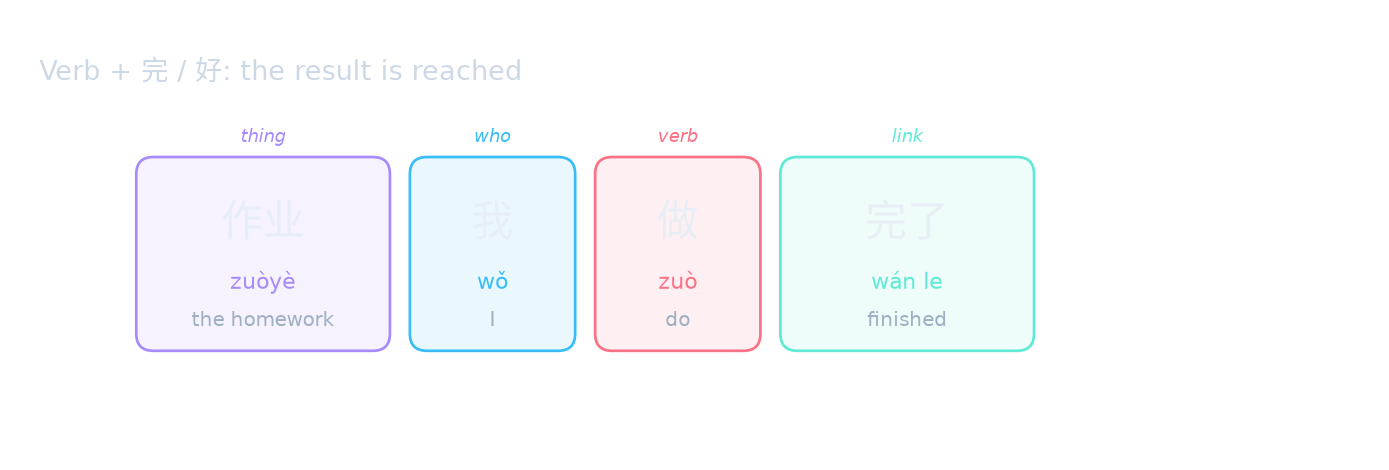
- school assignment作业I我make做finish完(completed / change)了! Zuòyè wǒ zuò wán le! — "I've finished my homework!"
- Goal: add a result word after a verb (finish完, ready好, wrongly错, to see / meet见, to understand懂, to / arrive / (result: get)到, clean干净) to say how the action ended, and negate and ask about it.
1 · Action or result?
- A Chinese verb alone often says only that you tried. The result word says whether you succeeded:
- I我look for找(completed / change)了ages半天,but但是did not没find找到。 Wǒ zhǎo le bàntiān, dànshì méi zhǎo dào. — "I looked for ages, but I didn't find it."
- look for找 = look for (the action). look for找to / arrive / (result: get)到 = find (the result). In the same way: to look at; to watch; to read看 = look, to look at; to watch; to read看to see / meet见 = see; to listen to听 = listen, to listen to听to understand懂 = understand.
I我look for找了ages半天,but但是did not没find找到。
我找了我的钥匙 tells you that I found my keys.
ความยาก 1/5 · 100 เหรียญ + บอนัสน้อยๆ เมื่อทำสำเร็จครั้งแรกในวันนี้
找 is only the action (look for). Found = 找到: 我找到了我的钥匙。
2 · Common result words
| Result | Meaning | Examples |
|---|---|---|
| finish完 | finished | eat吃finish完, make做finish完, to look at; to watch; to read看finish完 |
| ready好 | done properly, ready | make做ready好, prepare准备ready好 |
| wrongly错 | wrongly, by mistake | write写wrongly错, to hit / play / make (a call)打wrongly错, to mishear听错 |
| to see / meet见 | seen / heard | to see看见, to hear听见 |
| to understand懂 | understood | to understand (on hearing)听懂, to look at; to watch; to read看to understand懂 |
| to / arrive / (result: get)到 | reached, got it | find找到, to buy买to / arrive / (result: get)到, to receive收到 |
| clean干净 / distinct清楚 | clean / clear | to wash洗clean干净, to listen to听distinct清楚 |
- I'm sorry对不起,I我to err打错telephone电话(completed / change)了。 Duìbuqǐ, wǒ dǎ cuò diànhuà le. — "Sorry, I dialled the wrong number."
- this这本书I我to look at; to watch; to read看finish完(completed / change)了。 Zhè běn shū wǒ kàn wán le. — "I've finished reading this book."
Complete: “I've eaten up all the dumplings.” 饺子我都吃____了。
ความยาก 1/5 · 100 เหรียญ + บอนัสน้อยๆ เมื่อทำสำเร็จครั้งแรกในวันนี้
吃完 = eaten up, finished.
Match each phrase to its meaning.
ความยาก 2/5 · 140 เหรียญ + บอนัสน้อยๆ เมื่อทำสำเร็จครั้งแรกในวันนี้
The result word tells how the action ended.
3 · make做finish完 or make做ready好?
- make做finish完 = the job is over, nothing left (maybe not done well). make做ready好 = done properly, ready to use.
- dinner饭make做ready好(completed / change)了,quickly快come来eat吃(suggestion)吧! Fàn zuò hǎo le, kuài lái chī ba! — "Dinner's ready, come and eat!"
- you你prepare准备ready好(completed / change)了(yes/no ?)吗? Nǐ zhǔnbèi hǎo le ma? — "Are you ready?"
dinner饭make做ready好了,quickly快come来eat吃吧!
Your essay is not perfect, but you have written the last sentence. Which fits best?
ความยาก 1/5 · 100 เหรียญ + บอนัสน้อยๆ เมื่อทำสำเร็จครั้งแรกในวันนี้
完 = finished, nothing left, even if it is not good. 写好 would mean done properly.
4 · Not yet, and asking
- Negative: did not没 + verb + result, with no (completed / change)了: I我still还did not没make做finish完。 Wǒ hái méi zuò wán. — "I haven't finished yet."
- Question: you你eat吃finish完(completed / change)了(yes/no ?)吗? or you你eat吃finish完(completed / change)了not have / haven't没有? — "Have you finished eating?"
- Answer: eat吃finish完(completed / change)了。 — "Yes, I have." / still还did not没eat吃finish完。 — "Not yet."
I我still还not没do做finish完。
Which says “I haven't finished reading this book yet.”?
ความยาก 1/5 · 100 เหรียญ + บอนัสน้อยๆ เมื่อทำสำเร็จครั้งแรกในวันนี้
没 + verb + result, with no 了.
Build: “Are you ready?”
ความยาก 3/5 · 200 เหรียญ + บอนัสน้อยๆ เมื่อทำสำเร็จครั้งแรกในวันนี้
准备 + 好 + 了 + 吗.
Common mistakes
- not不 instead of did not没: ✗ I我not不make做finish完(completed / change)了 ✓ I我still还did not没make做finish完. A result that didn't happen takes did not没.
- The object in the middle: ✗ make做school assignment作业finish完 ✓ make做finish完school assignment作业. The result follows the verb directly.
- No result word: ✗ I我to look at; to watch; to read看(completed / change)了he / him他,but可是did not没to look at; to watch; to read看 ✓ I我to look at; to watch; to read看(completed / change)了,but可是did not没to see看见 — "I looked, but didn't see him."
Which is correct?
ความยาก 1/5 · 100 เหรียญ + บอนัสน้อยๆ เมื่อทำสำเร็จครั้งแรกในวันนี้
The result follows the verb directly; the object comes after: 做完作业.
Recap
- Verb + result (+ (completed / change)了): finish完 finished, ready好 done well, wrongly错 wrongly, to see / meet见 seen or heard, to understand懂 understood, to / arrive / (result: get)到 reached.
- The verb alone = the action; verb + result = the outcome (look for找 vs find找到).
- Negative did not没 + verb + result; question …(completed / change)了(yes/no ?)吗? / …(completed / change)了not have / haven't没有? Put (degree marker)得 / not不 in the middle for can / can't: potential complements.
Read the full reference: HSK 3 grammar — Complements.
Your mum asks about your homework before you go out to play. Close the examples. Say a Mandarin response, then write it in Chinese. Explain briefly in English what the lesson’s pattern adds. Compare with the model, then change one detail and try again.
This is supported productive practice. Compare meaning and structure; your answer need not copy the model. A partner or teacher must hear the spoken response to comment on pronunciation.