แผนการเรียนรู้ของคุณ · ดำเนินต่อ · ทบทวน →
Verb + 了 + Duration + 了 (have been …-ing)
แนะนำใหม่ตำแหน่งที่คุณบันทึกจะคงอยู่ในเบราว์เซอร์นี้ การต่อจากตำแหน่งจะไม่ทำให้บทเรียนเสร็จสิ้นหรือตอบคำถามในบทเรียน
 4:29
HSK 3Grammar 3: คำกริยา, ความสามารถ และคำเติม
หัวข้อนี้เกี่ยวกับกริยาที่รายงาน 着 แสดงสถานะ 了 ที่ท้ายประโยคประกาศการเปลี่ยนแปลง: ตอนนี้มันเป็นเรื่องจริงแล้ว กริยาเติมผล báo...
คำอธิบายภาษาอังกฤษ + ตัวอย่างภาษา mandarins · คำบรรยายตามข้อความที่พูด
ในบทเรียนนี้
Still waiting
- Your friend phones to ask where you are. You are still in the café where you have been since two o'clock.
- I我wait等(completed / change)了you你两个hour小时(completed / change)了! Wǒ děng le nǐ liǎng ge xiǎoshí le! — "I've been waiting for you for two hours (and I'm still here)!"
- Goal: say how long something has been going on up to now, how long it is since something happened, and how long you have not done something.
Verb + (completed / change)了 + Duration + (completed / change)了
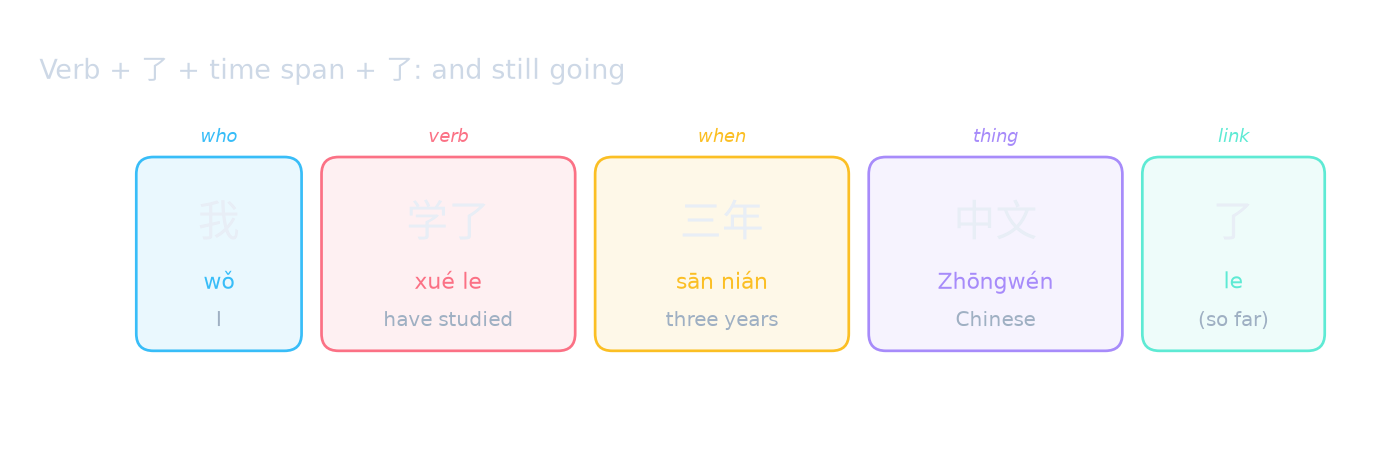
- The final (completed / change)了 says the period lasts up to now and may continue: I我study学(completed / change)了three years三年Chinese中文(completed / change)了 — "I've been studying Chinese for three years."
- Without it, the period is over: I我study学(completed / change)了three years三年Chinese中文 — "I studied Chinese for three years."
I我study学了three years三年Chinese中文了。
You still live here: “I've lived here for five years.” 我在这儿住了五年____。
ความยาก 1/5 · 100 เหรียญ + บอนัสน้อยๆ เมื่อทำสำเร็จครั้งแรกในวันนี้
The final 了 shows it continues up to now.
How long so far
- he他at在here这儿work工作(completed / change)了ten years十年(completed / change)了。 — "He has worked here for ten years (and still does)."
- Asking: you你study学middle / in中literature文学(completed / change)了多长时间(completed / change)了? — "How long have you been learning Chinese?"
he他at在here这儿work工作了ten years十年了。
Build: “I've already been waiting for an hour.”
ความยาก 3/5 · 200 เหรียญ + บอนัสน้อยๆ เมื่อทำสำเร็จครั้งแรกในวันนี้
已经 + verb + 了 + duration + 了.
Time since, and time without
- Time since a one-off event: with verbs that happen once (to come来, to / arrive / (result: get)到, to graduate毕业, to marry结婚), the time goes after the whole verb phrase: he他to come来China中国three years三年(completed / change)了。 Tā lái Zhōngguó sān nián le. — "He came to China three years ago (and is still here)." Not ✗ he他to come来(completed / change)了three years三年China中国(completed / change)了.
- Time without doing it: put the time before haven't没: I我for three days三天haven't没eaten吃meat肉(completed / change)了。 Wǒ sān tiān méi chī ròu le. — "I haven't eaten meat for three days." we / us我们degree / adjective linker很for a long time久haven't没to meet见面(completed / change)了! — "We haven't seen each other for ages!"
I我for three days三天haven't没eaten吃meat肉了。
“I haven't played basketball for a month.” Which is correct?
ความยาก 1/5 · 100 เหรียญ + บอนัสน้อยๆ เมื่อทำสำเร็จครั้งแรกในวันนี้
For time without doing something, the time goes before 没: 一个月没打篮球了. 打了一个月篮球了 means you have been playing for a month.
Build: “It is two years since my sister graduated.”
ความยาก 3/5 · 200 เหรียญ + บอนัสน้อยๆ เมื่อทำสำเร็จครั้งแรกในวันนี้
With a one-off verb like 毕业, the time goes after the verb: 毕业两年了.
One (completed / change)了 or two
- Two (completed / change)了 = still going: to live (somewhere)住(completed / change)了两年(completed / change)了 (I still live here). One (completed / change)了 = finished: to live (somewhere)住(completed / change)了两年 (I moved away).
- The duration still goes after the verb: study学(completed / change)了three years三年(completed / change)了, not three years三年study学(completed / change)了(completed / change)了.
Which sentence means the person still works at the bank?
ความยาก 1/5 · 100 เหรียญ + บอนัสน้อยๆ เมื่อทำสำเร็จครั้งแรกในวันนี้
Two 了 = still going.
我学了三年中文 and 我学了三年中文了 mean exactly the same.
ความยาก 1/5 · 100 เหรียญ + บอนัสน้อยๆ เมื่อทำสำเร็จครั้งแรกในวันนี้
The first is a finished period; the second continues up to now.
With already已经
- already已经 often comes in front to stress the length: I我already已经wait等(completed / change)了one一个hour小时(completed / change)了。 — "I've already been waiting an hour."
- The meaning of the two (completed / change)了 does not change; already已经 just adds emphasis.
I我already已经wait等了one一个hour小时了。
Recap
- Verb + (completed / change)了 + duration + (completed / change)了 = have been doing it for that long, up to now.
- One (completed / change)了 = a finished period; two (completed / change)了 = still going. already已经 adds emphasis.
- to come来China中国three years三年(completed / change)了 = three years since coming; for three days三天haven't没eaten吃meat肉(completed / change)了 = three days without meat.
Read the full reference: HSK 3 grammar — Verb phrases.
Your friend phones to ask where you are. You are still in the café where you have been since two o'clock. Close the examples. Say a Mandarin response, then write it in Chinese. Explain briefly in English what the lesson’s pattern adds. Compare with the model, then change one detail and try again.
This is supported productive practice. Compare meaning and structure; your answer need not copy the model. A partner or teacher must hear the spoken response to comment on pronunciation.