แผนการเรียนรู้ของคุณ · ดำเนินต่อ · ทบทวน →
难 + Verb (unpleasant to …)
แนะนำใหม่ตำแหน่งที่คุณบันทึกจะคงอยู่ในเบราว์เซอร์นี้ การต่อจากตำแหน่งจะไม่ทำให้บทเรียนเสร็จสิ้นหรือตอบคำถามในบทเรียน
 4:29
HSK 3Grammar 3: คำกริยา, ความสามารถ และคำเติม
หัวข้อนี้เกี่ยวกับกริยาที่รายงาน 着 แสดงสถานะ 了 ที่ท้ายประโยคประกาศการเปลี่ยนแปลง: ตอนนี้มันเป็นเรื่องจริงแล้ว กริยาเติมผล báo...
คำอธิบายภาษาอังกฤษ + ตัวอย่างภาษา mandarins · คำบรรยายตามข้อความที่พูด
ในบทเรียนนี้
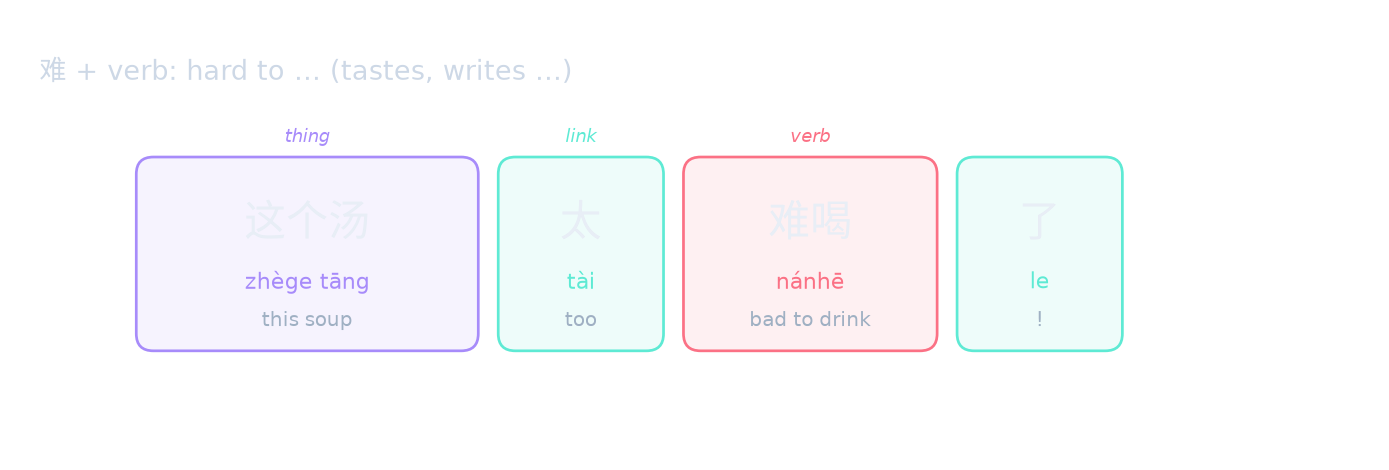
The canteen's new dish
- You try the canteen's new soup. It is salty and cold.
- this这个the soup汤too太hard to难to drink喝(completed / change)了! Zhè ge tāng tài nánhē le! — "This soup tastes awful!" hard to难 + a sense verb = unpleasant to …
- Goal: use good好 + verb and hard to难 + verb for "nice / easy to …" and "awful / hard to …", and say it politely.
hard to难 + sense verb
- unpalatable难吃, hard to难to drink喝, bad-looking; ugly难看, unpleasant to hear难听, unpleasant smell难闻 = bad-tasting (food), bad-tasting (drinks), ugly, unpleasant to hear, bad-smelling.
- They work like adjectives: very很bad-looking; ugly难看, too太unpleasant to hear难听(completed / change)了. The opposites start with good好: tasty好吃, nice to drink好喝, good-looking好看, pleasant to hear好听, 好闻.
this这(measure word)首song歌very很unpleasant to hear难听。
Complete: “This colour is ugly.” 这个颜色很____。
ความยาก 1/5 · 100 เหรียญ + บอนัสน้อยๆ เมื่อทำสำเร็จครั้งแรกในวันนี้
难看 = unpleasant to look at, ugly.
hard to难 + other verbs: hard to …
- With most other verbs, hard to难 means "difficult to": this这个Chinese character字very很hard to难to write写。 — "This character is hard to write."
- his他(modifier / structural particle)的question问题very很hard to难answer回答。 — "His question is hard to answer."
his他的question问题very很hard to难answer回答。
Match each word to its meaning.
ความยาก 2/5 · 140 เหรียญ + บอนัสน้อยๆ เมื่อทำสำเร็จครั้งแรกในวันนี้
With sense verbs 难 means unpleasant; with other verbs it means hard to do; 难受 is a feeling.
Build: “His question is hard to answer.”
ความยาก 3/5 · 200 เหรียญ + บอนัสน้อยๆ เมื่อทำสำเร็จครั้งแรกในวันนี้
Topic + 很 + 难 + verb.
good好 and hard to难 side by side
| good好 + verb | hard to难 + verb |
|---|---|
| tasty好吃 — tasty | unpalatable难吃 — tastes awful |
| good-looking好看 — good-looking; good (a film) | bad-looking; ugly难看 — ugly |
| pleasant to hear好听 — nice to hear | unpleasant to hear难听 — unpleasant to hear |
| good好to write写 — easy to write | hard to难to write写 — hard to write |
| 好找 — easy to find | hard to难to look for; to give change找 — hard to find |
- With a sense verb, good好 / hard to难 = pleasant / unpleasant. With other verbs, good好 / hard to难 = easy / hard.
“His home is easy to find.” 他家很____找。
ความยาก 1/5 · 100 เหรียญ + บอนัสน้อยๆ เมื่อทำสำเร็จครั้งแรกในวันนี้
With a verb that is not a sense, 好 + verb = easy to …: 好找.
Saying it politely
- At a friend's home, unpalatable难吃 is too strong. Soften it: not不too太tasty好吃 — "not very tasty", or a bit有点儿salty咸 — "a bit salty".
- Say the good side first: the soup汤very很nice to drink好喝,the food菜a bit有点儿spicy辣。 — "The soup is nice; the food is a bit spicy."
the soup汤very很nice to drink好喝,the food菜a bit有点儿spicy辣。
Your friend's mum asks how her soup is. It is too salty for you. What is the kindest answer?
ความยาก 1/5 · 100 เหรียญ + บอนัสน้อยๆ เมื่อทำสำเร็จครั้งแรกในวันนี้
Start with the good side and soften the problem with 有点儿.
Unpleasant versus difficult
- unpalatable难吃 means it tastes bad, not that it is hard to eat; bad-looking; ugly难看 means ugly, not hard to see.
- to feel unwell难受 is a feeling: "feel unwell, upset": I / me我headache头疼,very很to feel unwell难受.
hard to难 + Verb versus no good不好 + Verb
- not不tasty好吃 is milder: "not tasty". unpalatable难吃 is stronger: "awful".
- no good不好to write写 (not easy to write) is similar to very很hard to难to write写, but softer.
this这(measure word)个dish菜not不tasty好吃。
Which is the mildest way to say the food is not good?
ความยาก 1/5 · 100 เหรียญ + บอนัสน้อยๆ เมื่อทำสำเร็จครั้งแรกในวันนี้
不好吃 is milder than 难吃.
Recap
- hard to难 + sense verb (unpalatable难吃, bad-looking; ugly难看, unpleasant to hear难听, unpleasant smell难闻, hard to难to drink喝) = unpleasant to that sense; opposite good好 + verb.
- hard to难 + other verbs = hard to do: hard to难to write写, hard to难answer回答. to feel unwell难受 = feel bad.
Read the full reference: HSK 3 grammar — Verb phrases.
You try the canteen's new soup. It is salty and cold. Close the examples. Say a Mandarin response, then write it in Chinese. Explain briefly in English what the lesson’s pattern adds. Compare with the model, then change one detail and try again.
This is supported productive practice. Compare meaning and structure; your answer need not copy the model. A partner or teacher must hear the spoken response to comment on pronunciation.