Challenges of a New Century
แนะนำใหม่ 5:44
ช่วง 9: 1980 จนถึงปัจจุบัน
ช่วงนี้มีความครอบคลุมเนื้อหาสั้นแต่มีขอบเขตกว้าง และการสอบมองว่าเป็นจุดสูงสุดของหลักสูตรทั้งหมด มีสามข้อโต้แย้งที่ดำเนินมาตั้งแต่…
บรรยายภาษาอังกฤษ · สลับคำบรรยายภาษาอังกฤษและภาษาจีนได้
In this lesson
| English | ความหมาย |
|---|---|
| civil liberties/ˈsɪvl ˈlɪbətiz/ | Freedoms protected from government, such as speech and privacy. |
| human rights/ˈhjuːmən raɪts/ | The basic rights every person has, such as life, freedom from torture and a fair trial. |
| climate change/ˈklaɪmət tʃeɪndʒ/ | A long-term change in the statistical patterns of temperature, rainfall or other aspects of climate. |
A law passed in six weeks, October 2001
- On 26 October 2001, six weeks after the attacks of 11 September killed nearly 3000 people, President George W. Bush signed the USA PATRIOT Act. It passed the Senate by 98 votes to 1. It let the government track phone and internet records more easily and hold suspected terrorists. The one senator against, Russ Feingold, warned that it went too far against civil liberties.
- In the new century, Americans faced terrorism, long wars, debates over liberties and questions about energy and the environment.
The PATRIOT Act passed the Senate by 98 votes to 1 in October 2001. What does the vote show best?
ความยาก 1/5 · 100 เหรียญ + บอนัสน้อยๆ เมื่อทำสำเร็จครั้งแรกในวันนี้
Almost every senator of both parties voted yes six weeks after the attacks. Debate about liberties came mostly later.
The attacks and the response
- In October 2001, the US invaded Afghanistan, where the Taliban sheltered al-Qaeda. In March 2003, it invaded Iraq, claiming Saddam Hussein had weapons of mass destruction.
- No such weapons were found, and both wars became long and controversial. US forces left Afghanistan in 2021.
Match each event to its year.
ความยาก 2/5 · 140 เหรียญ + บอนัสน้อยๆ เมื่อทำสำเร็จครั้งแรกในวันนี้
Afghanistan came first because the Taliban sheltered al-Qaeda; Iraq followed in 2003; the Afghan war lasted twenty years.
What reason was given for invading Iraq in 2003?
ความยาก 1/5 · 100 เหรียญ + บอนัสน้อยๆ เมื่อทำสำเร็จครั้งแรกในวันนี้
The Bush administration claimed Iraq had weapons of mass destruction. None were found, which made the war more controversial. Iraq did not carry out the 11 September attacks.
Security against liberties
- The government detained prisoners at Guantánamo Bay without trial, and harsh questioning methods raised questions about human rights 人权.
- In 2013, Edward Snowden revealed mass collection of phone records, renewing debates about civil liberties 公民自由.
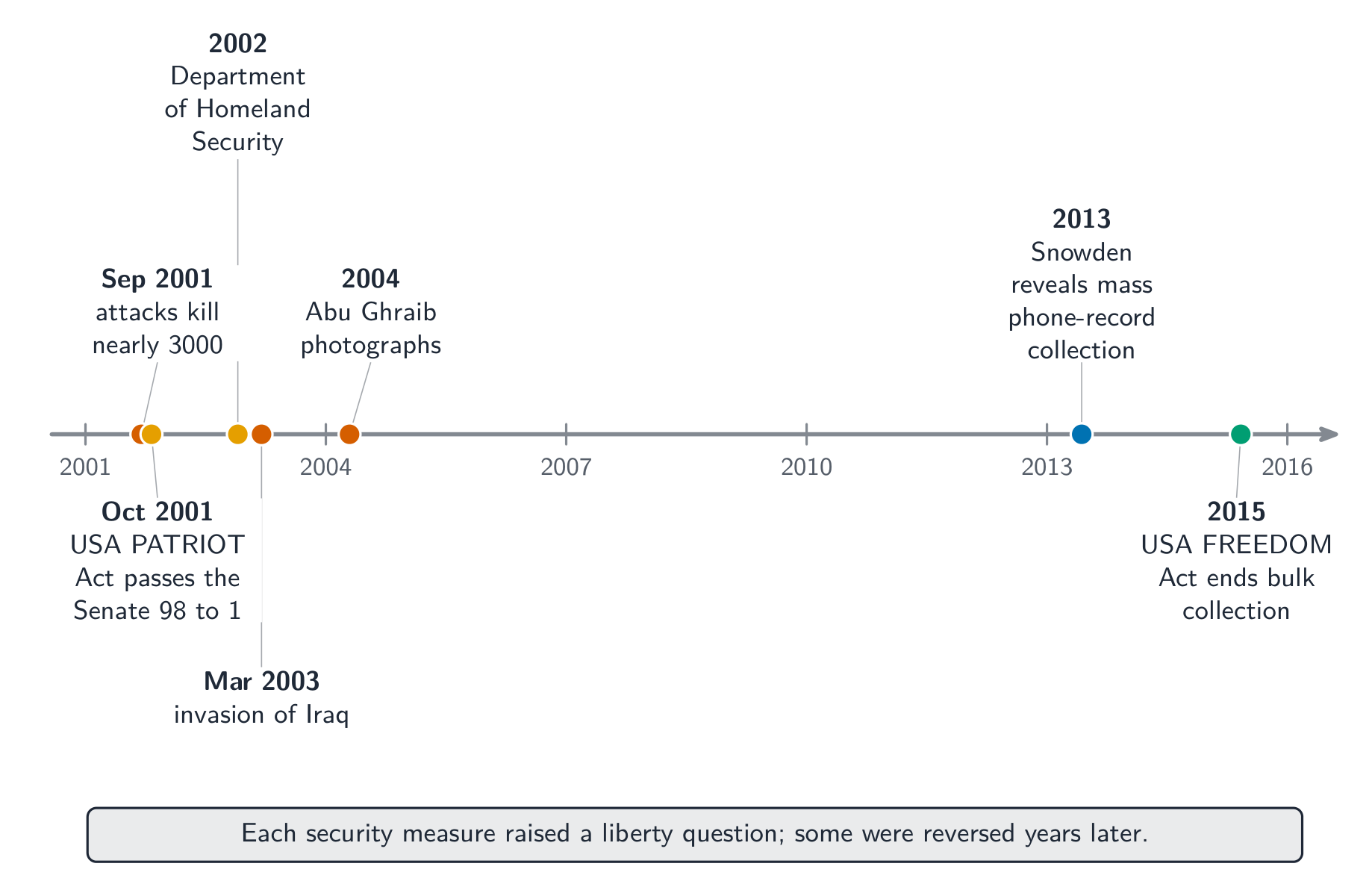
Which raised questions about civil liberties or human rights?
ความยาก 2/5 · 140 เหรียญ + บอนัสน้อยๆ เมื่อทำสำเร็จครั้งแรกในวันนี้
Detention without trial, harsh questioning and mass surveillance all touch rights. Fracking belongs to the energy and environment debate.
Worked example: one aim, several results
- Aim: protect Americans from terrorism.
- Result 1: no attack on the scale of 11 September followed in the US.
- Result 2: wars in Iraq and Afghanistan cost about 7000 American military lives and trillions of dollars, and debates over Guantánamo and surveillance continued. A security aim does not prove every result was worth it.
A military response, a domestic question, or an environmental debate?
Sort each element of 21st-century challenges.
Energy and climate
- Dependence on imported oil linked the economy to the Middle East. New drilling methods, called fracking, made the US a top oil and gas producer by the 2010s.
- Americans debated climate change 气候变化 and how far consumption and fossil fuels should be limited.
The 2008 crisis: cause → event → consequence
- Cause: banks sold risky "subprime" mortgages to buyers who could not repay, then packaged and resold the loans; looser financial rules since the 1990s let this grow. Event: house prices fell from 2006, and in September 2008 the bank Lehman Brothers collapsed.
- Consequence: unemployment reached 10% in 2009. Congress passed a 700-billion-dollar bank rescue (TARP, October 2008), a stimulus (2009) and new bank rules in the Dodd–Frank Act (2010), reopening the debate over deregulation from the 1980s.
Put the 2008 crisis in order, from cause to consequence.
ความยาก 3/5 · 200 เหรียญ + บอนัสน้อยๆ เมื่อทำสำเร็จครั้งแรกในวันนี้
Risky loans were the cause; falling prices broke the banks; the rescue and new rules were the government's responses.
What did US unemployment reach in 2009, in per cent?
ความยาก 2/5 · 140 เหรียญ + บอนัสน้อยๆ เมื่อทำสำเร็จครั้งแรกในวันนี้
About 10%, the highest since the early 1980s, which is why the 2008 crisis is called the worst since the Great Depression.
Worked exam skill: sourcing a document
Document: Senator Russ Feingold, speech in the Senate, 25 October 2001: "We will lose that war without firing a shot if we sacrifice the liberties of the American people."
- Historical situation: six weeks after 11 September, Congress was rushing the PATRIOT Act through with almost no opposition.
- Purpose: to explain on the record why he alone voted no, and to persuade Americans that security must not cost them their rights.
- Point of view: a Democrat from Wisconsin known for defending civil liberties, speaking against the mood of the moment.
- Why it scores (DBQ sourcing point): each line explains how the situation or purpose shapes what the document says. Just naming the author ("Feingold was a senator") earns nothing.
Which sentence earns the DBQ sourcing point for Feingold's speech?
ความยาก 1/5 · 100 เหรียญ + บอนัสน้อยๆ เมื่อทำสำเร็จครั้งแรกในวันนี้
Sourcing must explain how the situation or purpose shapes the document. Naming the author, the topic or repeating the quote describes it but does not source it.
The wars did not have one simple result. Supporters pointed to fewer attacks at home; critics pointed to the cost in lives, money and liberties.
The War on Terror had one simple result everyone agreed on.
ความยาก 1/5 · 100 เหรียญ + บอนัสน้อยๆ เมื่อทำสำเร็จครั้งแรกในวันนี้
Supporters pointed to no attack on the scale of 11 September; critics pointed to the cost in lives, money and liberties.
After 11 September 2001, the PATRIOT Act and wars in Afghanistan and Iraq aimed at security, but raised debates over civil liberties and human rights. Energy, climate change and the 2008 financial crisis, caused by risky mortgages and weak rules, added domestic challenges and revived the debate over regulation.
SAQ: (a) Briefly describe ONE way the federal government increased its security powers after 11 September 2001. (b) Briefly describe ONE criticism of these powers. (c) Briefly explain ONE way the debate over them continued after 2010.
One point per part; precise evidence earns it, general statements do not.