Capital, Migration, Reform
แนะนำใหม่ 7:16
ช่วงเวลา 6: 1865 ถึง 1898
นี่คือปริศนาในใจกลางของช่วงเวลานี้ เกษตรกรอเมริกันคนหนึ่งในปี 1890 ผลิตข้าวสาลีได้มากกว่าพ่อของเขาที่เคยทำ ever ด้วยเครื่องจักรที่ดีกว่า บนที่ดินมากขึ้น…
บรรยายภาษาอังกฤษ · สลับคำบรรยายภาษาอังกฤษและภาษาจีนได้
ในบทเรียนนี้
| English | ความหมาย |
|---|---|
| industrial capitalism/ɪnˈdʌstrɪəl ˈkæpɪtəlɪzəm/ | An economic system in which private companies own large factories and businesses and use wage workers to produce goods for profit. |
| tariff/ˈtærɪf/ | A tax imposed on imported goods. |
| trust/trʌst/ | A combination of companies placed under one board of trustees to reduce competition. |
| Chinese Exclusion Act/tʃaɪˈniːz eksˈkluːʒn ækt/ | The 1882 law that barred most Chinese labourers from immigrating. |
| Gospel of Wealth/ˈɡɒspl ɒv welθ/ | The argument that the rich should use their fortunes for the public good. |
A golden spike in Utah, May 1869
- On 10 May 1869, railroad leaders drove a golden spike at Promontory Summit, Utah, joining the Union Pacific line from the east and the Central Pacific from the west. A telegraph sent the news to the whole country at once.
- The trip from New York to San Francisco fell from about six months by wagon to about a week. Thousands of Chinese and Irish workers had built the line; many died. Period 6 (1865–1898) is the story of what this kind of growth did to the country.
What did the golden spike of 1869 mark?
ความยาก 1/5 · 100 เหรียญ + บอนัสน้อยๆ เมื่อทำสำเร็จครั้งแรกในวันนี้
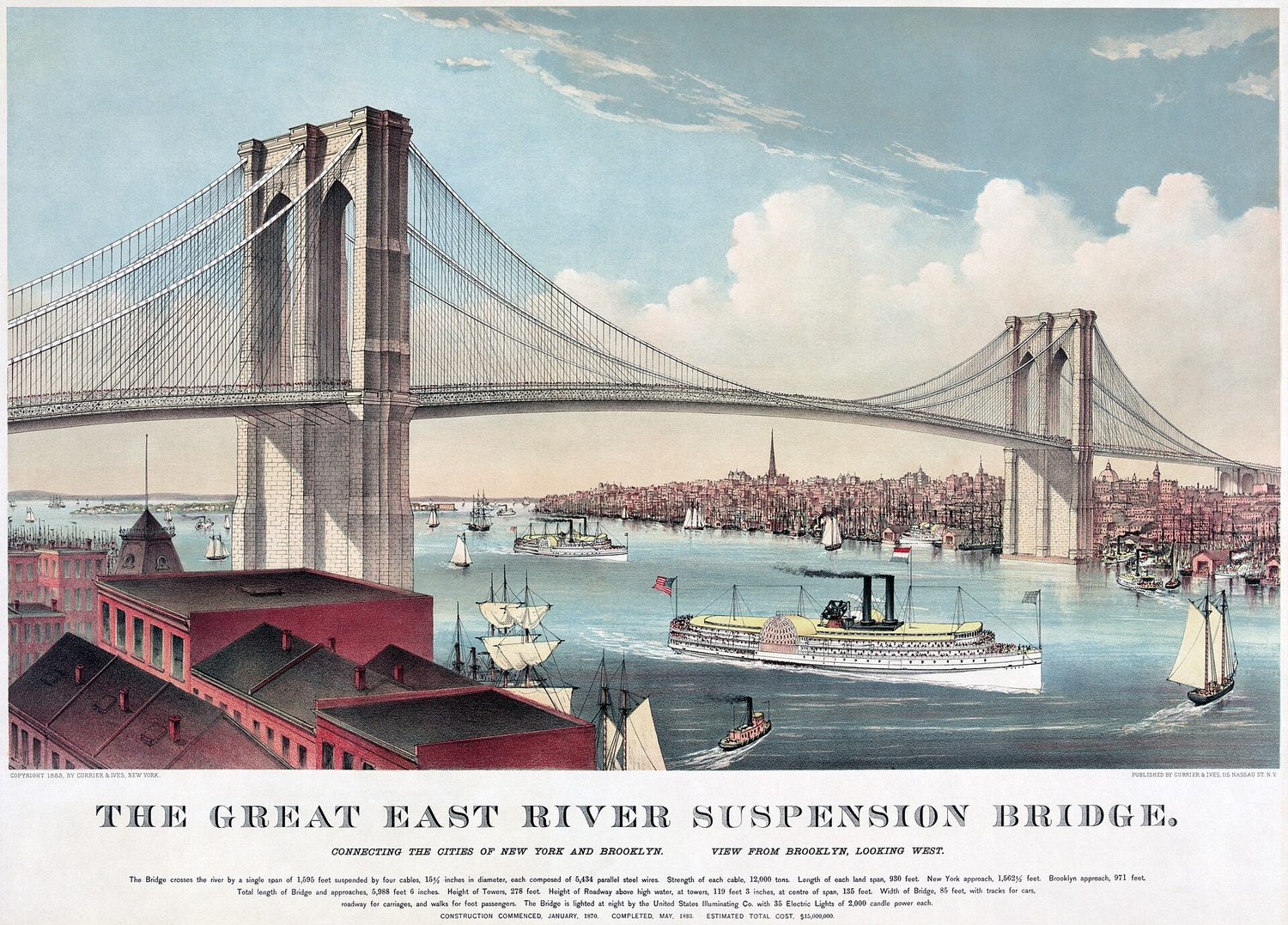
At Promontory Summit, Utah, the Union Pacific and Central Pacific lines met. The Civil War ended in 1865, the Brooklyn Bridge opened in 1883 and the California gold rush began in 1848.
Three threads for Period 6
- Industrial capitalism 工业资本主义: large-scale production and big business, linked by railroads to national markets.
- Migration and responses: millions moved to cities from farms and from abroad, and reformers, unions and farmers' movements challenged the new order.
Match each example to its thread.
ความยาก 2/5 · 140 เหรียญ + บอนัสน้อยๆ เมื่อทำสำเร็จครั้งแรกในวันนี้
Steel mills are big business (capitalism); newcomers filling cities is migration; the Grange is farmers organising against railroad rates, a response.
Why industry grew so fast
- New technology (the Bessemer process for cheap steel, electricity, the telephone), large supplies of coal, iron and oil, and investment money from Europe.
- Government helped: land grants for railroads, high tariffs 关税 that protected American factories, and courts that sided with business. Big firms grew into trusts 托拉斯 such as Rockefeller's Standard Oil (1882).
Which of unit 6's threads?
Sort each statement into its thread.
How did government help industry grow?
ความยาก 2/5 · 140 เหรียญ + บอนัสน้อยๆ เมื่อทำสำเร็จครั้งแรกในวันนี้
Land grants built railroads, tariffs kept out foreign goods and troops broke strikes (1877, 1894). Big business was not banned; the Sherman Act (1890) was weak and rarely used against trusts at first.
Cause → event → consequence
- Cause: railroads and tariffs create national markets; firms merge to cut costs. Event: a few firms control steel and oil; wages stay low and hours long. Consequence: strikes such as the Great Railroad Strike (1877), Homestead (1892) and Pullman (1894), and the Sherman Antitrust Act (1890) against trusts.
- Second chain: farmers pay high railroad rates and get falling crop prices → they form the Grange (1867) → Congress passes the Interstate Commerce Act (1887), which does little → farmers build the Populist Party (Omaha Platform, 1892).
Put the farmers' story in order, from cause to consequence.
ความยาก 3/5 · 200 เหรียญ + บอนัสน้อยๆ เมื่อทำสำเร็จครั้งแรกในวันนี้
High rates were the cause; the Grange organised farmers; the ICC was Congress's first answer; when it did little, farmers built a national party in 1892.
Migration in city and country
- Between 1870 and 1900, about 12 million immigrants arrived, many from southern and eastern Europe; Chicago grew from about 300 000 people (1870) to about 1.7 million (1900).
- In the West, railroads and mining remade rural areas and pushed Native nations off their land. Some Americans turned against newcomers: the Chinese Exclusion Act 排华法案 (1882) banned Chinese labourers.
Chicago grew from about 0.3 million (1870) to about 1.7 million (1900). By how many million?
ความยาก 2/5 · 140 เหรียญ + บอนัสน้อยๆ เมื่อทำสำเร็จครั้งแรกในวันนี้
1.7 − 0.3 = 1.4 million, almost six times bigger in 30 years.
The Chinese Exclusion Act of 1882 banned Chinese labourers from entering the United States.
ความยาก 1/5 · 100 เหรียญ + บอนัสน้อยๆ เมื่อทำสำเร็จครั้งแรกในวันนี้
It was the first US law to ban immigration by one national group, a nativist response to migration.
The responses
- New ideas such as the Gospel of Wealth 财富福音 (Carnegie, 1889) and Social Darwinism defended the rich; critics such as Henry George (Progress and Poverty, 1879) called for reform.
- Unions organised (Knights of Labor, American Federation of Labor 1886), and debates over tariffs, money (gold or silver) and monopolies led to the Populists in the 1890s.
Which idea DEFENDED the great fortunes of the Gilded Age?
ความยาก 1/5 · 100 เหรียญ + บอนัสน้อยๆ เมื่อทำสำเร็จครั้งแรกในวันนี้
Carnegie argued the rich had earned their wealth and should give it away wisely. The other three challenged the new order.
Worked exam question (short answer)
Question (SAQ style): (a) Briefly describe ONE cause of industrial growth in the United States, 1865–1898. (b) Briefly describe ONE effect of that growth on workers. (c) Briefly explain ONE way a group responded to these changes.
(a) The federal government gave railroads millions of acres of land, so lines like the transcontinental railroad (1869) linked factories to a national market.
(b) Workers faced long hours, low pay and dangerous jobs; when Carnegie Steel cut wages at Homestead in 1892, the strike was broken by force.
(c) Farmers formed the Populist Party; its Omaha Platform (1892) demanded government control of railroads because high shipping rates were ruining them.
- Why each part scores: every part answers only its own task, names specific evidence (a date, a law, a place) and, for (c), says why the group acted. One point per part.
- What loses the point: "industry grew because of new inventions" with no example, or describing a response from the wrong period (the New Deal is Period 7).
Part (b) asks for ONE effect of industrial growth on workers. Which answer earns the point?
ความยาก 1/5 · 100 เหรียญ + บอนัสน้อยๆ เมื่อทำสำเร็จครั้งแรกในวันนี้
The Pullman answer names a specific effect with evidence. "Industry grew very fast" answers a different part (a cause), "affected in many ways" has no evidence, and the New Deal is from the wrong period (1930s).
The Gilded Age was not a time of pure free markets. Government gave railroads land, set high tariffs and used troops against strikes (1877, 1894). "Laissez-faire" describes what business leaders said, not everything the government did.
The Gilded Age was a time of pure free markets without government help.
ความยาก 1/5 · 100 เหรียญ + บอนัสน้อยๆ เมื่อทำสำเร็จครั้งแรกในวันนี้
Land grants, high tariffs and troops against strikes all show government taking business's side.
From 1865 to 1898, railroads, new technology and government help built national markets and giant firms. Millions moved to cities and the West. Low wages and high rates led to strikes, unions and the Populists, and Congress answered with the ICC (1887) and the Sherman Act (1890).
Answer this SAQ in three short paragraphs. (a) Briefly describe ONE cause of the growth of cities, 1865–1898. (b) Briefly describe ONE problem this growth created. (c) Briefly explain ONE response to that problem.
An SAQ gives one point per part. Short, specific and on-task beats long and general.
เกิดปัญหาอะไรขึ้น? เฉพาะทีมเว็บไซต์เท่านั้นที่เห็นข้อมูลนี้